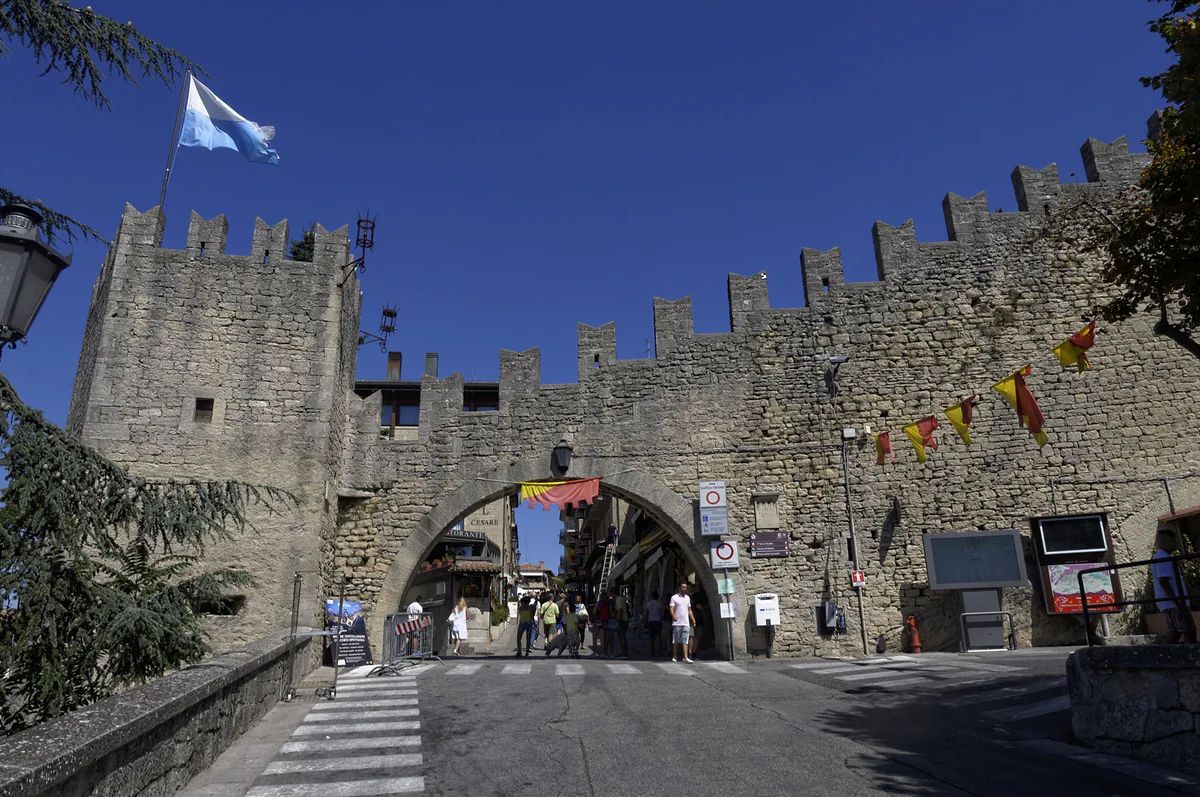
First defined in law in 2011
The flag of San Marino, white, light blue and three towers
The flag of San Marino has two equal horizontal bands, white above and light blue below, with the national coat of arms in the centre, showing three towers on three peaks, a closed crown and a ribbon reading LIBERTAS. Its design and colours are set by the Constitutional Law of 22 July 2011, the first to describe it. The date it was adopted is unknown.
In 30 seconds
Full read: 3 min
- The San Marino flag is white above and light blue below, with the national coat of arms in the centre.
- The arms show three towers on three peaks, a closed crown and the word LIBERTAS.
- The Constitutional Law of 22 July 2011 was the first to describe it, with 3:4 proportions.
- Its adoption date is unknown; white and blue were already in use before 1797.
What I like about this flag is that the coat of arms isn't symbolic, it's a landscape. The three towers are real and you can walk between them in a morning. In San Marino, look at the flag and then up at Titano, which is the quickest way to understand the country.

Before you go
What I would keep in mind
-
01 Most beautiful
The towers on the flag are ones you can visit
The three towers on the coat of arms are the Guaita, the Cesta and the Montale, the same ones crowning Mount Titano. Two open inside on the €11 pass and the third is seen from outside at the end of a path.
Three Towers of San Marino -
02 Money
The arms and towers are on your coins too
San Marino's euro coins carry the national symbols. In the current series the 20-cent shows Titano with its three towers and the 1-cent the coat of arms; in the first series the €1 coin carried the arms.
San Marino coins and stamps -
03 My tip
Two legal shapes, depending on where it flies
The law sets a squarer shape than usual, three by four, but allows two by three for international use. If you see two San Marino flags of different shapes, both can be correct.
San Marino facts -
04 My tip
Where to see it with ceremony
On 1 April and 1 October the Captains Regent take office, with the investiture between Palazzo Valloni and the Palazzo Pubblico. They're the two fixed-date state occasions of the year.
Captains Regent of San Marino
What I would book
The San Marino flag has an odd history for a country so proud of its age. For centuries it flew without any law saying what it looked like, and when one was finally written, in 2011, the government admitted nobody knows when it was adopted. I find that more honest than the neat dates doing the rounds, so here’s what the documents actually say.
What it looks like, according to the law
The Constitutional Law of 22 July 2011 describes it in a sentence that leaves no room for doubt. Two fields divided horizontally, white above and blue below, with the official coat of arms in the centre. Parliament passed it on 20 July with 45 votes for, 2 against and 1 abstention, and wrote it into the 1974 Declaration of Rights, the closest thing San Marino has to a constitution. How that piece fits with the rest I cover in San Marino’s constitution. There’s a detail at the foot of the text I love. Beside 22 July 2011 it gives a second date, 1710 d.F.R., the year counted from the founding of the Republic, signed by the Captains Regent of that semester, Maria Luisa Berti and Filippo Tamagnini.
The annexes fill in the rest. The proportions are three by four, a little squarer than we’re used to, though two by three is allowed for international use. The blue isn’t any blue, it’s a specific light blue, Pantone 2915 C. And the white is called, literally, flag white.
The coat of arms, a landscape that exists
The arms sit in the middle of the flag and make it recognisable. A blue field, three green peaks and above them three silver towers, windowed, battlemented and topped with ostrich feathers. Over the shield, a closed crown, symbol of sovereignty. Beneath, a laurel branch and an oak branch, crossed and bearing golden fruit. And a silver ribbon with the word LIBERTAS in black.
What I love is that the towers aren’t decoration. They’re the Guaita, the Cesta and the Montale, the three fortifications on Mount Titano, and you can walk from one to the next along the cliff edge. The walk between them, with times and tickets, is in three towers of San Marino. If you have Sammarinese coins in your pocket, look at the current 20-cent, which shows Titano with its three towers. I go through the rest in San Marino coins and stamps.
When was the San Marino flag adopted?
This is the interesting part. Plenty of websites say 6 April 1862, but San Marino’s Interior Ministry, presenting the 2011 law, explained that no historical source or institutional document lets anyone fix the adoption date of either the flag or the arms. The 1862 decree is real, but what it decided was that the arms should carry a closed crown.
There are clues, though. A document of 4 September 1465 mentions a banner in three vertical bands, yellow and crimson on the outside and white in the centre. Historians are certain white and blue were in use before 1797, because that year the Council ordered a white and blue cockade, similar to the one worn by French revolutionaries. A 1936 law regulated how the flag should be flown without saying what it looked like, and one from 1931 reserved the crowned arms for state offices. Nothing more until 2011.
What do the white and blue stand for?
The law doesn’t explain. The usual reading, which Wikipedia records, is that the blue is the sky and the white is liberty. It fits the motto on the arms, so I think it’s a decent way to remember it, but it’s interpretation rather than official fact.
Because private citizens weren’t allowed to use the arms, a civil flag with just the two bands also caught on, according to the same source. The town halls of the castelli fly it with their own local arms instead of the national ones, so don’t be surprised to see it without the towers.
Where to see it flying
On any public building. If you want to see it at a state occasion, the fixed dates are 1 April and 1 October, when the new Captains Regent are sworn in at Palazzo Valloni and at the Pubblico next door. For more odd details like the flag without a birthday, see my San Marino facts, and for the centuries of context, the history of San Marino.
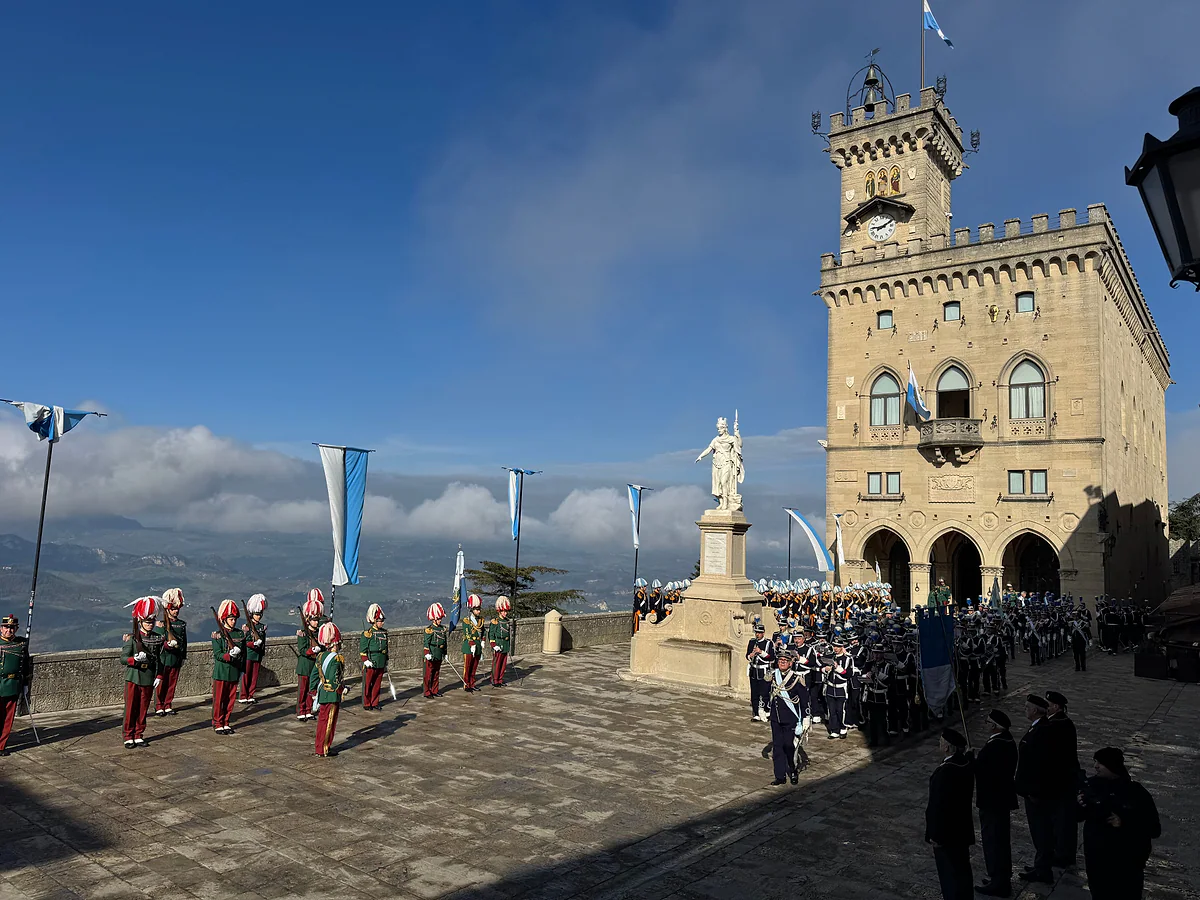
Uniformed guards parading in Piazza della Libertà, in front of the Palazzo Pubblico and the statue, with blue and white banners.
What the law says about the flag and arms
| Element | Description |
|---|---|
| Fields | Two, divided horizontally, white above and blue below |
| Coat of arms | In the centre of the flag |
| Crown | Closed, a symbol of sovereignty |
| Shield field | Blue, with three green peaks |
| Towers | Silver, windowed and battlemented, topped with ostrich feathers |
| Branches | One of laurel and one of oak, crossed beneath the shield |
| Motto | LIBERTAS, in black on a silver ribbon |
| Proportions | 3:4; 2:3 for international use |
| Official blue | Light blue, Pantone 2915 C |
Constitutional Law no. 1 of 22 July 2011, which adds Article 2 bis to the 1974 Declaration of Rights.
The flag through time
| Year | What happened | Source |
|---|---|---|
| 1465 | A document describes a banner in three vertical bands, yellow, white and crimson | Interior Ministry |
| Before 1797 | White and blue already in use, according to historians | Interior Ministry |
| 1797 | The Council orders a white and blue cockade | Interior Ministry |
| 1862 | A decree gives the arms a closed crown | Interior Ministry |
| 1936 | A law governs how the flag is flown, without describing it | Interior Ministry |
| 2011 | Constitutional law describing flag and arms | San Marino parliament |
Test yourself
True or false?
0/4 Pick before you peek.
-
The exact date San Marino adopted its flag is known.
See the answer
False. The Interior Ministry says no document allows it to be fixed. All that's known is that white and blue were in use before 1797.
-
San Marino's official flag is squarer than most.
See the answer
True. The 2011 law sets proportions of 3:4, while allowing the longer 2:3 for international use.
-
The three towers on the coat of arms are imaginary.
See the answer
False. They're the Guaita, the Cesta and the Montale, the three fortifications on Mount Titano. Two can be visited inside on the State Museums pass.
-
San Marino's first recorded banner wasn't white and blue.
See the answer
True. A document from 1465 describes a banner in three vertical bands, yellow and crimson on the outside and white in the middle.
- Official proportions of the flag
- 3:4
- First law to describe it
- 2011
- First recorded banner
- 1465
- Votes for the law, against 2
- 45
Map
Where Flag is
Every number opens its guide. The towers sit on the ridge, the city beside them and Borgo Maggiore below, linked by the cable car.
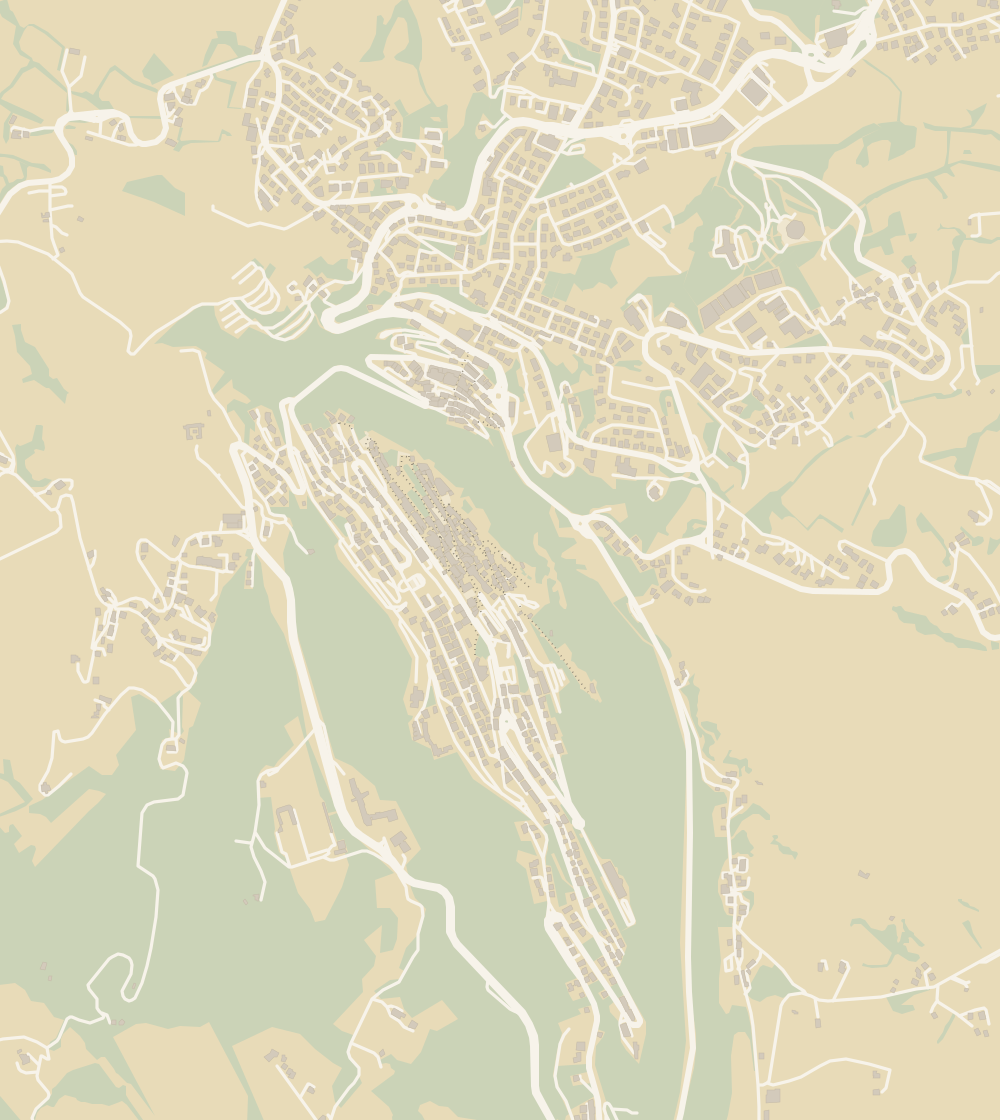 1The Three Towers 2Guaita Tower 3Cesta Tower and Arms Museum 4City of San Marino 5Montale Tower 6Borgo Maggiore 7Witches' Passage 8Palazzo Pubblico 9Changing of the guard 10Basilica of Saint Marinus 11Mount Titano 12Museums 13State Museum 14San Francesco Art Gallery 15Torture Museum 16Cable car (funivia) 17Quirky museums 18Stamp and Coin Museum 19National Gallery 20Valdragone 21San Giovanni sotto le Penne 22Medieval Days 23Christmas 24Hotel Titano 25Grand Hotel San Marino 26Hotel Rosa 27Hotel Crocenzi 28Hotel La Rocca 29Porta San Francesco 30Cava dei Balestrieri 31Map 32Teatro Titano 33Church of San Quirino 34Trenino Bianco Azzurro 35Consolazione Sanctuary 36University 37Prison 38Piazza della Libertà
 Map data © OpenStreetMap contributors (ODbL)
- 1The Three TowersTwo open inside, the third only from outside
- 2Guaita TowerAn 11th-century fortress that was a jail until 1970
- 3Cesta Tower and Arms MuseumThe top of Mount Titano, at 755 metres
- 4City of San MarinoWorld Heritage since 2008
- 5Montale TowerNo ticket, no hours, no pass
- 6Borgo MaggioreA cable car to the capital every 15 minutes
- 7Witches' PassageAbout 200 metres of battlements, no ticket
- 8Palazzo PubblicoClosed for restoration in 2026
- 9Changing of the guardNo timetable in any reliable source
- 10Basilica of Saint MarinusNeoclassical, begun in 1826, free to enter
- 11Mount Titano755 metres at the top of the Cesta
- 12MuseumsOne €11 ticket, seven venues
- 13State MuseumOpen to the public since 1899
- 14San Francesco Art GalleryIn the Franciscan cloister since 1966
- 15Torture MuseumMore than 100 original instruments
- 16Cable car (funivia)Closed from 21 to 23 October 2026
- 17Quirky museumsThree private museums with their own websites
- 18Stamp and Coin MuseumStamps since 1877, on the €11 pass
- 19National GalleryOpened on 7 July 2018
- 20ValdragoneA curazia of Borgo Maggiore
- 21San Giovanni sotto le PenneA curazia of Borgo Maggiore, below the towers
- 22Medieval DaysJuly, the old town and free entry
- 23Christmas28 November to 6 January, with a caveat
- 24Hotel TitanoOpen since 30 September 1894
- 25Grand Hotel San MarinoA hot tub on the third-floor terrace
- 26Hotel RosaFamily-run and open all year since 1965
- 27Hotel Crocenzi1 km from the cable car, 3 km from the old town
- 28Hotel La RoccaNot the Rocca, but on the road up to it
- 29Porta San FrancescoA guard post since 1361
- 30Cava dei BalestrieriThe crossbowmen's range since 1965
- 31MapNine castelli in 61 km²
- 32Teatro Titano2026-27 season from 22 October
- 33Church of San QuirinoOn the 5-cent coin
- 34Trenino Bianco AzzurroRimini to the City, 1932 to 1944
- 35Consolazione SanctuaryConsecrated on 11 June 1967
- 36UniversityCreated by law on 31 October 1985
- 37PrisonEmpty on the day the European inspectors arrived
- 38Piazza della LibertàIt used to be called the Pianello
0 of 108 San Marino guides
Your next stamp
- Constitution
- Piazza della Libertà
- University
- Events
- Facts
- History
- Things to do
- One day
- Two days
- The Three Towers
- Guaita Tower
- Cesta Tower and Arms Museum
- The 9 castelli
- City of San Marino
- Montale Tower
- Borgo Maggiore
- Witches' Passage
- Palazzo Pubblico
- Serravalle
- Changing of the guard
- Dogana
- Acquaviva
- Basilica of Saint Marinus
- Mount Titano
- Chiesanuova
- Domagnano
- Faetano
- Fiorentino
- Montegiardino
- Museums
- State Museum
- San Francesco Art Gallery
- Torture Museum
- Cable car (funivia)
- Quirky museums
- Viewpoints
- Murata
- Stamp and Coin Museum
- Walking trails
- Cailungo
- National Gallery
- Valdragone
- Best time to visit
- Getting there
- Ventoso
- Rimini to San Marino
- San Giovanni sotto le Penne
- Weather
- Getting around
- In winter
- With kids
- In summer
- Parking
- Passport stamp
- Rainy day
- Nightlife
- Phone and roaming
- Casino
- Gualdicciolo
- Money
- Coins and stamps
- Torraccia
- Falciano
- Shopping and tax-free
- Rovereta
- Lake Faetano
- Beaches
- Medieval Days
- Christmas
- MotoGP
- Where to stay
- Hotel Titano
- Where to eat
- Food
- Grand Hotel San Marino
- Luxury hotels
- Free and cheap
- Hotel iDesign
- Day trips
- Hotel Rosa
- Safety and rules
- Hotel Crocenzi
- Language
- Entry requirements
- Hotel La Rocca
- Healthcare and emergencies
- Plugs and voltage
- Is it a country?
- Opening hours
- Porta San Francesco
- Tap water
- Cava dei Balestrieri
- Map
- Post office
- Cost of a trip
- Teatro Titano
- Accessibility
- Church of San Quirino
- Captains Regent
- Trenino Bianco Azzurro
- With a dog
- Consolazione Sanctuary
- Weddings
- Wine
- Prison
- Camping
- Is it worth visiting?
Frequently asked questions
What colours is the San Marino flag?
White above and light blue below, in two equal horizontal bands, with the coat of arms in the centre. The law pins the blue down to a specific light blue, Pantone 2915 C.
What do the colours of the San Marino flag mean?
The law doesn't say. The usual reading, which Wikipedia records, is that the blue stands for the sky and the white for liberty. It fits a country with LIBERTAS on its arms, but it's an interpretation.
What is on San Marino's coat of arms?
Three silver towers on three green peaks on a blue field, topped with ostrich feathers, a closed crown above, a laurel and an oak branch below and a ribbon reading LIBERTAS. The towers are the Guaita, the Cesta and the Montale.
When was the San Marino flag adopted?
Nobody knows. San Marino's own Interior Ministry says no document fixes the date. Historians place it before 1797, when the Council ordered a white and blue cockade, and the first law describing it dates from 2011.
What does LIBERTAS mean on the San Marino flag?
Liberty, in Latin. It's the country's motto and sits on the silver ribbon under the shield, in black capitals according to the 2011 law.
Why does San Marino have two flags?
Because private citizens were barred from using the state coat of arms, a civil version with just the two bands spread, according to Wikipedia. The castelli fly it with their own local arms instead of the national ones.
By
Tourism graduate with a master’s in Tourism Management and Planning from the University of Málaga, who has travelled across Europe. He writes every guide from official sources and his own judgement.
Published on . Facts checked on .
Sources
Photos: © Ra Boe / Wikipedia (CC BY-SA 3.0 de); Hayden Soloviev (CC BY 4.0), via Wikimedia Commons.