Three colours and two cows
The Andorra flag, its four-quartered coat of arms and the national anthem
Andorra's flag has three equal vertical bands of blue, yellow and red, with blue at the hoist and the coat of arms in the centre. The General Council made it official on 22 December 1942, on the same day as the coat of arms and the anthem «El gran Carlemany», and the 1993 Constitution confirms them as the traditional national symbols.
In 30 seconds
Full read: 4 min
- The flag is three equal vertical bands of blue, yellow and red, with the arms in the centre.
- Flag, arms and anthem became official on 22 December 1942.
- The model coat of arms is the one over the Casa de la Vall's door.
- The anthem is «El gran Carlemany», first heard in 1914.
Don't settle for a photo of the coat of arms. Go and stand under the door of the Casa de la Vall, because the 1942 decision made that very carving the official model.

Before you go
What I would keep in mind
-
01 Most beautiful
The official coat of arms hangs over a door
The General Council adopted the arms exactly as they appear above the entrance of the Casa de la Vall. The motto Virtus, Unita, Fortior is on the same façade.
Casa de la Vall -
02 My tip
Blue always goes next to the pole
The 1942 text sets the order as blue, yellow and red, vertical, equal in size and with the blue attached to the staff. If you see it the other way round, it's been hung wrongly.
-
03 My tip
The arms are how you tell it apart
A plain blue, yellow and red vertical tricolour could belong to more than one country. Andorra's is the one with the mitre, the red stripes and the two cows in the middle.
You’ll recognise Andorra’s flag by its coat of arms rather than its colours. Blue, yellow and red in vertical stripes isn’t unique in Europe, so what makes it Andorran is the badge in the middle, with a bishop’s mitre, some red stripes and a pair of cows. I think it’s one of the friendliest coats of arms on the continent, and it tells the country’s whole story in miniature.
What the flag looks like, according to the official text
Rather than repeat hearsay, I’ve gone back to the wording that fixed it. On 22 December 1942 the General Council declared the official flag to be three colours running vertically, blue, yellow and red, of equal size and with the blue attached to the pole. The decision is quoted in full in a study of the anthem by the Andorran National Archive. Spain’s Foreign Ministry adds that the coat of arms sits in the centre.
That 1942 decision underpins article 2.2 of the 1993 Constitution, which says the national anthem, flag and arms of Andorra are the traditional ones. The Constitution didn’t invent the symbols, it confirmed them.
What do the colours mean?
I have to be careful here. Spain’s Foreign Ministry says blue represents France, yellow Andorra and red Spain. I haven’t found an official Andorran text that says the same, so I pass it on as the ministry’s reading rather than as settled fact.
It does fit the history, though, since the flag brings together the two neighbours whose lords created the principality. The background is on the history of Andorra.
A coat of arms with a mitre, stripes and cows
The 1942 decision adopted the coat of arms exactly as it appeared over the entrance of the Casa de la Vall, split into four quarters. The first shows a crozier and mitre. The second has three red stripes on gold, the third four red stripes on gold, and the fourth two golden cows with bells round their necks on a green field, facing outwards.
Spain’s Foreign Ministry sums it up as two quarters for each co-prince. The mitre and crozier point to the Bishop of Urgell, one of the co-princes of Andorra. Below runs the motto Virtus, Unita, Fortior, which Andorra Turisme places on the front of the Casa de la Vall.
I’d go and see it. It isn’t often that the official model of a national symbol is simply there in stone, on a street in the old town.
The anthem, «El gran Carlemany»
The anthem is named after Charlemagne, the emperor of Andorra’s founding legend. According to the National Archive, it was born in 1914 around the celebrations for the Virgin of Meritxell, with words by Dr Joan Benlloch, a former Bishop of Urgell and co-prince, and music by Enric Marfany, a priest born in Andorra. The General Council declared it the national anthem in 1917 and made it official on 22 December 1942, alongside the flag and the arms.
The archive links that date to the wider war. In November 1942 Nazi Germany occupied Vichy France and reached Andorra’s northern border, and the council feared for the country’s sovereignty. Making the symbols official was a way of asserting statehood. Of everything I read about these symbols, that’s the detail I found most striking.
The arms in your pocket
There’s a cheaper way to take the coat of arms home than any souvenir shop. Since 2014 Andorra has minted its own euro coins with four designs, and according to Andorra Turisme the €2 coin carries the national arms. The €1 shows the Casa de la Vall, the 50, 20 and 10 cent coins show Santa Coloma, and the smallest ones a chamois and a bearded vulture. There’s no guarantee you’ll be given one in your change, but it’s worth checking your coins before you leave. More on paying in Andorra’s currency.
The national flower and the patron saint
The national flower is the grandalla, which Andorra Turisme says has six petals in honour of the six original parishes, before Escaldes-Engordany became the seventh in 1978. The patron saint is Our Lady of Meritxell, and her feast day on 8 September is one of only four days a year when the shops shut. There’s more in Andorra’s national day.
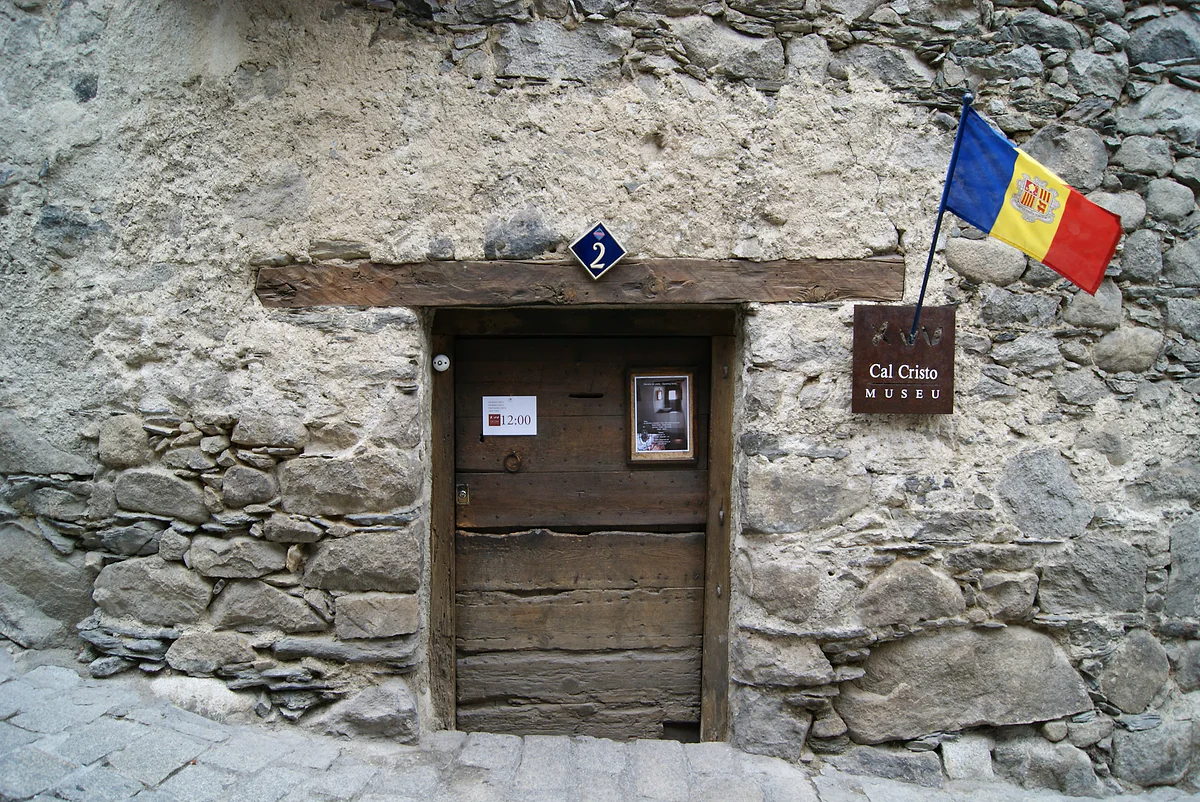
One practical tip to finish. If you want a photo of the flag flying with the arms clearly visible, public buildings and museums tend to fly it, like the Casa Cristo museum in Encamp pictured at the top of this page. If you like this sort of detail, there’s more in Andorra facts.
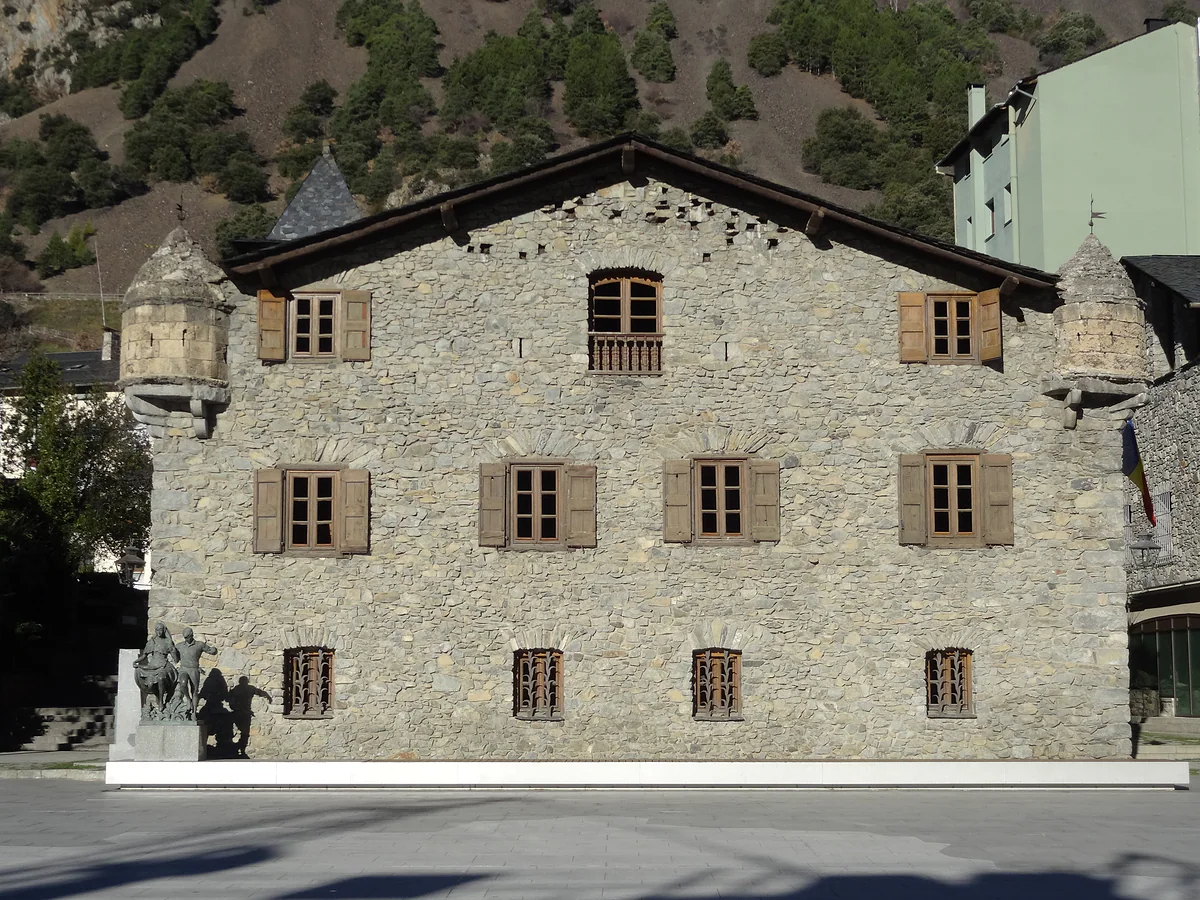
The main facade of Casa de la Vall, with corner turrets and wooden shutters on its stone walls
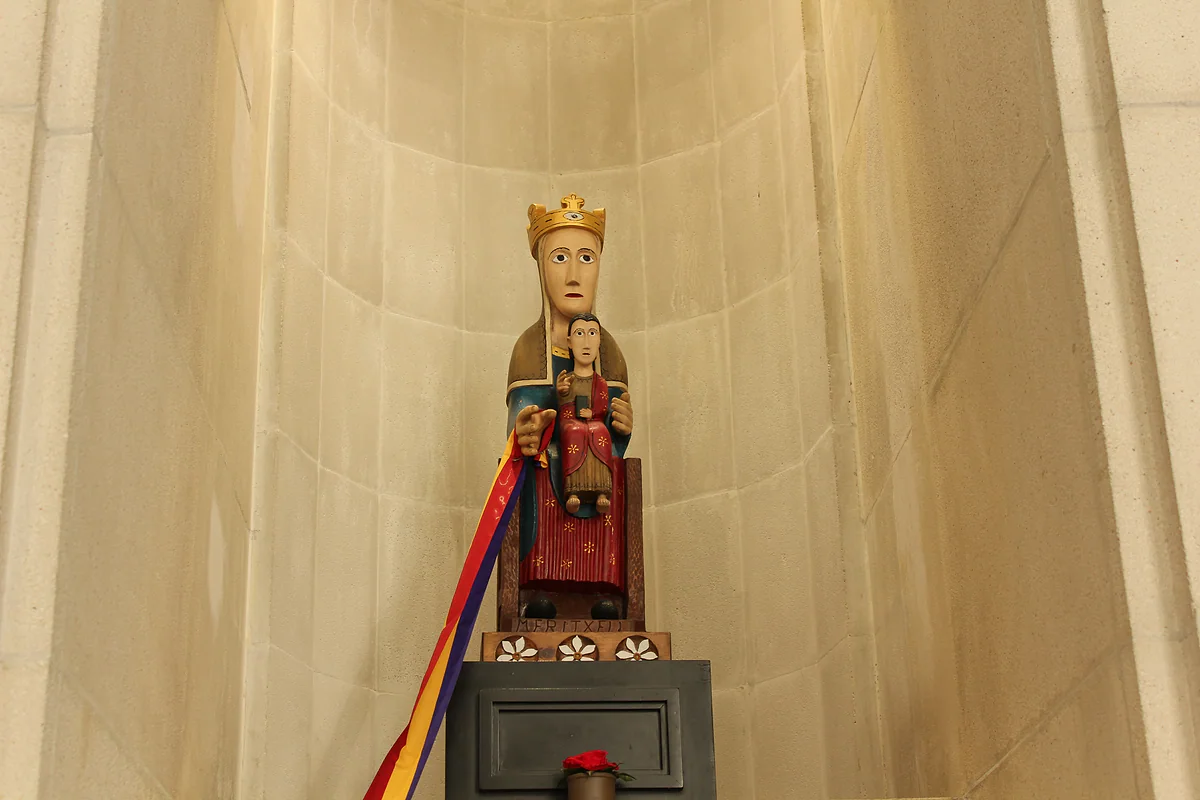
Our Lady of Meritxell, patron saint of Andorra, in her niche at the sanctuary with a flag ribbon
Andorra's national symbols
| Symbol | Description | Source |
|---|---|---|
| Flag | Blue, yellow and red vertical bands of equal width, blue at the hoist, arms in the centre | National Archive (1942 decision) and Spanish Foreign Ministry |
| Coat of arms | Four quarters: mitre and crozier, red stripes on gold (two quarters) and two cows on green | National Archive (1942 decision) |
| Motto | Virtus, Unita, Fortior, «strength united is stronger» | Andorra Turisme |
| Anthem | «El gran Carlemany», words by Joan Benlloch, music by Enric Marfany | National Archive |
| National flower | The grandalla, a six-petalled narcissus-like flower | Andorra Turisme |
| Patron saint | Our Lady of Meritxell, 8 September | Andorra Turisme |
Test yourself
True or false?
0/3 Pick before you peek.
-
The Andorra flag has horizontal stripes.
See the answer
False. They're vertical. The General Council's 1942 decision describes three equal colours running vertically, blue, yellow and red.
-
There are cows on Andorra's coat of arms.
See the answer
True. One of the four quarters shows two golden cows with bells round their necks on a green field, according to the official 1942 description.
-
The anthem only became official with the 1993 Constitution.
See the answer
False. The General Council named it the national anthem in 1917 and made it official on 22 December 1942. The Constitution simply confirms the traditional anthem, flag and arms.
- Flag, arms and anthem made official
- 1942
- Quarters on the coat of arms
- 4
- Year the anthem was born
- 1914
0 of 269 Andorra guides
Your next stamp
- Is Andorra a country?
- History
- Currency and payments
- Political system
- Road conditions
- Map
- Places to visit
- Things to do
- Most beautiful places
- Prettiest villages
- Andorra la Vella
- UNESCO World Heritage
- Escaldes-Engordany
- Where is Andorra?
- Parishes
- Casa de la Vall
- Margineda bridge
- Old town
- Santa Coloma church
- Towns and villages
- Population
- Size
- Mountains
- Language
- Andorra in one day
- Canillo
- Espai Columba
- Margineda rock shelter
- Sant Esteve church
- Co-princes
- Soldeu
- Weekend break
- Andorra in 3 days
- El Tarter
- Andorra in 4 days
- Ransol
- A week in Andorra
- Facts
- Prats
- El Forn
- Public holidays
- Sant Julià de Lòria
- L'Aldosa de Canillo
- Els Plans
- EU and Schengen
- Bordes d'Envalira
- Entry requirements
- Prices and budget
- On a budget
- Sant Joan de Caselles
- Santa Coloma
- Ski holidays
- Tourist tax
- Mobile and roaming
- Sant Serni de Canillo
- Tourist information
- Healthcare
- Meritxell Sanctuary
- With a dog
- Packing list
- Safety
- How to get there
- Scams
- From Barcelona
- Bus from Barcelona
- Day trip from Barcelona
- From Madrid
- From Toulouse
- Encamp
- Flights
- La Margineda
- La Massana
- Roc del Quer viewpoint
- Romanesque churches
- Andorra-La Seu airport
- Canillo Tibetan bridge
- Museums in Andorra
- Pal
- Pas de la Casa
- Arinsal
- Driving
- Grau Roig
- Mon(t) Magic
- Nearest airports
- By train
- Erts
- Les Bons
- Palau de Gel
- Motorcycle Museum
- Parking
- Sispony
- Vila
- Anyós
- Incles valley
- La Mosquera
- Petrol
- El Tremat
- Getting around
- Juclar lakes
- L'Aldosa (La Massana)
- Buses
- Els Cortals d'Encamp
- Sant Climent de Pal
- Bus station
- Sant Cristòfol d'Anyós
- Casa Rull
- Shopping
- Farga Rossell
- Sant Vicenç d'Enclar
- Santa Eulàlia d'Encamp
- What to buy
- Customs allowances
- La Massana Còmic
- Sant Romà de les Bons
- Car Museum
- Cigarettes
- Comapedrosa
- Electronics
- Alcohol
- Casa Cristo
- Clothes and sports shops
- Iron Route
- Coll d'Ordino
- Perfume
- Sacred Art Museum
- Shopping centres
- Funicamp
- Supermarkets
- Avinguda Meritxell
- Encamp Tibetan bridge
- Avinguda Carlemany (Vivand)
- Envalira pass
- Auvinyà
- Bici Lab Andorra
- Ordino
- Skiing
- With kids
- Zip lines
- Fontaneda
- For couples
- La Cortinada
- Ski pass
- Via ferratas
- Climbing
- Llorts
- Nagol
- Nightlife
- Ski season
- El Serrat
- Grandvalira
- Horse riding
- Juberri
- Aixovall
- Mountain biking
- Pal Arinsal
- Sornàs
- Aixirivall
- Ansalonga
- Ordino Arcalís
- Road cycling
- Bixessarri
- Naturland
- Segudet
- Arans
- Llumeneres
- Tobotronc
- Casa d'Areny-Plandolit
- Cross-country skiing
- Miniature Museum
- Skiing with kids
- Cal Pal
- Free walking tour
- Pessons lakes
- Sant Serni de Nagol
- Ski lessons
- Where to stay
- Canòlich Sanctuary
- Hotels in Andorra la Vella
- Sant Martí de la Cortinada
- Ski hire
- Hotels in Escaldes
- Juberri Gardens
- Llorts iron mine
- Webcams
- Hotels in Soldeu
- Snow report
- Sorteny valley
- Hotels in El Tarter
- Tristaina lakes
- Hotels in Canillo
- Night skiing
- Tristaina solar viewpoint
- Freeride
- Hotels in Encamp
- Hotels in Pas de la Casa
- Ski touring
- Hotels in La Massana
- Snowshoeing
- Hotels in Arinsal and Pal
- Snow activities
- Après-ski
- Engordany
- Hotels in Ordino
- Medieval bridges
- Nature parks
- Els Vilars
- Hotels in Sant Julià de Lòria
- Lakes
- Sant Romà dels Vilars
- Viewpoints
- Where to eat
- Caldea
- Restaurants in Andorra la Vella
- Borda restaurants
- Inúu
- Cheap hotels
- Food
- Hiking
- Spas and thermal baths
- Weather and climate
- Engolasters lake
- Pas de la Casa weather
- Spa hotels
- Trinxat
- Events
- Luxury hotels
- Sant Miquel d'Engolasters
- Ski resort weather
- Wine
- Best time to visit
- Family hotels
- Madriu valley
- All inclusive
- Estany de l'Illa
- In winter
- Apartments
- Coronallacs
- In spring
- Ski World Cup
- Christmas
- Hostels
- In summer
- Mountain huts
- Camping and rural stays
- Easy walks
- In autumn
- New Year
- Family walks
- Festes majors
- In January
- GR11 and other GRs
- In February
- National day
- Around Andorra
- GRP round Andorra
- In March
- Midsummer fire festival
- Carnival
- In April
- In May
- Travessa d'Encamp
- In June
- In July
- In August
- In September
- In October
- In November
- In December
Frequently asked questions
What colours are on the Andorra flag?
Blue, yellow and red, in three equal vertical bands with the blue next to the flagpole. The national coat of arms sits in the centre.
What do the colours of the Andorra flag mean?
Spain's Foreign Ministry says blue stands for France, yellow for Andorra and red for Spain. I haven't found an official Andorran explanation, so treat that as the ministry's reading.
What is on Andorra's coat of arms?
A mitre and crozier, three red stripes on gold, four red stripes on gold, and two golden cows with bells on green. Spain's Foreign Ministry sums it up as two quarters for each co-prince.
What is Andorra's national anthem?
«El gran Carlemany», meaning Great Charlemagne. The words are by Joan Benlloch, a former Bishop of Urgell and co-prince, and the music by Enric Marfany, a priest born in Andorra.
How is the Andorra flag different from similar tricolours?
The coat of arms is the giveaway. Without it, a vertical blue, yellow and red flag isn't enough to tell you which country you're looking at.
What is Andorra's motto?
Virtus, Unita, Fortior, usually rendered as virtue united is stronger. It's carved on the front of the Casa de la Vall in Andorra la Vella.
By
Tourism graduate with a master’s in Tourism Management and Planning from the University of Málaga, who has travelled across Europe. He writes every guide from official sources and his own judgement.
Published on . Facts checked on .
Sources
Photos: Mafoso (CC BY-SA 3.0); Don-vip (CC BY-SA 3.0); Ferran Llorens (CC BY-SA 2.0), via Wikimedia Commons.