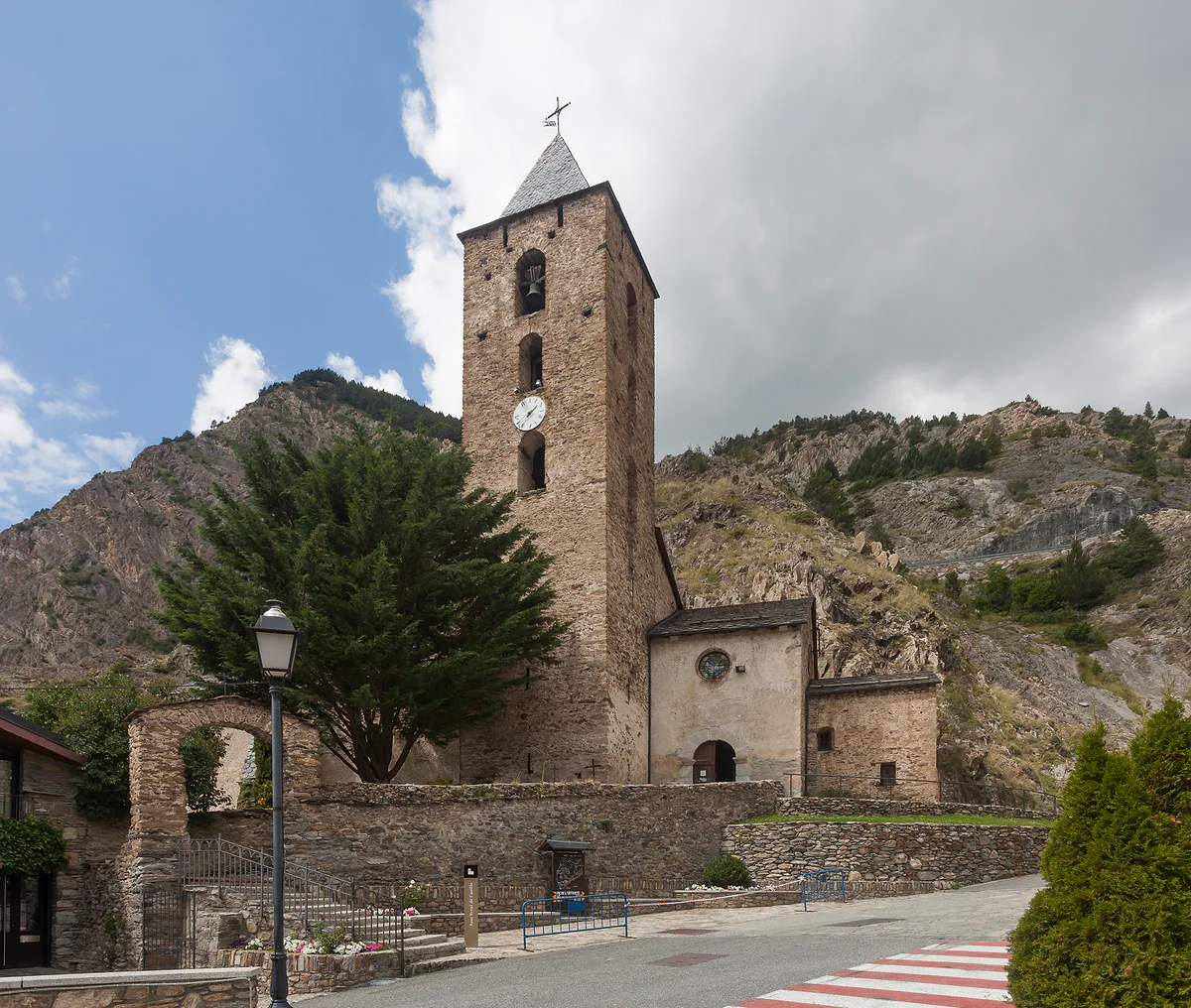
27-metre bell tower, free entry
Sant Serni, Canillo's church against the rock
Sant Serni is Canillo's parish church, in the old village at the foot of the Roc del Quer. Its bell tower, Romanesque in origin and rebuilt in the seventeenth century, is 27 m tall, and the Comú calls it the tallest in the Andorran valleys. The church is mostly Baroque, with a fourteenth-century Gothic crucifix and archaeological remains under the nave. It's open daily from 9:00 to 19:00 and entry is free.
In 30 seconds
Full read: 3 min
- Sant Serni is Canillo's parish church, at the foot of the Roc del Quer.
- Its bell tower is 27 m tall and the Comú calls it the tallest in the valleys.
- It's Baroque on a Romanesque base, with a Gothic crucifix and remains under the nave.
- It's open daily from 9:00 to 19:00 and entry is free.
Sant Serni takes twenty minutes and is the best introduction to Canillo. I'd go in to look at the floor of the nave, where the 2009 finds are on show, then step back into the square to see the tower against the rock, which is the village's defining image.

Before you go
What I would keep in mind
-
01 Most beautiful
A bell tower against a wall of rock
The church is tucked against the Roc del Quer massif, and the Comú says the two together form a symbol of Canillo's identity. The tower is 27 m tall.
Roc del Quer viewpoint -
02 To save money
Free and open all year
Entry is free, according to Andorra Turisme, and the Comú gives opening hours of 9:00 to 19:00 every day, with no seasonal variation.
-
03 My tip
Look down as you walk in
Restoration work in 2009 uncovered structures beneath the nave, possibly from the twelfth-century Romanesque church or an earlier one, plus burials from the seventh to eighteenth centuries. They're displayed in the floor.
-
04 Getting there
In the centre, easy on foot
It's on plaça de Sant Serni in Canillo's old quarter. Buses L3 and L4 stop in the village, and from there it's a short walk.
Canillo, Andorra's largest parish
My ranking, scored
What I'd look at in Sant Serni
My marks out of 10 for each feature, for its interest and for how rarely you'll see it in other Andorran churches. Personal opinion.
0 of 5 seen
-
The 27-metre bell tower
Romanesque in origin and rebuilt in the seventeenth century. From the square, with the rock behind, it's Canillo's postcard.
8.9 out of 10
-
The remains under the nave
Structures possibly from the twelfth century or earlier and burials from the seventh to eighteenth centuries, visible in the floor.
8.6 out of 10
-
The Gothic crucifix
A painted wooden Christ in folk Gothic style from the late fourteenth century, on the right-hand side altar.
8.2 out of 10
-
The Baroque high altarpiece
Seventeenth century, dedicated to Sant Serni, a third-century bishop of Toulouse, in painted carving and panel painting.
7.8 out of 10
-
The font turned fountain
Outside, next to fragments of Romanesque wall. A small detail almost nobody notices.
6.8 out of 10
Drive into Canillo and one building catches your eye before any other, a very tall bell tower pressed against a cliff. That’s Sant Serni. I think it’s the most rewarding short visit in the village, because in a quarter of an hour you pick up a good slice of Canillo’s history.
A church pressed against the Roc del Quer
Sant Serni is Canillo’s parish church and, in the Comú’s words, one of the parish’s most emblematic heritage sites. It’s tucked against the Roc del Quer massif, and the Comú says the two together form a symbol of Canillo’s identity. It stands on plaça de Sant Serni in the centre of the old quarter, surrounded by the village’s most historic houses.
The tower is what everyone remembers. It’s Romanesque in origin, was rebuilt in the seventeenth century and stands 27 m tall, which the Comú says makes it the tallest in the Andorran valleys. Andorra Turisme, for its part, gives Santa Eulàlia in Encamp the tallest Lombard Romanesque tower in the country, at 23 m. I don’t read that as a contradiction so much as two different categories, and I’d quote each with its caveat.
What is there to see inside?
Although the first church dates from the twelfth century, the building you see now is mostly Baroque, from the seventeenth and eighteenth centuries, when the nave and tower were substantially remodelled. Traces of the Romanesque structure survive inside and out.
The high altar is dominated by a seventeenth-century Baroque altarpiece dedicated to Sant Serni, a third-century bishop and martyr of Toulouse, shown with mitre and crozier. It mixes painted carving with panel painting, its imagery arranged in several tiers. To my mind, though, the real treasure is on the right-hand side altar, the Santcrist, a painted wooden Christ in folk Gothic style from the late fourteenth century, which the Comú counts among the church’s most valuable pieces.
What turned up under the floor in 2009
In 2009, restoration work exposed archaeological remains beneath the main nave. Studies suggest they may be structures from the twelfth-century Romanesque church or even an earlier building. Burials dating from the seventh to the eighteenth centuries were also found. Everything is displayed in the floor of the nave itself, and it’s the part I wouldn’t miss.
Outside you’ll find fragments of Romanesque wall and an old baptismal font that now serves as a fountain. It’s the kind of detail that makes you look at the square differently.
Opening times and how to fit it in
The Comú lists visiting hours as every day from 9:00 to 19:00, and Andorra Turisme says entry is free. The government’s museums site, museus.ad, gives no hours and just refers to service times, so the two official sources don’t say the same thing. I’d go by the Comú’s, since it runs the church, and make it the first stop of a day in Canillo. Service times aren’t published on the pages I’ve read, so if you’d rather not walk in during Mass, ask at the tourist office first. From there, carry on to Sant Joan de Caselles on the edge of the village, which in summer opens in the morning, 10:00 to 13:00, and again in the afternoon, 16:00 to 19:00.
Being so close to the rock has a practical upside too. The Roc del Quer viewpoint sits at the top of the same massif, and seeing the church from below and then the valley from above is the best way I know to get your bearings.
If you’re curious about the parish’s religious life, you’ll meet Sant Serni again at Meritxell Sanctuary, where the Andorran sculptor Sergi Mas carved figures of each parish’s patron saint. Canillo’s is Sant Serni, alongside Santa Eulàlia for Encamp and Sant Esteve for Andorra la Vella, so the sanctuary works as a sort of roll call of the country’s seven parishes.
Santa Creu, the village’s other church
In the lower part of Canillo, beside the Valira d’Orient in the area known as l’Areny, is the little church of Santa Creu. Andorra Turisme dates it to the fourteenth century, built in the style of Andorran manor houses of the period, and inside is a large altarpiece of 1739 showing the Crucifixion. It’s normally shut and opens as an exception every 14 September, the feast of the Exaltation of the Cross. The path to Meritxell starts beside it, as I explain in Prats.
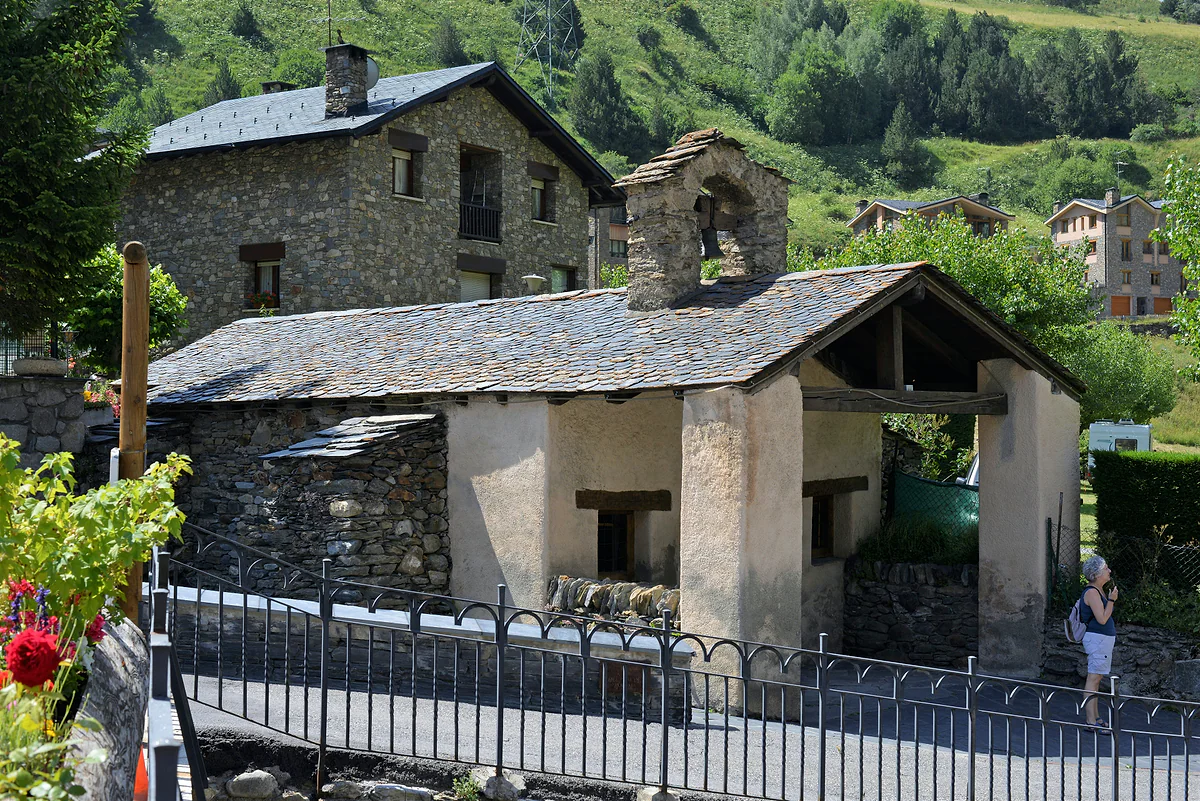
The chapel of Santa Creu in the centre of Canillo, with a stone porch and small bellcote
Sant Serni in brief
| Feature | Detail | Source |
|---|---|---|
| Original church | 12th century | Comú de Canillo |
| Present church | Mostly Baroque, 17th and 18th centuries | Comú de Canillo |
| Bell tower | 27 m, Romanesque, rebuilt in the 17th century | Comú de Canillo |
| Crucifix | Folk Gothic, late 14th century | Comú de Canillo |
| 2009 finds | Structures under the nave and burials from the 7th to 18th centuries | Comú de Canillo |
Visiting Sant Serni and Santa Creu
| Church | Hours | Entry |
|---|---|---|
| Sant Serni | Daily 9:00 to 19:00 | Free |
| Santa Creu | Usually closed; opens on 14 September | Free |
From the Comú de Canillo and Andorra Turisme, checked on 28 September 2026.
Test yourself
True or false?
0/3 Pick before you peek.
-
Sant Serni in Canillo is a Romanesque church that was never altered.
See the answer
False. The first church is twelfth century, but what you see today is mostly Baroque, from the seventeenth and eighteenth centuries.
-
There are burials more than a thousand years old under Sant Serni's nave.
See the answer
True. Work in 2009 uncovered burials dating from the seventh to eighteenth centuries, now visible in the floor.
-
Sant Serni was a bishop of Toulouse.
See the answer
True. He was a third-century bishop and martyr of Toulouse. The Baroque high altarpiece is dedicated to him.
- Height of the bell tower
- 27 m
- First church
- 12th c.
- Finds under the nave
- 2009
- Burials uncovered
- 7th-18th c.
Map
Where Sant Serni de Canillo is
The dashed line is the border with France and Spain. The Valira valley runs down from Pas de la Casa to Sant Julià, with Ordino and La Massana in the northern valley. Every number opens its guide.
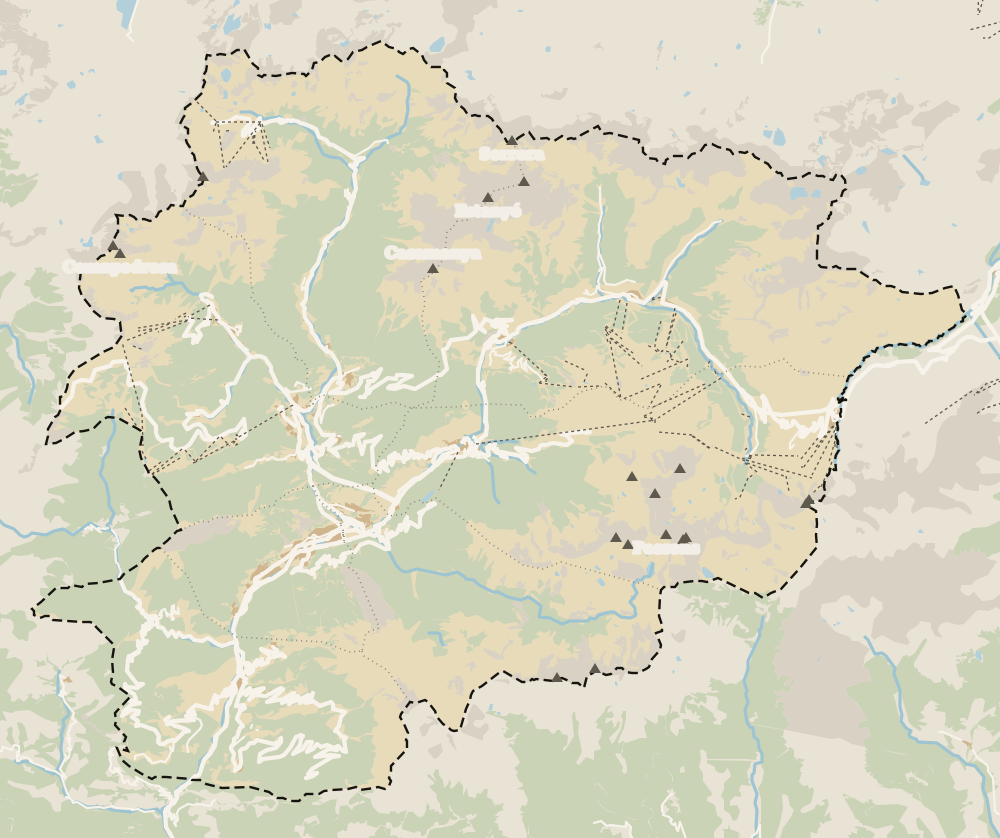 1Canillo 2Soldeu 3El Tarter 4Ransol 5Prats 6El Forn 7L'Aldosa de Canillo 8Els Plans 9Bordes d'Envalira 10Sant Joan de Caselles 11Sant Serni de Canillo 12Meritxell Sanctuary 13Roc del Quer viewpoint 14Canillo Tibetan bridge 15Mon(t) Magic 16Palau de Gel 17Motorcycle Museum 18Incles valley
 Map data © OpenStreetMap contributors (ODbL)
- 1CanilloParish 1 of 7, covering 120.86 km²
- 2SoldeuHome of the Avet run and the 2027 World Cup
- 3El TarterÀliga run, FIS-approved in 2013
- 4Ransol5 km from Canillo, gateway to the Coma
- 5PratsSant Miquel, rustic Romanesque with metre-thick walls
- 6El FornIts own village fiesta since 2025
- 7L'Aldosa de CanilloNot to be confused with L'Aldosa in La Massana
- 8Els PlansA Canillo hamlet above the Ransol road
- 9Bordes d'EnvaliraA Canillo hamlet with its own ski sector
- 10Sant Joan de Caselles11th and 12th centuries, on the edge of Canillo
- 11Sant Serni de Canillo27-metre bell tower, free entry
- 12Meritxell SanctuaryMinor basilica since 2014
- 13Roc del Quer viewpointCanillo, Montaup road, km 6.5
- 14Canillo Tibetan bridge603 m long, 158 m high
- 15Mon(t) MagicGrandvalira family park, Canillo sector
- 16Palau de GelCanillo, avinguda Sant Joan de Caselles
- 17Motorcycle MuseumCanillo, gondola building
- 18Incles valleyCanillo, by Soldeu and El Tarter
0 of 269 Andorra guides
Your next stamp
- Sant Serni de Nagol
- Roc del Quer viewpoint
- Sant Joan de Caselles
- Santa Eulàlia d'Encamp
- Sant Climent de Pal
- Canillo
- Santa Coloma church
- Canòlich Sanctuary
- Places to visit
- Things to do
- Most beautiful places
- Prettiest villages
- Andorra la Vella
- UNESCO World Heritage
- Map
- Escaldes-Engordany
- Where is Andorra?
- Is Andorra a country?
- Parishes
- Casa de la Vall
- Margineda bridge
- Old town
- Towns and villages
- Population
- Size
- Mountains
- Language
- Andorra in one day
- Espai Columba
- History
- Margineda rock shelter
- Sant Esteve church
- Co-princes
- Soldeu
- Weekend break
- Andorra in 3 days
- El Tarter
- Political system
- Andorra in 4 days
- Flag
- Ransol
- A week in Andorra
- Facts
- Prats
- El Forn
- Public holidays
- Sant Julià de Lòria
- Currency and payments
- L'Aldosa de Canillo
- Els Plans
- EU and Schengen
- Bordes d'Envalira
- Entry requirements
- Prices and budget
- On a budget
- Santa Coloma
- Ski holidays
- Tourist tax
- Mobile and roaming
- Tourist information
- Healthcare
- Meritxell Sanctuary
- With a dog
- Packing list
- Safety
- How to get there
- Scams
- From Barcelona
- Bus from Barcelona
- Day trip from Barcelona
- From Madrid
- From Toulouse
- Encamp
- Flights
- La Margineda
- La Massana
- Romanesque churches
- Andorra-La Seu airport
- Canillo Tibetan bridge
- Museums in Andorra
- Pal
- Pas de la Casa
- Arinsal
- Driving
- Grau Roig
- Mon(t) Magic
- Nearest airports
- By train
- Erts
- Les Bons
- Palau de Gel
- Road conditions
- Motorcycle Museum
- Parking
- Sispony
- Vila
- Anyós
- Incles valley
- La Mosquera
- Petrol
- El Tremat
- Getting around
- Juclar lakes
- L'Aldosa (La Massana)
- Buses
- Els Cortals d'Encamp
- Bus station
- Sant Cristòfol d'Anyós
- Casa Rull
- Shopping
- Farga Rossell
- Sant Vicenç d'Enclar
- What to buy
- Customs allowances
- La Massana Còmic
- Sant Romà de les Bons
- Car Museum
- Cigarettes
- Comapedrosa
- Electronics
- Alcohol
- Casa Cristo
- Clothes and sports shops
- Iron Route
- Coll d'Ordino
- Perfume
- Sacred Art Museum
- Shopping centres
- Funicamp
- Supermarkets
- Avinguda Meritxell
- Encamp Tibetan bridge
- Avinguda Carlemany (Vivand)
- Envalira pass
- Auvinyà
- Bici Lab Andorra
- Ordino
- Skiing
- With kids
- Zip lines
- Fontaneda
- For couples
- La Cortinada
- Ski pass
- Via ferratas
- Climbing
- Llorts
- Nagol
- Nightlife
- Ski season
- El Serrat
- Grandvalira
- Horse riding
- Juberri
- Aixovall
- Mountain biking
- Pal Arinsal
- Sornàs
- Aixirivall
- Ansalonga
- Ordino Arcalís
- Road cycling
- Bixessarri
- Naturland
- Segudet
- Arans
- Llumeneres
- Tobotronc
- Casa d'Areny-Plandolit
- Cross-country skiing
- Miniature Museum
- Skiing with kids
- Cal Pal
- Free walking tour
- Pessons lakes
- Ski lessons
- Where to stay
- Hotels in Andorra la Vella
- Sant Martí de la Cortinada
- Ski hire
- Hotels in Escaldes
- Juberri Gardens
- Llorts iron mine
- Webcams
- Hotels in Soldeu
- Snow report
- Sorteny valley
- Hotels in El Tarter
- Tristaina lakes
- Hotels in Canillo
- Night skiing
- Tristaina solar viewpoint
- Freeride
- Hotels in Encamp
- Hotels in Pas de la Casa
- Ski touring
- Hotels in La Massana
- Snowshoeing
- Hotels in Arinsal and Pal
- Snow activities
- Après-ski
- Engordany
- Hotels in Ordino
- Medieval bridges
- Nature parks
- Els Vilars
- Hotels in Sant Julià de Lòria
- Lakes
- Sant Romà dels Vilars
- Viewpoints
- Where to eat
- Caldea
- Restaurants in Andorra la Vella
- Borda restaurants
- Inúu
- Cheap hotels
- Food
- Hiking
- Spas and thermal baths
- Weather and climate
- Engolasters lake
- Pas de la Casa weather
- Spa hotels
- Trinxat
- Events
- Luxury hotels
- Sant Miquel d'Engolasters
- Ski resort weather
- Wine
- Best time to visit
- Family hotels
- Madriu valley
- All inclusive
- Estany de l'Illa
- In winter
- Apartments
- Coronallacs
- In spring
- Ski World Cup
- Christmas
- Hostels
- In summer
- Mountain huts
- Camping and rural stays
- Easy walks
- In autumn
- New Year
- Family walks
- Festes majors
- In January
- GR11 and other GRs
- In February
- National day
- Around Andorra
- GRP round Andorra
- In March
- Midsummer fire festival
- Carnival
- In April
- In May
- Travessa d'Encamp
- In June
- In July
- In August
- In September
- In October
- In November
- In December
Frequently asked questions
What are the opening times of Sant Serni church?
According to the Comú de Canillo, every day from 9:00 to 19:00. Entry is free.
Is Sant Serni's bell tower the tallest in Andorra?
The Comú says that at 27 m it's the tallest in the Andorran valleys. Andorra Turisme, meanwhile, gives Santa Eulàlia in Encamp the tallest Lombard Romanesque tower, at 23 m, so it depends on what you're comparing.
How old is Sant Serni de Canillo?
The first church dates from the twelfth century, but the present building is mostly Baroque, from the seventeenth and eighteenth centuries, when the nave and tower were remodelled.
Who was Sant Serni?
Sant Serni was a third-century bishop and martyr of Toulouse. The Baroque high altarpiece is dedicated to him and shows him with mitre and crozier.
What was found under Sant Serni in 2009?
Restoration work revealed possible twelfth-century Romanesque structures, or remains of an even earlier church, under the nave, along with burials dating from the seventh to eighteenth centuries. They're now displayed in the floor.
Are there other churches in Canillo village?
Yes. Sant Joan de Caselles stands on the way out towards France, and the small chapel of Santa Creu sits by the river in the lower village, opening only on 14 September.
By
Tourism graduate with a master’s in Tourism Management and Planning from the University of Málaga, who has travelled across Europe. He writes every guide from official sources and his own judgement.
Published on . Facts checked on .
Sources
Photos: Luis Miguel Bugallo Sánchez (CC BY-SA 3.0); Alberto-g-rovi (CC BY 3.0), via Wikimedia Commons.