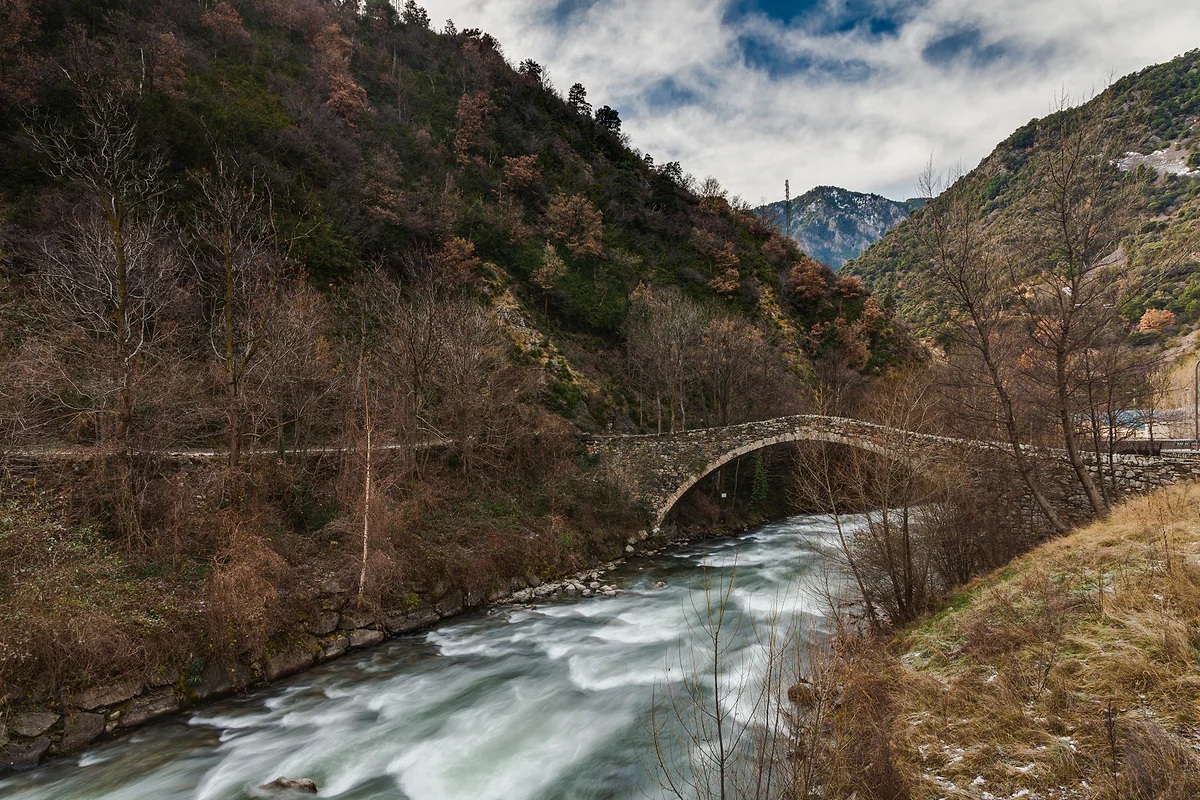
Andorra la Vella, by the Gran Valira
La Margineda, twelve thousand years in a few hundred metres
La Margineda is the southernmost village in Andorra la Vella parish, beside the Gran Valira on the road to Sant Julià de Lòria. Within a few hundred metres it has Andorra's largest medieval bridge (33 m), the Margineda rock shelter, used by people from 10,000 BC, and the Roureda, a medieval hamlet dig that opens in July and August.
In 30 seconds
Full read: 3 min
- La Margineda is the southernmost village in Andorra la Vella parish, by the Gran Valira.
- It has Andorra's largest medieval bridge, 33 metres long and free to visit.
- The Margineda rock shelter shows human presence from 10,000 BC and can be seen from the road.
- The Roureda, a medieval hamlet dig, opens only in July and August, at 10:30, for €5.
I'd save it for the end of the Arc Patrimonial, walking down from Santa Coloma, so you reach the bridge in the late light. In summer I'd book the Roureda tour for a morning before anything else.

Before you go
What I would keep in mind
-
01 Most beautiful
The largest of the medieval bridges
Thirty-three metres of stone in a single arch over the Gran Valira, on the old royal road to Sant Julià. The official listings call it the largest and most slender of Andorra's surviving medieval bridges.
Margineda bridge -
02 To save money
You can see the rock shelter from the road
The prehistoric shelter is five minutes' walk from the Margineda roundabout and clearly visible from the road, according to the capital's tourist office. It costs nothing.
Balma de la Margineda rock shelter -
03 My tip
The Roureda only opens in summer
The medieval Roureda site can be visited from 1 July to 31 August, daily at 10:30, booked ahead, for €5 per adult according to museus.ad. Tours run in English among other languages. It isn't suitable for reduced mobility.
-
04 Getting there
Walk down from Santa Coloma
The Arc Patrimonial links Santa Coloma and la Margineda over about five kilometres of historic paths. You can start at either end, so it also works in reverse, finishing at Espai Columba.
Santa Coloma, Andorra
What I would book
My ranking, scored
What to see in la Margineda
My own scores out of 10, weighing what each place tells you about Andorra's past and how easy it is to see. The Roureda loses a little for opening only two months a year.
0 of 5 seen
-
Margineda bridge
Andorra's largest medieval bridge, a single arch, with an accessible viewpoint beside it. Free, at any hour.
9.0 out of 10
-
Margineda rock shelter
Where people first set foot in these valleys, between 10,000 and 4,000 BC. Seen from outside.
8.4 out of 10
-
Roureda de la Margineda
A hamlet of at least five houses from the 12th to 14th centuries, the country's most extensive dig according to museus.ad. July and August only.
8.0 out of 10
-
Margineda viewpoint
A rocky outcrop that is the highest point on the Arc Patrimonial and looks over the whole route.
7.2 out of 10
-
Old village core
Traditional buildings and farmland that show how the local economy once worked. Ten minutes to walk through.
6.5 out of 10
La Margineda is the kind of place you drive through without noticing. A roundabout, a newer bridge, the road to the border. Yet within a few hundred metres of the Gran Valira sits Andorra’s story from end to end, from hunters twelve thousand years ago to the bridge that carried the old royal road. Here’s my plan for it.
The capital’s southernmost village
The Andorra la Vella tourist office describes it as the parish’s small southernmost settlement. The path runs through the village and shows off some traditional building and farmland that hints at how the local economy worked. The tourist board also singles out the Casa dels Pobres as a well-kept example.
The old royal road from Andorra la Vella to Sant Julià de Lòria came this way, and that explains everything else. The Margineda bridge was where it crossed the Gran Valira. Later came the so-called new bridge, which carried the La Seu d’Urgell road when it opened in 1914. About 300 metres from the medieval bridge stands the Madrid bridge, a modern structure the tourist office uses to contrast traditional Andorra with today’s.
The bridge and its viewpoint
Start with the bridge. It’s 33 metres long with a single arch, and the official listings call it the largest and most slender of the country’s surviving medieval bridges. Beside it stands a contemporary piece in two arches by a sculptor from Valencia, honouring a Catalan-language congress; the tourist board sees one arch as Andorra’s past and the other as its present.
Beside the bridge is the Margineda bridge viewpoint, fitted with Braille, raised relief and QR codes, and designed for step-free access. From it you look over riverside woodland of alder and ash, and in winter you may spot great cormorants, according to the tourist board.
What is the Margineda rock shelter?
An overhang under the rock that the capital’s tourist office calls the great unknown of Andorran heritage. It holds evidence of Andorra’s first inhabitants, hunter-gatherers living here between 10,000 and 4,000 BC. It was discovered in 1959, sits a short stroll from the roundabout and is visible from the road. I give it a separate page, the Margineda rock shelter.
The Roureda, a medieval hamlet
What fewer people know about, and what intrigues me most, is the Roureda de la Margineda. It’s a medieval site dug since 2007, with a cluster of at least five houses from the 12th to 14th centuries, laid out around lanes and shared spaces. museus.ad calls it the most extensive archaeological site in Andorra, and the tourist board says it has forced a rethink of parts of the country’s history. About 1,500 m² have been excavated, with roughly 3,000 m² still to study.
The catch is that it’s only open from 1 July to 31 August, daily at 10:30, booked through the Andorra la Vella tourist office. It costs €5 per adult according to museus.ad, tours run in English among other languages, and it isn’t suitable for reduced mobility. If you’re here in summer, I’d book it on day one.
museus.ad groups it with the rock shelter among the sites that best tell the country’s story, and the tourist board notes that in 2017 it hosted Andosinoi, the country’s first historical re-enactment festival. For me that sums the place up. La Margineda isn’t somewhere to potter for an hour; it’s where you understand where the country came from.
When to come
Any time of year works for the bridge and the rock shelter, since both are outdoors and free. Summer is the only season for the Roureda. The village also has its own festival, the Barracas de la Margineda, which the tourist board describes as the most famous and inventive in the area, but it doesn’t publish dates, so I can’t give you any. In late autumn and winter I’d come around midday, when the valley floor gets the most sun.
Fitting it in
My suggestion is to walk down from Santa Coloma on the Arc Patrimonial, about five kilometres in all, and finish here. The high point of the route is the Margineda viewpoint, a rocky outcrop overlooking the whole valley. For Andorra’s other old bridges, see my guide to medieval bridges in Andorra.
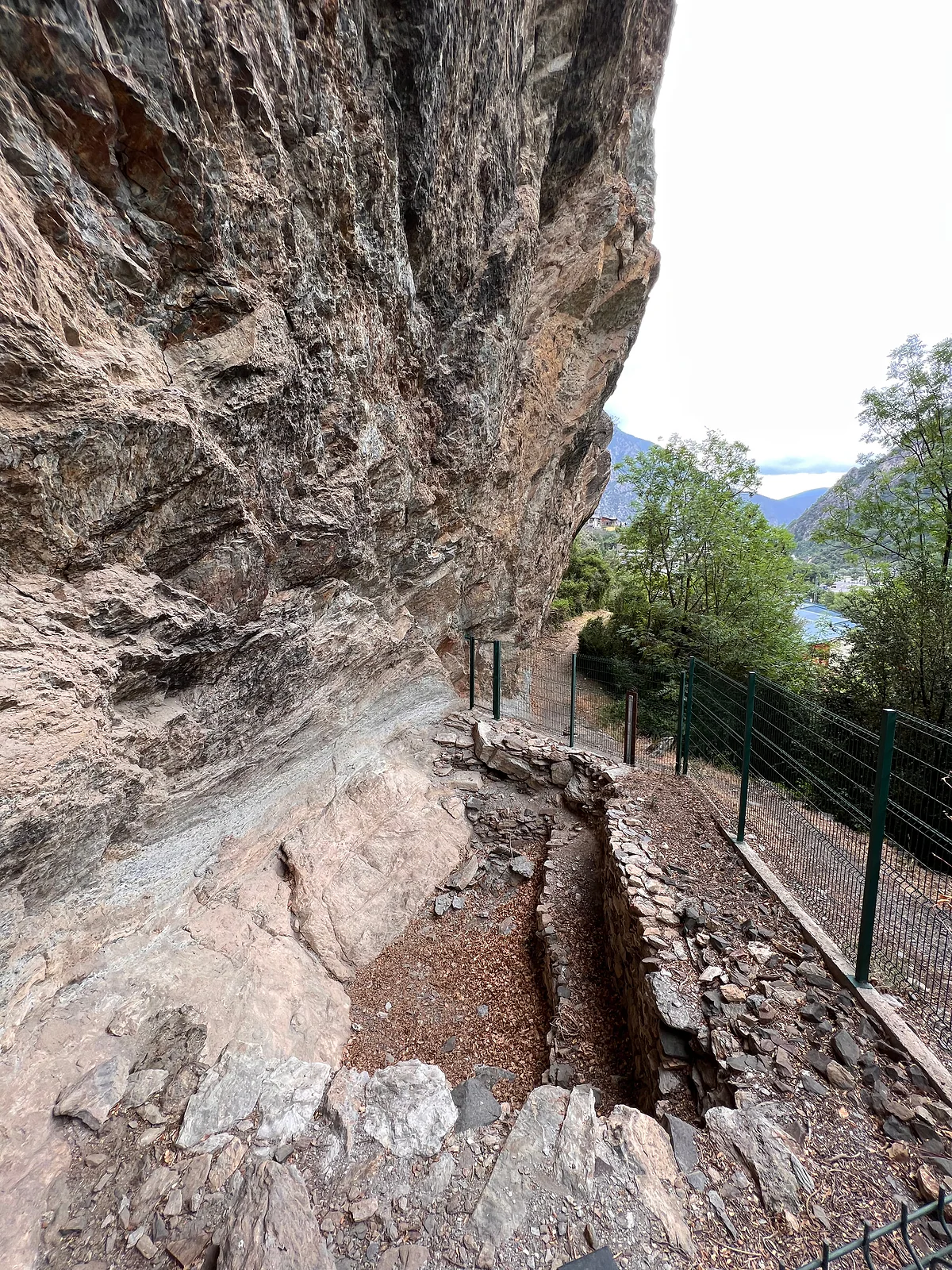
The Balma de la Margineda, a prehistoric rock shelter under an overhang, beside a fenced path
Visiting the Roureda de la Margineda (28-9-2026)
| What | Detail |
|---|---|
| Season | 1 July to 31 August |
| Times | Daily tour at 10:30, booking required |
| Adults (12 to 65) | €5 |
| Over-65s and youth card holders | €3 |
| Under-12s | Free |
| Languages | Catalan, Spanish, French and English |
museus.ad (Andorran government). Book through the Andorra la Vella tourist office, +376 750 100. Not accessible for reduced mobility; wear proper shoes and bring sun protection.
Test yourself
True or false?
0/3 Pick before you peek.
-
The Margineda rock shelter and the Roureda are the same site.
See the answer
False. The rock shelter is prehistoric (10,000 to 4,000 BC) and the Roureda is a medieval hamlet from the 12th to 14th centuries. They're two different places.
-
You can visit the Roureda de la Margineda all year round.
See the answer
False. Only from 1 July to 31 August, with a daily tour at 10:30 booked in advance, according to museus.ad.
-
La Margineda is the southernmost village in Andorra la Vella parish.
See the answer
True. The Andorra la Vella tourist office describes it as the parish's small southernmost village.
Map
Where La Margineda is
The dashed line is the border with France and Spain. The Valira valley runs down from Pas de la Casa to Sant Julià, with Ordino and La Massana in the northern valley. Every number opens its guide.
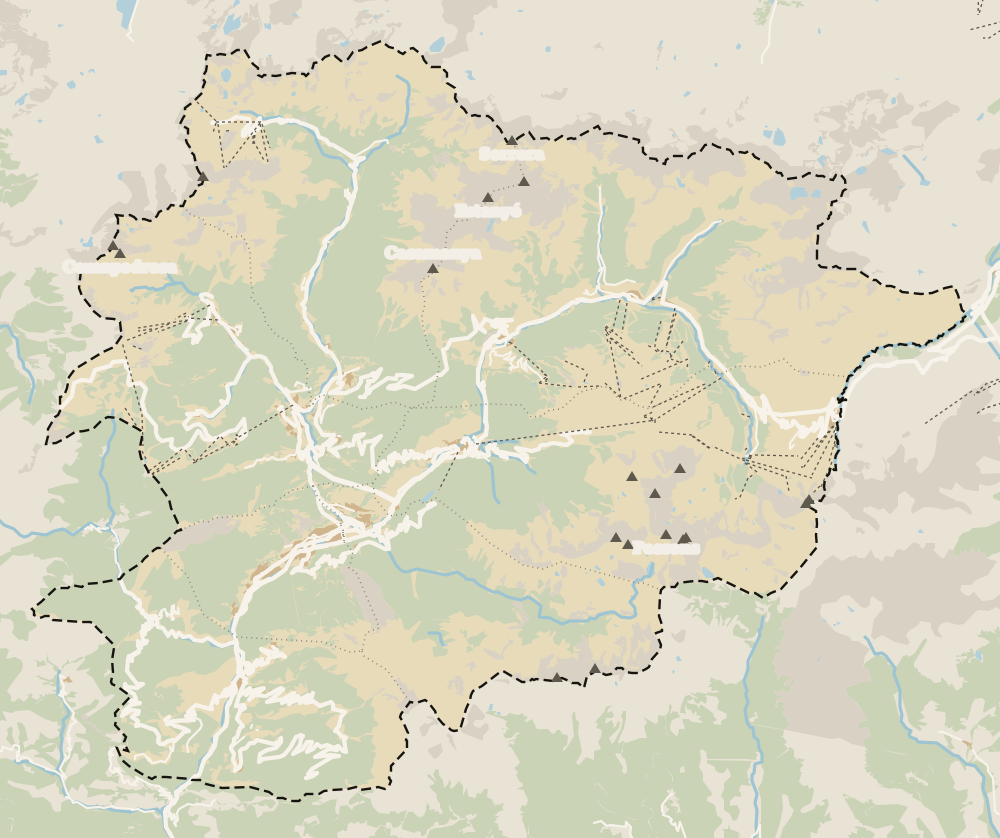 1Andorra la Vella 2Old town 3Santa Coloma 4La Margineda 5Sant Vicenç d'Enclar 6Avinguda Meritxell 7Bici Lab Andorra
 Map data © OpenStreetMap contributors (ODbL)
- 1Andorra la VellaParish 5 of 7
- 2Old townWhere the capital began
- 3Santa ColomaAndorra la Vella, down the valley
- 4La MarginedaAndorra la Vella, by the Gran Valira
- 5Sant Vicenç d'EnclarAbove Santa Coloma, on the Roc d'Enclar
- 6Avinguda MeritxellAndorra la Vella
- 7Bici Lab AndorraThe Riberaygua collection, on Prat de la Creu
What to see
What to see in La Margineda
0 of 269 Andorra guides
Your next stamp
- Margineda bridge
- Medieval bridges
- Margineda rock shelter
- Andorra la Vella
- Old town
- Prettiest villages
- Escaldes-Engordany
- Engordany
- Places to visit
- Things to do
- Most beautiful places
- UNESCO World Heritage
- Map
- Where is Andorra?
- Is Andorra a country?
- Parishes
- Casa de la Vall
- Santa Coloma church
- Towns and villages
- Population
- Size
- Mountains
- Language
- Andorra in one day
- Canillo
- Espai Columba
- History
- Sant Esteve church
- Co-princes
- Soldeu
- Weekend break
- Andorra in 3 days
- El Tarter
- Political system
- Andorra in 4 days
- Flag
- Ransol
- A week in Andorra
- Facts
- Prats
- El Forn
- Public holidays
- Sant Julià de Lòria
- Currency and payments
- L'Aldosa de Canillo
- Els Plans
- EU and Schengen
- Bordes d'Envalira
- Entry requirements
- Prices and budget
- On a budget
- Sant Joan de Caselles
- Santa Coloma
- Ski holidays
- Tourist tax
- Mobile and roaming
- Sant Serni de Canillo
- Tourist information
- Healthcare
- Meritxell Sanctuary
- With a dog
- Packing list
- Safety
- How to get there
- Scams
- From Barcelona
- Bus from Barcelona
- Day trip from Barcelona
- From Madrid
- From Toulouse
- Encamp
- Flights
- La Massana
- Roc del Quer viewpoint
- Romanesque churches
- Andorra-La Seu airport
- Canillo Tibetan bridge
- Museums in Andorra
- Pal
- Pas de la Casa
- Arinsal
- Driving
- Grau Roig
- Mon(t) Magic
- Nearest airports
- By train
- Erts
- Les Bons
- Palau de Gel
- Road conditions
- Motorcycle Museum
- Parking
- Sispony
- Vila
- Anyós
- Incles valley
- La Mosquera
- Petrol
- El Tremat
- Getting around
- Juclar lakes
- L'Aldosa (La Massana)
- Buses
- Els Cortals d'Encamp
- Sant Climent de Pal
- Bus station
- Sant Cristòfol d'Anyós
- Casa Rull
- Shopping
- Farga Rossell
- Sant Vicenç d'Enclar
- Santa Eulàlia d'Encamp
- What to buy
- Customs allowances
- La Massana Còmic
- Sant Romà de les Bons
- Car Museum
- Cigarettes
- Comapedrosa
- Electronics
- Alcohol
- Casa Cristo
- Clothes and sports shops
- Iron Route
- Coll d'Ordino
- Perfume
- Sacred Art Museum
- Shopping centres
- Funicamp
- Supermarkets
- Avinguda Meritxell
- Encamp Tibetan bridge
- Avinguda Carlemany (Vivand)
- Envalira pass
- Auvinyà
- Bici Lab Andorra
- Ordino
- Skiing
- With kids
- Zip lines
- Fontaneda
- For couples
- La Cortinada
- Ski pass
- Via ferratas
- Climbing
- Llorts
- Nagol
- Nightlife
- Ski season
- El Serrat
- Grandvalira
- Horse riding
- Juberri
- Aixovall
- Mountain biking
- Pal Arinsal
- Sornàs
- Aixirivall
- Ansalonga
- Ordino Arcalís
- Road cycling
- Bixessarri
- Naturland
- Segudet
- Arans
- Llumeneres
- Tobotronc
- Casa d'Areny-Plandolit
- Cross-country skiing
- Miniature Museum
- Skiing with kids
- Cal Pal
- Free walking tour
- Pessons lakes
- Sant Serni de Nagol
- Ski lessons
- Where to stay
- Canòlich Sanctuary
- Hotels in Andorra la Vella
- Sant Martí de la Cortinada
- Ski hire
- Hotels in Escaldes
- Juberri Gardens
- Llorts iron mine
- Webcams
- Hotels in Soldeu
- Snow report
- Sorteny valley
- Hotels in El Tarter
- Tristaina lakes
- Hotels in Canillo
- Night skiing
- Tristaina solar viewpoint
- Freeride
- Hotels in Encamp
- Hotels in Pas de la Casa
- Ski touring
- Hotels in La Massana
- Snowshoeing
- Hotels in Arinsal and Pal
- Snow activities
- Après-ski
- Hotels in Ordino
- Nature parks
- Els Vilars
- Hotels in Sant Julià de Lòria
- Lakes
- Sant Romà dels Vilars
- Viewpoints
- Where to eat
- Caldea
- Restaurants in Andorra la Vella
- Borda restaurants
- Inúu
- Cheap hotels
- Food
- Hiking
- Spas and thermal baths
- Weather and climate
- Engolasters lake
- Pas de la Casa weather
- Spa hotels
- Trinxat
- Events
- Luxury hotels
- Sant Miquel d'Engolasters
- Ski resort weather
- Wine
- Best time to visit
- Family hotels
- Madriu valley
- All inclusive
- Estany de l'Illa
- In winter
- Apartments
- Coronallacs
- In spring
- Ski World Cup
- Christmas
- Hostels
- In summer
- Mountain huts
- Camping and rural stays
- Easy walks
- In autumn
- New Year
- Family walks
- Festes majors
- In January
- GR11 and other GRs
- In February
- National day
- Around Andorra
- GRP round Andorra
- In March
- Midsummer fire festival
- Carnival
- In April
- In May
- Travessa d'Encamp
- In June
- In July
- In August
- In September
- In October
- In November
- In December
Frequently asked questions
Where is la Margineda in Andorra?
It's the southernmost village in Andorra la Vella parish, beside the Gran Valira on the way to Sant Julià de Lòria. You reach it from Santa Coloma on the Arc Patrimonial walking route or along the main road.
What is there to see in la Margineda?
The medieval bridge, the largest in Andorra, the Margineda rock shelter, a prehistoric site visible from the road, and in summer the medieval Roureda dig. Add the Margineda viewpoint and the small old core.
How much is the Roureda de la Margineda tour?
€5 for ages 12 to 65, €3 for over-65s and youth card holders and free for under-12s, according to museus.ad on 28 September 2026. It runs only from 1 July to 31 August, at 10:30, and must be booked.
Are the Margineda rock shelter and the Roureda the same site?
No. The rock shelter is a prehistoric overhang used between 10,000 and 4,000 BC. The Roureda is a medieval hamlet from the 12th to 14th centuries, excavated since 2007. They're two separate sites a short distance apart.
Can you do la Margineda without a car?
Yes, on foot from Santa Coloma along the Arc Patrimonial, about five kilometres in all. The capital's tourist office says the route can be joined at any point.
By
Tourism graduate with a master’s in Tourism Management and Planning from the University of Málaga, who has travelled across Europe. He writes every guide from official sources and his own judgement.
Published on . Facts checked on .
Sources
Photos: Diego Delso (CC BY-SA 4.0); Walmaul (CC BY-SA 4.0), via Wikimedia Commons.