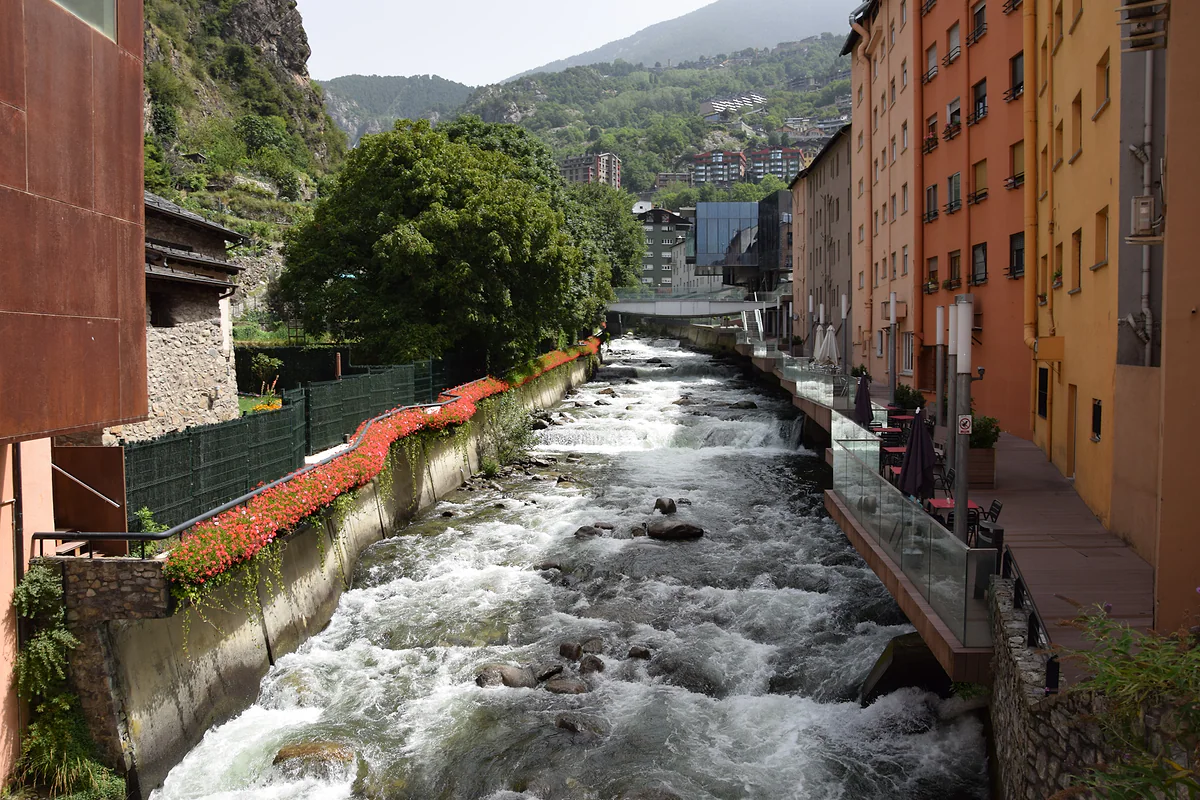
A district of Escaldes-Engordany
Engordany, the village hiding inside the parish name
Engordany is the settlement that gives Escaldes-Engordany the second half of its name, separated from Escaldes by the Engordany bridge, rebuilt in 1785. The way to see it is the Engordany heritage walk, an easy route with 60 m of climbing from Plaça Santa Anna to the church of Sant Jaume, consecrated in 1992 on the site of the original.
In 30 seconds
Full read: 2 min
- Engordany is the settlement behind the second half of the Escaldes-Engordany name.
- Its bridge over the Valira d'Orient was rebuilt in 1785 after a flood.
- The Engordany heritage walk runs from Plaça Santa Anna to Sant Jaume with 60 m of climbing.
Engordany isn't worth a special trip, but it's worth an hour once you're in Escaldes. I'd do the walk first thing, before Caldea opens its doors to the crowds, and finish at the Sant Jaume viewpoint with the town below you.

Before you go
What I would keep in mind
-
01 Most beautiful
A bridge with lopsided ends
The two ends of the Engordany bridge don't match because each bank sits at a different height. Look for it as you cross from Avinguda Carlemany.
medieval bridges in Andorra -
02 To save money
Signboards, no guide needed
The Engordany walk has information panels outside houses such as Cal Rafel, Cal Ricart and Cal Vicari. You won't need to pay anyone to make sense of it.
-
03 My tip
Carry on up to Els Vilars
From Sant Jaume the paths continue to Els Vilars and its pre-Romanesque church. It's a few minutes' more climbing for another viewpoint.
Els Vilars
The parish name is misleading. Most people just say “Escaldes” and forget that Engordany was a separate village, with its own church, farmhouses and bridge. Andorra Turisme describes it as a place often masked by the parish’s name, which is precisely what I like about it. In twenty minutes you swap shop windows for the Andorra of a century ago.
One bridge, two villages
Escaldes and Engordany grew up on either side of the Valira d’Orient, joined by the Engordany bridge. The design is medieval, a single round arch with a flat cobbled deck, but the stones you cross were laid in 1785, after a great flood carried away the 1772 bridge. One detail I enjoy is that the two ends don’t match, because each bank sits at a different level. You reach it from Avinguda Carlemany or along the Camí d’Ensucaranes, and the Tosca bridge is a few steps upstream. I cover both in medieval bridges in Andorra.
Walking the Engordany route
The route leaves Plaça Santa Anna, by the tourist office, and climbs the Camí de la Peletera to the church of Sant Jaume. Along the way, panels introduce houses such as Cal Rafel, Cal Ricart and Cal Vicari and explain life in the early 1900s, when water, crops and livestock shaped everything. There’s only 60 m of ascent, and it’s meant to be done on foot by anyone.
Sant Jaume already appears in 1040 as a property of the monastery of Sant Cerni de Tavèrnoles, but the old building collapsed in the 1950s. What stands there now is modern, consecrated on 24 July 1992 on the same spot. I wouldn’t go in for the architecture. I’d go for what’s next to it.
What’s right by the bridge
Before or after the walk, it’s worth lingering by the river. Between the Engordany and Tosca bridges stands Espai Caldes, a contemporary arts space of more than 400 m² with a glass viewpoint jutting out over the Valira. You need to arrange a visit in advance on (+376) 890 897. Those streets also hold Javier Balmaseda’s “El agua y la forma”, a trail of fountains, pipes and washhouses recalling that this parish grew rich on thermal water. I’d string it all together in a single morning, since everything is a few steps apart, and finish with a coffee in the upper town before heading up the hill.
The view from Sant Jaume
Right beside the church, at 1,100 m, the Sant Jaume d’Engordany viewpoint faces south over Escaldes, Andorra la Vella and the mouth of the Madriu valley. Oaks, holm oaks and nettle trees surround it, a surprisingly Mediterranean patch of woodland inside the town. If your legs are willing, paths carry on to Els Vilars and its pre-Romanesque church.
For everything else in the parish, from Caldea to the lake, see my guide to Escaldes-Engordany.
The Engordany heritage walk
| Detail | Figure |
|---|---|
| Start | Plaça Santa Anna |
| Finish | Church of Sant Jaume d'Engordany |
| Climb | +60 m / −60 m |
| Difficulty | Easy, designed for walking |
| Houses with panels | Cal Rafel, Cal Ricart, Cal Vicari |
Andorra Turisme, checked on 29-09-2026.
Test yourself
True or false?
0/3 Pick before you peek.
-
The Engordany bridge you see today dates from 1785.
See the answer
True. Andorra Turisme says it was built for a second time in 1785, after a major flood destroyed the earlier structure.
-
Sant Jaume d'Engordany still has its Romanesque apse.
See the answer
False. The original building collapsed in the 1950s. Today's church is modern and was consecrated on 24 July 1992.
-
The Engordany walk is about daily life in the early 20th century.
See the answer
True. Its panels cover farming, livestock, water and village life as it was in the early 1900s.
Map
Where Engordany is
The dashed line is the border with France and Spain. The Valira valley runs down from Pas de la Casa to Sant Julià, with Ordino and La Massana in the northern valley. Every number opens its guide.
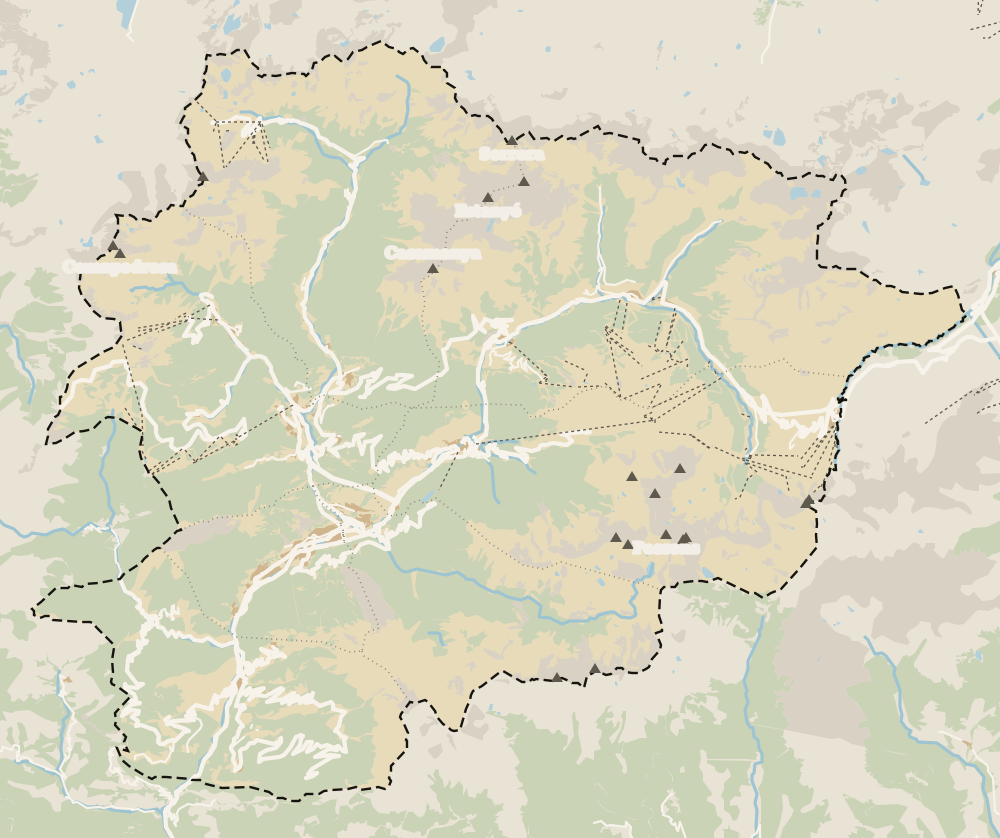 1Escaldes-Engordany 2Avinguda Carlemany (Vivand) 3Engordany 4Els Vilars 5Caldea 6Engolasters lake 7Sant Miquel d'Engolasters 8Madriu valley
 Map data © OpenStreetMap contributors (ODbL)
- 1Escaldes-EngordanyParish 7 of 7
- 2Avinguda Carlemany (Vivand)Escaldes-Engordany
- 3EngordanyA district of Escaldes-Engordany
- 4Els VilarsA hamlet in Escaldes-Engordany
- 5CaldeaThermal spa in Escaldes-Engordany
- 6Engolasters lakeAbove Escaldes-Engordany
- 7Sant Miquel d'Engolasters12th-century Romanesque
- 8Madriu valleyUNESCO World Heritage Site since 2004
0 of 269 Andorra guides
Your next stamp
- Escaldes-Engordany
- Hotels in Escaldes
- La Margineda
- Sant Romà dels Vilars
- Parishes
- Places to visit
- Medieval bridges
- Andorra la Vella
- Things to do
- Most beautiful places
- Prettiest villages
- UNESCO World Heritage
- Map
- Where is Andorra?
- Is Andorra a country?
- Casa de la Vall
- Margineda bridge
- Old town
- Santa Coloma church
- Towns and villages
- Population
- Size
- Mountains
- Language
- Andorra in one day
- Canillo
- Espai Columba
- History
- Margineda rock shelter
- Sant Esteve church
- Co-princes
- Soldeu
- Weekend break
- Andorra in 3 days
- El Tarter
- Political system
- Andorra in 4 days
- Flag
- Ransol
- A week in Andorra
- Facts
- Prats
- El Forn
- Public holidays
- Sant Julià de Lòria
- Currency and payments
- L'Aldosa de Canillo
- Els Plans
- EU and Schengen
- Bordes d'Envalira
- Entry requirements
- Prices and budget
- On a budget
- Sant Joan de Caselles
- Santa Coloma
- Ski holidays
- Tourist tax
- Mobile and roaming
- Sant Serni de Canillo
- Tourist information
- Healthcare
- Meritxell Sanctuary
- With a dog
- Packing list
- Safety
- How to get there
- Scams
- From Barcelona
- Bus from Barcelona
- Day trip from Barcelona
- From Madrid
- From Toulouse
- Encamp
- Flights
- La Massana
- Roc del Quer viewpoint
- Romanesque churches
- Andorra-La Seu airport
- Canillo Tibetan bridge
- Museums in Andorra
- Pal
- Pas de la Casa
- Arinsal
- Driving
- Grau Roig
- Mon(t) Magic
- Nearest airports
- By train
- Erts
- Les Bons
- Palau de Gel
- Road conditions
- Motorcycle Museum
- Parking
- Sispony
- Vila
- Anyós
- Incles valley
- La Mosquera
- Petrol
- El Tremat
- Getting around
- Juclar lakes
- L'Aldosa (La Massana)
- Buses
- Els Cortals d'Encamp
- Sant Climent de Pal
- Bus station
- Sant Cristòfol d'Anyós
- Casa Rull
- Shopping
- Farga Rossell
- Sant Vicenç d'Enclar
- Santa Eulàlia d'Encamp
- What to buy
- Customs allowances
- La Massana Còmic
- Sant Romà de les Bons
- Car Museum
- Cigarettes
- Comapedrosa
- Electronics
- Alcohol
- Casa Cristo
- Clothes and sports shops
- Iron Route
- Coll d'Ordino
- Perfume
- Sacred Art Museum
- Shopping centres
- Funicamp
- Supermarkets
- Avinguda Meritxell
- Encamp Tibetan bridge
- Avinguda Carlemany (Vivand)
- Envalira pass
- Auvinyà
- Bici Lab Andorra
- Ordino
- Skiing
- With kids
- Zip lines
- Fontaneda
- For couples
- La Cortinada
- Ski pass
- Via ferratas
- Climbing
- Llorts
- Nagol
- Nightlife
- Ski season
- El Serrat
- Grandvalira
- Horse riding
- Juberri
- Aixovall
- Mountain biking
- Pal Arinsal
- Sornàs
- Aixirivall
- Ansalonga
- Ordino Arcalís
- Road cycling
- Bixessarri
- Naturland
- Segudet
- Arans
- Llumeneres
- Tobotronc
- Casa d'Areny-Plandolit
- Cross-country skiing
- Miniature Museum
- Skiing with kids
- Cal Pal
- Free walking tour
- Pessons lakes
- Sant Serni de Nagol
- Ski lessons
- Where to stay
- Canòlich Sanctuary
- Hotels in Andorra la Vella
- Sant Martí de la Cortinada
- Ski hire
- Juberri Gardens
- Llorts iron mine
- Webcams
- Hotels in Soldeu
- Snow report
- Sorteny valley
- Hotels in El Tarter
- Tristaina lakes
- Hotels in Canillo
- Night skiing
- Tristaina solar viewpoint
- Freeride
- Hotels in Encamp
- Hotels in Pas de la Casa
- Ski touring
- Hotels in La Massana
- Snowshoeing
- Hotels in Arinsal and Pal
- Snow activities
- Après-ski
- Hotels in Ordino
- Nature parks
- Els Vilars
- Hotels in Sant Julià de Lòria
- Lakes
- Viewpoints
- Where to eat
- Caldea
- Restaurants in Andorra la Vella
- Borda restaurants
- Inúu
- Cheap hotels
- Food
- Hiking
- Spas and thermal baths
- Weather and climate
- Engolasters lake
- Pas de la Casa weather
- Spa hotels
- Trinxat
- Events
- Luxury hotels
- Sant Miquel d'Engolasters
- Ski resort weather
- Wine
- Best time to visit
- Family hotels
- Madriu valley
- All inclusive
- Estany de l'Illa
- In winter
- Apartments
- Coronallacs
- In spring
- Ski World Cup
- Christmas
- Hostels
- In summer
- Mountain huts
- Camping and rural stays
- Easy walks
- In autumn
- New Year
- Family walks
- Festes majors
- In January
- GR11 and other GRs
- In February
- National day
- Around Andorra
- GRP round Andorra
- In March
- Midsummer fire festival
- Carnival
- In April
- In May
- Travessa d'Encamp
- In June
- In July
- In August
- In September
- In October
- In November
- In December
Frequently asked questions
Where is Engordany in Andorra?
In the parish of Escaldes-Engordany, across the river from Escaldes. The Engordany bridge over the Valira d'Orient links the two, and you reach it from Avinguda Carlemany.
What is there to see in Engordany?
The Engordany bridge, the traditional houses along the heritage walk, the church of Sant Jaume and the viewpoint beside it, at 1,100 m, looking over Escaldes, Andorra la Vella and the Madriu valley.
Is Sant Jaume d'Engordany a Romanesque church?
Not the current one. It's a modern building consecrated on 24 July 1992 on the site of the original, which was recorded in the early 11th century and collapsed in the 1950s.
How long does the Engordany walk take?
Andorra Turisme grades it easy, with 60 m of climbing, in its up-to-three-hours bracket. At a gentle pace, stopping at the panels, I'd allow about an hour.
Is the Engordany bridge medieval?
Its design is medieval in origin, but the bridge you walk on was rebuilt in 1785 after a major flood swept away the earlier one.
By
Tourism graduate with a master’s in Tourism Management and Planning from the University of Málaga, who has travelled across Europe. He writes every guide from official sources and his own judgement.
Published on . Facts checked on .
Sources
Photos: Chatsam (CC BY-SA 3.0), via Wikimedia Commons.