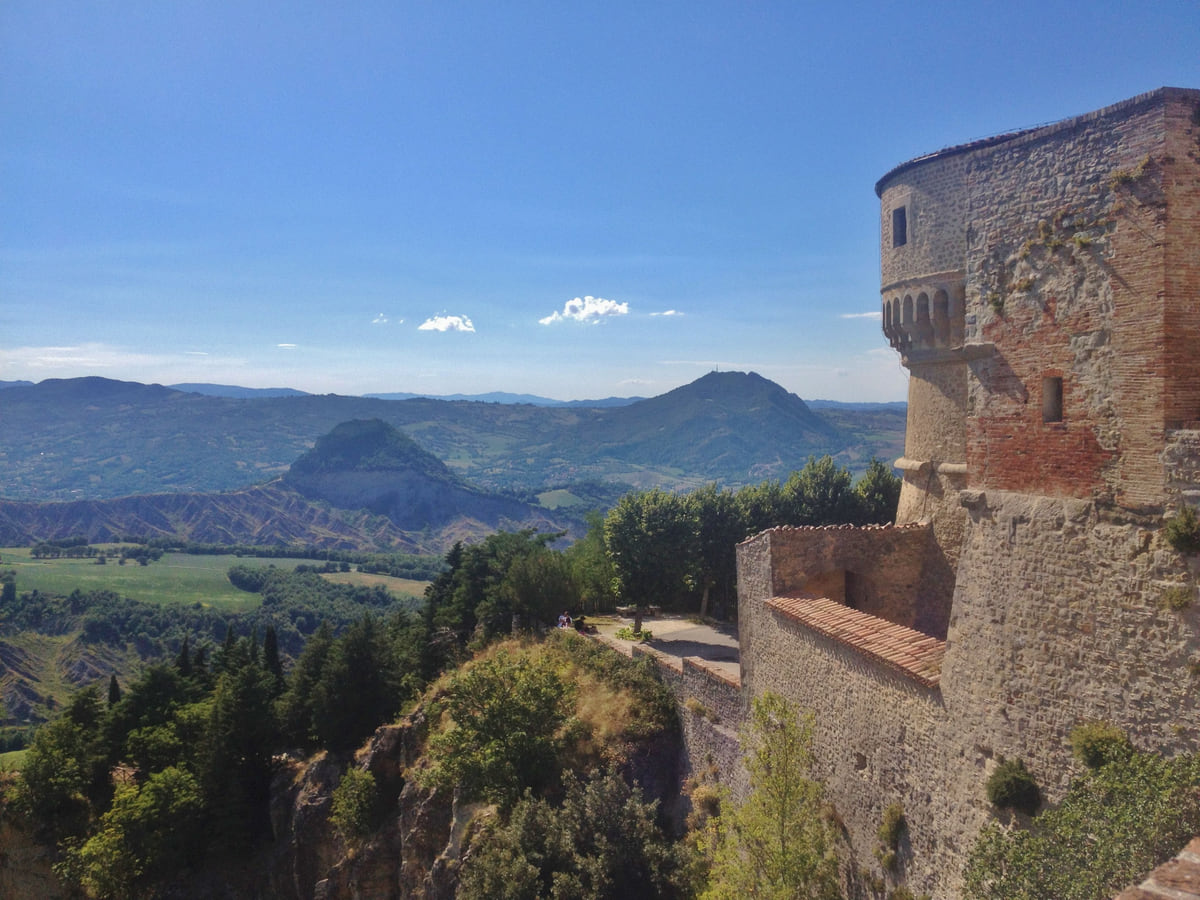
Fortress open until 19:45 at weekends
San Leo, the rock that named the Montefeltro and imprisoned Cagliostro

- Country
- Italy (EU), province of Rimini
- From San Marino
- 22 km
San Leo is a hill town on a sheer-sided crag 22 km from San Marino, crowned by Francesco di Giorgio Martini's fortress. It was a papal prison from 1631, and Cagliostro died there in 1795. Entry is €11, €2 for ages 18 to 25 and free up to 17, and the 2026-2027 winter timetable hasn't been published yet.
From San Marino I'd drive over on a Saturday or Sunday morning, while the village is quiet, and carry on to Verucchio on the weekend combined ticket. In winter, with no published hours, I'd ring the village tourist office first so I didn't find the fortress shut.
San Leo, in short
Full read: 4 min
- San Leo is in Italy, 22 km from San Marino, on a crag with a single way in.
- Its fortress was rebuilt by Francesco di Giorgio Martini for Federico da Montefeltro in the 15th century.
- It was a papal prison from 1631; Cagliostro died there in 1795.
- Entry is €11, €2 for ages 18 to 25 and free up to 17.
- By bus it's weekdays only, with a change at Pietracuta.
My ranking, scored
What to see in San Leo, in order
My own scores out of 10. I weigh how impressive it is, what it tells you about the Montefeltro's history and the time it takes. The fortress rules; everything else is a few minutes' walk away.
0 of 5 seen
-
The Francesco di Giorgio Martini fortress
Built to withstand artillery, on the tip of the crag, with the Pozzetto cell where Cagliostro was held. The reason for the trip.
9.5 out of 10
-
San Leone Cathedral
Romanesque, reconsecrated in 1173 and raised on the rock as if on a pedestal. It keeps the lid of the saint's sarcophagus.
8.8 out of 10
-
Pieve of Santa Maria Assunta
The oldest religious building in the Montefeltro, wedged onto a bulge of rock like a stranded ship.
8.6 out of 10
-
Views over the Marecchia valley
From San Leo you see the Marecchia valley all the way to the sea. Free, and half the charm for me.
8.4 out of 10
-
Palazzo Mediceo and its Museum of Sacred Art
A Renaissance palace with the village's sacred art collection. Worth it if you have time after the fortress.
7.2 out of 10
What I would book
- Tours and ticketsGetYourGuide An organised trip to San Leo Without a car, the public bus runs on weekdays only with a change. An organised trip sorts out the climb for you.
- Places to stayBooking.com A San Marino base for driving there At 22 km, San Leo is the natural outing from Mount Titano. With a car and a night up top you'll be there for opening.
My key points
Before you go to San Leo, this
-
01 Most beautiful
A town with a single way in
The village sits on a sheer-sided crag reached by one road cut into the rock. Right at the top, on the tip of the spur, stands the Renaissance fortress.
-
02 To save money
Two fortresses for €14.50
At weekends and on public holidays, San Leo's fortress plus Verucchio's Rocca Malatestiana and Archaeological Museum costs €14.50. Add the Gradara rampart walk and it's €18.
Verucchio, cradle of the Malatesta -
03 Getting there
By bus, Monday to Friday only
From Rimini station, Start Romagna's line 160 goes to Pietracuta, where you change to the Valmabus for San Leo, weekdays only. By car, leave the A14 at Rimini Sud and take the SS72.
-
04 My tip
Under-26s pay €2
Fortress entry is €11 from age 26 but only €2 from 18 to 25, and free up to 17. Few fortresses treat students this well.
San Leo is the day trip from San Marino I’d never skip, and not only for the photo. It’s a whole village perched on a sheer-sided crag, with a single road in cut into the rock and a fortress on its tip that was both a Renaissance military masterpiece and a papal prison. It also has a link with San Marino that hardly anyone mentions.
Getting to San Leo from San Marino, plus opening times
Until 31 October 2026 the fortress opened 10:00 to 18:45 on weekdays and 10:00 to 19:45 at weekends and on holidays, with last entry 45 minutes before closing. Tickets are €11 from age 26, €2 from 18 to 25 and free up to 17. On a Saturday, Sunday or holiday you can pay €14.50 and add the stronghold and museum in Verucchio, which is what I’d go for.
By car, leave the A14 at Rimini Sud and follow the SS72, the same road as for San Marino. By public transport you go from Rimini on line 160 to Pietracuta and change to the Valmabus, which only runs on weekdays. In summer the San Leo Experience excursion bus ran from the Riviera on Thursdays, but its 2026 season ended on 10 September.
San Leo is 22 km from San Marino and about 30 from Rimini. How to combine it with the rest is in day trips from San Marino.
A fortress that was a capital and a jail
The Romans already fortified the summit, and in the Middle Ages the rock was fought over by Byzantines, Goths, Franks and Lombards. Between 961 and 963 King Berengar II held out here against Otto I’s siege, and the fortress briefly served as the capital of Italy. In 1441 the young Federico da Montefeltro took it with a daring climb, and since the old castle couldn’t cope with artillery he had the Sienese engineer Francesco di Giorgio Martini rebuild it. The result, according to Pietro Bembo, was a «mighty bulwark and marvellous engine of war».
Then came Cesare Borgia, who seized it in 1502, the Florentines and the Della Rovere, until in 1631 it passed to the Papal States. From then on it was a prison.
If you are staying the night, see the best hotel deals in San Marino for your dates: the well-placed rooms go fast.
Cagliostro, its most famous prisoner
Giuseppe Balsamo, known as Count Cagliostro, was born in Palermo in 1743 and became an alchemist, healer and freemason famous at courts across Europe. The Inquisition arrested him on 27 December 1789 and locked him in Rome’s Castel Sant’Angelo, which I cover in Castel Sant’Angelo. On 7 April 1790 he was sentenced to death for heresy. Pope Pius VI commuted it to life imprisonment in San Leo.
He was first held in the Treasure cell, the safest and dampest in the fortress, and then in the Pozzetto, where he died in 1795. Stepping into that cell is, for me, the most powerful moment of the visit. A papal physician of the time wrote that those dungeons were not prisons but graves, and once you see them you understand why.
What to see in the village
Down in the village are two Romanesque churches I wouldn’t miss. San Leone Cathedral rises on a bulge of rock as if on a pedestal, was reconsecrated in 1173 and keeps fragments of an earlier church, such as the winged lions now propping up a column. The pieve of Santa Maria Assunta is the oldest religious building in the Montefeltro, and the municipal website likens it to a stone ship run aground on the rock. Both open daily 09:30 to 12:30 and 14:30 to 19:00.
The civic tower beside the cathedral is usually closed and only opens for festivals and events. Palazzo Mediceo houses the Museum of Sacred Art. And from any edge of the village you look down the Marecchia valley to the sea. Dante came here and mentions it in the Divine Comedy, as did Saint Francis, who according to the region received the gift of Mount La Verna in San Leo.
Before you fix your dates, compare train and coach tickets to Rome: the same journey can cost very different amounts from one day to the next.
Leo and Marinus, two stonemasons from Dalmatia
According to the tradition on the municipality’s tourism website, in the late 3rd century two Christian stonemasons arrived from Dalmatia fleeing Diocletian’s persecution. One, Marinus, settled on Mount Titano and founded the community that would become San Marino. The other, Leo, withdrew as a hermit to this rock, then called Mons Feretrius after a Roman temple to Jupiter Feretrius. That name gave us Montefeltro, the historic region, and the saint gave the village its modern name.
To me that shared story is the best reason to do both in the same trip. While San Marino turned its mountain into a republic, San Leo became the fortress everyone wanted.
If you would rather go at your own pace, see the car hire deals in Rome: the earlier you book, the more cars are left to choose from.
If you are staying the night, see the best hotel deals in San Marino for your dates: the well-placed rooms go fast.
San Leo fortress hours, 14 September to 31 October 2026
| Day | Hours | Last entry |
|---|---|---|
| Monday to Friday | 10:00-18:45 | 18:00 |
| Saturdays, Sundays and holidays | 10:00-19:45 | 19:00 |
San Leo 2000 Servizi Turistici. Hours may change; the 2026-2027 winter timetable hasn't been published yet.
Fortress tickets
| Ticket | Price |
|---|---|
| Age 26 and over | €11 |
| Age 18 to 25 | €2 |
| Up to 17 | Free |
| Combined with Verucchio (weekends and holidays) | €14.50 |
| Combined with Verucchio and Gradara | €18 |
IAT tourist office at Piazza Dante Alighieri, 14, tel. +39 0541 926967; Monday to Friday 10:30-12:00, weekends 10:00-12:30.
Test yourself
True or false?
0/3 Pick before you peek.
-
San Leo belongs to the Republic of San Marino.
See the answer
False. It's in Italy, in the province of Rimini, 22 km away. It's the historic centre of the Montefeltro and gave the region its name.
-
Cagliostro died a prisoner in San Leo fortress.
See the answer
True. Sentenced by the Inquisition in 1790 and with the penalty commuted to life, he died in San Leo in 1795.
-
San Leo's fortress was once, briefly, the capital of Italy.
See the answer
True. Between 961 and 963, with Berengar II besieged there by Otto I, the fortress played that role, according to the municipal tourism website.
- From San Marino
- 22 km
- The Romanesque cathedral is reconsecrated
- 1173
- Cagliostro dies a prisoner in the fortress
- 1795
- Adult entry to the fortress
- €11
Frequently asked questions
How do I get to San Leo from San Marino?
By car it's 22 km. I haven't found a direct bus from San Marino; from Rimini, Start Romagna line 160 goes to Pietracuta, where you change to the Valmabus, which only runs on weekdays.
How much does San Leo fortress cost?
€11 from age 26, €2 from 18 to 25 and free up to 17. At weekends and on public holidays there's a combined ticket with Verucchio's Rocca and Archaeological Museum for €14.50.
What are San Leo fortress opening hours?
Until 31 October 2026 it opened Monday to Friday 10:00 to 18:45 and weekends and holidays 10:00 to 19:45. Winter hours aren't published, and the fortress refers you to its tourist office.
Who was Cagliostro and why did he die in San Leo?
Giuseppe Balsamo, known as Count Cagliostro, was an alchemist and freemason born in Palermo in 1743. The Inquisition sentenced him to death in 1790, the pope commuted it to life imprisonment and locked him up in San Leo, where he died in 1795.
Is San Leo in San Marino?
No, it's in Italy, in the province of Rimini. But their stories are linked, because tradition says Saint Leo came from Dalmatia in the late 3rd century together with Marinus, founder of the community on Mount Titano.
How long do you need in San Leo?
I'd allow half a day for the fortress, the cathedral, the pieve and a stroll round the village. Paired with Verucchio, a full day.
0 of 8 Italy guides
Your next stamp

Questions about San Leo? Write to me
I read every email. If a fact is wrong or missing, tell me and I will check it.
My email sergiolepone@gmail.com
By
Tourism graduate with a master’s in Tourism Management and Planning from the University of Málaga, who has travelled across Europe. He writes every guide from official sources and his own judgement.
Published on . Updated on . Facts checked on .
Sources
Some links in this guide are affiliate links: if you book through them, the site earns a commission at no extra cost to you. Affiliate disclosure
Photos: Effepi93 (CC BY-SA 4.0), via Wikimedia Commons.