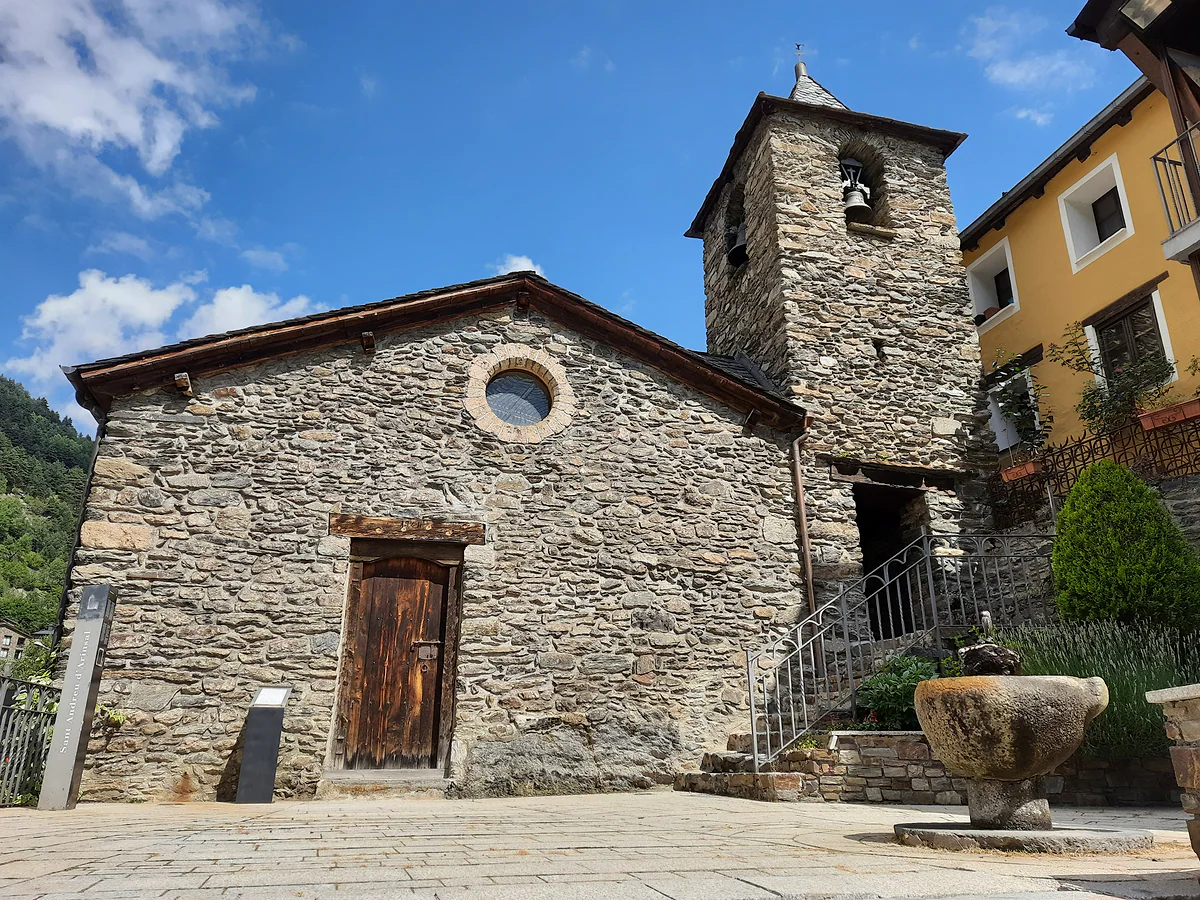
400 m north of Arinsal, La Massana
Sant Andreu del Prat del Campanar, the church the avalanches took
Sant Andreu del Prat del Campanar is a small roadside church about 400 metres north of Arinsal. It's a rebuild, on the same spot, of the Romanesque church that avalanches destroyed twice, in the 13th and 17th centuries. Digs from 1969 to 1973 turned up Romanesque wall painting, medieval pottery, 12th-century coins and a reliquary.
It's a five-minute stop, but with plenty of history behind it. I'd look at it leaving Arinsal down the valley, especially if you want to understand why this parish built with such fear of the snow.

Before you go
What I would keep in mind
-
01 Most beautiful
Twice flattened by snow
The original Romanesque church was destroyed by avalanches in the 13th century and again in the 17th. What you see is its rebuild on the same site.
Romanesque churches in Andorra -
02 My tip
A family vault
The 1983 annexe on the south wall holds the vault of the Rossell family of Andorra la Vella, who own the church.
-
03 Getting there
On the way out of Arinsal
It's by the road, about 400 m north of the village, on the way to the Pal Arinsal ski area.
Arinsal
On the road heading north out of Arinsal there’s a small church that sums up this parish’s relationship with snow better than most. Sant Andreu del Prat del Campanar stands about 400 metres above the village, by the roadside, and what you see today is the rebuild of a Romanesque church that avalanches destroyed not once but twice.
Why was it rebuilt?
The original Romanesque church was buried by avalanches in the 13th century and again in the 17th. The current one went up on the same spot. It’s small and rectangular, with a semicircular apse to the east, the entrance to the west and a bellcote with a single opening. Against the south wall is a 1983 annexe holding the vault of the Rossell family of Andorra la Vella, who own the church.
What lay beneath the floor
The 1969 to 1973 excavations were very fruitful. They turned up fragments of Romanesque wall painting, a large amount of medieval pottery, a batch of 12th-century coins, a tufa reliquary and several burials. To me that proves there was life and worship here long before Arinsal filled up with skiers.
If you are short on time, see the best tours in Sant Andreu del Prat del Campanar and pick one that fits your day.
Fitting it into your visit
It’s a short stop on the way to or from the Pal Arinsal ski area. Information and visits are handled by the La Massana tourist office. To carry on with the parish’s Romanesque, Sant Cristòfol d’Anyós is a few kilometres further down, while the other churches across Andorra are in the Romanesque churches of Andorra.
Getting there
The L5 national bus climbs to Arinsal; on weekdays it runs every 20 minutes early on and every half hour later. From the village, the church is about 400 metres to the north beside the road, an easy short walk.
Where the bus does not go, a car does: compare car hire in Andorra la Vella before you arrive rather than at the desk.
What’s nearby
The village has a second church to the same saint, Sant Andreu d’Arinsal, from the 17th century, which rests directly on the bedrock and was restored by Cèsar Martinell in the 1960s; inside hangs an 18th-century Our Lady of the Snows. The Comapedrosa Nature Park begins just beyond the village, with the country’s highest summit at its head.
Is it worth stopping?
For anyone sleeping in Arinsal or heading up to walk in the Comapedrosa, it’s a five-minute stop that gives the whole valley context. If you’re after Romanesque paintings on show, or an interior to visit, Pal or Anyós are better. I like it as a history lesson, because two avalanches in four centuries explain why the mountain has always called the shots here. And if you’re driving up to the ski area, simply pull over for a moment to look at it. In winter, with snow all around, it’s easy to picture the avalanches that twice destroyed it. Ask the La Massana tourist office if you’d like to know more about the excavations and what they found there.
If you still need a way in, check the best ticket deals to Andorra la Vella from where you are.
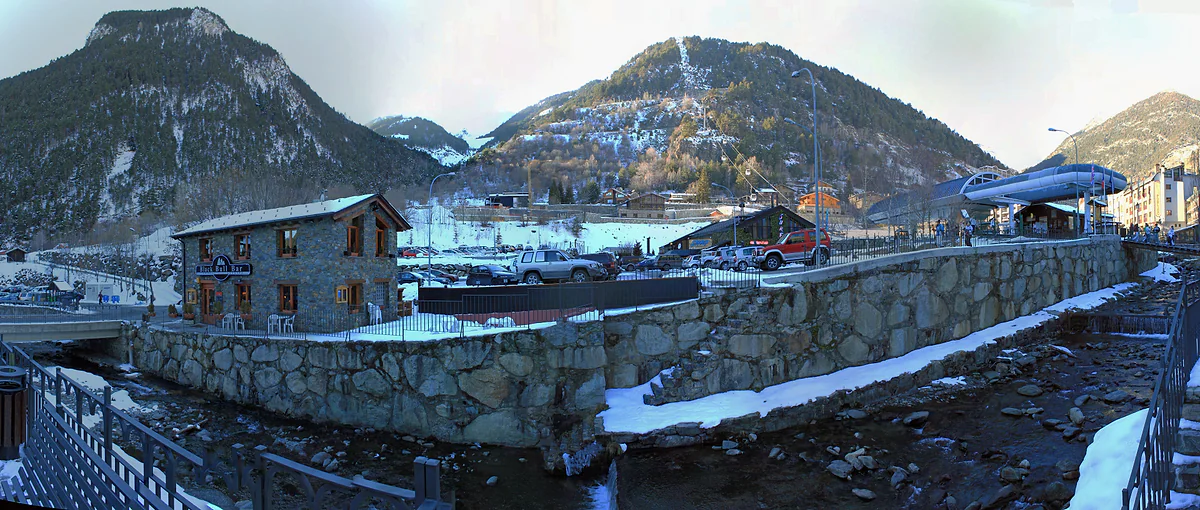
Arinsal in winter, with stone houses beside the river and ski slopes on the mountains above
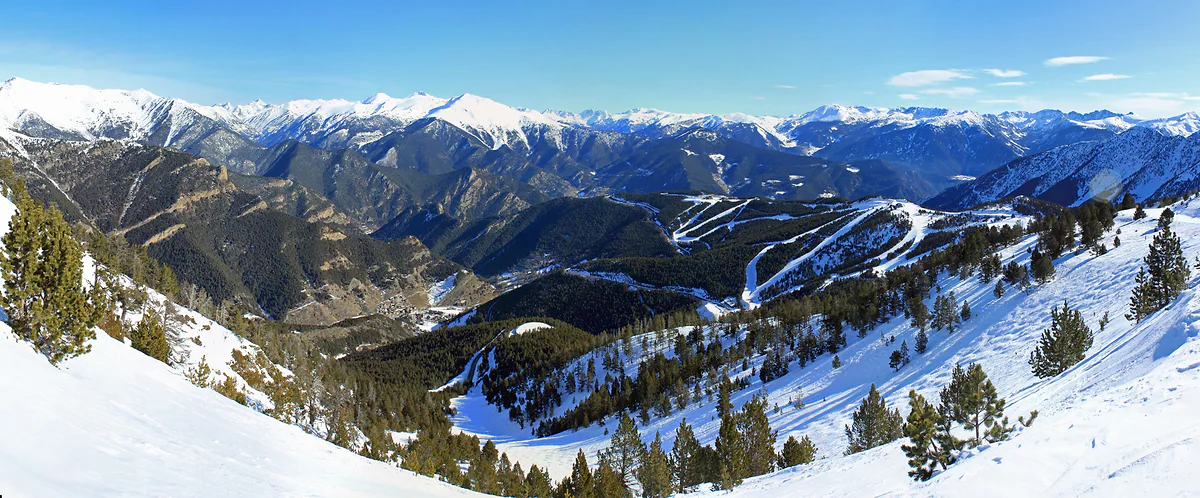
Panorama of the Pal ski runs threading through forest, with the snowy Pyrenees on the horizon
What the excavations found
| Find | Detail |
|---|---|
| Wall painting | Romanesque fragments |
| Pottery | A large number of medieval sherds |
| Coins | A batch dated to the 12th century |
| Reliquary | In tufa stone |
| Burials | Several |
Excavations from 1969 to 1973, per the Andorra Turisme page checked on 04-10-2026.
Test yourself
True or false?
0/3 Pick before you peek.
-
Today's church is the untouched Romanesque original.
See the answer
False. It's a rebuild; avalanches destroyed the original in the 13th and 17th centuries.
-
The excavations found 12th-century coins.
See the answer
True. Along with wall painting, medieval pottery and a reliquary.
-
The church belongs to the La Massana council.
See the answer
False. It belongs to the Rossell family of Andorra la Vella.
Map
Where Sant Andreu del Prat del Campanar is
The dashed line is the border with France and Spain. The Valira valley runs down from Pas de la Casa to Sant Julià, with Ordino and La Massana in the northern valley. Every number opens its guide.
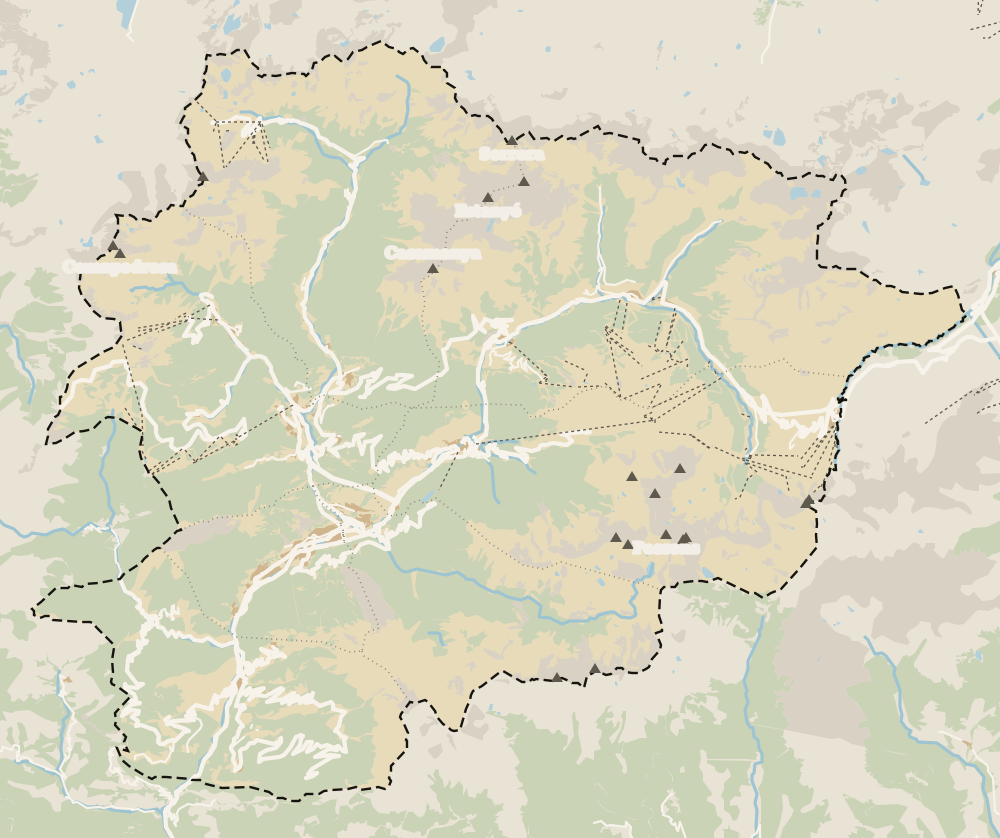
0 of 290 Andorra guides
Your next stamp
- Sant Romà dels Vilars
- Pal Arinsal
- Sant Vicenç d'Enclar
- Sant Joan de Caselles
- Aixirivall
- Sant Esteve church
- Hotels in Arinsal and Pal
- Prats
- Places to visit
- Things to do
- Most beautiful places
- Prettiest villages
- Andorra la Vella
- UNESCO World Heritage
- Map
- Escaldes-Engordany
- Where is Andorra?
- Is Andorra a country?
- Parishes
- Casa de la Vall
- Margineda bridge
- Old town
- Santa Coloma church
- Towns and villages
- Population
- Size
- Mountains
- Language
- Andorra in one day
- Canillo
- Espai Columba
- History
- Margineda rock shelter
- Co-princes
- Soldeu
- Weekend break
- Andorra in 3 days
- El Tarter
- Political system
- Andorra in 4 days
- Flag
- Ransol
- A week in Andorra
- Facts
- El Forn
- Public holidays
- Sant Julià de Lòria
- Currency and payments
- L'Aldosa de Canillo
- Els Plans
- EU and Schengen
- Bordes d'Envalira
- Entry requirements
- Prices and budget
- On a budget
- Santa Coloma
- Ski holidays
- Tourist tax
- Mobile and roaming
- Sant Serni de Canillo
- Tourist information
- Healthcare
- Meritxell Sanctuary
- With a dog
- Packing list
- Safety
- How to get there
- Scams
- From Barcelona
- Bus from Barcelona
- Day trip from Barcelona
- From Madrid
- From Toulouse
- Encamp
- Flights
- La Margineda
- La Massana
- Roc del Quer viewpoint
- Romanesque churches
- Andorra-La Seu airport
- Caldea deals
- Canillo Tibetan bridge
- Museums in Andorra
- Pal
- Pas de la Casa
- Arinsal
- Caldea restaurants
- Driving
- Grau Roig
- Mon(t) Magic
- Nearest airports
- By train
- Erts
- Les Bons
- Palau de Gel
- Road conditions
- Motorcycle Museum
- Parking
- Sispony
- Vila
- Anyós
- Incles valley
- La Mosquera
- Petrol
- El Tremat
- Getting around
- Juclar lakes
- L'Aldosa (La Massana)
- Buses
- Els Cortals d'Encamp
- Sant Climent de Pal
- Bus station
- Sant Cristòfol d'Anyós
- Casa Rull
- Shopping
- Farga Rossell
- Santa Eulàlia d'Encamp
- What to buy
- Customs allowances
- La Massana Còmic
- Sant Romà de les Bons
- Car Museum
- Cigarettes
- Comapedrosa
- Electronics
- Alcohol
- Casa Cristo
- Clothes and sports shops
- Iron Route
- Coll d'Ordino
- Perfume
- Sacred Art Museum
- Shopping centres
- Funicamp
- Supermarkets
- Avinguda Meritxell
- Encamp Tibetan bridge
- Avinguda Carlemany (Vivand)
- Envalira pass
- Auvinyà
- Bici Lab Andorra
- Ordino
- Skiing
- With kids
- Zip lines
- Fontaneda
- For couples
- Hotel Grau Roig
- La Cortinada
- Ski pass
- Via ferratas
- Climbing
- Hotel Piolets Soldeu Centre
- Llorts
- Nagol
- Nightlife
- Ski season
- El Serrat
- Grandvalira
- Horse riding
- Hotel Himàlaia Soldeu
- Juberri
- Aixovall
- Mountain biking
- Sornàs
- Sport Hotel Hermitage & Spa
- Ansalonga
- Hotel Soldeu Maistre
- Ordino Arcalís
- Road cycling
- Bixessarri
- Hotel Les Closes
- Naturland
- Segudet
- Arans
- Hotel Espel
- Llumeneres
- Tobotronc
- Abba Ordino Babot Hotel
- Casa d'Areny-Plandolit
- Cross-country skiing
- Miniature Museum
- Skiing with kids
- Tarter Mountain Suites
- Cal Pal
- Free walking tour
- Pessons lakes
- Sant Corneli i Sant Cebrià
- Sant Serni de Nagol
- Ski lessons
- Where to stay
- Canòlich Sanctuary
- Hotels in Andorra la Vella
- Sant Iscle i Santa Victòria
- Sant Martí de la Cortinada
- Ski hire
- Hotels in Escaldes
- Juberri Gardens
- Llorts iron mine
- Sant Julià i Sant Germà
- Webcams
- Hotels in Soldeu
- Sant Antoni de la Grella
- Snow report
- Sorteny valley
- Hotels in El Tarter
- Tristaina lakes
- Escaldes-Engordany Art Centre
- Hotels in Canillo
- Night skiing
- Tristaina solar viewpoint
- Espai Caldes
- Freeride
- Hotels in Encamp
- Espai Galobardes
- Hotels in Pas de la Casa
- Ski touring
- Casa de la Muntanya
- Hotels in La Massana
- Snowshoeing
- Government Exhibition Hall
- Snow activities
- Après-ski
- Engordany
- Hotels in Ordino
- Medieval bridges
- Nature parks
- Els Vilars
- Hotels in Sant Julià de Lòria
- Lakes
- Viewpoints
- Where to eat
- Caldea
- Restaurants in Andorra la Vella
- Borda restaurants
- Inúu
- Cheap hotels
- Food
- Hiking
- Spas and thermal baths
- Weather and climate
- Engolasters lake
- Pas de la Casa weather
- Spa hotels
- Trinxat
- Events
- Luxury hotels
- Sant Miquel d'Engolasters
- Ski resort weather
- Wine
- Best time to visit
- Family hotels
- Madriu valley
- All inclusive
- Estany de l'Illa
- In winter
- Apartments
- Coronallacs
- In spring
- Ski World Cup
- Christmas
- Hostels
- In summer
- Mountain huts
- Camping and rural stays
- Easy walks
- In autumn
- New Year
- Family walks
- Festes majors
- In January
- GR11 and other GRs
- In February
- National day
- Around Andorra
- GRP round Andorra
- In March
- Midsummer fire festival
- Carnival
- In April
- In May
- Travessa d'Encamp
- In June
- In July
- In August
- In September
- In October
- In November
- In December
Frequently asked questions
Where is Sant Andreu del Prat del Campanar?
About 400 metres north of Arinsal village, by the road, in the parish of La Massana.
Is it Romanesque?
It's a rebuild, on the same site, of the original Romanesque church, which avalanches destroyed in the 13th century and again in the 17th.
What does it look like?
Small and rectangular, with a semicircular apse to the east, the entrance to the west and a single-opening bellcote.
What did the excavations find?
Between 1969 and 1973 they found fragments of Romanesque wall painting, plenty of medieval pottery, 12th-century coins, a tufa reliquary and several burials.
Who owns it?
The Rossell family of Andorra la Vella, whose vault is in the 1983 annexe against the south wall.
By
Tourism graduate with a master’s in Tourism Management and Planning from the University of Málaga, who has travelled across Europe. He writes every guide from official sources and his own judgement.
Published on . Facts checked on .
Sources
Some links in this guide are affiliate links: if you book through them, the site earns a commission at no extra cost to you. Affiliate disclosure
Photos: Josep Maria Viñolas Esteva (CC BY-SA 4.0); Michael Karavanov (CC BY-SA 3.0); Michael Karavanov (CC BY-SA 3.0), via Wikimedia Commons.