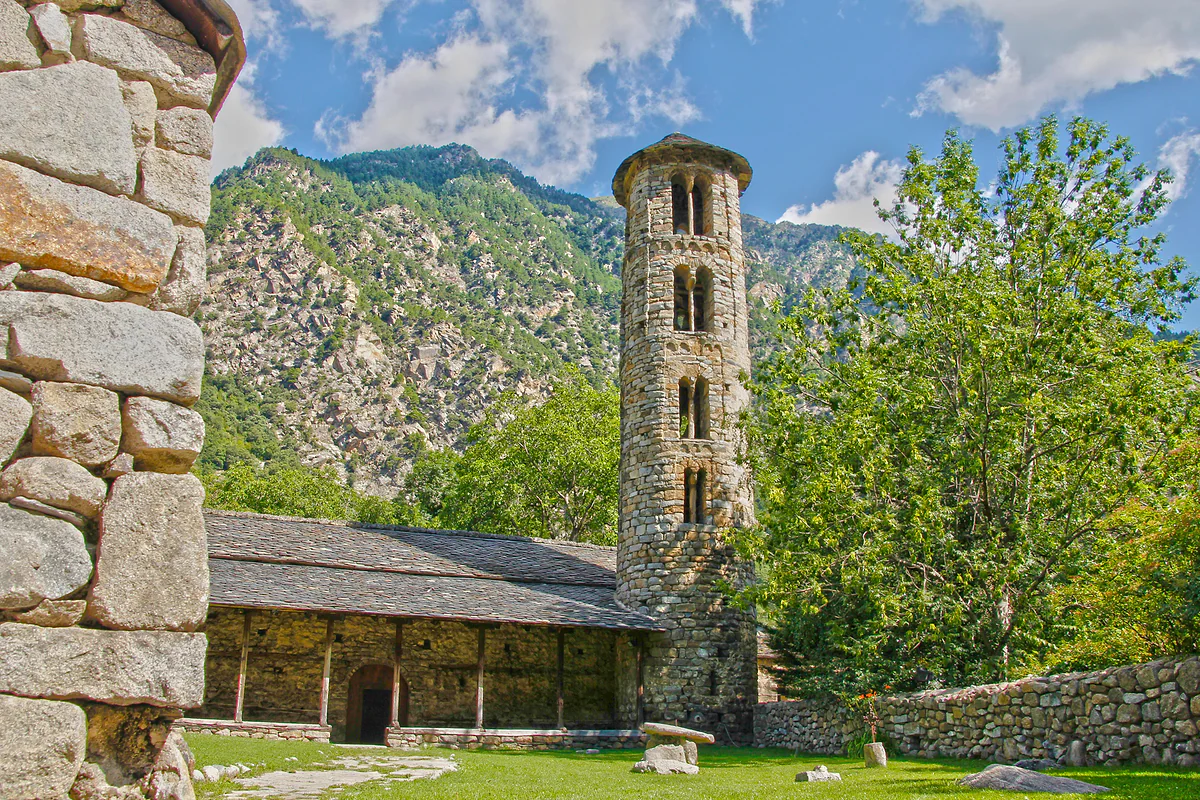
Pre-Romanesque, in Andorra la Vella parish
Santa Coloma church and its round bell tower
Santa Coloma church, in Andorra la Vella parish, is pre-Romanesque in origin and has the only circular Lombard bell tower in the Principality, added in the 12th century. You can only visit it with Espai Columba, on a €7 ticket according to museus.ad on 28 September 2026, and inside a six-minute projection puts its Romanesque murals back on the walls.
In 30 seconds
Full read: 3 min
- Santa Coloma church is pre-Romanesque in origin and has the Principality's only round bell tower, from the 12th century.
- It's only visited with Espai Columba; the joint ticket was €7 on museus.ad on 28 September 2026.
- From October to May it opens Tuesday to Saturday, 10:00 to 14:00 and 15:00 to 18:00.
- A six-minute projection recreates the murals sold in 1933 and recovered in 2007.
See the church first and Espai Columba second. You'll walk into the museum with the projection fresh in your mind and recognise each figure in the original, which is when it really hits home.

Before you go
What I would keep in mind
-
01 Most beautiful
A four-storey round bell tower
Lombard, circular in plan, four storeys and about 18 metres tall, added in the 12th century. The tourist board calls it unique in the Principality and one of very few in the Pyrenees.
-
02 Worth the splurge
Six minutes with the murals back in place
Six projectors recreate on the nave and apse the paintings sold off in 1933, with light and sound, for groups of up to ten. It's included in the €7 ticket.
-
03 My tip
You can't see it on its own
The church is only visited with Espai Columba, a few metres away. According to the tourist board it's the one church in Andorra that isn't free, precisely because it's tied to the museum.
Espai Columba -
04 Money
It's in your change
Santa Coloma is one of the four designs on Andorra's own euro coins, used on the 50, 20 and 10 cent pieces, according to the tourist board. Check your coppers.
Andorra's currency
What I would book
Of all Andorra’s churches, this is the one you’d recognise from a photo without ever having been. It’s the bell tower. Round, four storeys high, standing beside a small nave in the village of Santa Coloma, just down the valley from the capital. What you can’t tell from outside is that almost everything that made it famous has gone from the inside, and that there’s now a clever way of giving it back for six minutes.
An ancient nave and a 12th-century tower
The tourist board counts it among the oldest churches in Andorra. It’s pre-Romanesque in origin, with a rectangular nave and a square apse. The official sources don’t agree on an exact date for that first building, and all that’s firm is that it’s older than the Romanesque.
Its present look comes from 12th-century alterations. That’s when the circular Lombard bell tower went up, four storeys and about 18 metres high according to the Andorra la Vella tourist office, and when the east end was painted. The tourist board calls the tower unique in the Principality and one of very few in the Pyrenees. For me it’s the kind of detail that justifies the detour. The tourist board counts more than thirty Romanesque churches in the country, and in silhouette this one looks like none of them.
What happened to the murals?
In the 12th century the east end was covered in frescoes long credited to the Master of Santa Coloma. The tourist board adds a nuance, that they weren’t the work of one hand but of travelling workshops trained in the same way, which is common across Romanesque murals in Andorra and the Pyrenees. Hence the experts talk of a school rather than a single painter.
The bulk went to buyers in 1933. The government recovered the cycle in 2007, but changes to the paintings and to the apse itself made it impossible to put them back. They now hang in Espai Columba, a few metres away. Only a small part of the original frescoes remains in the church. The capital’s tourist office mentions an Agnus Dei and fragments of decorative borders that had been hidden behind a Baroque altarpiece and came to light during a restoration in 1934.
The six-minute projection
Here’s the clever bit. Six projectors recreate the paintings on the walls of the nave and inside the apse, with light and sound, in a show lasting six minutes. It runs for small groups of up to ten so the effect isn’t lost.
To me it’s about the best possible answer to a problem with no real solution. It’s a copy made of light, and says so. Yet it lets you see the church as someone walking in during the 12th century would have, and when you then cross to Espai Columba every figure feels familiar. That’s why I’d go in that order, church first, museum second. Keep an eye on the group size too. With ten places per showing, a coach party arriving just before you can mean a short wait, so I’d aim for the first slot after opening at 10:00 or the one straight after lunch.
Opening hours, tickets and guided visits
The church can only be visited together with Espai Columba. The tourist board points out that every church visit in Andorra is free except this one, precisely because it’s tied to the museum. You pay €7 for church and museum together, €3.50 reduced, with under-10s free (official prices, 28-9-2026); a guide is €1.50 on top and has to be reserved, so ask about English when you do.
Winter hours, through May, are Tuesday to Saturday with a lunchtime closure. Summer adds Sunday mornings and longer afternoons; see the table. As a working church, services can shift visits and projections. In July and August it’s also part of Romànic de bat a bat, the summer guided visits to six Andorran churches.
Around the church
It sits in the old core of Santa Coloma, with the Torre dels Russos a few minutes away and, up on the Roc d’Enclar, Sant Vicenç d’Enclar, reachable only on foot. With both visits and the walk, your afternoon is full. For more Romanesque, see my route round the Romanesque churches of Andorra.
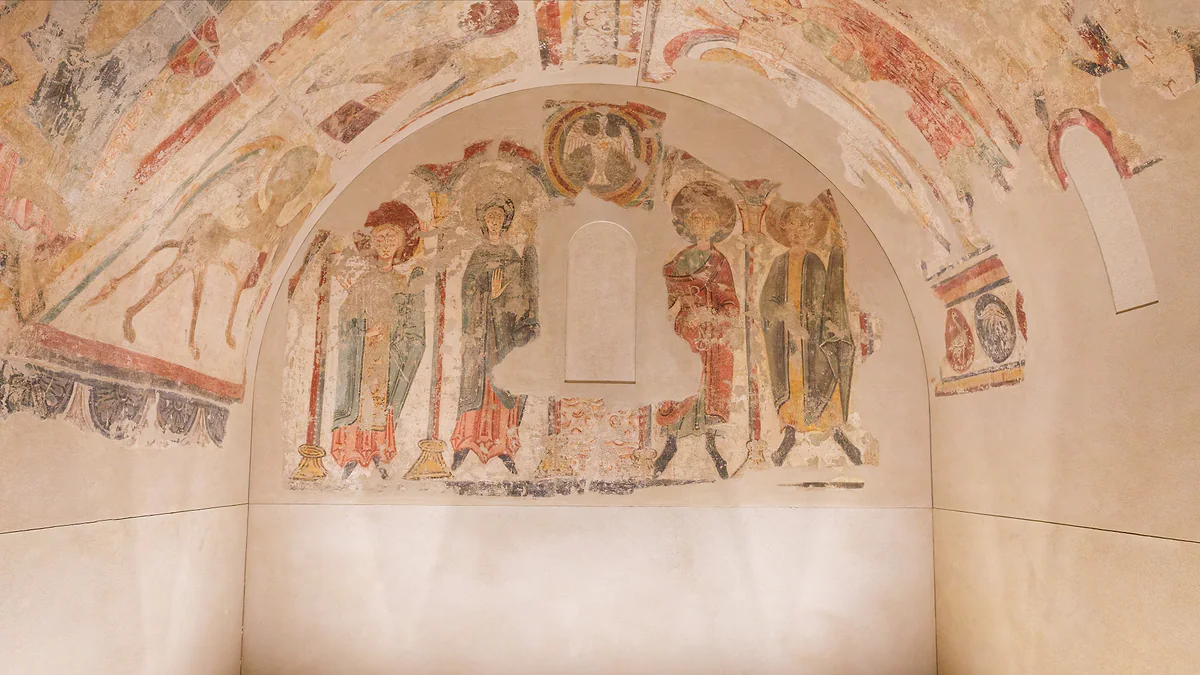
Romanesque apse murals from the church of Santa Coloma, now displayed at Espai Columba
Opening hours, church and Espai Columba
| Months | Tuesday to Friday | Saturday | Sunday | Monday |
|---|---|---|---|---|
| January to May, October to December | 10:00-14:00 and 15:00-18:00 | 10:00-14:00 and 15:00-18:00 | Closed | Closed |
| June and September | 10:00-14:00 and 15:00-18:00 | 10:00-14:00 and 15:00-20:00 | 10:00-14:00 | Closed |
| July and August | 10:00-14:00 and 15:00-19:00 | 10:00-14:00 and 15:00-20:00 | 10:00-14:00 | Closed |
museus.ad, checked on 28-9-2026. Visits and projections may change for services.
Joint ticket with Espai Columba (28-9-2026)
| Ticket | Price |
|---|---|
| Standard | €7 |
| Concession (over-65s, groups of more than 10, overseas students) | €3.50 |
| Under-10s and youth card holders | Free |
| Guided tour supplement, booked ahead | €1.50 |
museus.ad. Part of the PassMuseu. Bookings on +376 839 760.
Test yourself
True or false?
0/4 Pick before you peek.
-
Santa Coloma's round bell tower is the only one of its kind in Andorra.
See the answer
True. The tourist board describes it as unique in the Principality and one of very few in the Pyrenees.
-
The Santa Coloma murals were restored and put back on the walls in 2007.
See the answer
False. The government bought them back in 2007, but changes to the paintings and the apse made it impossible to return them. They're on show at Espai Columba.
-
Santa Coloma church appears on some Andorran euro coins.
See the answer
True. It's the design on the 50, 20 and 10 cent coins, according to the official tourist board.
-
All the Master of Santa Coloma paintings are by one artist.
See the answer
False. The tourist board explains that they weren't painted by a single hand but by travelling workshops trained in the same way.
- Height of the round bell tower
- 18 m
- Year the murals were sold
- 1933
- Year the government bought them back
- 2007
- Length of the projection
- 6 min
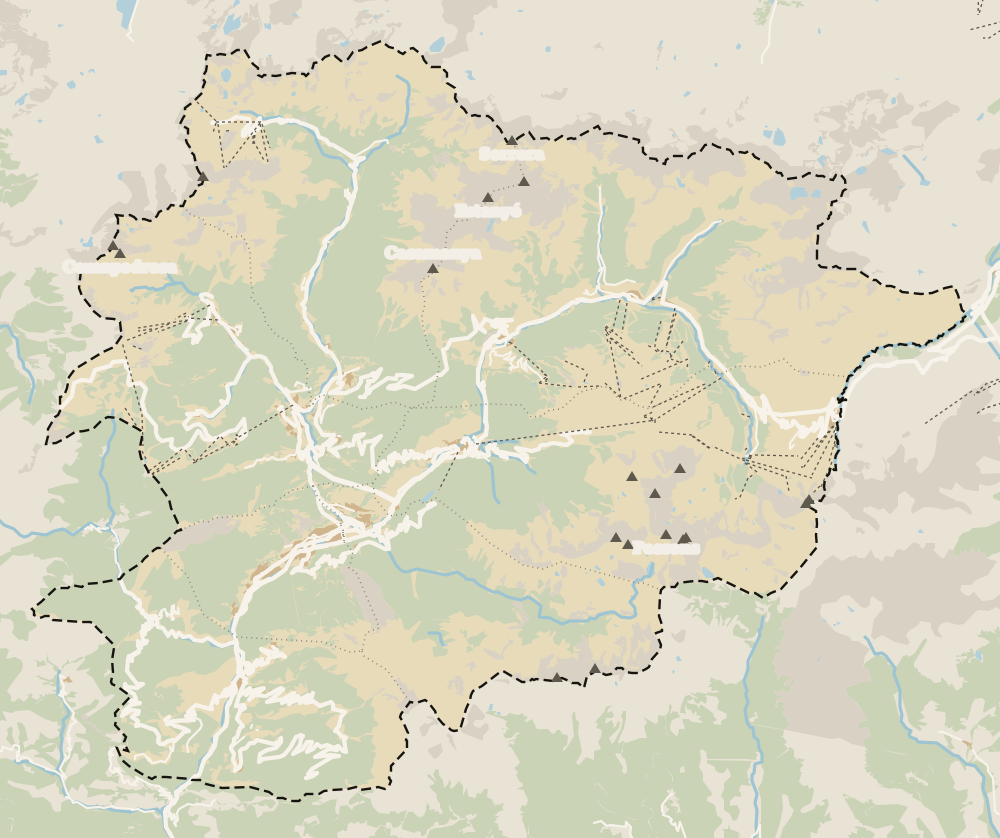
Map
Where Santa Coloma church is
The dashed line is the border with France and Spain. The Valira valley runs down from Pas de la Casa to Sant Julià, with Ordino and La Massana in the northern valley. Every number opens its guide.
0 of 269 Andorra guides
Your next stamp
- Santa Coloma
- Espai Columba
- Sant Climent de Pal
- Andorra la Vella
- Sant Vicenç d'Enclar
- Sant Miquel d'Engolasters
- Santa Eulàlia d'Encamp
- Casa de la Vall
- Places to visit
- Things to do
- Most beautiful places
- Prettiest villages
- UNESCO World Heritage
- Map
- Escaldes-Engordany
- Where is Andorra?
- Is Andorra a country?
- Parishes
- Margineda bridge
- Old town
- Towns and villages
- Population
- Size
- Mountains
- Language
- Andorra in one day
- Canillo
- History
- Margineda rock shelter
- Sant Esteve church
- Co-princes
- Soldeu
- Weekend break
- Andorra in 3 days
- El Tarter
- Political system
- Andorra in 4 days
- Flag
- Ransol
- A week in Andorra
- Facts
- Prats
- El Forn
- Public holidays
- Sant Julià de Lòria
- Currency and payments
- L'Aldosa de Canillo
- Els Plans
- EU and Schengen
- Bordes d'Envalira
- Entry requirements
- Prices and budget
- On a budget
- Sant Joan de Caselles
- Ski holidays
- Tourist tax
- Mobile and roaming
- Sant Serni de Canillo
- Tourist information
- Healthcare
- Meritxell Sanctuary
- With a dog
- Packing list
- Safety
- How to get there
- Scams
- From Barcelona
- Bus from Barcelona
- Day trip from Barcelona
- From Madrid
- From Toulouse
- Encamp
- Flights
- La Margineda
- La Massana
- Roc del Quer viewpoint
- Romanesque churches
- Andorra-La Seu airport
- Canillo Tibetan bridge
- Museums in Andorra
- Pal
- Pas de la Casa
- Arinsal
- Driving
- Grau Roig
- Mon(t) Magic
- Nearest airports
- By train
- Erts
- Les Bons
- Palau de Gel
- Road conditions
- Motorcycle Museum
- Parking
- Sispony
- Vila
- Anyós
- Incles valley
- La Mosquera
- Petrol
- El Tremat
- Getting around
- Juclar lakes
- L'Aldosa (La Massana)
- Buses
- Els Cortals d'Encamp
- Bus station
- Sant Cristòfol d'Anyós
- Casa Rull
- Shopping
- Farga Rossell
- What to buy
- Customs allowances
- La Massana Còmic
- Sant Romà de les Bons
- Car Museum
- Cigarettes
- Comapedrosa
- Electronics
- Alcohol
- Casa Cristo
- Clothes and sports shops
- Iron Route
- Coll d'Ordino
- Perfume
- Sacred Art Museum
- Shopping centres
- Funicamp
- Supermarkets
- Avinguda Meritxell
- Encamp Tibetan bridge
- Avinguda Carlemany (Vivand)
- Envalira pass
- Auvinyà
- Bici Lab Andorra
- Ordino
- Skiing
- With kids
- Zip lines
- Fontaneda
- For couples
- La Cortinada
- Ski pass
- Via ferratas
- Climbing
- Llorts
- Nagol
- Nightlife
- Ski season
- El Serrat
- Grandvalira
- Horse riding
- Juberri
- Aixovall
- Mountain biking
- Pal Arinsal
- Sornàs
- Aixirivall
- Ansalonga
- Ordino Arcalís
- Road cycling
- Bixessarri
- Naturland
- Segudet
- Arans
- Llumeneres
- Tobotronc
- Casa d'Areny-Plandolit
- Cross-country skiing
- Miniature Museum
- Skiing with kids
- Cal Pal
- Free walking tour
- Pessons lakes
- Sant Serni de Nagol
- Ski lessons
- Where to stay
- Canòlich Sanctuary
- Hotels in Andorra la Vella
- Sant Martí de la Cortinada
- Ski hire
- Hotels in Escaldes
- Juberri Gardens
- Llorts iron mine
- Webcams
- Hotels in Soldeu
- Snow report
- Sorteny valley
- Hotels in El Tarter
- Tristaina lakes
- Hotels in Canillo
- Night skiing
- Tristaina solar viewpoint
- Freeride
- Hotels in Encamp
- Hotels in Pas de la Casa
- Ski touring
- Hotels in La Massana
- Snowshoeing
- Hotels in Arinsal and Pal
- Snow activities
- Après-ski
- Engordany
- Hotels in Ordino
- Medieval bridges
- Nature parks
- Els Vilars
- Hotels in Sant Julià de Lòria
- Lakes
- Sant Romà dels Vilars
- Viewpoints
- Where to eat
- Caldea
- Restaurants in Andorra la Vella
- Borda restaurants
- Inúu
- Cheap hotels
- Food
- Hiking
- Spas and thermal baths
- Weather and climate
- Engolasters lake
- Pas de la Casa weather
- Spa hotels
- Trinxat
- Events
- Luxury hotels
- Ski resort weather
- Wine
- Best time to visit
- Family hotels
- Madriu valley
- All inclusive
- Estany de l'Illa
- In winter
- Apartments
- Coronallacs
- In spring
- Ski World Cup
- Christmas
- Hostels
- In summer
- Mountain huts
- Camping and rural stays
- Easy walks
- In autumn
- New Year
- Family walks
- Festes majors
- In January
- GR11 and other GRs
- In February
- National day
- Around Andorra
- GRP round Andorra
- In March
- Midsummer fire festival
- Carnival
- In April
- In May
- Travessa d'Encamp
- In June
- In July
- In August
- In September
- In October
- In November
- In December
Frequently asked questions
How much does it cost to visit Santa Coloma church?
€7 standard and €3.50 concession, always together with Espai Columba, according to museus.ad on 28 September 2026. Under-10s go free and a guided tour is €1.50 extra.
When is Santa Coloma church open?
From October to May, Tuesday to Saturday, 10:00 to 14:00 and 15:00 to 18:00. From June to September it also opens on Sunday mornings and until 20:00 on Saturdays. Services can affect visits.
How old is Santa Coloma church?
It's pre-Romanesque in origin, and the official sources don't agree on an exact date for the nave. The round bell tower and the apse paintings are both 12th-century.
Where are the Santa Coloma murals now?
At Espai Columba, a few metres from the church. Most were sold in 1933 and bought back by the government in 2007, but they couldn't go back on the walls. Only a small part of the original frescoes remains in the church.
What is the Santa Coloma video mapping?
A six-minute show using six projectors to recreate the murals on the nave and apse, with light and sound. It runs for groups of up to ten and is only available with the Espai Columba ticket.
Is the Santa Coloma tour available in English?
Espai Columba's audio guide comes in English, among other languages, according to museus.ad. For a guided tour in English, ask when you book, as the €1.50 guided option has to be reserved in advance.
By
Tourism graduate with a master’s in Tourism Management and Planning from the University of Málaga, who has travelled across Europe. He writes every guide from official sources and his own judgement.
Published on . Facts checked on .
Sources
Photos: Ferran Llorens (CC BY-SA 2.0); Marie-Lan Nguyen (Public domain), via Wikimedia Commons.