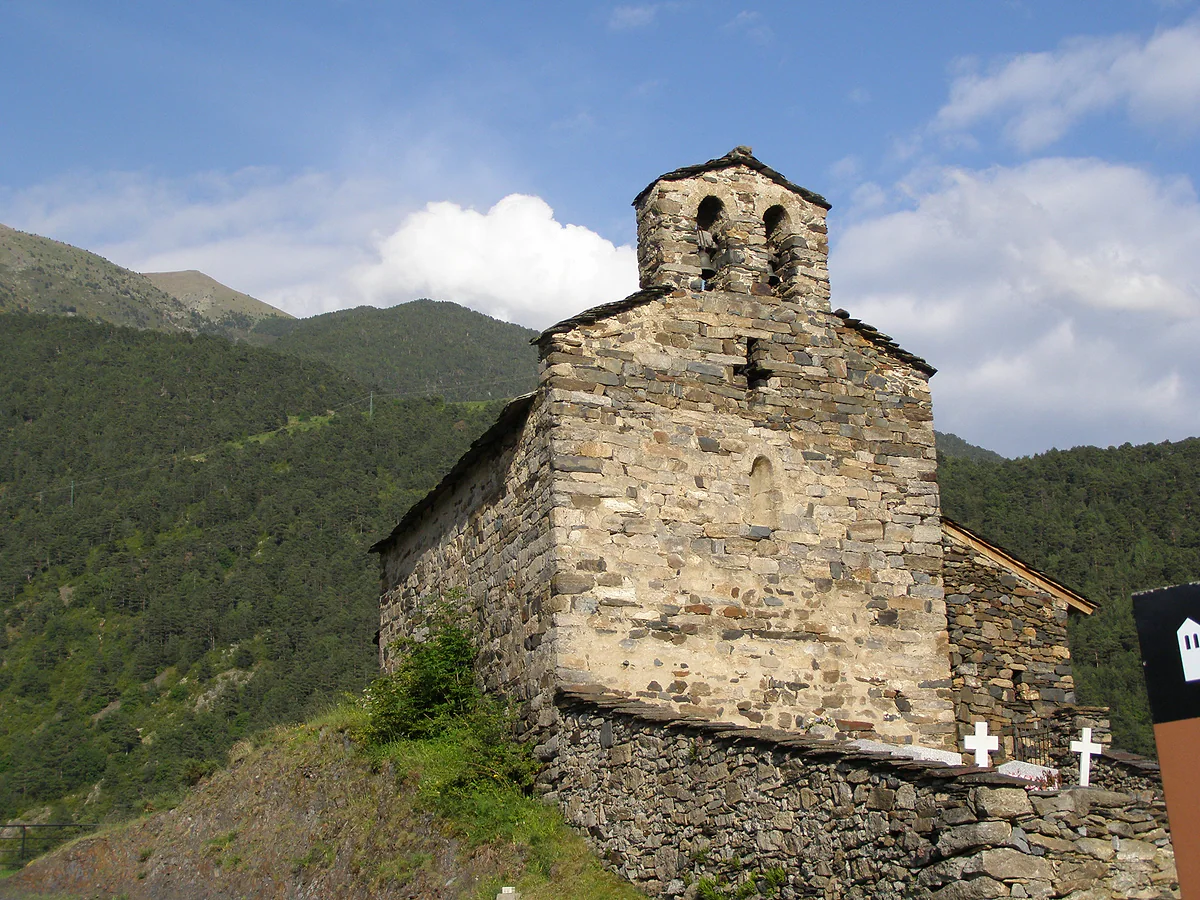
Romanesque from 1055, at 1,145 m in Sant Julià de Lòria
Sant Serni de Nagol, primitive paintings and the valley at your feet
Sant Serni de Nagol is a Romanesque church in Sant Julià de Lòria whose deed of consecration dates from 1055. It stands at 1,145 m above the town and holds wall paintings uncovered in 1978, drawn in a strikingly primitive hand, plus a 15th-century altarpiece. Entry and guided visits are free, and in October and November it opens Tuesday to Saturday, 10am-1pm and 3pm-6pm.
In 30 seconds
Full read: 3 min
- Sant Serni de Nagol is a Romanesque church consecrated in 1055, above Sant Julià de Lòria.
- Its wall paintings were uncovered in 1978 and are strikingly primitive.
- In October and November it opens Tuesday to Saturday; entry and guided visits are free.
- It stands at 1,145 m, 2.2 km from the centre along the CS-120.
Of all the churches in southern Andorra, this is the one I wouldn't skip. I'd go up on an autumn Saturday morning, ask for the free guided visit and then linger outside looking over the valley before heading down.

On the calendar
The date at a glance
-
Les 7 curiositats de Sant Serni de Nagol
Sant Serni de Nagol, Sant Julià de Lòria
Before you go
What I would keep in mind
-
01 Most beautiful
Paintings that look like a manuscript
The murals came to light in 1978. The government describes them as very linear, roughly coloured and influenced by the illuminated Beatus manuscripts, with an uncertain date.
-
02 To save money
Free, guide included
Both entry and guided visits cost nothing, according to the government's museums portal. You just need to book through the central line on (+376) 839 760.
-
03 My tip
A date for 24 October
On 24 October 2026 at midday there's a free guided visit on the church's seven curiosities, finishing with hot chocolate. Booking is recommended.
-
04 Getting there
2.2 km from the centre
Take the Nagol road, the CS-120, which leaves town beside the tourist office on Plaça Laurèdia. By bus, the L1 gets you to Sant Julià and you walk or drive the rest.
Nagol
My ranking, scored
What to look at in Sant Serni de Nagol
My own marks out of 10, based on what each feature adds to the visit and how hard it is to find elsewhere in Andorra. Personal opinion.
0 of 4 seen
-
The wall paintings
Uncovered in 1978, linear and roughly coloured, with echoes of the Beatus manuscripts. The Comú calls them the earliest surviving painted sketches of Andorran Romanesque.
9.2 out of 10
-
The view of the valley
The church commands the whole Sant Julià valley from a strategic spot, and the parish lists it as a viewpoint with an information panel.
8.9 out of 10
-
The 15th-century altarpiece
Dedicated to the patron, the first bishop of Toulouse, with the monograms of Christ and the Virgin.
8.0 out of 10
-
The apse and original altar
A quarter-sphere vault over the apse, the original altar and remains of 12th and 13th-century Romanesque decoration.
7.6 out of 10
If you only go inside one church in the whole of southern Andorra, make it this one. Sant Serni de Nagol isn’t big and has no proper tower, but it brings together three things that rarely coincide, a very early, documented date, paintings with an almost childlike line, and one of the best views over the Sant Julià de Lòria valley.
A church that predates the Lombards
The deed of consecration of Sant Serni de Nagol dates from 1055. At that point Lombard influence hadn’t yet spread across Andorra, which is why the outside has no blind arcades or decorative bands. It’s a small building on the classic Andorran Romanesque plan, a rectangular timber-roofed nave with a semicircular apse under a quarter-sphere vault.
On the front stands a double-arched bell gable, and the porch beside it was probably added in the early modern period. Inside, the original altar survives along with part of the Romanesque decoration, from the 12th and 13th centuries according to Andorra Turisme. To me that plainness is its greatest strength, because it makes you look inside.
Why the paintings matter
The murals were uncovered in 1978. The government museums portal describes them with welcome candour, as a very linear composition with rather rough colouring, clearly influenced by the Beatus manuscripts, the illuminated books of the Middle Ages. Their exact date is uncertain. The Comú goes further and presents them as the earliest painted sketches to survive from Andorran Romanesque.
Don’t expect the refinement of the Espai Columba. What this church offers is a direct, almost naive religious story, which in my view makes far more sense with someone to explain it. That’s why I’d ask for the guided visit.
Among the church furnishings are a 15th-century altarpiece dedicated to the patron, Saint Saturninus, first bishop of Toulouse, bearing the monograms of Christ and the Virgin, and a thorned processional cross that’s no longer kept in the church. There’s also an anecdote I love. In 1339 the priest of Nagol ran up a debt of five Barcelona sous, and to this day nobody knows who he owed or why.
Opening hours, price and getting there
The government museums portal gives hours for October and November, Tuesday to Saturday from 10am to 1pm and 3pm to 6pm, closed on Sunday and Monday. It publishes no hours for the rest of the year, so I’d ring the central booking line on (+376) 839 760, or the parish tourist office, (+376) 744 045. Entry and guided visits are free. The church hasn’t been adapted for wheelchair users or others with reduced mobility.
You reach it on the Nagol road, the CS-120, which leaves the town centre beside the tourist office on Plaça Laurèdia. It’s 2.2 km. By public transport, the L1 bus drops you in Sant Julià at the Plaça Laurèdia stop, and you walk or take a taxi from there. On foot, the paths up to Nagol from town pass very close. The Sant Martí path climbs along the Sant Serni track itself, and the Aixirivall trail-running circuit finishes here, with a quick descent to town on a marked path, about 500 m of road and a cobbled stretch that brings you back into the village streets. Walking up rather than driving is, in my view, the better way to arrive, because the valley opens up behind you with every bend and the terrace at the top feels properly earned. Save the car for the way back if your legs have had enough.
A guided visit on 24 October
As part of the government museums’ autumn and winter programme, on 24 October 2026 at midday there’s a free guided visit on the seven curiosities of Sant Serni de Nagol, rounded off with hot chocolate. Booking is recommended on (+376) 839 760. If you’re in Andorra that Saturday, I wouldn’t miss it.
What to pair it with
The terrace, signposted by the Comú as a viewpoint with a panel and a selfie post, looks over the whole valley. Beside Nagol is the chapel of Sant Martí, clinging to the rock, and a little higher up is Llumeneres with its waterfall. For more Romanesque across the country, see Romanesque churches in Andorra.
Opening hours and price
| Period | Days | Hours |
|---|---|---|
| October and November | Tuesday to Saturday | 10am-1pm and 3pm-6pm |
| October and November | Sunday and Monday | Closed |
| All year | Entry and guided visit | Free |
Government museums portal (museus.ad), checked on 29-09-2026. No hours published for the rest of the year; bookings on (+376) 839 760, Sant Julià tourist office on (+376) 744 045.
The church at a glance
| Feature | Detail |
|---|---|
| Consecration | 1055 |
| Plan | Rectangular timber-roofed nave, semicircular apse |
| Bell tower | Double-arched bell gable |
| Paintings | Uncovered in 1978 |
| Altarpiece | 15th century, dedicated to Saint Saturninus |
| Accessibility | Not adapted for reduced mobility |
Test yourself
True or false?
0/4 Pick before you peek.
-
Sant Serni de Nagol has a Lombard bell tower.
See the answer
False. It has a double-arched bell gable. It was consecrated in 1055, before the Lombard style reached Andorra.
-
The wall paintings were only discovered in the 20th century.
See the answer
True. They came to light in 1978, according to the government museums portal.
-
Guided visits to Sant Serni de Nagol have to be paid for.
See the answer
False. Guided visits are free, just like entry.
-
In 1339 the priest of Nagol ran up a debt of five Barcelona sous.
See the answer
True. Andorra Turisme includes it among its curiosities of Andorran Romanesque, though nobody knows who he owed or why.
- Year of the deed of consecration
- 1055
- Wall paintings uncovered
- 1978
- Altitude of the church
- 1,145 m
- Entry and guided visit
- €0
Map
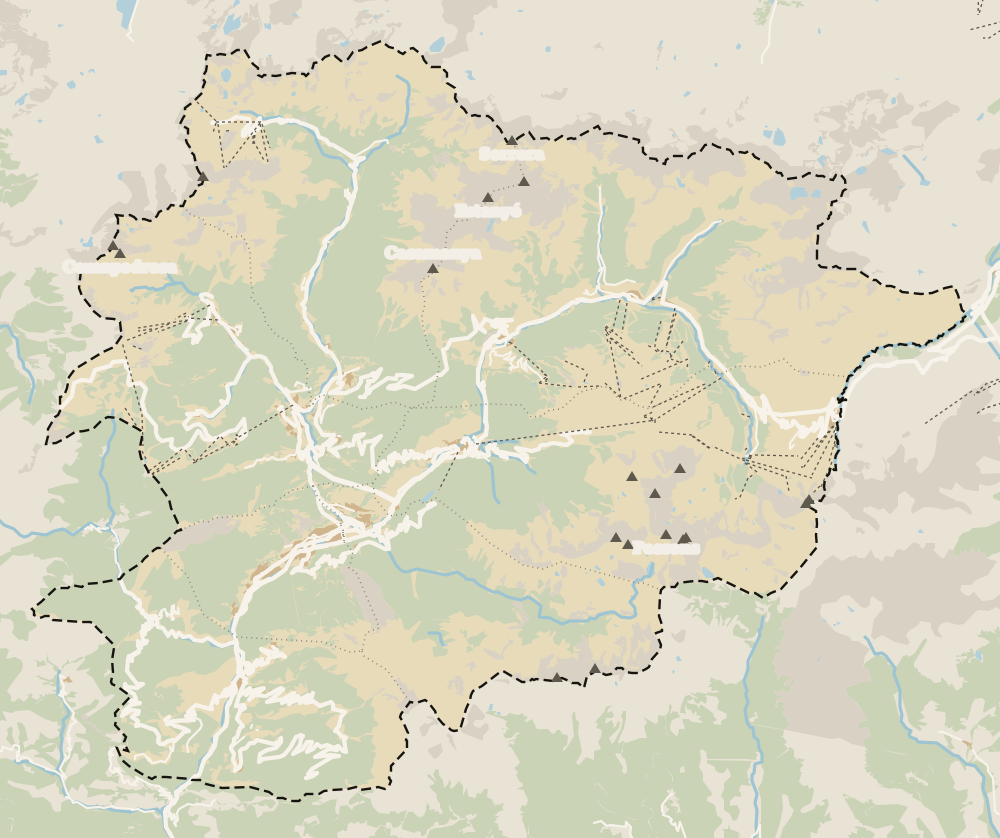
Where Sant Serni de Nagol is
The dashed line is the border with France and Spain. The Valira valley runs down from Pas de la Casa to Sant Julià, with Ordino and La Massana in the northern valley. Every number opens its guide.
0 of 269 Andorra guides
Your next stamp
- Nagol
- Sant Romà de les Bons
- Sant Joan de Caselles
- Sant Romà dels Vilars
- Sant Martí de la Cortinada
- Sant Climent de Pal
- Sant Esteve church
- Sant Serni de Canillo
- Places to visit
- Things to do
- Most beautiful places
- Prettiest villages
- Andorra la Vella
- UNESCO World Heritage
- Map
- Escaldes-Engordany
- Where is Andorra?
- Is Andorra a country?
- Parishes
- Casa de la Vall
- Margineda bridge
- Old town
- Santa Coloma church
- Towns and villages
- Population
- Size
- Mountains
- Language
- Andorra in one day
- Canillo
- Espai Columba
- History
- Margineda rock shelter
- Co-princes
- Soldeu
- Weekend break
- Andorra in 3 days
- El Tarter
- Political system
- Andorra in 4 days
- Flag
- Ransol
- A week in Andorra
- Facts
- Prats
- El Forn
- Public holidays
- Sant Julià de Lòria
- Currency and payments
- L'Aldosa de Canillo
- Els Plans
- EU and Schengen
- Bordes d'Envalira
- Entry requirements
- Prices and budget
- On a budget
- Santa Coloma
- Ski holidays
- Tourist tax
- Mobile and roaming
- Tourist information
- Healthcare
- Meritxell Sanctuary
- With a dog
- Packing list
- Safety
- How to get there
- Scams
- From Barcelona
- Bus from Barcelona
- Day trip from Barcelona
- From Madrid
- From Toulouse
- Encamp
- Flights
- La Margineda
- La Massana
- Roc del Quer viewpoint
- Romanesque churches
- Andorra-La Seu airport
- Canillo Tibetan bridge
- Museums in Andorra
- Pal
- Pas de la Casa
- Arinsal
- Driving
- Grau Roig
- Mon(t) Magic
- Nearest airports
- By train
- Erts
- Les Bons
- Palau de Gel
- Road conditions
- Motorcycle Museum
- Parking
- Sispony
- Vila
- Anyós
- Incles valley
- La Mosquera
- Petrol
- El Tremat
- Getting around
- Juclar lakes
- L'Aldosa (La Massana)
- Buses
- Els Cortals d'Encamp
- Bus station
- Sant Cristòfol d'Anyós
- Casa Rull
- Shopping
- Farga Rossell
- Sant Vicenç d'Enclar
- Santa Eulàlia d'Encamp
- What to buy
- Customs allowances
- La Massana Còmic
- Car Museum
- Cigarettes
- Comapedrosa
- Electronics
- Alcohol
- Casa Cristo
- Clothes and sports shops
- Iron Route
- Coll d'Ordino
- Perfume
- Sacred Art Museum
- Shopping centres
- Funicamp
- Supermarkets
- Avinguda Meritxell
- Encamp Tibetan bridge
- Avinguda Carlemany (Vivand)
- Envalira pass
- Auvinyà
- Bici Lab Andorra
- Ordino
- Skiing
- With kids
- Zip lines
- Fontaneda
- For couples
- La Cortinada
- Ski pass
- Via ferratas
- Climbing
- Llorts
- Nightlife
- Ski season
- El Serrat
- Grandvalira
- Horse riding
- Juberri
- Aixovall
- Mountain biking
- Pal Arinsal
- Sornàs
- Aixirivall
- Ansalonga
- Ordino Arcalís
- Road cycling
- Bixessarri
- Naturland
- Segudet
- Arans
- Llumeneres
- Tobotronc
- Casa d'Areny-Plandolit
- Cross-country skiing
- Miniature Museum
- Skiing with kids
- Cal Pal
- Free walking tour
- Pessons lakes
- Ski lessons
- Where to stay
- Canòlich Sanctuary
- Hotels in Andorra la Vella
- Ski hire
- Hotels in Escaldes
- Juberri Gardens
- Llorts iron mine
- Webcams
- Hotels in Soldeu
- Snow report
- Sorteny valley
- Hotels in El Tarter
- Tristaina lakes
- Hotels in Canillo
- Night skiing
- Tristaina solar viewpoint
- Freeride
- Hotels in Encamp
- Hotels in Pas de la Casa
- Ski touring
- Hotels in La Massana
- Snowshoeing
- Hotels in Arinsal and Pal
- Snow activities
- Après-ski
- Engordany
- Hotels in Ordino
- Medieval bridges
- Nature parks
- Els Vilars
- Hotels in Sant Julià de Lòria
- Lakes
- Viewpoints
- Where to eat
- Caldea
- Restaurants in Andorra la Vella
- Borda restaurants
- Inúu
- Cheap hotels
- Food
- Hiking
- Spas and thermal baths
- Weather and climate
- Engolasters lake
- Pas de la Casa weather
- Spa hotels
- Trinxat
- Events
- Luxury hotels
- Sant Miquel d'Engolasters
- Ski resort weather
- Wine
- Best time to visit
- Family hotels
- Madriu valley
- All inclusive
- Estany de l'Illa
- In winter
- Apartments
- Coronallacs
- In spring
- Ski World Cup
- Christmas
- Hostels
- In summer
- Mountain huts
- Camping and rural stays
- Easy walks
- In autumn
- New Year
- Family walks
- Festes majors
- In January
- GR11 and other GRs
- In February
- National day
- Around Andorra
- GRP round Andorra
- In March
- Midsummer fire festival
- Carnival
- In April
- In May
- Travessa d'Encamp
- In June
- In July
- In August
- In September
- In October
- In November
- In December
Frequently asked questions
Where is Sant Serni de Nagol?
In the parish of Sant Julià de Lòria, beside the hamlet of Nagol at 1,145 m. It's 2.2 km up the Nagol road, the CS-120, from the centre of Sant Julià.
What are the opening hours of Sant Serni de Nagol?
In October and November it opens Tuesday to Saturday, 10am-1pm and 3pm-6pm, closed Sunday and Monday, according to museus.ad. No hours are published for the rest of the year, so ring (+376) 839 760.
How much does it cost to visit Sant Serni de Nagol?
Nothing. Entry is free and so are guided visits, according to the government museums portal and Andorra Turisme.
How old is Sant Serni de Nagol?
Its deed of consecration dates from 1055, before Lombard influence reached Andorra, which is why there's no exterior decoration.
What's special about its wall paintings?
They were uncovered in 1978 and have a very linear composition and rough colouring influenced by the Beatus manuscripts. Their date is uncertain, according to the government.
Is Sant Serni de Nagol wheelchair accessible?
No. The government museums portal says the church isn't adapted for people with reduced mobility.
By
Tourism graduate with a master’s in Tourism Management and Planning from the University of Málaga, who has travelled across Europe. He writes every guide from official sources and his own judgement.
Published on . Facts checked on .
Sources
Photos: Queralt jqmj (CC BY-SA 2.0), via Wikimedia Commons.