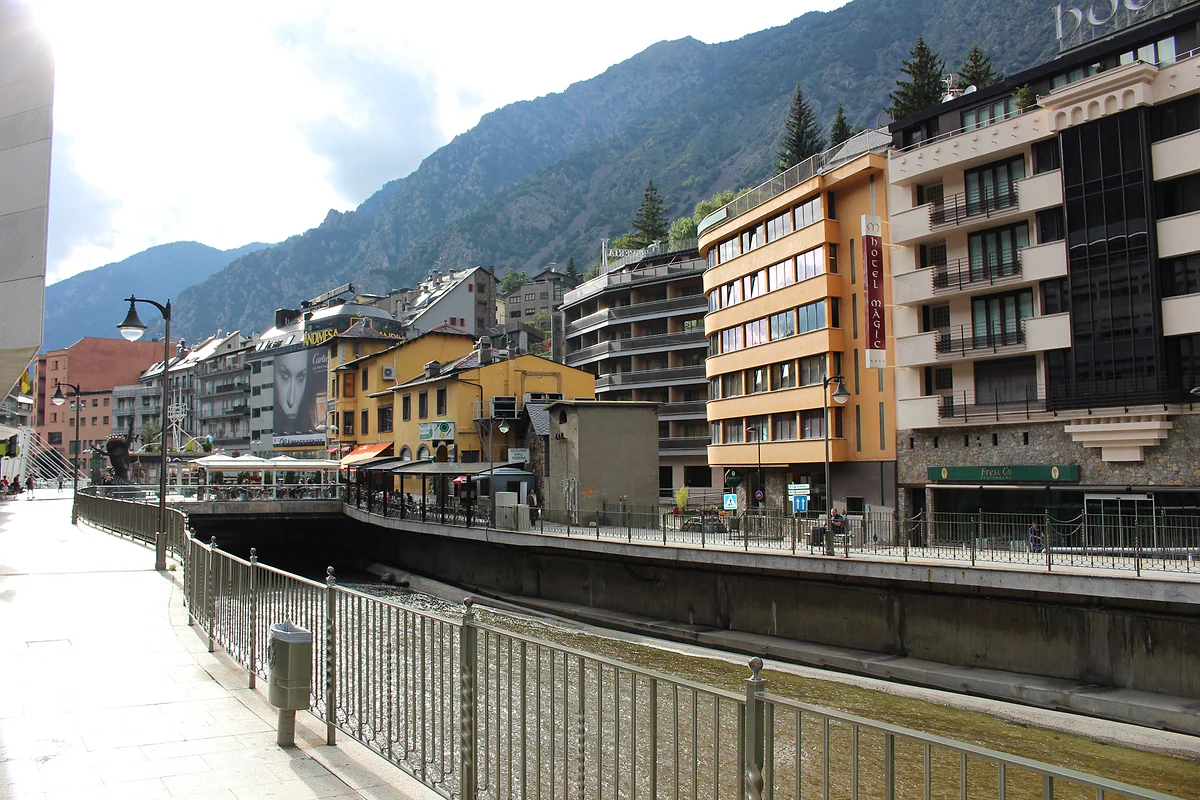
Official figure at 31 August 2026
Andorra's population: how many, and who
Andorra had 90,105 residents on 31 August 2026, according to its statistics department, 1,699 more than a year earlier. Andorran nationals make up 44.6% and Spanish nationals 23.5%, followed by Portuguese and French. The most populated parish is Andorra la Vella, with 24,840 residents, and the least is Ordino, with 5,851.
In 30 seconds
Full read: 3 min
- Andorra had 90,105 residents on 31 August 2026, up 1.9% in a year.
- Andorran nationals make up 44.6% and Spanish nationals 23.5%.
- Andorra la Vella is the most populated parish with 24,840; Ordino the least with 5,851.
- The next official population release is due on 12 October 2026.
If you're quoting Andorra's population, always check the date. The statistics department publishes monthly and older figures float around the web as if they were current; the one on this page is August 2026, and the next is due on 12 October.

Before you go
What I would keep in mind
-
01 My tip
Registered isn't the same as resident
The parish registers list 94,480 people, but the statistics department stresses that's a different measure. For the number of residents, the figure to use is the estimate, 90,105.
parishes of Andorra -
02 Money
A small country living off visitors
The tourist board says retail and tourism make up 60% of the economy, with finance third. That's why 90,105 residents share their valleys with far more visitors each year.
shopping in Andorra -
03 Most beautiful
One of the longest life expectancies
The Spanish foreign ministry gives a life expectancy of 84.1 years in 2024, from Andorran statistics. The tourist board claims fifth place in the world, but I haven't been able to check that ranking.
Andorra facts
What I would book
Andorra is home to barely ninety thousand people, and yet the simple question of how many people live there causes confusion. You’ll find figures from 2023, from June, from July and from the parish registers, and none of them match. Here’s the latest official number, from August 2026, and where the others come from, so you don’t quote the wrong one.
How many people live in Andorra?
The statistics department’s release of 15 September 2026 is unambiguous. On 31 August, the resident population of the principality stood at 90,105. That’s 1,699 more than twelve months earlier, growth of 1.9%. At the end of 2025 it was 89,058, and on 30 June 2026, 89,752, so the country is still adding people month by month.
A new release comes out every month. The September figures are due on 12 October 2026, after which this one will be out of date. That’s why I always give it with its date attached.
Why do the numbers differ?
Because each measures something different, or a different moment. The 90,021 on the Spanish foreign ministry’s profile is the July 2026 figure from the same series. The 85,101 still used by the tourist board comes from the 2023 census. And 94,480 is the number registered with the parish councils, which the statistics department explicitly keeps apart from the estimate, because being on a parish register isn’t the same as living in the country. For residents, the estimate is the one to trust.
Parish by parish
Andorra la Vella leads with 24,840 residents, 27.6% of the total, though it’s growing slowest, at 0.5%. Escaldes-Engordany, which it merges into, has 16,347. Together they pass 41,000, almost half the country, on the floor of the same valley. Then come Encamp with 13,751, La Massana with 12,402 and Sant Julià de Lòria with 10,300.
The two least populated parishes are in the mountainous north and east. Canillo has 6,614 residents and the fastest growth in the country, 4.4% in a year, while Ordino is the smallest, with 5,851. What each offers visitors is in the parishes of Andorra. If you’re choosing a base, the population gap matters less than you’d think, because even the busiest parish feels small once you’re off the main road.
Where do Andorra’s residents come from?
Andorran nationals number 40,168, 44.6% of the total, so less than half the people living in Andorra hold its passport. Spanish nationals form the second group, 21,197 people or 23.5%. Next come the Portuguese, 8,300, the French, 4,274, and other nationalities, 16,166 between them. British residents aren’t counted separately in the release, so I won’t guess at a number.
The trend is revealing. In 2025, according to the December release, other nationalities grew fastest, by 8.0%, followed by the French at 6.2%, while the Portuguese fell by 1.2%. You’ll hear that mix in the street, in the languages around you, as I explain in what language they speak in Andorra.
Age, health and work
Under-15s make up 10.5% of the population and over-65s 16.1%, according to the same release. The Spanish foreign ministry adds a life expectancy of 84.1 years in 2024 and an unemployment rate of 0.9% in 2025. The tourist board goes further and claims a world top-five place, but without naming the ranking behind it, so I’ll stick to the 84.1 years.
The ministry also notes that from the 1950s the country shifted from farming to trade and tourism, with strong population growth. Density in 2025 was 192 people per km², but that figure misleads, because nearly everyone lives on the valley floors while the tourist board counts over nine-tenths of the territory as forest, meadow, lake or bare mountain. Exactly how big the country is, in square miles too, is in how big is Andorra.
What it means for visitors
For travellers, these figures explain a lot. A country of 90,105 people hosts far more visitors than that, since the tourist board puts retail and tourism at 60% of the economy. That’s why there are so many hotels in so little space and so many services aimed at outsiders. And it’s why, as the Andorran government itself acknowledges, customer service in many shops is mostly in Spanish. For a British visitor that’s useful to know. A few words of Spanish or Catalan will get you further here than French, and a smile and a card payment will get you through the rest, since cards are accepted almost everywhere.
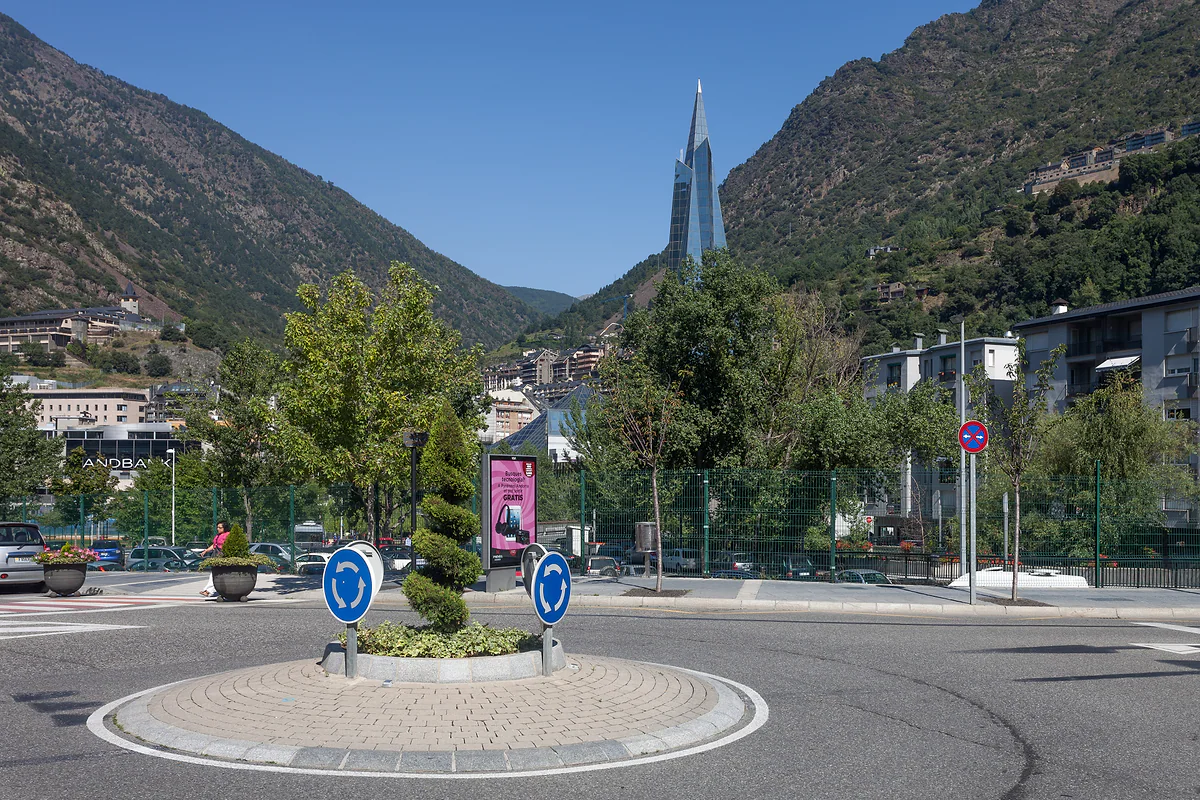
A roundabout in Escaldes-Engordany with the glass spire of Caldea rising at the end of the valley
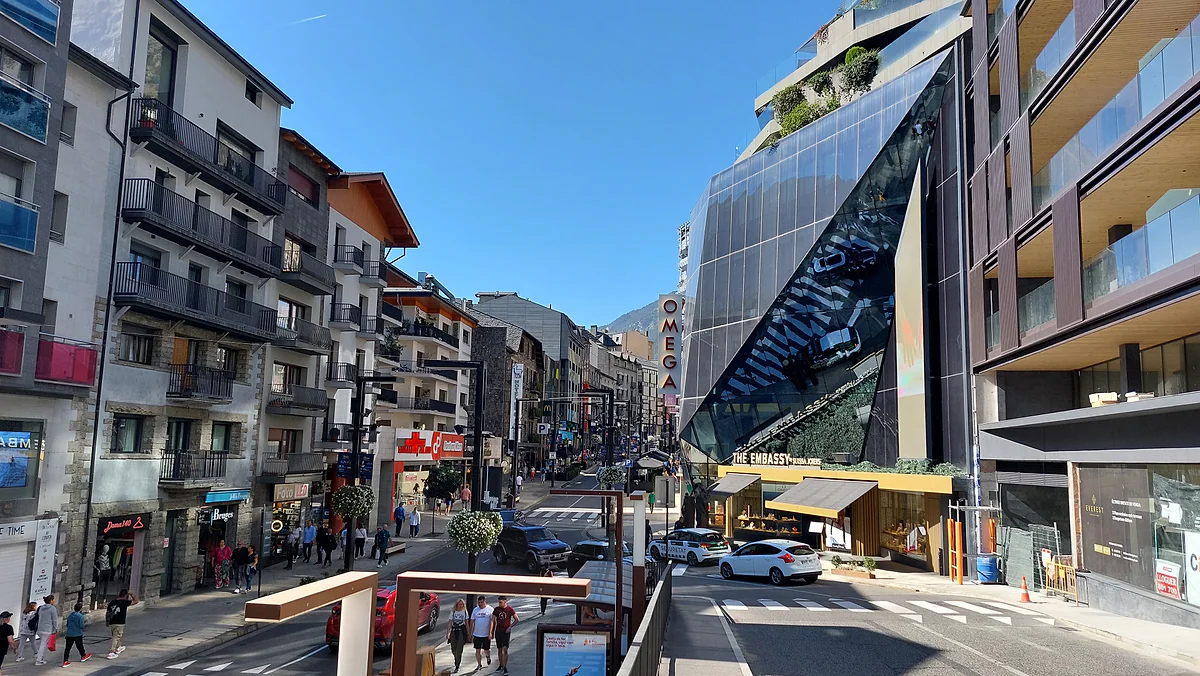
Avinguda Meritxell in Andorra la Vella, the main shopping street with shops, cafés and glass-fronted buildings
Residents by parish
| Parish | Residents | % of total | Annual change |
|---|---|---|---|
| Andorra la Vella | 24,840 | 27.6% | +0.5% |
| Escaldes-Engordany | 16,347 | 18.1% | +2.0% |
| Encamp | 13,751 | 15.3% | +2.3% |
| La Massana | 12,402 | 13.8% | +2.4% |
| Sant Julià de Lòria | 10,300 | 11.4% | +1.6% |
| Canillo | 6,614 | 7.3% | +4.4% |
| Ordino | 5,851 | 6.5% | +3.8% |
| Total | 90,105 | 100% | +1.9% |
Estimated population at 31-08-2026, Andorran statistics department, published on 15-09-2026.
Residents by nationality
| Nationality | People | % of total |
|---|---|---|
| Andorran | 40,168 | 44.6% |
| Spanish | 21,197 | 23.5% |
| Portuguese | 8,300 | 9.2% (my calculation) |
| French | 4,274 | 4.7% (my calculation) |
| Other | 16,166 | 17.9% (my calculation) |
Same release. Under-15s make up 10.5% and over-65s 16.1%. British residents aren't broken out separately.
Test yourself
True or false?
0/4 Pick before you peek.
-
Spanish nationals are the largest group in Andorra.
See the answer
False. They're second, with 21,197 people. The largest group is Andorran nationals, 40,168 or 44.6% of the total.
-
Andorra now has more than 90,000 residents.
See the answer
True. It had 90,105 on 31 August 2026, according to the Andorran statistics department.
-
Ordino is the least populated parish.
See the answer
True. It has 5,851 residents, 6.5% of the country. Canillo, with 6,614, is next, and it's growing fastest.
-
The parish registers and the estimated population give the same total.
See the answer
False. The registers list 94,480 people, but the statistics department says that's a different measure. The estimated resident population is 90,105.
- Residents on 31-8-2026
- 90,105
- Growth over a year
- +1.9%
- Andorran nationals
- 44.6%
- Spanish residents
- 21,197
- Years of life expectancy (2024)
- 84.1
0 of 269 Andorra guides
Your next stamp
- Parishes
- Prices and budget
- Tourist tax
- Public holidays
- Map
- Towns and villages
- Political system
- Places to visit
- Things to do
- Most beautiful places
- Prettiest villages
- Andorra la Vella
- UNESCO World Heritage
- Escaldes-Engordany
- Where is Andorra?
- Is Andorra a country?
- Casa de la Vall
- Margineda bridge
- Old town
- Santa Coloma church
- Size
- Mountains
- Language
- Andorra in one day
- Canillo
- Espai Columba
- History
- Margineda rock shelter
- Sant Esteve church
- Co-princes
- Soldeu
- Weekend break
- Andorra in 3 days
- El Tarter
- Andorra in 4 days
- Flag
- Ransol
- A week in Andorra
- Facts
- Prats
- El Forn
- Sant Julià de Lòria
- Currency and payments
- L'Aldosa de Canillo
- Els Plans
- EU and Schengen
- Bordes d'Envalira
- Entry requirements
- On a budget
- Sant Joan de Caselles
- Santa Coloma
- Ski holidays
- Mobile and roaming
- Sant Serni de Canillo
- Tourist information
- Healthcare
- Meritxell Sanctuary
- With a dog
- Packing list
- Safety
- How to get there
- Scams
- From Barcelona
- Bus from Barcelona
- Day trip from Barcelona
- From Madrid
- From Toulouse
- Encamp
- Flights
- La Margineda
- La Massana
- Roc del Quer viewpoint
- Romanesque churches
- Andorra-La Seu airport
- Canillo Tibetan bridge
- Museums in Andorra
- Pal
- Pas de la Casa
- Arinsal
- Driving
- Grau Roig
- Mon(t) Magic
- Nearest airports
- By train
- Erts
- Les Bons
- Palau de Gel
- Road conditions
- Motorcycle Museum
- Parking
- Sispony
- Vila
- Anyós
- Incles valley
- La Mosquera
- Petrol
- El Tremat
- Getting around
- Juclar lakes
- L'Aldosa (La Massana)
- Buses
- Els Cortals d'Encamp
- Sant Climent de Pal
- Bus station
- Sant Cristòfol d'Anyós
- Casa Rull
- Shopping
- Farga Rossell
- Sant Vicenç d'Enclar
- Santa Eulàlia d'Encamp
- What to buy
- Customs allowances
- La Massana Còmic
- Sant Romà de les Bons
- Car Museum
- Cigarettes
- Comapedrosa
- Electronics
- Alcohol
- Casa Cristo
- Clothes and sports shops
- Iron Route
- Coll d'Ordino
- Perfume
- Sacred Art Museum
- Shopping centres
- Funicamp
- Supermarkets
- Avinguda Meritxell
- Encamp Tibetan bridge
- Avinguda Carlemany (Vivand)
- Envalira pass
- Auvinyà
- Bici Lab Andorra
- Ordino
- Skiing
- With kids
- Zip lines
- Fontaneda
- For couples
- La Cortinada
- Ski pass
- Via ferratas
- Climbing
- Llorts
- Nagol
- Nightlife
- Ski season
- El Serrat
- Grandvalira
- Horse riding
- Juberri
- Aixovall
- Mountain biking
- Pal Arinsal
- Sornàs
- Aixirivall
- Ansalonga
- Ordino Arcalís
- Road cycling
- Bixessarri
- Naturland
- Segudet
- Arans
- Llumeneres
- Tobotronc
- Casa d'Areny-Plandolit
- Cross-country skiing
- Miniature Museum
- Skiing with kids
- Cal Pal
- Free walking tour
- Pessons lakes
- Sant Serni de Nagol
- Ski lessons
- Where to stay
- Canòlich Sanctuary
- Hotels in Andorra la Vella
- Sant Martí de la Cortinada
- Ski hire
- Hotels in Escaldes
- Juberri Gardens
- Llorts iron mine
- Webcams
- Hotels in Soldeu
- Snow report
- Sorteny valley
- Hotels in El Tarter
- Tristaina lakes
- Hotels in Canillo
- Night skiing
- Tristaina solar viewpoint
- Freeride
- Hotels in Encamp
- Hotels in Pas de la Casa
- Ski touring
- Hotels in La Massana
- Snowshoeing
- Hotels in Arinsal and Pal
- Snow activities
- Après-ski
- Engordany
- Hotels in Ordino
- Medieval bridges
- Nature parks
- Els Vilars
- Hotels in Sant Julià de Lòria
- Lakes
- Sant Romà dels Vilars
- Viewpoints
- Where to eat
- Caldea
- Restaurants in Andorra la Vella
- Borda restaurants
- Inúu
- Cheap hotels
- Food
- Hiking
- Spas and thermal baths
- Weather and climate
- Engolasters lake
- Pas de la Casa weather
- Spa hotels
- Trinxat
- Events
- Luxury hotels
- Sant Miquel d'Engolasters
- Ski resort weather
- Wine
- Best time to visit
- Family hotels
- Madriu valley
- All inclusive
- Estany de l'Illa
- In winter
- Apartments
- Coronallacs
- In spring
- Ski World Cup
- Christmas
- Hostels
- In summer
- Mountain huts
- Camping and rural stays
- Easy walks
- In autumn
- New Year
- Family walks
- Festes majors
- In January
- GR11 and other GRs
- In February
- National day
- Around Andorra
- GRP round Andorra
- In March
- Midsummer fire festival
- Carnival
- In April
- In May
- Travessa d'Encamp
- In June
- In July
- In August
- In September
- In October
- In November
- In December
Frequently asked questions
What is the population of Andorra?
90,105 on 31 August 2026, according to the statistics department's release of 15 September. That's 1,699 more than a year earlier, growth of 1.9%.
How many people live in Andorra la Vella?
24,840 in the parish of Andorra la Vella on 31 August 2026. With neighbouring Escaldes-Engordany, which it merges into, the total passes 41,000.
Why do sources give different population figures for Andorra?
Because the statistics department publishes monthly and many sites copy old months. The 89,752 figure is from June 2026, 90,021 from July, and the 85,101 still used by the tourist board comes from the 2023 census.
What nationality are most people in Andorra?
Andorran, with 40,168 people or 44.6%, so under half. Spanish nationals follow with 21,197, then Portuguese with 8,300 and French with 4,274. Other nationalities total 16,166.
Is Andorra's population growing?
Yes, by 1.9% in the year to August 2026. In 2025, other nationalities grew fastest, by 8.0%, followed by the French at 6.2%, while the Portuguese fell by 1.2%.
How many British people live in Andorra?
The official release doesn't list British nationals separately; they fall within the 16,166 residents of other nationalities. I wouldn't trust any exact figure without a source.
By
Tourism graduate with a master’s in Tourism Management and Planning from the University of Málaga, who has travelled across Europe. He writes every guide from official sources and his own judgement.
Published on . Facts checked on .
Sources
Photos: tiger rus (CC BY 3.0); Luis Miguel Bugallo Sánchez (CC BY-SA 3.0); FrankAndProust (CC0), via Wikimedia Commons.