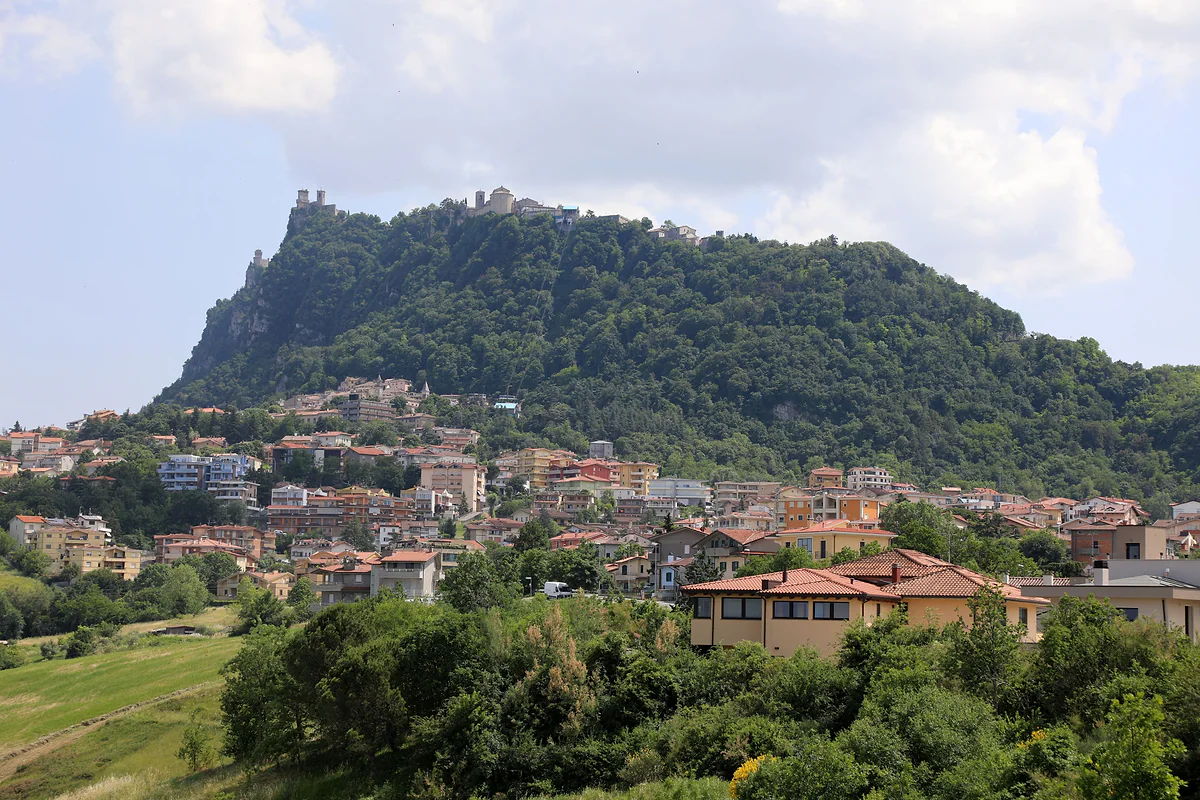
755 metres at the top of the Cesta
Mount Titano, the rock that holds up a country
Monte Titano is the mountain San Marino grew up on and where its capital stands. Its highest point, according to the State Museums, is the Second Tower, the Cesta, at 755 metres. It has three peaks in a row, each crowned by a tower, and since 2008 it has formed a UNESCO World Heritage Site together with the historic centre.
In 30 seconds
Full read: 3 min
- Monte Titano is San Marino's mountain; its highest point is the Cesta, at 755 metres according to the State Museums.
- It has three peaks in a row, each with a tower, the Guaita, the Cesta and the Montale.
- With the old town, it has been a UNESCO World Heritage Site since 2008.
- The Guaita and the Cesta are on the €11 pass; the Montale is outside only.
I wouldn't climb Titano just for the city. What really justifies the mountain is the ridge path between the towers, with the cliff on one side and the plain rolling to the sea on the other, and I'd walk it first thing or late in the afternoon.

Before you go
What I would keep in mind
-
01 Most beautiful
The cliff edge between the Guaita and the Cesta
The battlemented stretch between the first two towers, the Passo delle Streghe, is about 200 metres long and looks out over the coast from Cesenatico to Pesaro, according to a private website. For me it's the best spot in the country.
Witches' Passage in San Marino -
02 To save money
Two towers for €11, or €5 at the end of the day
The Guaita and the Cesta are covered by the single State Museums pass, which costs €11. In the last opening hour it drops to €5 at the desk. Under-18s go free.
museums in San Marino -
03 My tip
The third tower is outside only
The Montale can't be visited inside and isn't on the pass. You reach it on a woodland path from the Cesta, about twenty minutes and easy going, according to unofficial sources.
Montale, San Marino's Third Tower -
04 Getting there
Up without a car, by bus or cable car
Bonelli's shuttle climbs from Rimini station to the city in 55 minutes for €7. From Borgo Maggiore, the cable car leaves every quarter of an hour for €4.
Rimini to San Marino bus
What I would book
- Places to stayBooking.com Stay on top for the ridge without crowds The path between the towers has a different light early in the morning and at sunset, once the day groups have gone.
- Tours and ticketsGetYourGuide A day trip from Rimini with transport If you'd rather not depend on the bus timetable, a trip from the coast takes you up Titano and brings you back without worrying about the return.
From the beach at Rimini you can pick out a block of rock rising sharply above the hills, with three towers along its crest. That’s Mount Titano, and without it there would be no San Marino. The city, the fortresses and the legend of the saint all come from this mountain, and I see it as the country’s real attraction, more than any museum sitting on top of it.
A 755-metre rock with three peaks
The official height comes from the State Museums, and it’s 755 metres at the top of the Second Tower, the Cesta, the highest point of Titano. You’ll see other numbers around, 739 metres on Wikipedia or 749 and 756 on a private website, but for me the state’s figure wins. What strikes you isn’t so much the height as the shape. It’s an almost sheer block above gently rolling hills, with three peaks in a line and a tower on each.
According to a private website about the territory, the rock is a mix of limestone and sandstone, the remains of a huge undersea plate from around twenty million years ago, and the same plate produced other outcrops nearby, such as the crag of San Leo. I’m no geologist, but it helps me understand why Titano looks as if it was placed there on purpose, and why it was so easy to defend. If that other rock tempts you, I cover it in San Leo, next to San Marino.
Why a country was born here
By tradition, it all began on 3 September 301. A Dalmatian stonemason from the island of Arbe, Marinus, fled Diocletian’s persecution and set up a small Christian community on Titano. The same tradition says the mountain’s owner, a woman from Rimini called Felicissima, gave it to the community. It’s legend, and no official source treats it as fact, but every 3 September the state still marks its feast of the patron saint and of the founding.
The documented part comes later. The core of the Guaita dates from the 11th century, a guard post and shelter for the mountain’s first settlers according to the State Museums, and the Cesta appears by name in a document of 1253. Before it was a postcard, the mountain was a natural fortress. I tell the rest in the history of San Marino.
What to do on Titano
First, the tower walk. The Guaita and the Cesta can be visited inside on the single State Museums pass, which costs €11, and the Cesta keeps some 700 old weapons in its arms museum. Between them runs a battlemented stretch of about 200 metres, the Passo delle Streghe, which a private website says looks out along the coast from Cesenatico to Pesaro. For me, it’s the best time you can spend in San Marino.
The Montale, the third tower, doesn’t open inside. It’s roughly twenty minutes from the Cesta through the trees, and its only door is roughly seven metres off the ground, typical of prisons of its time according to English Wikipedia. The full route from Piazza della Libertà to the Montale and back, going into the first two, takes around three hours. I look at all three together in the Three Towers of San Marino.
If it’s views you’re after, you’re spoilt for choice up here. The Guaita’s bell tower commands the entire city and, far off, Malatesta strongholds like Verucchio, while the Penna tower looks over the flatlands to the sea and, southwards, to Monte Carpegna. I rank them with scores in the viewpoints of San Marino.
Getting up, and when to go
You reach the ridge on Bonelli’s bus from Rimini, which takes 55 minutes and costs €7, or from Borgo Maggiore by cable car, with a departure every fifteen minutes. By car you leave the vehicle in the numbered car parks, because the centre is a limited traffic zone. The practical detail is in getting around San Marino.
Seasonally, remember it’s a mountain. According to Arpae data quoted by English Wikipedia, the average January high is around 6 °C, November is the wettest month and above 400 or 500 metres it snows nearly every winter, as I set out in San Marino weather. I’d go up in spring or early autumn, first thing in the morning, when the cliff has its best light and the coaches haven’t arrived yet.
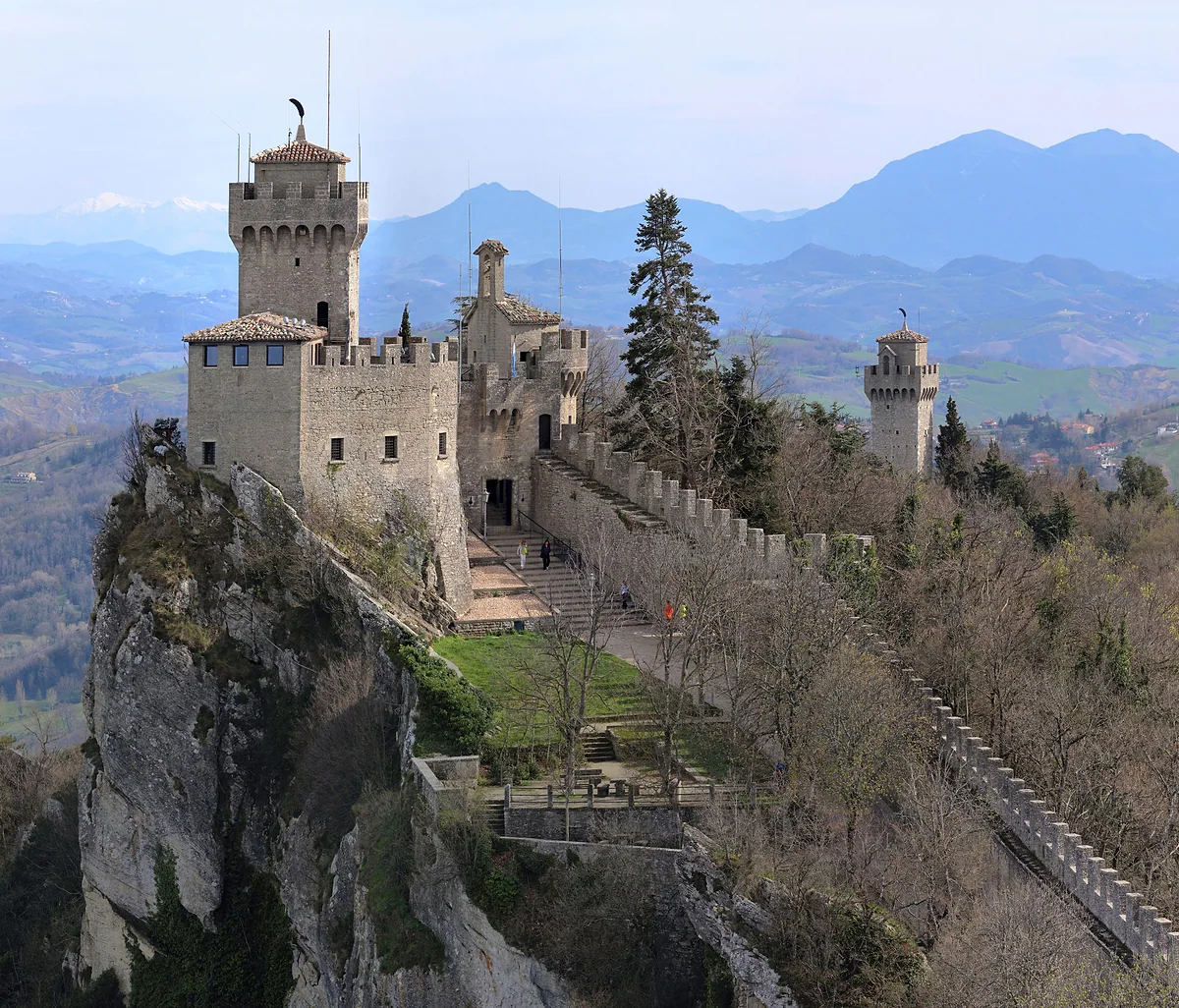
The Cesta, the second tower, with its feather-shaped weathervane and wall walk, and the Montale rising among the trees behind.
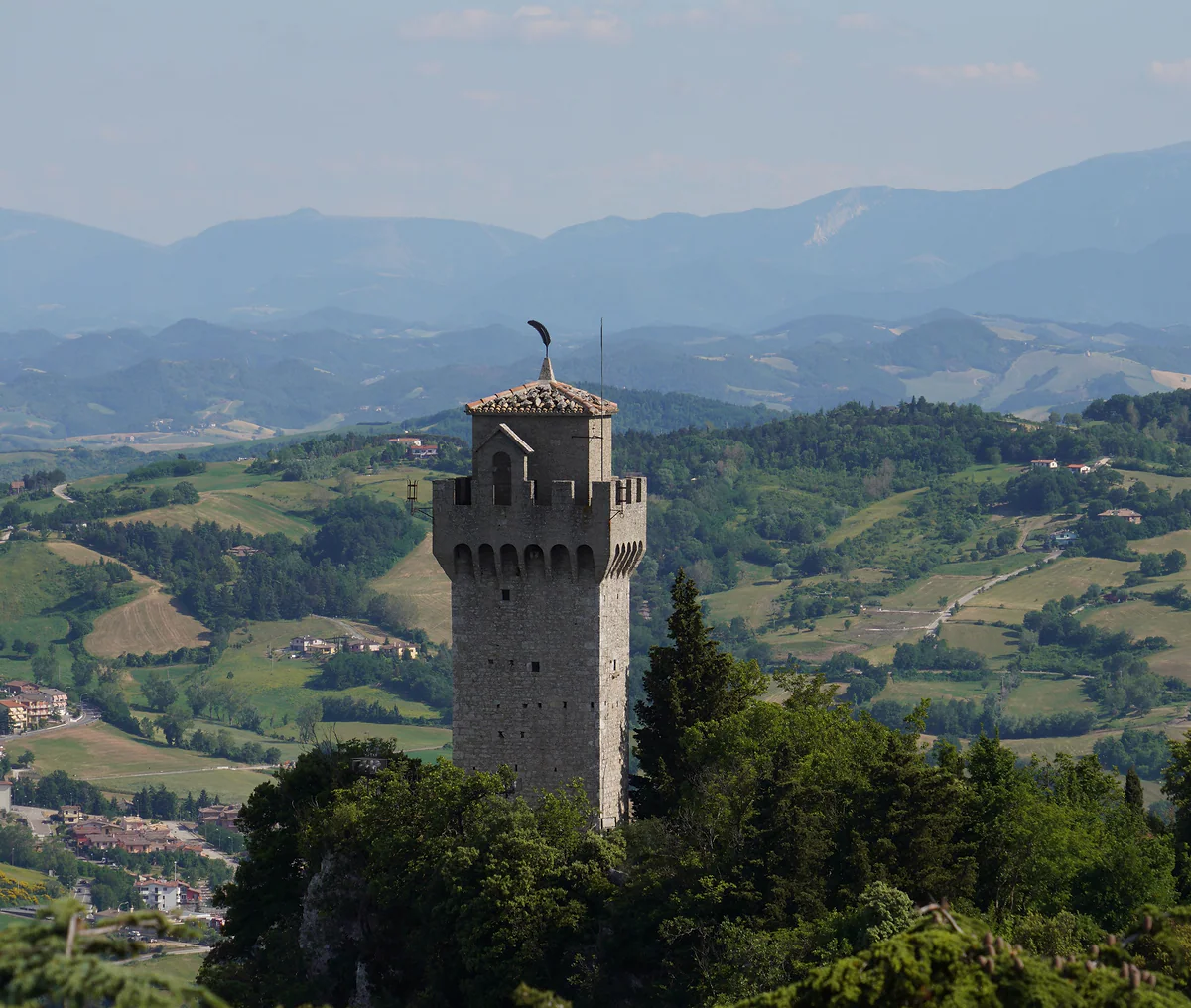
The Montale, the third tower, rising from the woods of Monte Titano with the hills and the Apennines behind.
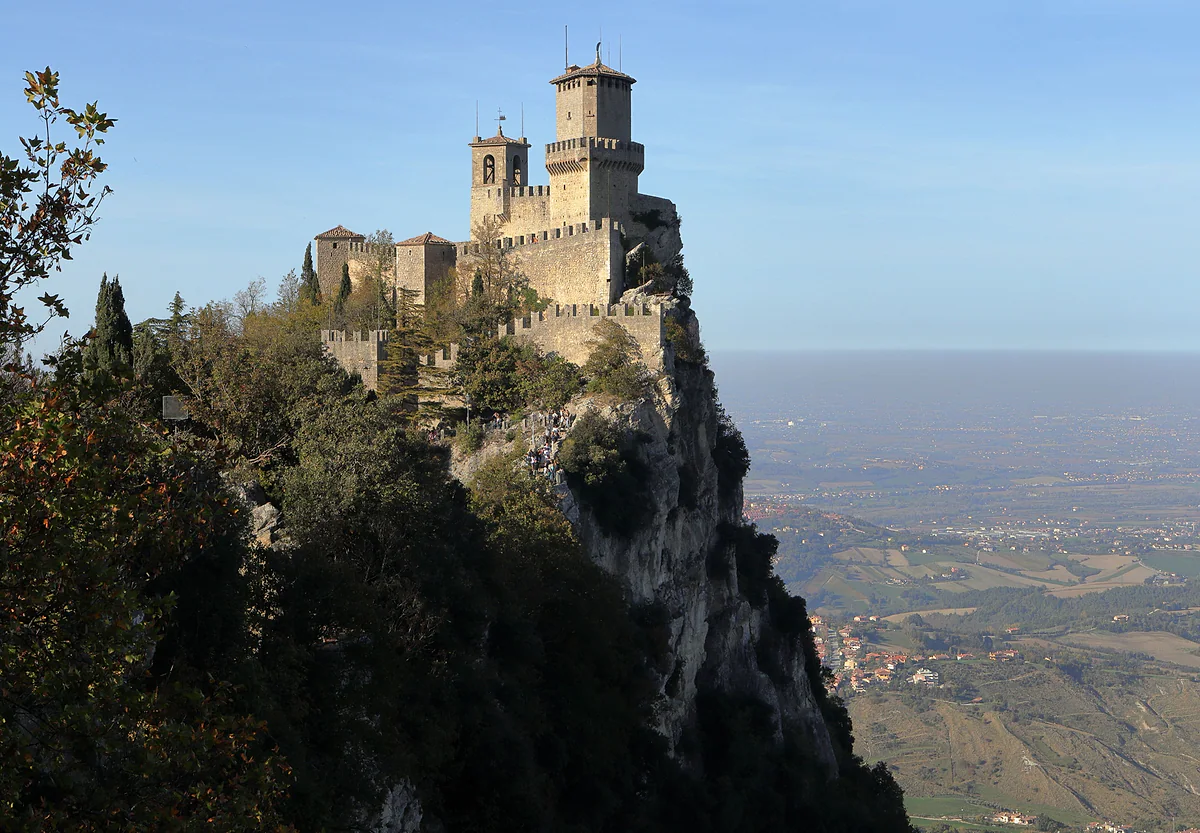
The Guaita, San Marino's first tower, on its rocky crag with its battlemented walls and the plain towards the Adriatic behind.
Titano's three summits and their towers
| Summit | Tower | What we know | Can you go in? |
|---|---|---|---|
| First | Guaita | Core from the 11th century, the oldest of the three; a prison until 1970 | Yes, on the State Museums pass |
| Second | Cesta | The highest summit, 755 m; recorded in 1253; Museum of Ancient Arms with around 700 pieces | Yes, on the State Museums pass |
| Third | Montale | 14th century; its only door is about seven metres off the ground | No, outside only |
Guaita and Cesta from the State Museums. The Montale details come from unofficial sources; that it isn't on the pass is official.
Weather on Titano, selected months
| Month | Average high | Average low | Rainfall |
|---|---|---|---|
| January | 6.4 °C | 2.1 °C | 50.2 mm |
| April | 15.0 °C | 8.5 °C | 59.4 mm |
| July | 27.4 °C | 19.7 °C | 40.4 mm |
| October | 15.6 °C | 10.9 °C | 70.2 mm |
| November | 10.8 °C | 6.7 °C | 99.0 mm |
2006-2023 series credited to Arpae Emilia-Romagna in English Wikipedia; no official Sammarinese source was read. The same source says snow falls almost every winter above 400-500 m.
Test yourself
True or false?
0/4 Pick before you peek.
-
San Marino's highest point is the First Tower, the Guaita.
See the answer
False. The Guaita is the oldest, but the highest summit is the Second Tower, the Cesta, at 755 metres according to the State Museums.
-
Mount Titano appears on a San Marino euro coin.
See the answer
True. According to the European Central Bank, the 20-cent coin of the second series shows Mount Titano with its three towers.
-
All three towers on Titano can be visited inside.
See the answer
False. Only the Guaita and the Cesta. The Montale is seen from outside and isn't among the sites on the State Museums pass.
-
UNESCO lists Titano for its natural value.
See the answer
False. It was listed in 2008 with the old town under criterion (iii), as evidence of a free republic that has continued since the Middle Ages.
- Official height of the Cesta summit
- 755 m
- Peaks, each with its tower
- 3
- Year it joined the UNESCO list
- 2008
- Founding year according to tradition
- 301
Map
Where Mount Titano is
Every number opens its guide. The towers sit on the ridge, the city beside them and Borgo Maggiore below, linked by the cable car.
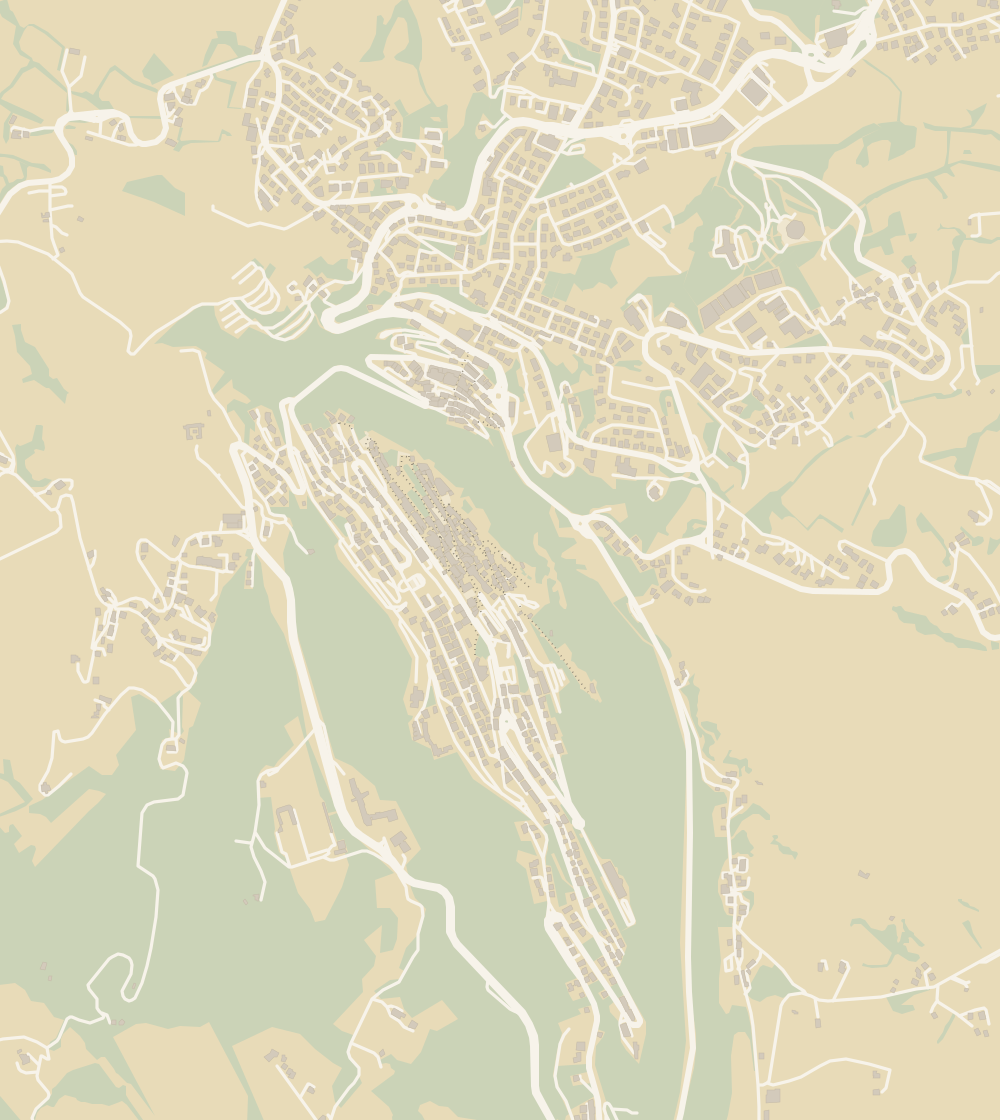 1The Three Towers 2Guaita Tower 3Cesta Tower and Arms Museum 4City of San Marino 5Montale Tower 6Borgo Maggiore 7Witches' Passage 8Palazzo Pubblico 9Changing of the guard 10Basilica of Saint Marinus 11Mount Titano 12Museums 13State Museum 14San Francesco Art Gallery 15Torture Museum 16Cable car (funivia) 17Quirky museums 18Stamp and Coin Museum 19National Gallery 20Valdragone 21San Giovanni sotto le Penne 22Medieval Days 23Christmas 24Hotel Titano 25Grand Hotel San Marino 26Hotel Rosa 27Hotel Crocenzi 28Hotel La Rocca 29Porta San Francesco 30Cava dei Balestrieri 31Map 32Teatro Titano 33Church of San Quirino 34Trenino Bianco Azzurro 35Consolazione Sanctuary 36University 37Prison 38Piazza della Libertà
 Map data © OpenStreetMap contributors (ODbL)
- 1The Three TowersTwo open inside, the third only from outside
- 2Guaita TowerAn 11th-century fortress that was a jail until 1970
- 3Cesta Tower and Arms MuseumThe top of Mount Titano, at 755 metres
- 4City of San MarinoWorld Heritage since 2008
- 5Montale TowerNo ticket, no hours, no pass
- 6Borgo MaggioreA cable car to the capital every 15 minutes
- 7Witches' PassageAbout 200 metres of battlements, no ticket
- 8Palazzo PubblicoClosed for restoration in 2026
- 9Changing of the guardNo timetable in any reliable source
- 10Basilica of Saint MarinusNeoclassical, begun in 1826, free to enter
- 11Mount Titano755 metres at the top of the Cesta
- 12MuseumsOne €11 ticket, seven venues
- 13State MuseumOpen to the public since 1899
- 14San Francesco Art GalleryIn the Franciscan cloister since 1966
- 15Torture MuseumMore than 100 original instruments
- 16Cable car (funivia)Closed from 21 to 23 October 2026
- 17Quirky museumsThree private museums with their own websites
- 18Stamp and Coin MuseumStamps since 1877, on the €11 pass
- 19National GalleryOpened on 7 July 2018
- 20ValdragoneA curazia of Borgo Maggiore
- 21San Giovanni sotto le PenneA curazia of Borgo Maggiore, below the towers
- 22Medieval DaysJuly, the old town and free entry
- 23Christmas28 November to 6 January, with a caveat
- 24Hotel TitanoOpen since 30 September 1894
- 25Grand Hotel San MarinoA hot tub on the third-floor terrace
- 26Hotel RosaFamily-run and open all year since 1965
- 27Hotel Crocenzi1 km from the cable car, 3 km from the old town
- 28Hotel La RoccaNot the Rocca, but on the road up to it
- 29Porta San FrancescoA guard post since 1361
- 30Cava dei BalestrieriThe crossbowmen's range since 1965
- 31MapNine castelli in 61 km²
- 32Teatro Titano2026-27 season from 22 October
- 33Church of San QuirinoOn the 5-cent coin
- 34Trenino Bianco AzzurroRimini to the City, 1932 to 1944
- 35Consolazione SanctuaryConsecrated on 11 June 1967
- 36UniversityCreated by law on 31 October 1985
- 37PrisonEmpty on the day the European inspectors arrived
- 38Piazza della LibertàIt used to be called the Pianello
0 of 108 San Marino guides
Your next stamp
- Cesta Tower and Arms Museum
- The Three Towers
- Walking trails
- Montegiardino
- City of San Marino
- Montale Tower
- Viewpoints
- Things to do
- One day
- Two days
- Guaita Tower
- The 9 castelli
- Borgo Maggiore
- Witches' Passage
- Palazzo Pubblico
- Serravalle
- Changing of the guard
- Dogana
- Acquaviva
- Basilica of Saint Marinus
- Chiesanuova
- Domagnano
- Faetano
- Fiorentino
- Museums
- State Museum
- San Francesco Art Gallery
- Torture Museum
- Cable car (funivia)
- Quirky museums
- Murata
- Stamp and Coin Museum
- Cailungo
- National Gallery
- Valdragone
- Best time to visit
- Getting there
- Ventoso
- Rimini to San Marino
- San Giovanni sotto le Penne
- Weather
- Getting around
- In winter
- With kids
- In summer
- Parking
- Passport stamp
- Rainy day
- Nightlife
- Phone and roaming
- Casino
- Gualdicciolo
- Money
- Coins and stamps
- Torraccia
- Falciano
- Shopping and tax-free
- Rovereta
- Lake Faetano
- Events
- Beaches
- Medieval Days
- Christmas
- MotoGP
- Where to stay
- Hotel Titano
- Where to eat
- Food
- Grand Hotel San Marino
- Luxury hotels
- Free and cheap
- Hotel iDesign
- Day trips
- Hotel Rosa
- Safety and rules
- Hotel Crocenzi
- Language
- Entry requirements
- Hotel La Rocca
- Healthcare and emergencies
- Plugs and voltage
- Is it a country?
- Opening hours
- Porta San Francesco
- Tap water
- Cava dei Balestrieri
- Map
- Post office
- Cost of a trip
- Flag
- Teatro Titano
- Accessibility
- Church of San Quirino
- History
- Captains Regent
- Trenino Bianco Azzurro
- With a dog
- Consolazione Sanctuary
- Facts
- University
- Weddings
- Wine
- Prison
- Camping
- Piazza della Libertà
- Is it worth visiting?
- Constitution
Frequently asked questions
How high is Mount Titano?
The State Museums' official figure is 755 metres, at the top of the Second Tower, the Cesta. Other numbers circulate, such as 739 m on Wikipedia or 749 and 756 m on a private website, but I go with the official one.
What is the highest point in San Marino?
The summit of the Cesta, the Second Tower, on Mount Titano, at 755 metres according to the State Museums. The Guaita and the Montale stand on the mountain's other two peaks.
Is Mount Titano a UNESCO site?
Yes. In 2008 UNESCO listed San Marino Historic Centre and Mount Titano, which joins the mountain and the old town in 55 hectares, plus a 167-hectare buffer zone.
Can you walk up Mount Titano?
Once on top, the city and the towers are all on foot, and the full walk to the Montale and back from Piazza della Libertà takes around three hours, according to a private website. For the climb from below, the easy options are the bus or the cable car.
Why is San Marino on a mountain?
According to tradition, Marinus, a stonemason from the island of Arbe, took refuge on Titano from Diocletian's persecution and founded a community there in 301. The mountain gave the country its natural defence.
Does it snow on Mount Titano?
According to English Wikipedia, citing Arpae data, snow falls frequently almost every winter above 400 or 500 metres. The city sits above that level.
By
Tourism graduate with a master’s in Tourism Management and Planning from the University of Málaga, who has travelled across Europe. He writes every guide from official sources and his own judgement.
Published on . Facts checked on .
Sources
Photos: Francesco Bini (CC BY-SA 4.0); Terragio67 (CC BY-SA 4.0); Commonists (CC BY-SA 4.0); Terragio67 (CC BY-SA 4.0), via Wikimedia Commons.