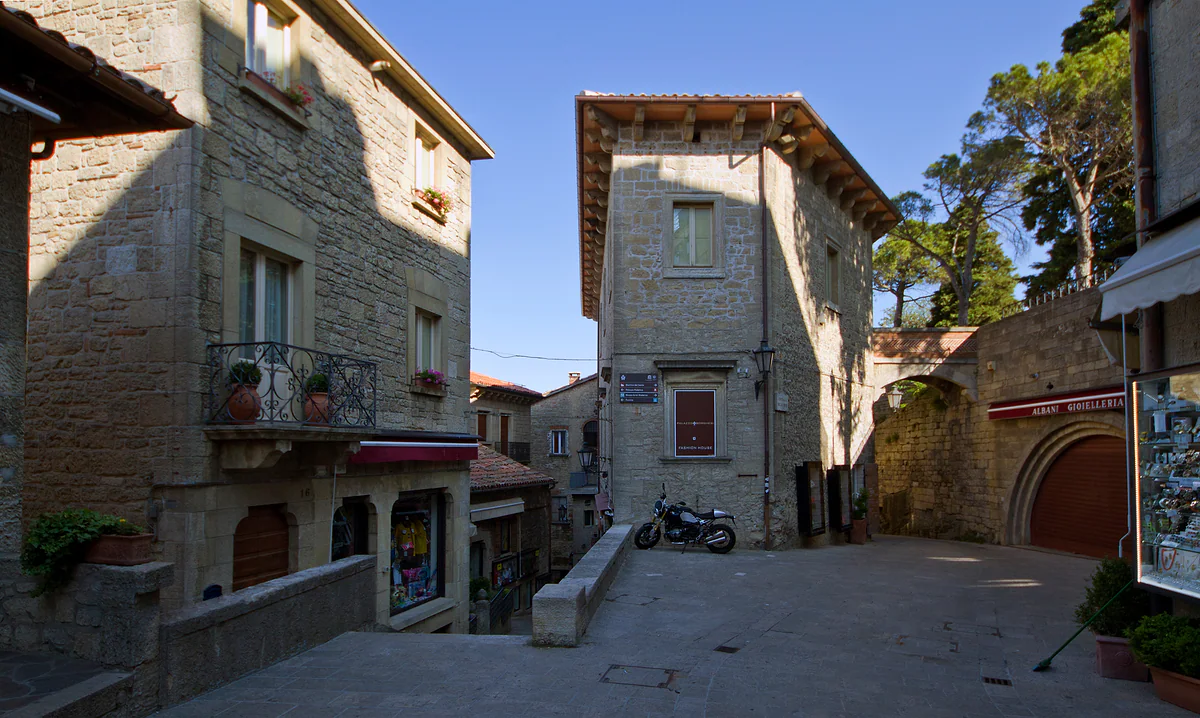
Italian on the signs, Romagnol at home
What language they speak in San Marino, and how to get by
The official language of San Marino is Italian, according to the Spanish foreign ministry's country profile, and it's what you'll see on every sign, menu and museum panel. Many locals also speak Sammarinese, a variety of Romagnol with no official status and no standard spelling. There is no separate San Marino language, and a handful of Italian phrases will carry you a long way.
In 30 seconds
Full read: 3 min
- San Marino's official language is Italian, according to the Spanish foreign ministry.
- Sammarinese is a local variety of Romagnol, unofficial and without a standard spelling.
- There's no separate San Marino language distinct from Italian.
- No official figures exist for English; ten Italian phrases go a long way.
I'd learn ten words of Italian before going up. You'll be served without them, but in a country of 34,000 people that lives off visitors, opening with buongiorno rather than hello changes the tone. Leave Sammarinese for listening, as nobody picks it up on a day trip.

Before you go
What I would keep in mind
-
01 My tip
Lead with Italian, then ask about English
A polite «mi scusi, parla inglese?» tends to go down better than launching straight into English. It's a small thing, but in a place this size people notice who has made the effort.
-
02 Most beautiful
Dughéna, San Marèin, Bórg
In Sammarinese, Dogana becomes Dughéna, the capital San Marèin and Borgo Maggiore just Bórg, according to the 2021 dictionary quoted by Wikipedia. Hearing it from older locals at the Thursday market is as local as San Marino gets.
Borgo Maggiore and its market -
03 My tip
Plan museum visits from the English website
The State Museums website runs in Italian and English, so you can read up on what's inside before you buy the pass instead of puzzling over Italian labels once you're in.
museums in San Marino -
04 Getting there
Nothing changes at the border, including the language
Crossing from Italy at Dogana, there's no passport check and the signs stay in Italian. It's the clearest sign of how intertwined the two countries are, and why so many visitors ask whether San Marino is really a country.
is San Marino a country?
Short answer, Italian. The more interesting answer is that San Marino also has a way of speaking all of its own, which hardly any guide mentions and which tells you something about the place. Here’s both, plus what you actually need to get around if your Italian stops at ciao.
What language is spoken in San Marino?
Italian, for everything. The country profile published by Spain’s foreign ministry in April 2026 lists it as the official language, and it’s the language of every street sign, menu, bus timetable and museum panel you’ll see. You arrive on a bus from an Italian railway station, pay in euros and read Italian from start to finish, which is exactly why so many people end up asking whether it’s really a separate state. I deal with that in is San Marino a country?
I find that more telling than it first looks. A republic that dates its independence, by tradition, to the year 301 has never needed a language of its own to feel distinct. The towers, the Captains Regent and the history do that job, not the vocabulary.
Sammarinese, the language you won’t see written down
The same Spanish profile names a second language, «romañolo sammarinese», and marks it as unofficial. It’s the local variety of Romagnol, a Romance language in the Gallo-Italic family that’s also spoken across Romagna in Italy. Wikipedia places it somewhere between the speech of Rimini, the Marecchia valley and Urbino, with Serravalle sounding closest to Rimini, which makes sense once you look at a map.
What strikes me is how fragile it is. There’s no official spelling and no standard, and the first dictionary only appeared in 2021, published by the Ente Cassa di Faetano. Wikipedia says 83% of residents speak it and calls its state critical, with a projection that it could be gone by around 2040. Those figures are undated and second-hand, so I’d treat them with care, but the picture fits what’s happening to dialects all over Italy.
That dictionary also gives the local names for places. Dogana is Dughéna, the capital is San Marèin and Borgo Maggiore shrinks to Bórg. If you’re at the Thursday market in Borgo Maggiore and two older locals are chatting, chances are you won’t catch a word, and that’s about as authentic a moment as the country offers.
Will English get you by?
Honestly, I can’t give you a figure, as no official body I’ve come across publishes one. What I can confirm is that the State Museums run their website in English as well as Italian, which suggests the main sights expect English-speaking visitors. I’d count on English in the busiest parts of the old town and fall back on Italian everywhere else, from the bus driver to the pharmacy.
The good news is that Italian is forgiving for an English speaker when it’s written down. «Uscita» is the exit, «chiuso» means closed and «biglietteria» is the ticket office, and after an hour you’ll be reading menus without much trouble. Spoken Italian at full speed is harder, and the trick is simply to ask people to slow down. «Più piano, per favore» does the job. If something medical or official goes wrong, the UK government keeps lists of English-speaking doctors, lawyers and translators, though the ones it points to are in Italy rather than San Marino itself, which is worth knowing before you need them.
The ten phrases I’d take
The table above has ten phrases of standard Italian, chosen for what you’ll actually do. Greeting someone in a shop, asking for the bill, finding the bus stop and buying the ticket back down to Rimini, which is where most visitors get tongue-tied. Times and fares for that journey are in Rimini to San Marino by bus.
Don’t try to memorise the lot. Buongiorno, grazie, per favore and il conto will already change how people respond to you. And if you’re stuck, a smiling «mi scusi, parla inglese?» opens more doors than starting in English as if it were a given.
What the language doesn’t change
Hearing Italian all around you doesn’t mean you’re in Italy for practical purposes. Your phone is the obvious trap, because UK networks set their own roaming terms for San Marino whatever language the adverts are in, which I cover in phone and roaming in San Marino. The border has no checks either, but the passport rules for British travellers still apply, and they’re set out in San Marino entry requirements.
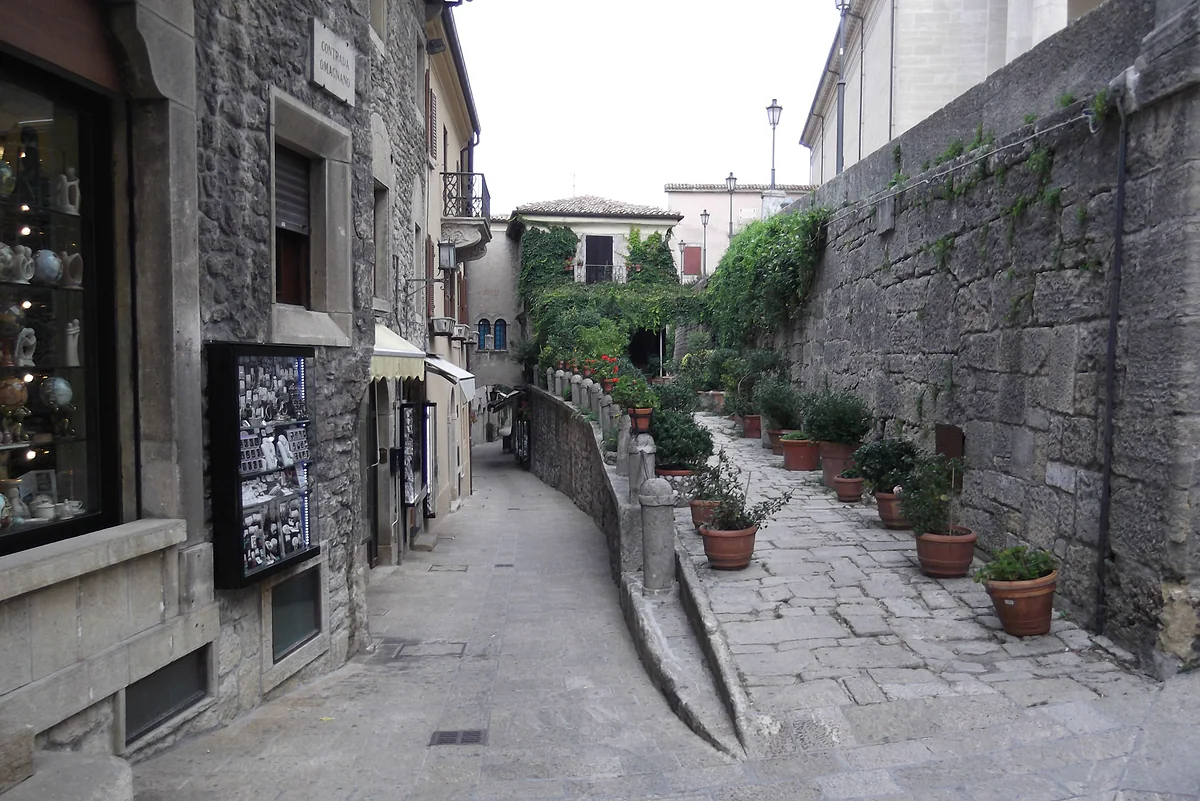
A cobbled street in the old town slopes down between stone facades, shops and flower pots along the wall.
Ten Italian phrases I'd keep on my phone
| English | Italian | When you'll need it |
|---|---|---|
| Good morning | Buongiorno | Walking into a shop or café, until mid-afternoon |
| Good evening | Buonasera | From mid-afternoon onwards |
| Thank you | Grazie | All the time |
| Please | Per favore | When ordering |
| Excuse me | Mi scusi | To catch someone's attention |
| How much is it? | Quanto costa? | In the old town shops |
| The bill, please | Il conto, per favore | At the end of a meal |
| Where's the bus stop? | Dov'è la fermata dell'autobus? | For the bus back down to Rimini |
| A ticket to Rimini | Un biglietto per Rimini | On the Bonelli bus |
| Do you speak English? | Parla inglese? | When you're stuck |
Standard Italian, San Marino's official language according to the Spanish foreign ministry's country profile (April 2026).
Place names in Sammarinese
| Official name | In Sammarinese |
|---|---|
| City of San Marino | San Marèin (San Maróin in Serravalle) |
| Borgo Maggiore | Bórg |
| Serravalle | Seravàl |
| Dogana | Dughéna |
| Domagnano | Dmagnén |
| Faetano | Faitèn |
From the 2021 «Dizionario di dialetto sammarinese», as quoted by Wikipedia. Sammarinese has no official spelling.
Test yourself
True or false?
0/4 Pick before you peek.
-
San Marino has its own national language, separate from Italian.
See the answer
False. The official language is Italian. The local speech, Sammarinese, is a variety of Romagnol with no official status.
-
Sammarinese has an official spelling set by the state.
See the answer
False. According to Wikipedia there's no official spelling or standard. The first dictionary, published by the Ente Cassa di Faetano, came out in 2021.
-
In Sammarinese, Borgo Maggiore is simply called Bórg.
See the answer
True. That's how the 2021 dictionary quoted by Wikipedia gives it, alongside Dughéna for Dogana and San Marèin for the capital.
-
Romagnol, the language behind Sammarinese, is also spoken in Italy.
See the answer
True. It's spoken across Romagna, in San Marino and in the Tuscan part of Romagna, which is why Serravalle's speech sounds so close to Rimini's.
- Official language: Italian
- 1
- First dictionary of Sammarinese
- 2021
- Year Sammarinese could vanish, per Wikipedia
- 2040
Map
Where Language is
Every number opens its guide. The towers sit on the ridge, the city beside them and Borgo Maggiore below, linked by the cable car.
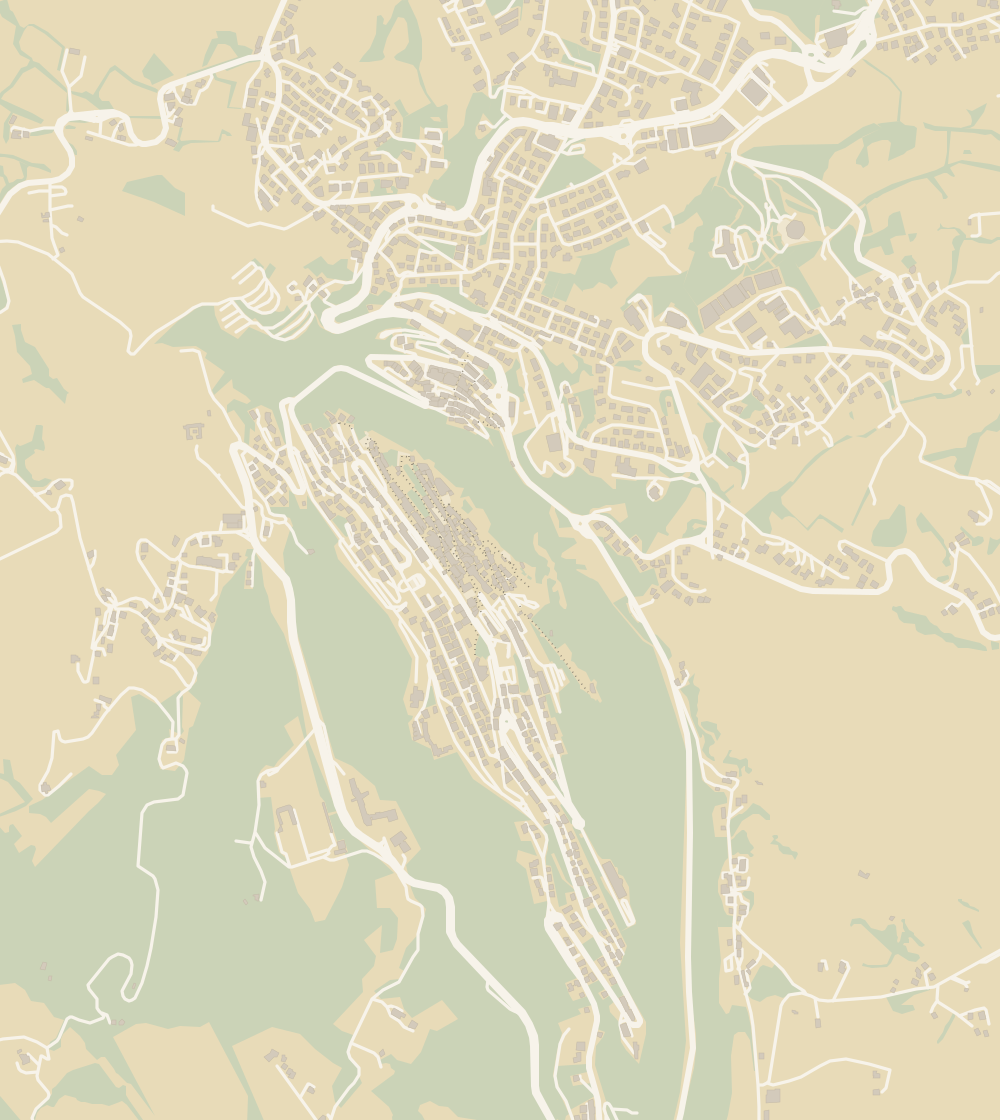 1The Three Towers 2Guaita Tower 3Cesta Tower and Arms Museum 4City of San Marino 5Montale Tower 6Borgo Maggiore 7Witches' Passage 8Palazzo Pubblico 9Changing of the guard 10Basilica of Saint Marinus 11Mount Titano 12Museums 13State Museum 14San Francesco Art Gallery 15Torture Museum 16Cable car (funivia) 17Quirky museums 18Stamp and Coin Museum 19National Gallery 20Valdragone 21San Giovanni sotto le Penne 22Medieval Days 23Christmas 24Hotel Titano 25Grand Hotel San Marino 26Hotel Rosa 27Hotel Crocenzi 28Hotel La Rocca 29Porta San Francesco 30Cava dei Balestrieri 31Map 32Teatro Titano 33Church of San Quirino 34Trenino Bianco Azzurro 35Consolazione Sanctuary 36University 37Prison 38Piazza della Libertà
 Map data © OpenStreetMap contributors (ODbL)
- 1The Three TowersTwo open inside, the third only from outside
- 2Guaita TowerAn 11th-century fortress that was a jail until 1970
- 3Cesta Tower and Arms MuseumThe top of Mount Titano, at 755 metres
- 4City of San MarinoWorld Heritage since 2008
- 5Montale TowerNo ticket, no hours, no pass
- 6Borgo MaggioreA cable car to the capital every 15 minutes
- 7Witches' PassageAbout 200 metres of battlements, no ticket
- 8Palazzo PubblicoClosed for restoration in 2026
- 9Changing of the guardNo timetable in any reliable source
- 10Basilica of Saint MarinusNeoclassical, begun in 1826, free to enter
- 11Mount Titano755 metres at the top of the Cesta
- 12MuseumsOne €11 ticket, seven venues
- 13State MuseumOpen to the public since 1899
- 14San Francesco Art GalleryIn the Franciscan cloister since 1966
- 15Torture MuseumMore than 100 original instruments
- 16Cable car (funivia)Closed from 21 to 23 October 2026
- 17Quirky museumsThree private museums with their own websites
- 18Stamp and Coin MuseumStamps since 1877, on the €11 pass
- 19National GalleryOpened on 7 July 2018
- 20ValdragoneA curazia of Borgo Maggiore
- 21San Giovanni sotto le PenneA curazia of Borgo Maggiore, below the towers
- 22Medieval DaysJuly, the old town and free entry
- 23Christmas28 November to 6 January, with a caveat
- 24Hotel TitanoOpen since 30 September 1894
- 25Grand Hotel San MarinoA hot tub on the third-floor terrace
- 26Hotel RosaFamily-run and open all year since 1965
- 27Hotel Crocenzi1 km from the cable car, 3 km from the old town
- 28Hotel La RoccaNot the Rocca, but on the road up to it
- 29Porta San FrancescoA guard post since 1361
- 30Cava dei BalestrieriThe crossbowmen's range since 1965
- 31MapNine castelli in 61 km²
- 32Teatro Titano2026-27 season from 22 October
- 33Church of San QuirinoOn the 5-cent coin
- 34Trenino Bianco AzzurroRimini to the City, 1932 to 1944
- 35Consolazione SanctuaryConsecrated on 11 June 1967
- 36UniversityCreated by law on 31 October 1985
- 37PrisonEmpty on the day the European inspectors arrived
- 38Piazza della LibertàIt used to be called the Pianello
0 of 108 San Marino guides
Your next stamp
- Is it a country?
- Dogana
- Facts
- Safety and rules
- Phone and roaming
- Entry requirements
- Things to do
- One day
- Two days
- The Three Towers
- Guaita Tower
- Cesta Tower and Arms Museum
- The 9 castelli
- City of San Marino
- Montale Tower
- Borgo Maggiore
- Witches' Passage
- Palazzo Pubblico
- Serravalle
- Changing of the guard
- Acquaviva
- Basilica of Saint Marinus
- Mount Titano
- Chiesanuova
- Domagnano
- Faetano
- Fiorentino
- Montegiardino
- Museums
- State Museum
- San Francesco Art Gallery
- Torture Museum
- Cable car (funivia)
- Quirky museums
- Viewpoints
- Murata
- Stamp and Coin Museum
- Walking trails
- Cailungo
- National Gallery
- Valdragone
- Best time to visit
- Getting there
- Ventoso
- Rimini to San Marino
- San Giovanni sotto le Penne
- Weather
- Getting around
- In winter
- With kids
- In summer
- Parking
- Passport stamp
- Rainy day
- Nightlife
- Casino
- Gualdicciolo
- Money
- Coins and stamps
- Torraccia
- Falciano
- Shopping and tax-free
- Rovereta
- Lake Faetano
- Events
- Beaches
- Medieval Days
- Christmas
- MotoGP
- Where to stay
- Hotel Titano
- Where to eat
- Food
- Grand Hotel San Marino
- Luxury hotels
- Free and cheap
- Hotel iDesign
- Day trips
- Hotel Rosa
- Hotel Crocenzi
- Hotel La Rocca
- Healthcare and emergencies
- Plugs and voltage
- Opening hours
- Porta San Francesco
- Tap water
- Cava dei Balestrieri
- Map
- Post office
- Cost of a trip
- Flag
- Teatro Titano
- Accessibility
- Church of San Quirino
- History
- Captains Regent
- Trenino Bianco Azzurro
- With a dog
- Consolazione Sanctuary
- University
- Weddings
- Wine
- Prison
- Camping
- Piazza della Libertà
- Is it worth visiting?
- Constitution
Frequently asked questions
What language do they speak in San Marino?
Italian. The Spanish foreign ministry's country profile lists it as the official language, alongside Sammarinese, a local variety of Romagnol that it describes as unofficial.
Does San Marino have its own language?
Not a separate national language. What it has is Sammarinese, a dialect of Romagnol with no standard spelling; its first dictionary only came out in 2021.
Do they speak Italian in San Marino?
Yes, everywhere. Street signs, menus, museum panels and the government all use Italian, which is the official language.
Is English widely spoken in San Marino?
I haven't found any official figures on it. The State Museums website is in English as well as Italian, but I'd expect English mainly in the busiest tourist spots and learn a few Italian phrases for everything else.
What is Sammarinese?
It's San Marino's local speech, a variety of Romagnol, the Gallo-Italic language of Romagna. According to Wikipedia it sits somewhere between the dialects of Rimini, the Marecchia valley and Urbino.
Is Sammarinese dying out?
Wikipedia describes its state as critical and mentions a projection that it could disappear around 2040. That's an undated, secondary source, so treat it as a warning sign rather than a firm forecast.
By
Tourism graduate with a master’s in Tourism Management and Planning from the University of Málaga, who has travelled across Europe. He writes every guide from official sources and his own judgement.
Published on . Facts checked on .
Sources
Photos: trolvag (CC BY-SA 3.0); karel291 (CC BY 3.0), via Wikimedia Commons.