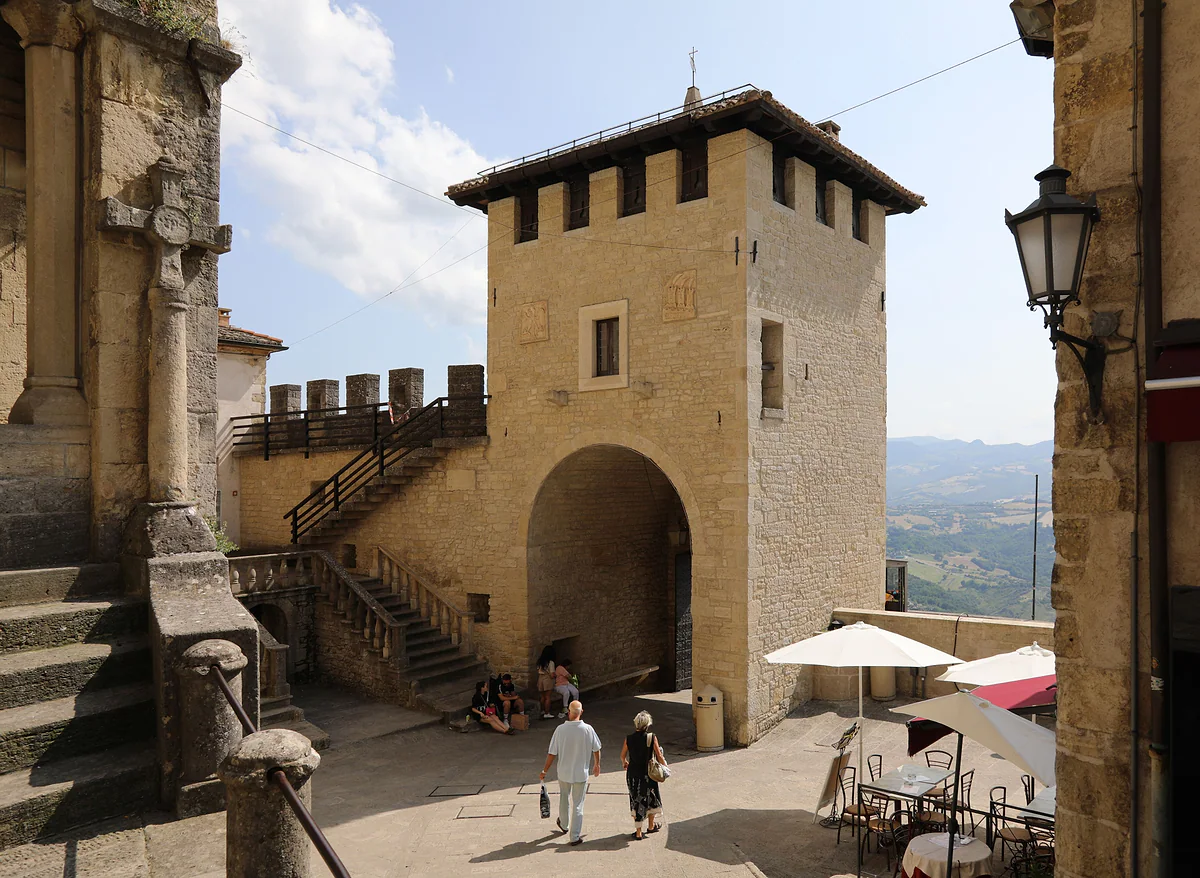
A guard post since 1361
Porta San Francesco, the way into old San Marino
Porta San Francesco, also called Porta del Paese, is the gate in the first ring of walls around the City of San Marino. It began as a guard post in 1361, was remodelled in 1451 and in 1581 gained an outer gate and a crenellated tower with a machicolation. It's free to see at any hour and a few steps from the San Francesco Art Gallery.
In 30 seconds
Full read: 3 min
- Porta San Francesco, or Porta del Paese, is the gate in San Marino's first ring of walls.
- It was built as a guard post in 1361 and gained its outer gate and crenellated tower in 1581.
- Under the arch are 17th-century plaques banning outsiders from entering armed.
- It's free and features on the second-series 2-cent coin.
Don't rush through it. I'd stop under the arch and look for the inscriptions banning people from entering armed, because they say more about how this republic protected itself than any cannon at the Guaita.

Before you go
What I would keep in mind
-
01 My tip
Read the stones under the arch
According to Wikipedia, plaques under the gate carry 17th-century statutes warning outsiders not to enter the city carrying weapons.
-
02 Money
It's probably in your pocket
The ECB describes San Marino's second-series 2-cent coin as showing «the City Gate», which Wikipedia identifies as this one.
San Marino coins and stamps -
03 To save money
Free, right beside the museum pass
The gate has no ticket. A few steps away is the San Francesco Art Gallery, included in the €11 State Museums pass.
San Francesco Art Gallery in San Marino
Almost everyone who walks or takes the bus up to San Marino passes through Porta San Francesco without looking, eyes already fixed on the towers. It’s a small mistake I’d put right, because it’s the first medieval piece you meet and in ten seconds it tells you how this republic felt about outsiders.
A guard post six and a half centuries old
According to Wikipedia, the gate began life as a guard post in 1361. It was thoroughly remodelled in 1451 and altered again in 1581, when it gained an outer gate and the original arch was raised with a crenellated tower and a machicolation, the opening defenders used to drop whatever was to hand on attackers. It was once known as Porta del Loco or del Lucho. Set into the back are the coats of arms of San Marino and the Montefeltro family.
The State Museums call it Porta del Paese and use it to locate the San Francesco Art Gallery, a few steps away inside the first ring of walls. Today’s name comes from that Franciscan convent next door.
The plaques nobody reads
Under the arch are plaques bearing 17th-century statutes that warned outsiders not to enter the city armed. For me that’s the best thing about the gate. A country that prides itself on neutrality and on sheltering refugees was also perfectly clear that nobody walked into its home with a sword drawn. If you’re travelling with children, hunting for them together is a little game that works.
On the 2-cent coin
The ECB describes San Marino’s second-series coins this way, with the 2-cent piece showing «the City Gate», and Wikipedia identifies it as this one. In the first series the same coin carried the Statue of Liberty. It’s a good excuse to check your change in any café in the centre, and I go into more detail in San Marino coins and stamps.
One of four gates
A private Sammarinese tourism site says the historic centre had four gates, Porta San Francesco or del Paese, Porta della Fratta, Porta della Rupe and Porta della Murata, also called Portanova. San Francesco is the one visitors notice most, as it’s on the side you reach from the lower car parks and bus stop. I can’t give you that as an official fact, but in practice it’s the natural way into the old town.
When to walk through
The gate never closes, so the timing depends on what you want to see beyond it. The State Museums go on to winter opening on 27 September 2026, 09:00 until 16:50, and after 16:00 the desks sell a €5 late ticket covering every venue. I’d come through early, see the art gallery before the tour groups arrive and save the rest of the pass for the towers. On that same 27 September, World Tourism Day, the State Museums are free for everyone.
What’s nearby
Once through, you have the church and convent of St Francis on one side, with the gallery inside, and on the other Contrada San Francesco, home to the Torture Museum. Just below, outside the wall, is the church of San Quirino, the Capuchin church that features on the 5-cent coin and holds the story of Garibaldi in San Marino. With only a morning, I’d do gate and church back to back before heading up. From here the climb to Piazza della Libertà and the Palazzo Pubblico takes minutes, and for everything else up there, see the City of San Marino.
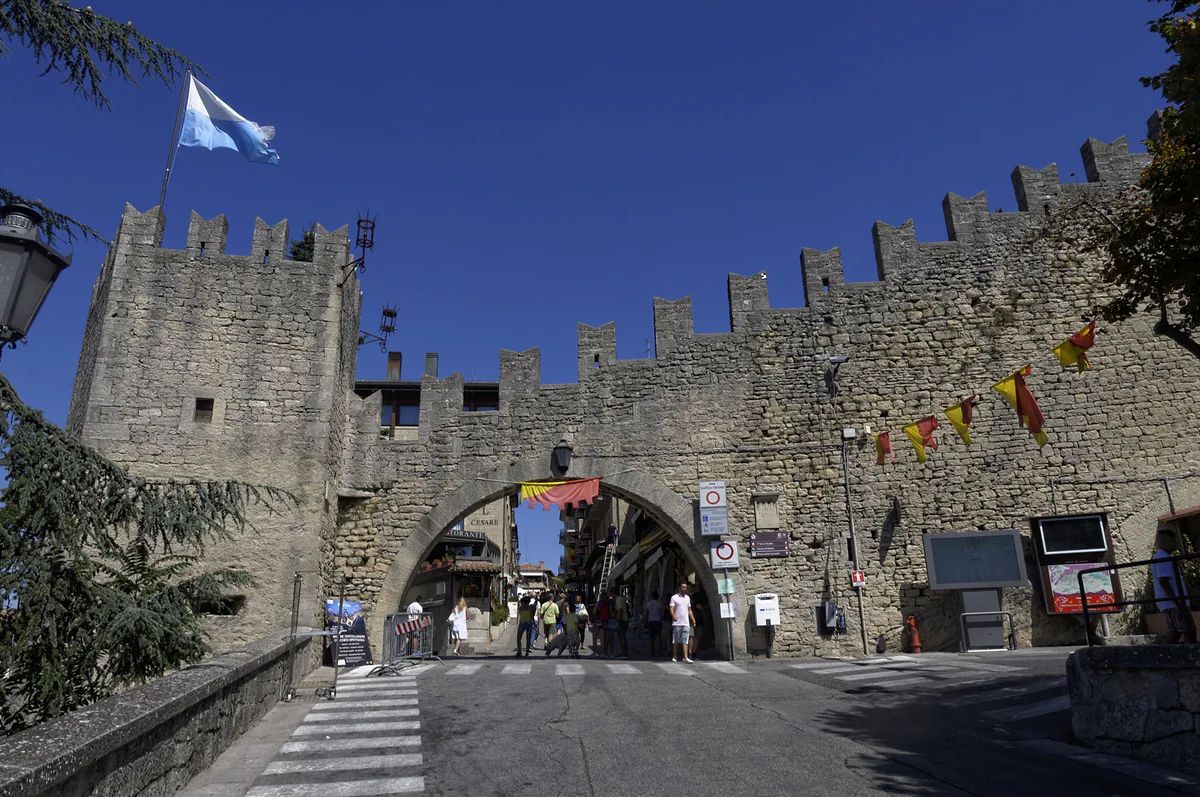
The white and blue flag of San Marino flies over the tower of Porta San Francesco, the battlemented entrance to the town.
Porta San Francesco through the centuries
| Year | What happened | Source |
|---|---|---|
| 1361 | Built as a guard post | Wikipedia |
| 1451 | Thoroughly remodelled | Wikipedia |
| 1581 | Outer gate added, arch raised with a crenellated tower and machicolation | Wikipedia |
| 17th century | Plaques with the statutes against carrying arms | Wikipedia |
| Second euro series | Appears on the 2-cent coin | ECB |
No opening hours or fee. It's a gateway in the wall, open at all times.
Test yourself
True or false?
0/3 Pick before you peek.
-
Porta San Francesco was built as a grand ceremonial entrance for visitors.
See the answer
False. It began in 1361 as a guard post, according to Wikipedia. The crenellated tower with its machicolation and the outer gate were added in 1581.
-
Plaques under the gate once banned people from entering the city armed.
See the answer
True. They're 17th-century statutes warning outsiders they couldn't come in with weapons, according to Wikipedia.
-
Porta San Francesco appears on a San Marino euro coin.
See the answer
True. The ECB describes the second-series 2-cent coin as showing the City Gate. In the first series that coin carried the Statue of Liberty.
- Year the guard post was built
- 1361
- Year of the crenellated tower
- 1581
- Second-series coin showing the gate
- 2 cent
Map
Where Porta San Francesco is
Every number opens its guide. The towers sit on the ridge, the city beside them and Borgo Maggiore below, linked by the cable car.
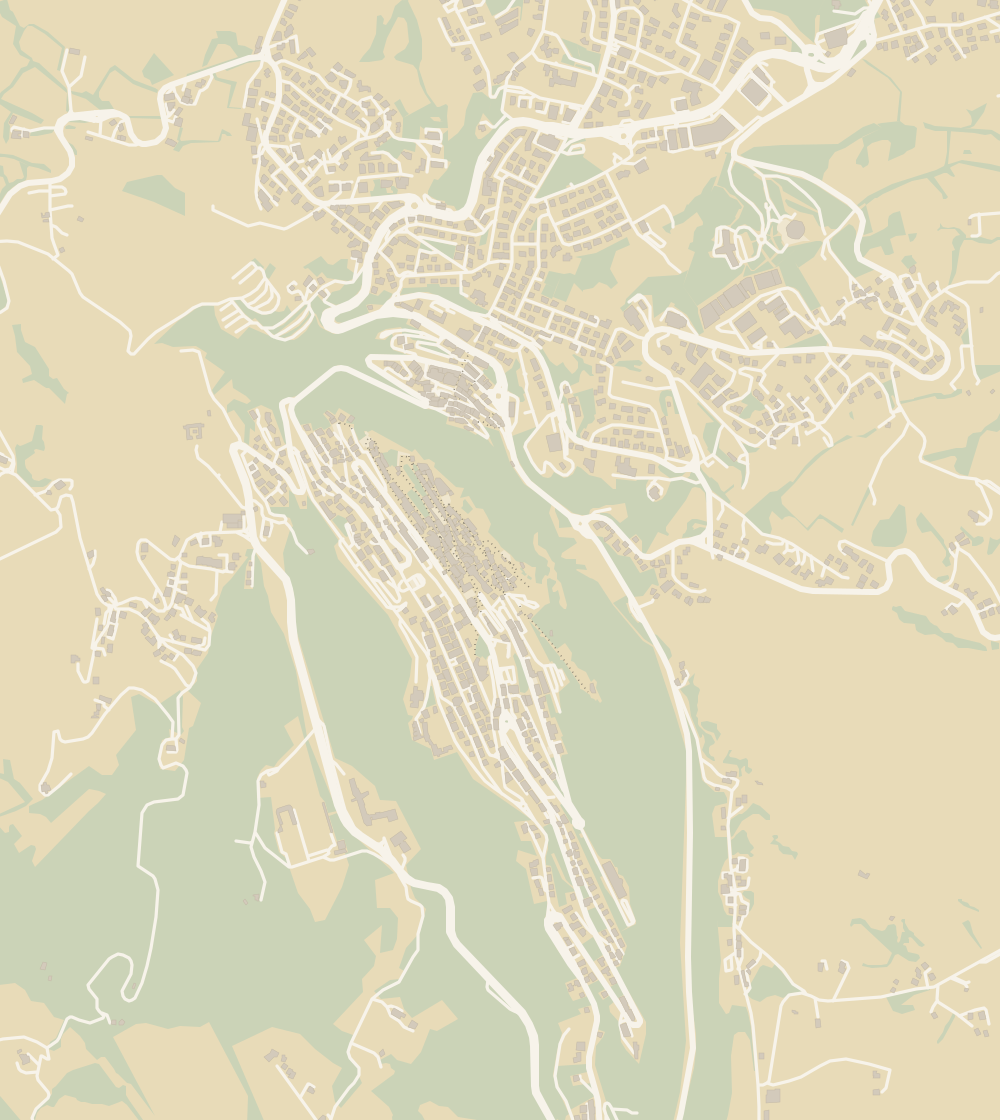 1The Three Towers 2Guaita Tower 3Cesta Tower and Arms Museum 4City of San Marino 5Montale Tower 6Borgo Maggiore 7Witches' Passage 8Palazzo Pubblico 9Changing of the guard 10Basilica of Saint Marinus 11Mount Titano 12Museums 13State Museum 14San Francesco Art Gallery 15Torture Museum 16Cable car (funivia) 17Quirky museums 18Stamp and Coin Museum 19National Gallery 20Valdragone 21San Giovanni sotto le Penne 22Medieval Days 23Christmas 24Hotel Titano 25Grand Hotel San Marino 26Hotel Rosa 27Hotel Crocenzi 28Hotel La Rocca 29Porta San Francesco 30Cava dei Balestrieri 31Map 32Teatro Titano 33Church of San Quirino 34Trenino Bianco Azzurro 35Consolazione Sanctuary 36University 37Prison 38Piazza della Libertà
 Map data © OpenStreetMap contributors (ODbL)
- 1The Three TowersTwo open inside, the third only from outside
- 2Guaita TowerAn 11th-century fortress that was a jail until 1970
- 3Cesta Tower and Arms MuseumThe top of Mount Titano, at 755 metres
- 4City of San MarinoWorld Heritage since 2008
- 5Montale TowerNo ticket, no hours, no pass
- 6Borgo MaggioreA cable car to the capital every 15 minutes
- 7Witches' PassageAbout 200 metres of battlements, no ticket
- 8Palazzo PubblicoClosed for restoration in 2026
- 9Changing of the guardNo timetable in any reliable source
- 10Basilica of Saint MarinusNeoclassical, begun in 1826, free to enter
- 11Mount Titano755 metres at the top of the Cesta
- 12MuseumsOne €11 ticket, seven venues
- 13State MuseumOpen to the public since 1899
- 14San Francesco Art GalleryIn the Franciscan cloister since 1966
- 15Torture MuseumMore than 100 original instruments
- 16Cable car (funivia)Closed from 21 to 23 October 2026
- 17Quirky museumsThree private museums with their own websites
- 18Stamp and Coin MuseumStamps since 1877, on the €11 pass
- 19National GalleryOpened on 7 July 2018
- 20ValdragoneA curazia of Borgo Maggiore
- 21San Giovanni sotto le PenneA curazia of Borgo Maggiore, below the towers
- 22Medieval DaysJuly, the old town and free entry
- 23Christmas28 November to 6 January, with a caveat
- 24Hotel TitanoOpen since 30 September 1894
- 25Grand Hotel San MarinoA hot tub on the third-floor terrace
- 26Hotel RosaFamily-run and open all year since 1965
- 27Hotel Crocenzi1 km from the cable car, 3 km from the old town
- 28Hotel La RoccaNot the Rocca, but on the road up to it
- 29Porta San FrancescoA guard post since 1361
- 30Cava dei BalestrieriThe crossbowmen's range since 1965
- 31MapNine castelli in 61 km²
- 32Teatro Titano2026-27 season from 22 October
- 33Church of San QuirinoOn the 5-cent coin
- 34Trenino Bianco AzzurroRimini to the City, 1932 to 1944
- 35Consolazione SanctuaryConsecrated on 11 June 1967
- 36UniversityCreated by law on 31 October 1985
- 37PrisonEmpty on the day the European inspectors arrived
- 38Piazza della LibertàIt used to be called the Pianello
0 of 108 San Marino guides
Your next stamp
- San Francesco Art Gallery
- Guaita Tower
- Piazza della Libertà
- Stamp and Coin Museum
- City of San Marino
- Viewpoints
- State Museum
- Basilica of Saint Marinus
- Things to do
- One day
- Two days
- The Three Towers
- Cesta Tower and Arms Museum
- The 9 castelli
- Montale Tower
- Borgo Maggiore
- Witches' Passage
- Palazzo Pubblico
- Serravalle
- Changing of the guard
- Dogana
- Acquaviva
- Mount Titano
- Chiesanuova
- Domagnano
- Faetano
- Fiorentino
- Montegiardino
- Museums
- Torture Museum
- Cable car (funivia)
- Quirky museums
- Murata
- Walking trails
- Cailungo
- National Gallery
- Valdragone
- Best time to visit
- Getting there
- Ventoso
- Rimini to San Marino
- San Giovanni sotto le Penne
- Weather
- Getting around
- In winter
- With kids
- In summer
- Parking
- Passport stamp
- Rainy day
- Nightlife
- Phone and roaming
- Casino
- Gualdicciolo
- Money
- Coins and stamps
- Torraccia
- Falciano
- Shopping and tax-free
- Rovereta
- Lake Faetano
- Events
- Beaches
- Medieval Days
- Christmas
- MotoGP
- Where to stay
- Hotel Titano
- Where to eat
- Food
- Grand Hotel San Marino
- Luxury hotels
- Free and cheap
- Hotel iDesign
- Day trips
- Hotel Rosa
- Safety and rules
- Hotel Crocenzi
- Language
- Entry requirements
- Hotel La Rocca
- Healthcare and emergencies
- Plugs and voltage
- Is it a country?
- Opening hours
- Tap water
- Cava dei Balestrieri
- Map
- Post office
- Cost of a trip
- Flag
- Teatro Titano
- Accessibility
- Church of San Quirino
- History
- Captains Regent
- Trenino Bianco Azzurro
- With a dog
- Consolazione Sanctuary
- Facts
- University
- Weddings
- Wine
- Prison
- Camping
- Is it worth visiting?
- Constitution
Frequently asked questions
What is Porta San Francesco in San Marino?
It's the gate in the first ring of walls of the City of San Marino, also called Porta del Paese. It started as a guard post in 1361 and took its present shape, with a crenellated tower, in 1581.
Why is it called Porta San Francesco?
After the Franciscan convent and church beside it, now home to the San Francesco Art Gallery. Wikipedia notes it was once called Porta del Loco or del Lucho.
Do you have to pay to see Porta San Francesco?
No. It's a gateway in the town wall and you can see it free at any time. The art gallery next door is paid, with the €11 State Museums pass.
Which coin shows Porta San Francesco?
The 2-cent coin of San Marino's second series, which the ECB says shows the City Gate. In the first series that coin showed the Statue of Liberty.
How many gates does the City of San Marino have?
A private tourism site lists four in the historic centre, Porta San Francesco, Porta della Fratta, Porta della Rupe and Porta della Murata, also known as Portanova.
By
Tourism graduate with a master’s in Tourism Management and Planning from the University of Málaga, who has travelled across Europe. He writes every guide from official sources and his own judgement.
Published on . Facts checked on .
Sources
Photos: Francesco Bini (CC BY-SA 4.0); © Ra Boe / Wikipedia (CC BY-SA 3.0 de), via Wikimedia Commons.