Inside the Vatican Museums
The Sistine Chapel, what I'd look at first and why

- Monday to Saturday
- 08:00–20:00
- Entry
- Vatican Museums ticket, from €20
The Sistine Chapel is the last stretch of the Vatican Museums route, and you get in on a museum ticket, €20 at the door or €25 booked online, or free on the last Sunday of the month. Michelangelo painted the ceiling between 1508 and 1512 and the Last Judgement between 1536 and 1541, above walls painted in 1481-1482 by Perugino, Botticelli, Ghirlandaio and Rosselli. No photos inside.
I'd do my reading before going in, in the Pine Cone Courtyard or at home, and once inside I'd take the ceiling in three passes, from the entrance to the altar, before turning to the Last Judgement. On the first slot of the morning you also get a little more room to breathe.
In 30 seconds
Full read: 6 min
- There's no Sistine Chapel ticket as such. You see it on a Vatican Museums ticket, which costs €20 on the door or €25 through the official booking site.
- It's the last room on the museums route, which welcomes visitors Monday to Saturday from 08:00 and stops letting people in at 18:00.
- Michelangelo painted the ceiling from 1508 to 1512 and the Last Judgement from 1536 to 1541, while the walls by Botticelli, Perugino and others date from 1481-1482.
- Photos, filming and phones are banned inside and guides must stay silent, so I'd arrive with the ceiling already studied.
- I'd book the 08:00 online slot on a weekday rather than the free last Sunday, which crams everyone into 09:00 to 14:00.
Before you set off, check this
My ranking, scored
The scenes I'd look at first
My own scores out of 10. They weigh how much each part impresses from the floor and how much it tells you about the chapel, and the order is the one I'd follow on an unhurried visit. It's a way of sharing out your attention, not an art history verdict.
0 of 7 seen
-
Michelangelo's ceiling
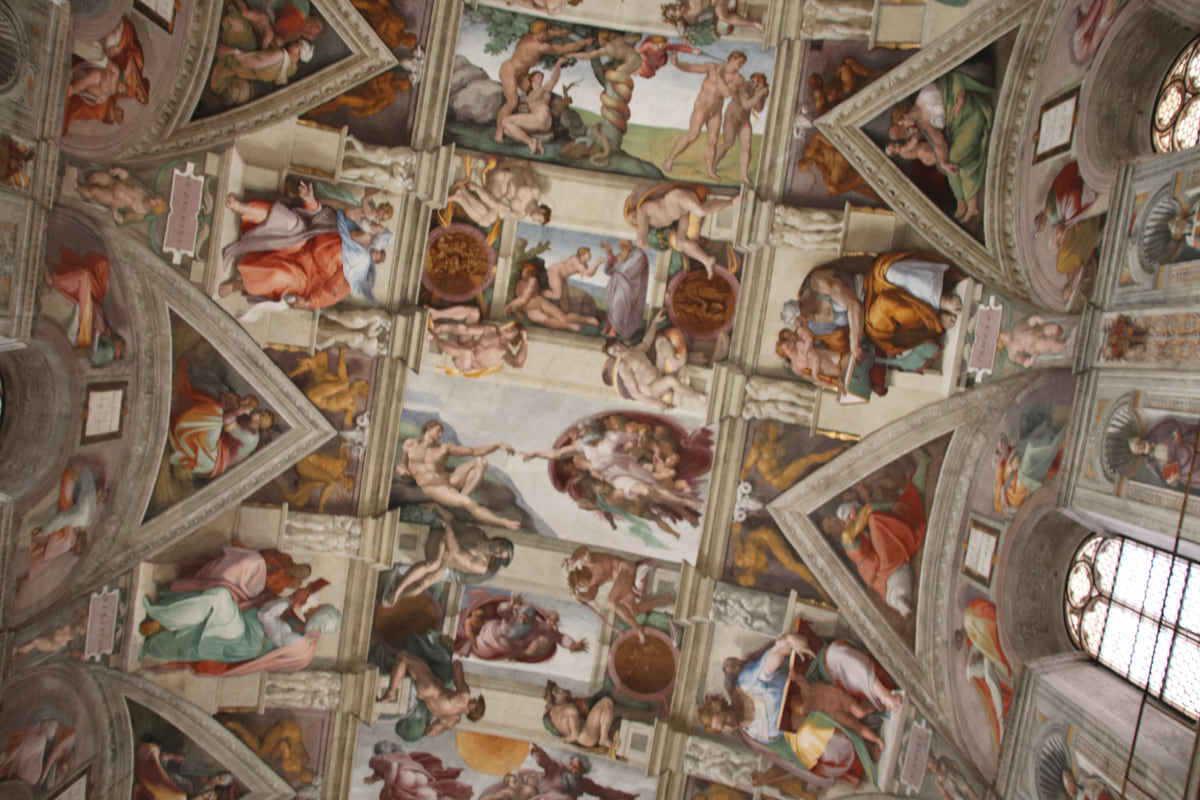
Four years of work, from 1508 to 1512, over a room almost 21 metres high. It's the reason for the queue, and the central band of nine Genesis scenes reads from one end of the chapel to the other.
9.8 out of 10
-
The Creation of Adam
It sits in the central band and it's the scene nearly everyone hunts for the moment they walk in. I'd use it as an anchor to get my bearings, then follow the rest of Genesis along the length of the room.
9.6 out of 10
-
The Last Judgement
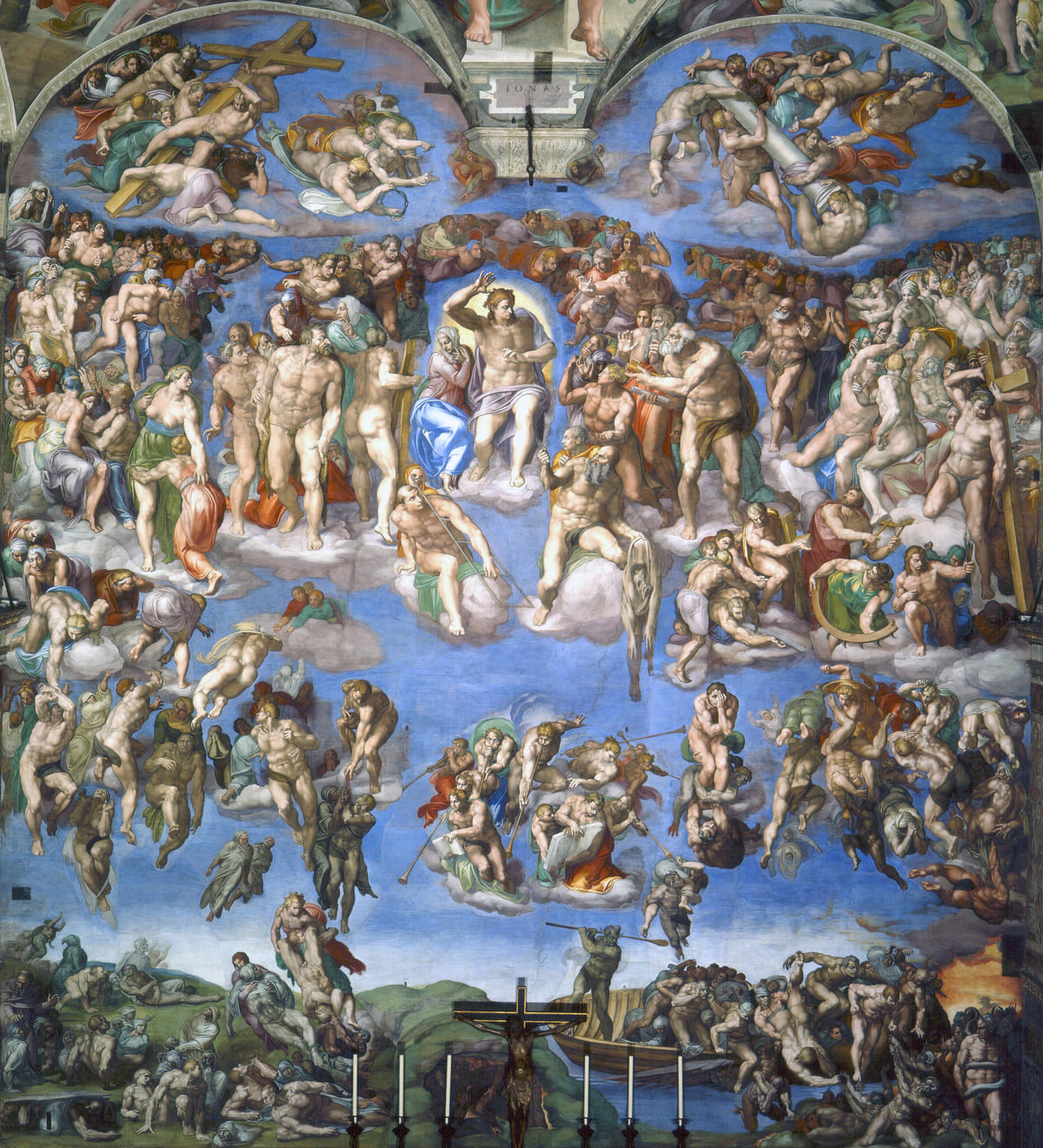
Painted between 1536 and autumn 1541, more than twenty years after the ceiling, and cleaned between February and March 2026. It's a single scene on the altar wall and it asks you to stand still in front of it.
9.5 out of 10
-
The Sibyls and Prophets
Five Sibyls and seven Prophets frame the central band. Hardly anyone gives them any time because everyone heads straight for the middle, and to my mind they're the most underrated part of the ceiling.
8.8 out of 10
-
Stories of Moses and of Christ
The walls by Perugino, Botticelli, Ghirlandaio and Cosimo Rosselli, from 1481-1482. They'd been there for over twenty-five years when Michelangelo arrived, and they're what most people walk straight past.
8.5 out of 10
-
Daniele da Volterra's draperies
In 1564 it was decided to cover the nudes in the Last Judgement, and Daniele da Volterra painted the draperies. Spotting them reminds you that this wall has its own history of censorship.
7.4 out of 10
-
Papal portraits and painted curtains
They complete the fifteenth-century scheme. The curtains are painted to look like fabric, a small detail I like because it shows the chapel was already a luxury commission before Michelangelo turned up.
7.0 out of 10
Essential, optional and skippable
Unmissable
- The central band of the ceiling, starting from the Creation of Adam to get your bearings
- The Last Judgement on the altar wall, seen head-on once you've read the ceiling
- Knowing what to look for before you go in, as the phone stays in your pocket
If you have time
- The five Sibyls and seven Prophets framing the Genesis scenes
- The Stories of Moses and of Christ by Botticelli and Perugino, at eye level
- Spotting the draperies Daniele da Volterra painted over the nudes in 1564
- Meet every painter in the chapel, beyond Michelangelo
- Read the chapel's facts before you go in
I would skip
- Skip-the-line tickets bought away from tickets.museivaticani.va, which are the same ticket with a mark-up
- An afternoon slot, because rooms start clearing half an hour before closing and the chapel comes last
- Planning the day around a shortcut to St Peter's that the museums' website never mentions
- Buying a reduced ticket you're not entitled to, as it gets cancelled and you pay full price again
What I would book ahead
- Tours and ticketsGetYourGuide Museums and Sistine Chapel in a small group No guide may speak inside the chapel, so they brief you beforehand and you walk in knowing what to look for. Check whether museum entry is included and compare it with the official tour.
- Places to stayBooking.com Staying in Prati for the 08:00 slot The 08:00 slot is the one I'd book, and from Prati you can walk to Viale Vaticano without relying on the first metro.
Notebook
Worth knowing about Sistine Chapel
-
01 Most beautiful
The Creation of Adam, seen in its sequence
For me the loveliest thing in the chapel is the central band of the ceiling, nine scenes from Genesis. Find the Creation of Adam first and work outwards from there. The image you know from fridge magnets is far better in place, surrounded by Sibyls and Prophets.
Things to do in Vatican City -
02 My tip
Take the first slot, not the free Sunday
Online slots run every half hour from 08:00, and that's the one I'd book. The last Sunday of the month is free, but the whole visit is squeezed into 09:00 to 14:00 (last entry 12:30), which isn't the day I'd pick to stare at a ceiling in peace.
Vatican tickets 2026 -
03 Watch out
The skip-the-line ticket someone resells you
At the Vatican Museums, skip the line is an official €5 booking fee already built into the €25 online ticket. The museums themselves warn about lookalike websites charging significantly higher prices. If it's sold to you as something special, it's the same ticket with a mark-up.
Vatican scams and tourist traps to avoid in 2026 -
04 To save money
Students up to 25 pay half
The reduced ticket is €10 at the door or €15 online, for ages 7 to 18 and students up to 25 with a valid card. Under-7s go free. Be careful, though, because if you buy a reduced ticket you're not entitled to, it's cancelled and you pay full price again.
Is the Sistine Chapel free? -
05 Worth the splurge
If I spent more, it would be on another door
The official ticket office doesn't sell a private Sistine Chapel visit. The most exclusive thing the museums offer is opening a closed area, such as the Bramante Staircase, for €300 per group plus entry. I run through the numbers on my page of Vatican splurges.
Private Vatican tours and what's worth paying for -
06 Getting there
In via Viale Vaticano, metro at Ottaviano or Cipro
The chapel has no door of its own. You reach it through the museums' entrance on Viale Vaticano, and the closest metro stops are Ottaviano and Cipro, both on line A. Every other route, from the airport or Termini, is in my transport guide.
How to get to Vatican City from Rome and the airports
It’s the most searched-for room in the Vatican and, in my view, the one visitors prepare for worst. People arrive with the Creation of Adam in their heads, look up, get overwhelmed by everything else and leave without really knowing what they’ve seen. Here’s how I’d read it, in what order, and how to see it with a few fewer people around without paying anyone over the odds.
Where is the Sistine Chapel, and how do you get to it?
It’s inside Vatican City, at the end of the Vatican Museums route, and it has no visitors’ entrance of its own. You go in on Viale Vaticano with a museum ticket, which covers the museums and the chapel on the day of issue only. Full price is €20 at the ticket office or €25 on the official website, because of the €5 booking fee, and reduced tickets are €10 or €15. Every option, guided or not, is compared on the Vatican tickets page, and the metro, buses and airport trains are covered in getting to the Vatican.
The official guided tours leave the chapel until last, after the Pinacoteca, the Pio Clementino, the Gallery of the Candelabra, the Maps gallery, the Gallery of Tapestries and the Raphael Rooms. Expect to arrive with a few hours of walking in your legs. And when you leave, bear in mind that the museums’ official website doesn’t mention any direct route through to St Peter’s Basilica. I’d plan the rest of the day around the normal museum exit.
How I’d read the ceiling
I wouldn’t try to take it all in at once. I’d read it in three passes, following the ranking above. First, find the Creation of Adam in the central band, because it’s the scene everyone recognises and it gives you a fixed point. Second, follow the nine Genesis scenes along the axis of the chapel, end to end. Third, drop your gaze slightly to the five Sibyls and seven Prophets around that band, the part of the ceiling that gets the least attention and the one I like best.
The colours you see today come from a full restoration of the frescoes that ran from 1979 to 1999. I mention it because many people compare what’s in front of them with reproductions in older books, and the two look nothing alike.
If you are staying the night, see the best hotel deals in Prati, Rome for your dates: the well-placed rooms go fast.
The Last Judgement after its 2026 clean
The altar wall has its own story of losses and additions. Frescoes by Perugino from the fifteenth-century scheme were sacrificed to make room for it. In 1564 the decision was taken to cover the nudes, and the draperies were painted by Daniele da Volterra. Restoration of this wall finished in 1994, marked by a Mass celebrated by John Paul II on 8 April.
In 2026 it went back under the conservators’ hands without the chapel closing. From 1 February to 27 March the museums carried out extraordinary maintenance to remove a whitish film of calcium lactate, which they link to lactic acid in visitors’ perspiration, and a canvas reproducing the fresco hung in front while the work went on. For me that’s the best argument against treating the chapel as a box to tick, because the crowds quite literally leave a mark on the paint. ANSA, the Italian news agency, puts daily numbers at between 10,000 and 20,000, although the museums publish no official figure. I’d look at the Last Judgement in the Sistine Chapel after the ceiling, face on and without rushing, since it’s a single scene and rewards standing still.
The walls everyone walks past
The Stories of Moses and of Christ, the papal portraits and the painted curtains that imitate fabric make up the scheme Sixtus IV paid for. They’re the oldest painting in the room and the part most people miss, because everyone walks in with their head tipped back. When Michelangelo signed his contract in 1508, those frescoes had already been there for more than a quarter of a century. If you have five minutes to spare, give them to Botticelli and Perugino at eye level.
Before you fix your dates, compare train and coach tickets to Rome: the same journey can cost very different amounts from one day to the next.
Who painted the Sistine Chapel, apart from Michelangelo?
Most people give a single name, and I think that’s the quickest way to miss half the chapel. The building is named after Pope Sixtus IV della Rovere, who rebuilt the old Cappella Magna between 1477 and 1480 and consecrated it to the Assumption on 15 August 1483. For the walls he brought in a team led by Perugino, Botticelli, Ghirlandaio and Cosimo Rosselli, with Luca Signorelli, Biagio di Antonio and Bartolomeo della Gatta helping, and they worked there in 1481 and 1482. Overhead was a starry sky by Pier Matteo d’Amelia.
Michelangelo came later, in two separate spells. The contract for the Sistine Chapel ceiling was signed on 8 May 1508, and he finished the first half in August 1510 and completed it in October 1512. Julius II celebrated Mass beneath it on 1 November that year. The Last Judgement was a separate commission from Clement VII at the end of 1533, painted from 1536, by then under Paul III, until the autumn of 1541. What I find most rewarding about the room is exactly that. Three different moments share the same space, and you can read each one on its own.
What I’d do before walking in
Inside the chapel you can’t do most of what you’d normally do in a museum. The rules ban photos and filming on any device, ban phone use altogether and ask for complete silence, and attendants can make you delete anything you’ve recorded. Accredited guides aren’t allowed to speak inside either, which is why groups get their briefing at the door. In the rest of the museums, photos for personal use are fine, without flash.
This is where plenty of visitors come unstuck. They plan to look things up once they’re under the ceiling and find they can’t take the phone out. My advice is to read this on the metro or in the galleries on the way and walk in knowing what you’re looking for. The Holy See gives the chapel as roughly 40 metres long, 13 wide and almost 21 high, and without a plan your eyes just skid from one corner to the next. The dress code is the museums’ own, with shoulders and cleavage covered and no shorts above the knee, miniskirts or hats, and the rest of the rules for the day are on how to visit the Vatican.
If you would rather go at your own pace, see the car hire deals in Rome: the earlier you book, the more cars are left to choose from.
Fewer crowds without paying a tout
The museums open at 08:00 from Monday to Saturday, last entry is 18:00 and rooms start clearing half an hour before the 20:00 close. Book an afternoon slot, linger over Raphael, and you’ll reach the chapel just as staff are ushering people out. That’s why I’d take the first online slot rather than the free last Sunday, which squeezes every visitor into 09:00 to 14:00.
On the money side, the only official way to save queuing is the €5 online booking, which the museums themselves call skip the line. The only official shop is tickets.museivaticani.va, and the museums warn about lookalike domains charging significantly higher prices. If someone offers you a no-queue ticket for a lot more, it’s the same ticket with a mark-up, and the other usual traps are on Vatican scams to avoid. If you’d rather spend more on something that’s genuinely worth it, my picks are on exclusive Vatican experiences.
Conclaves and the days it’s shut
The Sistine Chapel has been the permanent venue for conclaves since 1878, and how the voting works inside is in how the pope is chosen in a conclave. The latest elected Robert Francis Prevost as Leo XIV on 8 May 2025, and according to ANSA the chapel closed to the public from 28 April to prepare. If your trip coincides with a conclave, assume you won’t get in. To see the Pope in person, audiences and Masses are covered on how to see the Pope. For the rest of 2026 the museums also close on 8, 25 and 26 December and every Sunday except the last of the month.
If you are staying the night, see the best hotel deals in Prati, Rome for your dates: the well-placed rooms go fast.
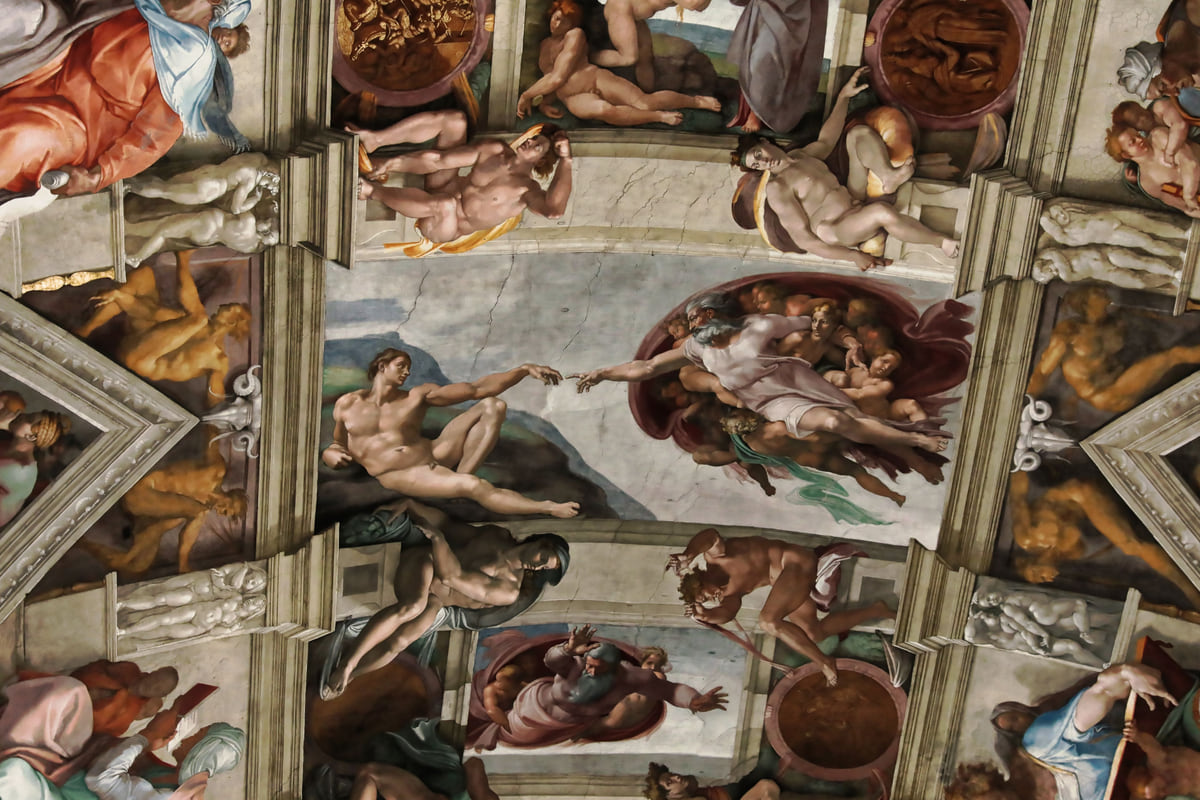
The Creation of Adam on the Sistine Chapel ceiling by Michelangelo, surrounded by painted ignudi and medallions.
Vatican Museums and Sistine Chapel opening hours (2026)
| Day | Hours | Last entry |
|---|---|---|
| Monday to Saturday | 08:00-20:00 | 18:00 |
| Last Sunday of the month | 09:00-14:00, free | 12:30 |
| Other Sundays | Closed | No entry |
| 24 and 31 December 2026 | Closes at 15:00 | 13:00 |
For the rest of 2026 the museums also close on 8, 25 and 26 December. The free last Sundays left in 2026 are 29 November and 27 December. Rooms start clearing 30 minutes before closing time.
Ticket prices (Vatican Museums and Sistine Chapel)
| Ticket | At the ticket office | Online, with booking |
|---|---|---|
| Full price | €20 | €25 |
| Reduced (ages 7 to 18, students up to 25) | €10 | €15 |
| Children under 7 | Free | Free |
| Last Sunday of the month | Free | Optional official guided tour, €20 |
The only official online shop is tickets.museivaticani.va. Tickets are valid only on the date issued and are non-refundable.
- Years Michelangelo spent painting the ceiling
- 1508-1512
- Years of the Last Judgement on the altar wall
- 1536-1541
- Museums ticket at the door, chapel included
- €20
- Height of the chapel, according to the Holy See
- Almost 21 m
What to see
What there is in Sistine Chapel
0 of 93 Vatican City guides
Your next stamp
- Last Judgement
- Ceiling
- Who painted it
- The Creation of Adam
- Facts
- Gallery of Maps
- Vatican Pinacoteca
- Egyptian and Etruscan Museums
- Things to do
- One day
- Tickets
- Two days
- Vatican Museums
- St Peter's Basilica
- St Peter's Square
- St Peter's Dome
- Vatican Necropolis
- Vatican Gardens
- Swiss Guard
- Seeing the Pope
- How to visit
- Castel Gandolfo
- Guided tours
- Where to eat
- Free and cheap
- Apostolic Palace
- Scams to avoid
- Getting there
- Money and payments
- Exclusive experiences
- Papal audience
- Angelus
- Where the Pope lives
- Where to stay
- Dress code
- Opening hours
- Map
- Flag
- Post office and stamps
- Is it a country?
- Vatican Grottoes
- History
- Pietà
- Baldachin
- Chair of St Peter
- Raphael Rooms
- Architecture and architects
- Holy Door
- Library and Archives
- Bramante Staircase
- Facade and balcony
- Mass at St Peter's
- Pio Clementino Museum
- Papal blessing
- Catacombs
- Gallery of Tapestries
- Gallery of the Candelabra
- Obelisk
- Vatican Museums map
- Bernini's colonnade
- How long you need
- Night opening
- Chiaramonti and Braccio Nuovo
- Christmas
- Anima Mundi Museum
- Easter
- Carriage Pavilion
- Gift shops and souvenirs
- With kids
- Best time to visit
- Courtyard of the Pine Cone
- Photography
- Train station
- Accessible travel
- Vatican Observatory
- Borgia Apartment
- Modern art collection
- Papal Palace
- Barberini Gardens
- Facts
- Getting there
- Holy See
- Lake Albano
- Police and army
- Passport
- Pharmacy, shop and petrol
- What Vatican means
- Papal tombs
- List of popes
- Pope Leo XIV
- Conclave
- The Pope in Spain
Frequently asked questions
Who painted the Sistine Chapel?
Michelangelo painted the ceiling (1508-1512) and the Last Judgement on the altar wall (1536-1541). The walls are older, from 1481-1482, and were painted by a team led by Perugino, Botticelli, Ghirlandaio and Cosimo Rosselli, with Luca Signorelli among their assistants. I think stopping at the first name means missing half the room.
How long did it take Michelangelo to paint the Sistine Chapel ceiling?
A little over four years. He signed the contract on 8 May 1508, finished the first half in August 1510 and completed the ceiling in October 1512. Pope Julius II unveiled it with a Mass on 1 November 1512.
Is the Sistine Chapel inside the Vatican Museums?
Yes. It's at the end of the Vatican Museums route and there's no separate visitors' entrance. You go in through Viale Vaticano on a museum ticket, and the nearest metro stops are Ottaviano and Cipro on line A.
Can you take photos in the Sistine Chapel?
No. Vatican Museums rules ban photos and video on any device inside the chapel, and attendants can ask you to delete them on the spot. Phones can't be used at all and silence is expected. Everywhere else in the museums you can take photos for personal use, without flash.
How much are Sistine Chapel tickets?
There's no chapel-only ticket. A Vatican Museums ticket covers it and costs €20 at the ticket office or €25 on the official website, which adds a €5 booking fee. Reduced tickets are €10 or €15 and under-7s go free. I'd pay the €5 to choose my slot.
What are the Sistine Chapel opening hours?
The chapel keeps the Vatican Museums' hours, Monday to Saturday from 08:00 to 20:00 with last entry at 18:00. It's closed on Sundays except the last Sunday of the month, when entry is free from 09:00 to 14:00 (last entry 12:30).
Can you visit the Sistine Chapel during a conclave?
No. The chapel has been the permanent venue for conclaves since 1878 and it closes to the public to prepare. Before the conclave that opened on 7 May 2025, according to the ANSA news agency, it closed on 28 April.

Questions about Sistine Chapel? Write to me
If your question is not answered here, write to me and I will look it up in the official sources.
My email sergiolepone@gmail.com
By
Tourism graduate with a master’s in Tourism Management and Planning from the University of Málaga, who has travelled across Europe. He writes every guide from official sources and his own judgement.
Published on . Updated on . Facts checked on .
Sources
Some links in this guide are affiliate links: if you book through them, the site earns a commission at no extra cost to you. Affiliate disclosure
Photos: Gary Todd from Xinzheng, China (Public domain); Burkhard Mücke (fotografía); Miguel Ángel (obra) (Public domain), via Wikimedia Commons.