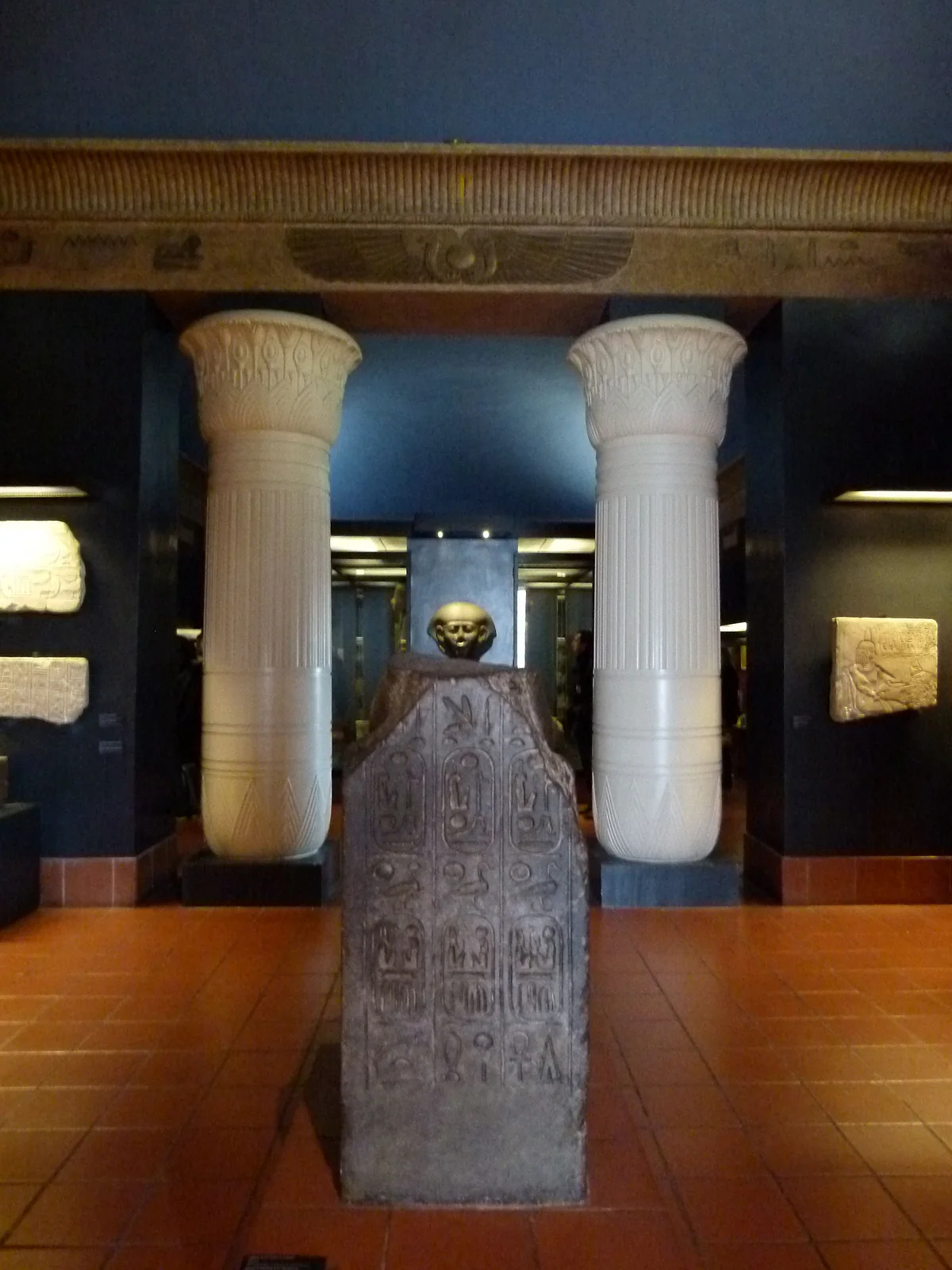
Number 1 on the map, by the Cortile della Pigna
The Vatican Egyptian Museum and the Etruscan galleries, what I'd look for
The Gregorian Egyptian Museum was founded by Gregory XVI in 1839 and fills nine rooms beside the Cortile della Pigna, with two mummies, painted coffins and the Naophorus of Udjahorresne, which the Museums call their most important historical document. The Etruscan Museum, from 1837, is on the floor above. Both are covered by the standard ticket, from €20.
In 30 seconds
Full read: 4 min
- The Gregorian Egyptian Museum was founded by Gregory XVI in 1839 and has nine rooms, the last three given over to the ancient Near East.
- There are two mummies in room II, including Amenirdis, still in her original 22nd Dynasty coffin.
- The piece with the best story is the Naophorus of Udjahorresne, an Egyptian who served the Persian kings.
- The Etruscan Museum, from 1837, is on the second floor and holds the gold of the Regolini-Galassi Tomb from Cerveteri.
- Both come with the standard Museums ticket, from €20, and I'd allow about 45 minutes for the pair.
In my overall ranking of the Museums it sits near the bottom, and I stand by that. But if Egypt is your thing, I'd give it 25 minutes split three ways, room II with the mummies, the Naophorus in room I and the terrace of Sekhmet statues, and upstairs I'd only chase the Cerveteri gold.

Before you go
What I would keep in mind
-
01 Most beautiful
Eight lion goddesses above the Pine Cone courtyard
From the Hemicycle you step out onto the Nicchione terrace, lined with eight granite statues of Sekhmet commissioned by Amenhotep III. Below sits the bronze Pine Cone, with the lions of Nectanebo I at its feet.
the Vatican Museums map -
02 My tip
Find the Pope's name written in hieroglyphs
Along the cornice of room II runs a hieroglyphic inscription celebrating the museum's founding in 1839, with Gregory XVI's name inside a cartouche like a pharaoh's. Hardly anyone looks up.
Vatican Museums -
03 To save money
Included in the normal ticket, free on the last Sunday
There's no supplement. The €20 desk ticket or €25 online ticket covers the Egyptian and Etruscan museums and the Sistine Chapel. On the last Sunday of each month entry is free from 09:00 to 14:00, though it gets very busy.
Is the Sistine Chapel free? -
04 Watch out
Nobody sells the Egyptian Museum on its own
There's no separate ticket for it. If a site offers a pricier «Egyptian Vatican tour», check what's included, because entry is the same Museums ticket and the only official site is tickets.museivaticani.va.
Vatican scams and tourist traps to avoid in 2026 -
05 Getting there
Metro line A to Ottaviano or Cipro
The Museums entrance is on Viale Vaticano, a few minutes from Ottaviano and Cipro stations on line A. The Egyptian Museum comes early on the route, near the Atrium of the Four Gates.
How to get to Vatican City from Rome and the airports
My priorities
Unmissable
- Room II, with the mummy of Amenirdis and the Vatican Lady
- The Naophorus of Udjahorresne, in room I
- The Nicchione terrace and its Sekhmet statues, above the Cortile della Pigna
If you have time
- The Regolini-Galassi gold, in room II of the Etruscan Museum
- The Assyrian reliefs in room IX, from palaces at Nineveh and Nimrud
- Bramante's Staircase, visible from the Etruscan rooms
What I would book
- Places to stayBooking.com Prati, for the 08:00 slot The Egyptian rooms come early on the route. Staying in Prati means you're in on the first slot and see them before the groups arrive.
- Tours and ticketsGetYourGuide If the official site is sold out I'd buy on tickets.museivaticani.va. Only if your day has no slots left would I look here, comparing against the official €25.
My ranking, scored
What I'd hunt for in the Egyptian and Etruscan museums
My own scores out of 10. They weigh the impact of the piece, how much it tells you without a guide and how easy it is to find. It isn't an official order or the order of the rooms.
0 of 6 seen
-
Naophorus of Udjahorresne (Egyptian, room I)
An Egyptian official who served the Persian kings and recorded it on his robe, giving a version of the conquest that contradicts the Greek one. It arrived headless in 1738.
9.2 out of 10
-
Regolini-Galassi Tomb (Etruscan, room II)
Grave goods of a royal woman from Cerveteri, 675-650 BC, found covered in gold. The gold pectoral is 42 cm across, and three chariots were reassembled in 2013.
9.0 out of 10
-
Room II, mummies and the Vatican Lady
The mummy of Amenirdis in her original coffin and the Vatican Lady shroud, a full-length painted portrait of a type known from just six examples.
8.9 out of 10
-
Nicchione terrace and the Sekhmet statues
Eight granite lion goddesses above the Cortile della Pigna and three sarcophagi from Memphis. The best light in the museum, and the corner that feels least like a display case.
8.7 out of 10
-
Hemicycle, Tuya and Ptolemy II (Egyptian, room V)
Granite figures well over two metres tall, probably brought to the Gardens of Sallust by Caligula. Tuya's statue was carved for another queen and reused by Ramesses II for his mother.
8.4 out of 10
-
Exekias amphora (Etruscan, room XIX)
Achilles and Ajax playing a board game, around 540-530 BC, with their scores coming out of their mouths like a comic strip. It's at the far end, so only if time allows.
8.2 out of 10
Most people walk into the Vatican Museums with the Sistine Chapel on their mind and pass the Egyptian Museum without a sideways glance. I get it, and in my overall ranking it sits well below Raphael. Yet it’s one of my favourite places to start the morning, because it comes early, sits off the path most visitors follow and is full of stories you don’t expect to find in the Pope’s house. Here’s what’s in its nine rooms, what I’d do with the Etruscan Museum upstairs and how long I’d give them. The rest of the route is in my Vatican Museums guide.
An Egyptian museum that really tells Rome’s story
Gregory XVI founded it in 1839, in Pius IV’s former retreat apartment inside the Belvedere palace. The first layout was the work of a Barnabite Egyptologist, Luigi Ungarelli, and some rooms still keep his Nile-inspired decoration, papyrus columns and starry ceilings included. I love that, because you’re looking at Egypt and at how 19th-century Rome pictured it, both at once.
What few guides mention is where the collection came from. A good share reached Rome under the emperors, shipped in to decorate villas and sanctuaries, and some was carved here in the Egyptian manner. That’s why the statues in the Hemicycle once stood in the Gardens of Sallust and those in room III at Hadrian’s Villa. According to the Museums themselves, Rome held Egyptian treasures long before the great European collections were formed.
Mummies and the Vatican Lady
Room II is what most people come looking for. Seven cases surround a central one with painted wooden coffins, and there are two mummies. The one I’d spend time with is a woman, probably named Amenirdis, from the 22nd Dynasty, lying in what was most likely her own coffin. Nearby are 22 shabti figures from the tomb of Seti I, father of Ramesses II, found by Belzoni in 1817.
The piece that grabs me most in this room is another one. It’s known as the Vatican Lady, a 3rd-century linen shroud painted with a full-length, life-size woman whose hair follows the fashion of the Severan empresses. The Museums say only six shrouds of this type are known. Before you leave, look up at the cornice, where Gregory XVI’s name is written in hieroglyphs inside a cartouche, just like a pharaoh’s.
Which piece wouldn’t I skip?
The Naophorus of Udjahorresne, in room I. It’s a 58-centimetre basalt statue of a physician, treasurer and admiral who served the Persian kings after Cambyses conquered Egypt in 525 BC. On his robe he recorded that the Persians respected Egyptian tradition, the opposite of what Greek writers claim. The Museums rate it the most important historical document in the collection. It arrived headless in 1738, was given a head that wasn’t its own and later had it removed, and that tale sums up old-school collecting better than anything I could write.
The same room holds the stele of Hatshepsut beside her nephew, the future Thutmose III, who most likely had her name chiselled off monuments after her death.
The Hemicycle and the terrace of lion goddesses
Room V is a great semicircle built by Pirro Ligorio in 1562. Here stand the granite figures of Ptolemy II and Arsinoe II, each around 2.7 metres tall, and Queen Tuya, carved for another queen and reused by Ramesses II in honour of his mother. A door halfway along leads onto the Nicchione terrace, with eight statues of Sekhmet made for Amenhotep III. The Museums reckon the epithets carved across the whole group once ran to 365, one for every day of the year.
From there you look down on the Cortile della Pigna and its 2nd-century bronze Pine Cone, in the courtyard since 1608. The two lions at its feet are the originals of Nectanebo I. They once stood outside the Pantheon and then on the Acqua Felice fountain, which now has copies. To place all this on the route, use the Vatican Museums map. And if you want more Egypt outside, the obelisk in St Peter’s Square is a few minutes away.
The Etruscan Museum, upstairs and full of gold
The Gregorian Etruscan Museum opened on 2 February 1837, two years before its Egyptian neighbour, and fills 22 rooms on the second floor. I’d head straight for room II and the finds from the Regolini-Galassi Tomb at Cerveteri, from 675-650 BC. The tomb was found intact in 1836, and the woman buried there, the Museums say, was literally covered in gold. The pectoral is 42 centimetres across, and alongside it are three chariots reassembled in the 2013 restoration.
If you’ve still got energy, the Mars of Todi is a 141-centimetre bronze warrior dug up from between stone slabs in 1835, possibly after being struck by lightning. And from the Etruscan rooms you can see Bramante’s Staircase, which the standard ticket doesn’t let you set foot on.
How long I’d give them
There’s no official figure. I’d give the Egyptian Museum 25 minutes if it interests you and 10 if you only want the mummies and the terrace. The Etruscan one gets another 20, focused on Cerveteri. Both are in the standard ticket with no supplement. If you’re pushed for time, I explain where to trim when working out how much time to allow for the Vatican Museums.
The nine rooms of the Gregorian Egyptian Museum
| Room | Theme | What I'd look for |
|---|---|---|
| I | Inscriptions | Naophorus of Udjahorresne and the Hatshepsut stele |
| II | Funerary customs | Mummy of Amenirdis, the Vatican Lady and the shabtis of Seti I |
| III | Canopus of Hadrian's Villa | Osiris-Antinous, 241 cm, under a starry ceiling |
| IV | Egypt and Rome | Anubis dressed as Mercury |
| V | Hemicycle, statuary | Queen Tuya, Ptolemy II and the way out to the terrace |
| VI | Grassi Collection | Bronze urn for a mummified cat |
| VII | Alexandria and Palmyra | Funerary reliefs from Palmyra |
| VIII | Ancient Near East | Two fragments of the Qumran scrolls |
| IX | Assyrian palaces | Reliefs from Nineveh and Nimrud |
Rooms and works from the Vatican Museums' own entries. The last three rooms aren't Egyptian, they cover the ancient Near East.
The Etruscan Museum in three stops
| Piece | Room | Detail |
|---|---|---|
| Regolini-Galassi Tomb gold | II | Cerveteri, 675-650 BC, excavated 1836-1837 |
| Mars of Todi | III | Bronze, 141 cm, late 5th century BC |
| Exekias amphora | XIX | Achilles and Ajax at play, 540-530 BC |
The Gregorian Etruscan Museum opened on 2 February 1837 and has 22 rooms. Bramante's Staircase can be seen from inside.
Test yourself
True or false?
0/4 Pick before you peek.
-
You can see Egyptian mummies in the Vatican Museums.
See the answer
True. Room II of the Gregorian Egyptian Museum has two, including Amenirdis from the 22nd Dynasty (945-712 BC), displayed in her original painted wooden coffin.
-
Everything in the Vatican's Egyptian Museum comes from Egypt.
See the answer
False. Rooms VII, VIII and IX cover Palmyra, Mesopotamia, Syria-Palestine and the Assyrian palaces, with two fragments of the Qumran scrolls. Plenty of the Egyptian statuary was also made or brought to Rome under the emperors.
-
Gregory XVI's name is written in hieroglyphs inside the museum.
See the answer
True. Luigi Ungarelli, the first curator, composed a hieroglyphic inscription for the cornice of room II celebrating the 1839 founding, with the Pope's name in a cartouche.
-
The granite lions under the bronze Pine Cone are copies.
See the answer
False. They're the originals of Nectanebo I (360-343 BC). The copies are at the Acqua Felice fountain, where Gregory XVI swapped them in 1839 to bring the lions into the museum.
- Year Gregory XVI founded the Egyptian Museum
- 1839
- Rooms in the Egyptian Museum, three of them Near Eastern
- 9
- Mummies in room II
- 2
- Rooms in the Gregorian Etruscan Museum, opened in 1837
- 22
0 of 88 Vatican City guides
Your next stamp
- Vatican Museums
- Sistine Chapel
- Vatican Museums map
- Gallery of Tapestries
- Anima Mundi Museum
- Pio Clementino Museum
- Vatican Pinacoteca
- Gallery of Maps
- Things to do
- One day
- Tickets
- Two days
- St Peter's Basilica
- St Peter's Square
- St Peter's Dome
- Vatican Necropolis
- Vatican Gardens
- Swiss Guard
- Seeing the Pope
- How to visit
- Castel Gandolfo
- Where to eat
- Free and cheap
- Apostolic Palace
- Scams to avoid
- Getting there
- Money and payments
- Exclusive experiences
- Papal audience
- Angelus
- Who painted it
- Where the Pope lives
- Where to stay
- Dress code
- Facts
- Opening hours
- Map
- Flag
- Post office and stamps
- Is it a country?
- Vatican Grottoes
- History
- Pietà
- Baldachin
- Ceiling
- Chair of St Peter
- Last Judgement
- Raphael Rooms
- Architecture and architects
- Holy Door
- Library and Archives
- Bramante Staircase
- Facade and balcony
- Mass at St Peter's
- Papal blessing
- Catacombs
- Gallery of the Candelabra
- Obelisk
- Bernini's colonnade
- How long you need
- Night opening
- Chiaramonti and Braccio Nuovo
- Christmas
- Easter
- Carriage Pavilion
- Gift shops and souvenirs
- With kids
- Best time to visit
- Courtyard of the Pine Cone
- Photography
- Train station
- Accessible travel
- Vatican Observatory
- Borgia Apartment
- Modern art collection
- Papal Palace
- Barberini Gardens
- Facts
- Getting there
- Holy See
- Lake Albano
- Police and army
- Passport
- Pharmacy, shop and petrol
- What Vatican means
- Papal tombs
- List of popes
Frequently asked questions
Where is the Egyptian Museum in the Vatican?
Inside the Vatican Museums, number 1 on the official map, on the first floor beside the Cortile della Pigna. It comes early on the route, near the Atrium of the Four Gates, and the Hemicycle opens onto the Nicchione terrace overlooking the courtyard.
Is there a mummy in the Vatican Museums?
Yes, two, in room II of the Gregorian Egyptian Museum. One is a woman probably named Amenirdis, from the 22nd Dynasty (945-712 BC), shown in her original painted wooden coffin. Room VI also has a bronze urn that once held a mummified cat.
Why does the Vatican have Egyptian artefacts?
Many reached Rome in imperial times to decorate villas and sanctuaries, such as the statues from the Gardens of Sallust or Hadrian's Villa at Tivoli. When Gregory XVI founded the museum in 1839, Rome already held Egyptian treasures older than the great European collections.
Is the Egyptian Museum included in the Vatican Museums ticket?
Yes, there's no separate ticket. The standard one, €20 at the desk or €25 online, covers the Egyptian and Etruscan museums and the Sistine Chapel, and entry is free on the last Sunday of each month.
What is in the Vatican's Etruscan Museum?
The Gregorian Etruscan Museum, opened in 1837, has 22 rooms. The highlights are the gold from the Regolini-Galassi Tomb at Cerveteri, the Mars of Todi, a 141 cm bronze, and the Greek vase collection with the Exekias amphora. Bramante's Staircase is visible from its rooms.
How long do you need for the Egyptian Museum?
There's no official figure. I'd give it about 25 minutes if you're keen on Egypt and 10 if you only want the mummies and the terrace. Add another 20 for the Etruscan Museum, which will come out of your time in the galleries or the Pinacoteca.
By
Tourism graduate with a master’s in Tourism Management and Planning from the University of Málaga, who has travelled across Europe. He writes every guide from official sources and his own judgement.
Published on . Facts checked on .
Sources
Photos: Dawid Skalec (CC BY-SA 3.0), via Wikimedia Commons.