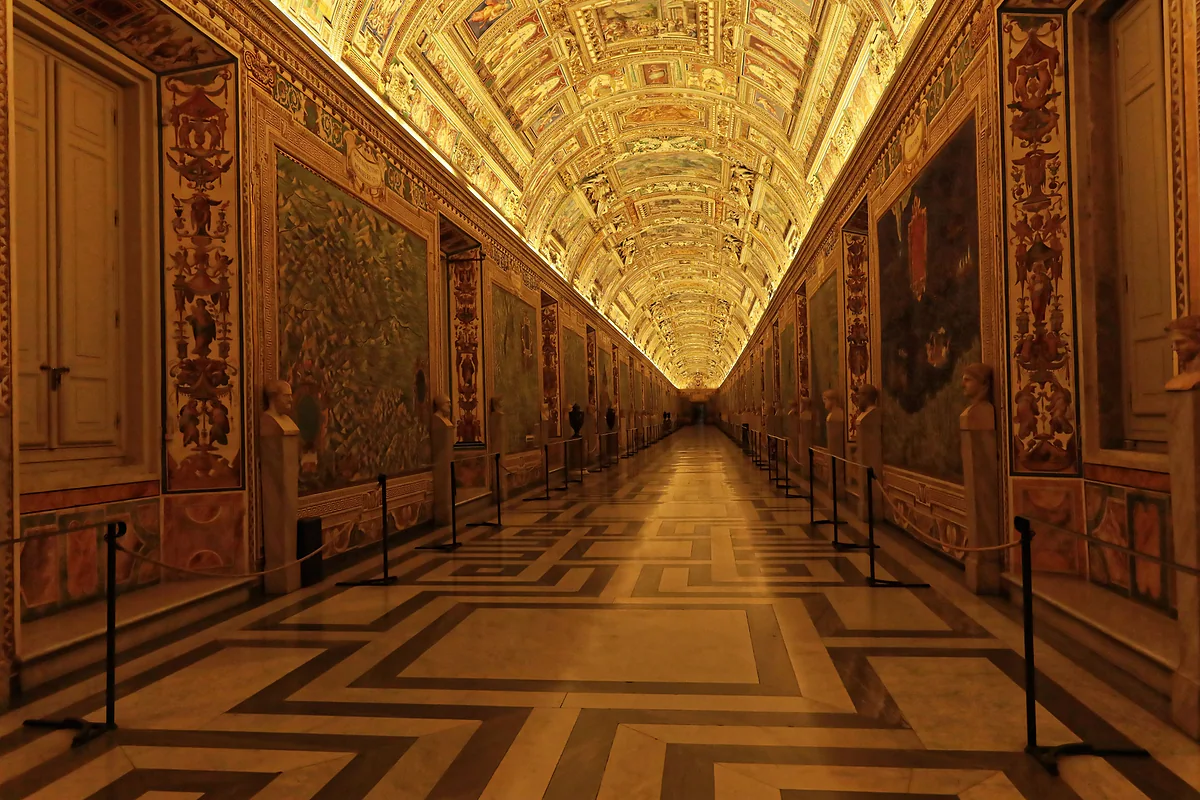
Two institutions most visitors never enter
The Vatican Archives and Library, what they are and what you can see
The Vatican Apostolic Archives, known as the Vatican Secret Archives until 2019, and the Vatican Library, formally founded in 1475, offer no tourist visits. Only accredited researchers get in, over 1,200 a year at the Archives. What you can see on a Museums ticket are rooms that once belonged to the Library, and the Library runs occasional exhibitions.
In 30 seconds
Full read: 5 min
- Neither the Vatican Library nor the Vatican Apostolic Archives offer tourist visits; only accredited researchers are admitted.
- The Archives were called the Vatican Secret Archives until 22 October 2019, and «secret» meant the Pope's private papers, not hidden ones.
- The Library was formally founded in 1475 and holds some 180,000 manuscripts and 1,600,000 printed books.
- The Archives hold twelve centuries of documents on 85 km of shelving, open up to October 1958, the end of Pius XII's reign.
- A Museums ticket, from €20, does take you through rooms that once belonged to the Library, such as the Aldobrandini Wedding room.
For me the Secret Archives are the perfect example of a mistranslated word inventing a mystery. «Secret» meant the Pope's private papers, not hidden ones, and today more than a thousand researchers a year consult them on a free pass. As a tourist you won't get in, but you can walk through rooms that once belonged to the Library.

Before you go
What I would keep in mind
-
01 My tip
The Library's old rooms are on your ticket
The official Museums map shows the Library Museums (no. 15) and the Room of the Aldobrandini Wedding (no. 13). They're included in the general ticket, from €20, and hardly anyone realises they're walking through the old Library.
Vatican Museums -
02 Watch out
Nobody can sell you a Secret Archives tour
The Archives offer no tourist visits and the Library has no regular ones either. If you see a tour promising the secret archives, be wary, because the official websites make no provision for it.
Vatican scams and tourist traps to avoid in 2026 -
03 Most beautiful
The Sistine Hall, 70 metres of painted walls
The Library's great hall, built for Sixtus V in the late 16th century, is 70 metres long and painted throughout. Today it's reached only from the study rooms, but the public sees it during the Library's exhibitions.
Things to do in Vatican City -
04 To save money
Thousands of manuscripts, free from home
The Library has an online catalogue and a Digital Library of scanned manuscripts, and the Museums offer a virtual tour of the Sistine Hall. It's the cheapest way to see the collections, and the only guaranteed one.
Is the Sistine Chapel free?
My priorities
Unmissable
- Finding the Room of the Aldobrandini Wedding and the Library Museums on the Museums map
- Checking the Library's website before you travel in case a Sistine Hall exhibition is on
If you have time
- Taking the virtual tour of the Sistine Hall at home, the room museum visitors never reach
- Browsing scanned manuscripts in the Digital Library to see that not everything is locked away
- Reading how the Archives began in 1612 within the Vatican's longer story
- Follow the Observatory's trail to Castel Gandolfo
I would skip
- Paying for a tour that promises the «secret archives», as no official tourist visit exists
- Confusing the Library with the Archives, two separate institutions with separate rules
- Assuming the Archives hide things because of the old name, which meant private, not concealed
What I would book
- Places to stayBooking.com Staying in Borgo, by St Anne's Gate If you're coming for a Library exhibition, which you book online, Borgo puts St Anne's Gate a few minutes' walk away and you arrive for your slot without rushing.
- Tours and ticketsGetYourGuide A guide for the Museums, not the Archives No tour gets into the Archives, so be wary of any that promises to. If you want a guide, make it for the Museums, where the old Library rooms are.
My ranking, scored
Ways to glimpse the Library and the Archives
My own scores out of 10. They weigh how much of the Library or Archives each option shows you and how realistic it is for someone travelling, not researching.
0 of 4 seen
-
A Library exhibition
Since November 2021 the Library has staged shows in the Barberini Room and the Sistine Hall, bookable online up to 48 hours ahead. It's the only way into the Hall, but on 24-09-2026 nothing is running.
9.0 out of 10
-
The old Library rooms in the Museums
The Library Museums and the Room of the Aldobrandini Wedding, decorated by Guido Reni in 1608, are on the official map. It's as close as almost any traveller will get.
8.2 out of 10
-
The Sistine Hall virtual tour
Offered by the Museums on their website. It isn't the same as being there, but it shows you the whole room, which is exactly the one museum visitors never set foot in.
6.8 out of 10
-
The Digital Library
The Library's scanned manuscripts, viewable online. To me it's the best antidote to the myth that everything is locked away.
6.5 out of 10
The question almost everyone asks is if you can visit, and the short answer is no. Neither the Vatican Library nor the Archives that were called Secret for centuries run tourist visits. I think that answer sells them short if it stops there, though, because there’s plenty worth understanding about both and a couple of ways to peek in. Here’s what they are, why one was called secret, who actually gets in and what you can see on an ordinary Museums ticket.
Two institutions with intertwined pasts
The first thing to know is that they’re two different bodies, even if they started out together. From the 4th century the Roman Church kept a Scrinium that served as both library and archive, and that first collection was scattered in the early 13th century. The modern Library dates from the 15th century, while the Archives began in 1612 as a sort of department of the Library before going their own way.
Today each has its own website, access rules and holdings. The Library mostly keeps manuscripts and books, the Archives the popes’ records of government. For Library readers, the first visit means leaving photo ID at the Gendarmerie permit office by St Anne’s Gate.
The Library, from a humanist pope to 1.6 million books
Nicholas V, pope from 1447 to 1455, decided to open the popes’ Latin, Greek and Hebrew codices to scholars, and grew them from 350 to about 1,200. The formal founding came with Sixtus IV, who on 15 June 1475 signed the bull giving it a librarian and the money to run it. He’s the same pope behind the Sistine Chapel, a coincidence that tells me a lot about what the Vatican wanted to be back then.
Sixtus V had Domenico Fontana put up a new building in the late 16th century, the one still in use, with the Sistine Hall on its upper floor, 70 metres long and 15 wide and painted top to bottom. Whole libraries then arrived, such as Heidelberg’s Palatine library in 1623 and Queen Christina of Sweden’s in 1690, followed in 1902 by the Barberini collection with over 11,000 manuscripts. Today the Library holds some 180,000 manuscript and archival volumes, 1,600,000 printed books, around 9,000 incunabula and 300,000 coins and medals.
Why were they called the Vatican Secret Archives?
This is the misunderstanding I most enjoy unpicking. In 1611 Paul V created the Novum Archivum inside the Apostolic Palace, next to today’s Sistine Hall, gathering records from the Library, the Apostolic Camera and the archive of Castel Sant’Angelo. Its official history begins on 31 January 1612, when he appointed Baldassarre Ansidei as custodian. The founding name was the Vatican Apostolic Archives, and from the mid-17th century «Secret Archives» took over.
The word came from the Latin «secretum», from the verb to separate. It meant an archive kept apart from the others and reserved to the Pope and his officials, his private archive. Over time «secret» came to be heard as concealed, with a sinister edge, and on 22 October 2019 Francis restored the original name without changing anything about its structure or mission. I find that a lesson in communication. Centuries of suspicion over a word that never meant what we assume.
What the Archives hold and how far you can read
Roughly twelve centuries of documents, from the 8th to the 20th century, in more than 600 collections and 85 kilometres of shelving. Part of it sits in a two-storey bunker beneath the Pine Cone Courtyard of the Museums, opened by John Paul II on 18 October 1980. The Tower of the Winds, built in 1578-1580 and used as an observatory for Gregory XIII’s calendar reform, belongs to the Archives too.
Not everything has always stayed put. In 1810 Napoleon carted the papal archives off to Paris, some 3,239 crates, and their return, begun in 1814-1815, came with losses. In 1881 Leo XIII opened the Archives to scholars of any nationality or faith, and since 1924 popes have released records a whole pontificate at a time. The latest opened is Pius XII’s, from 2 March 2020, so today you can read up to October 1958.
Can you visit the Vatican Library?
Not on a regular basis. The Library says plainly that it doesn’t offer regular public visits and that its historic rooms open only for special events. Since November 2021 it has staged temporary exhibitions in the Barberini Room and the Sistine Hall, bookable online up to 48 hours ahead, usually on Friday evenings and Saturdays. The last, «En Route», closed on 20 December 2025, and as of 24 September 2026 nothing new has been announced. If one coincides with your trip, I’d rate it above almost any paid tour you’ll be offered on the street.
To work there, the Library admits qualified researchers, university lecturers, doctoral candidates and, exceptionally, final-year students who can show they need material held only there. The Archives ask for a master’s or equivalent and a letter of introduction, and the pass is free. Over 1,200 scholars from about sixty countries use it every year. So it isn’t a closed club either, it’s a research room with entry requirements.
What you do see on a Museums ticket
Here’s the chink in the door. The official Vatican Museums map shows the Library Museums at number 15 and the Room of the Aldobrandini Wedding at number 13, decorated by Guido Reni in 1608. A guide published by the Museums themselves in 2013 describes the route out of the Sistine crossing several rooms of the old Library, among them the Pauline Rooms, the small Sistine Rooms with gifts to the popes and the Gallery of Urban VIII with its globes and maps. The route changes often, so I’d treat that as a pointer rather than a promise.
The Sistine Hall, on the other hand, is off limits to museum visitors, since it’s only reached from the study rooms, though the Museums do offer a virtual tour of it. My advice is simple. Buy a standard ticket through Vatican City tickets, look for those two numbers on the map and be wary of any tour promising the secret archives, since no official website allows for it, as I explain in Vatican scams to avoid. And if you want the backstory to all this, the history of Vatican City puts it in context.
Library and Archives side by side
| Vatican Apostolic Library | Vatican Apostolic Archives | |
|---|---|---|
| Origins | Scrinium from the 4th century; formally founded 15-06-1475 | Paul V's Novum Archivum in 1611; first custodian 31-01-1612 |
| Holdings | About 180,000 manuscripts, 1,600,000 printed books and 9,000 incunabula | Twelve centuries of documents in 600+ collections and 85 km of shelving |
| Who gets in | Researchers and academics; exceptionally, doctoral and final-year students | Scholars with a master's or equivalent and a letter of introduction |
| Reading hours | Reading rooms Monday to Friday 9:00-17:20 | Pass holders only |
| Tourist visits | Not regular; occasional exhibitions by booking | None |
From vaticanlibrary.va and archivioapostolicovaticano.va. On 24-09-2026 the Library has no exhibition running; the last one, «En Route», closed on 20-12-2025.
- Formal founding of the Library by a bull of Sixtus IV
- 1475
- Manuscript and archival volumes in the Library
- 180,000
- Of shelving in the Vatican Apostolic Archives
- 85 km
- Scholars using the Archives each year, from about sixty countries
- 1,200
- Year the Archives stopped being called «Secret»
- 2019
0 of 88 Vatican City guides
Your next stamp
- Gift shops and souvenirs
- Passport
- Vatican Museums map
- Vatican Gardens
- Apostolic Palace
- St Peter's Square
- Scams to avoid
- Sistine Chapel
- Things to do
- One day
- Tickets
- Two days
- Vatican Museums
- St Peter's Basilica
- St Peter's Dome
- Vatican Necropolis
- Swiss Guard
- Seeing the Pope
- How to visit
- Castel Gandolfo
- Where to eat
- Free and cheap
- Getting there
- Money and payments
- Exclusive experiences
- Papal audience
- Angelus
- Who painted it
- Where the Pope lives
- Where to stay
- Dress code
- Facts
- Opening hours
- Map
- Flag
- Post office and stamps
- Is it a country?
- Vatican Grottoes
- History
- Pietà
- Baldachin
- Ceiling
- Chair of St Peter
- Last Judgement
- Raphael Rooms
- Architecture and architects
- Gallery of Maps
- Holy Door
- Bramante Staircase
- Facade and balcony
- Mass at St Peter's
- Pio Clementino Museum
- Papal blessing
- Vatican Pinacoteca
- Catacombs
- Gallery of Tapestries
- Gallery of the Candelabra
- Egyptian and Etruscan Museums
- Obelisk
- Bernini's colonnade
- How long you need
- Night opening
- Chiaramonti and Braccio Nuovo
- Christmas
- Anima Mundi Museum
- Easter
- Carriage Pavilion
- With kids
- Best time to visit
- Courtyard of the Pine Cone
- Photography
- Train station
- Accessible travel
- Vatican Observatory
- Borgia Apartment
- Modern art collection
- Papal Palace
- Barberini Gardens
- Facts
- Getting there
- Holy See
- Lake Albano
- Police and army
- Pharmacy, shop and petrol
- What Vatican means
- Papal tombs
- List of popes
Frequently asked questions
Can you visit the Vatican Archives?
No. The Vatican Apostolic Archives, as they've been called since 2019, offer no tourist visits. Only scholars with a master's degree or equivalent, a letter of introduction and photo ID are admitted, and the pass is free.
Why were they called the Vatican Secret Archives?
Because the Latin «secretum», from the verb to separate, meant an archive set apart from the others and reserved to the Pope, in other words his private archive. Over time the word came to be read as hidden, so on 22 October 2019 Francis restored its founding name, the Vatican Apostolic Archives.
What is in the Vatican Archives?
Around twelve centuries of documents, from the 8th to the 20th century, in more than 600 collections and 85 kilometres of shelving, some of it in a two-storey bunker under the Pine Cone Courtyard opened by John Paul II in 1980. Researchers can currently read up to the end of Pius XII's pontificate, in October 1958.
Can you visit the Vatican Library?
Not as a tourist. The Library itself says it doesn't offer regular public visits, and its historic rooms open only for special events. Since 2021 it has run temporary exhibitions you can book, but on 24 September 2026 none is on.
Who can use the Vatican Library?
Qualified researchers and scholars with the degrees and publications to show for it, university lecturers, graduates working on a doctorate and, exceptionally, final-year students who need material only held there. School pupils and undergraduates in general aren't admitted.
Are the Vatican Library and Archives the same thing?
No, they're two separate institutions. The Archives began in 1612 as a sort of department of the Library and later went their own way, and each now has its own website, access rules and collections.
By
Tourism graduate with a master’s in Tourism Management and Planning from the University of Málaga, who has travelled across Europe. He writes every guide from official sources and his own judgement.
Published on . Facts checked on .
Sources
Photos: Burkhard Mücke (CC BY-SA 4.0), via Wikimedia Commons.