Ten years' work and a dove twenty metres up
The Chair of St Peter, Bernini's ending to the basilica
The Chair of St Peter is the gilded bronze monument Bernini finished in 1666 for Alexander VII, at the far end of the basilica's apse. It weighs 74 tonnes, stands 14.74 metres high and encloses a wooden chair with 9th-century ivory panels. It's free to see inside the basilica, and Mass is said at its altar on weekdays at 11:00, 12:00, 17:00 and 18:00.
In 30 seconds
Full read: 3 min
- The Chair of St Peter is Bernini's gilded bronze monument closing the basilica's apse.
- He finished it in 1666, after ten years, for Alexander VII, and its bronzes weigh 74 tonnes.
- It encloses a wooden chair with 9th-century Carolingian ivories.
- Every 22 February it's lit with more than a hundred candles.
- It's free with the basilica, and there's weekday Mass at its altar at 11:00, 12:00, 17:00 and 18:00.
I'd see it twice. First from the nave, framed between the baldachin's columns, which is how Bernini wanted you to meet it. Then from the benches in the apse during one of the morning Masses, when the light from the dove really falls on the altar.

On the calendar
The date at a glance
-
Feast of the Chair of St Peter, with the monument lit
St Peter's Basilica, Vatican City
Before you go
What I would keep in mind
-
01 Most beautiful
The dove in the window
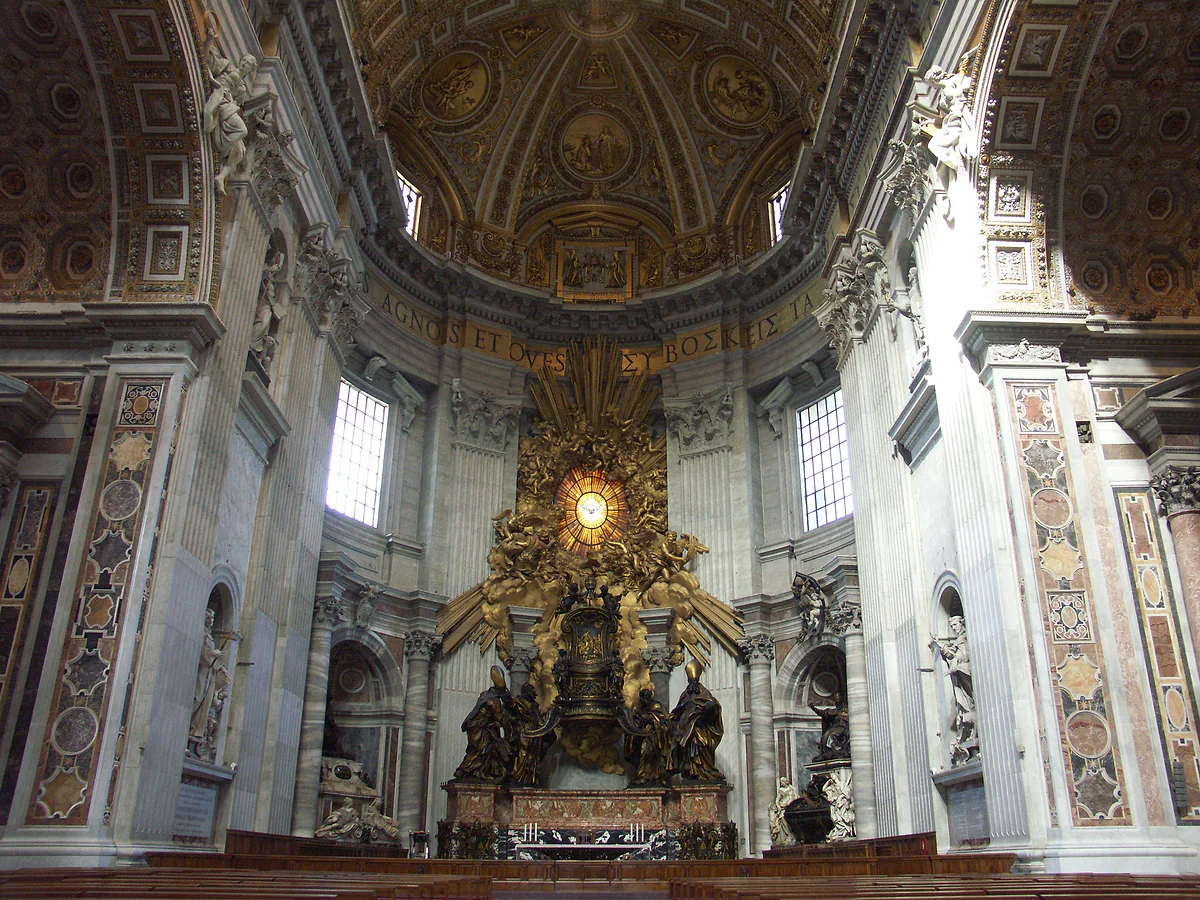
The dove of the Holy Spirit sits in the window about twenty metres up, above the gilded bronze. When the sun comes through, it's to my mind the brightest spot in the whole basilica.
architecture of St Peter's Basilica -
02 My tip
22 February, with a hundred candles
Every 22 February, the feast of the Chair of St Peter, the monument is lit with more than a hundred candles. If you're in Rome in late February, that's the day to see it.
Best time to visit Vatican City -
03 My tip
Mass at the Altar of the Chair
On weekdays there's Mass here at 11:00, 12:00, 17:00 and 18:00. It's free and lets you sit facing the work instead of standing among tour groups.
Mass times at the Vatican -
04 To save money
Free, no booking needed
The Chair is inside the basilica, which costs nothing. The €7 booking just gets you a time slot and audio guide, not better access to the apse.
Is the Sistine Chapel free?
My priorities
Unmissable
- See it from the nave, framed between the baldachin's columns
- Walk up to the apse to see the dove in the window
If you have time
I would skip
- Using flash during Mass, which is banned and disruptive
- Wandering round the apse mid-service as if it were a museum
What I would book
My ranking, scored
What to look at in the Chair, top to bottom
My own scores out of 10. They weigh what you can make out with the naked eye from the apse and what it tells you about the work. Ten minutes does it, or a Mass if you want calm.
0 of 3 seen
-
The Glory with the dove
The window with the dove of the Holy Spirit about twenty metres up. Restored in 2024, it's what gives the whole thing its meaning.
9.6 out of 10
-
The gilded bronze throne
The reliquary Bernini shaped as a throne. Inside is the wooden chair that gives the monument its name.
9.0 out of 10
-
The view from the nave, between columns
From the middle of the nave the Chair appears framed by the baldachin. They're two Bernini works meant to be seen together.
8.9 out of 10
Nearly everyone who walks into St Peter’s heads for the baldachin and stops there, as if the basilica ended under the dome. It doesn’t. At the far end, in the apse, Bernini placed the real finale of the route, a gilded bronze throne and, above it, a dove made of light. For me it’s the most theatrical moment in the basilica, and one of the least looked at. Here’s what it is, what it holds and when to see it at its best.
A reliquary shaped like a throne
The Chair of St Peter isn’t a seat. It’s a monument that protects one. Inside the gilded bronze throne is a wooden chair with Carolingian ivory friezes from the 9th century, according to the Fabbrica di San Pietro. Tradition links it to the authority of the Bishop of Rome, and Bernini treated it as a relic, sealing it inside a monumental reliquary.
The patron was Alexander VII, who also gave Bernini the square, and the work took a decade, ending in 1666. The figures explain the effort. The bronzes weigh 74 tonnes and the whole ensemble stands 14.74 metres high. What strikes me most is the contrast between all that weight and how light the thing looks from the nave.
What is Bernini’s Glory?
It’s the top part, and the bit you see from the entrance. A window with the dove of the Holy Spirit, about twenty metres up, over the gilded bronze. When light comes through the glass the whole apse glows. The Glory was restored in 2024, straight after the baldachin, and the cleaning finished in November that year.
The best way to get the idea is from a distance. From the middle of the nave the Chair sits framed between the twisted columns of St Peter’s baldachin, and the two Bernini works read as a single scene. The basilica’s axis starts at the door, passes over Peter’s tomb and ends at the dove. The architects who shaped that axis are covered in St Peter’s Basilica architecture.
22 February, with over a hundred candles
The feast of the Chair of St Peter is on 22 February. On that day, the Fabbrica says, the monument is lit with more than a hundred candles. If you can be flexible about travelling to Rome in late February, which is also low season, I’d pencil in that date. The next one is 22 February 2027.
The rest of the year you see it by the natural light of the window, which is plenty.
Mass in front of the Chair
Here’s a tip hardly anyone uses. The Altar of the Chair has more Masses than most in the basilica. There are four on weekdays, two in the morning and two in the afternoon, and five on feast days, the 10:30 chapter Mass being the grandest. The exact times are in the table above. No ticket is needed, just the basilica’s security check. If you want to look at the work sitting down in silence, rather than standing among groups, going to a Mass is the way, and the basilica’s full timetable is on my page about Mass times at the Vatican.
Do respect the service, though. No flash photos during Mass, which are banned in the basilica anyway, and no wandering round the apse as if it were a gallery.
Why does a chair matter so much?
Because in the Church the cathedra is the bishop’s symbol, the seat from which he teaches, which is where the word cathedral comes from. Rome’s, by tradition, is Peter’s, so Bernini treated it as a relic and placed it at the end of the axis, above even the papal altar. I think it’s a brilliant bit of stagecraft. He doesn’t show you the chair, he shows you what it means, with light, gold and height.
That’s also why the feast on 22 February is no minor date at St Peter’s. It’s the day the monument does, quite literally, what it was designed to do.
Fitting it into your visit
The Chair is inside St Peter’s Basilica, open 07:00 to 20:00 and free. My order would be to arrive early, walk the nave, stop under the dome and carry straight on to the apse. Ten minutes is enough to see it properly. On the way out, the facade and the pope’s balcony round the visit off outside.
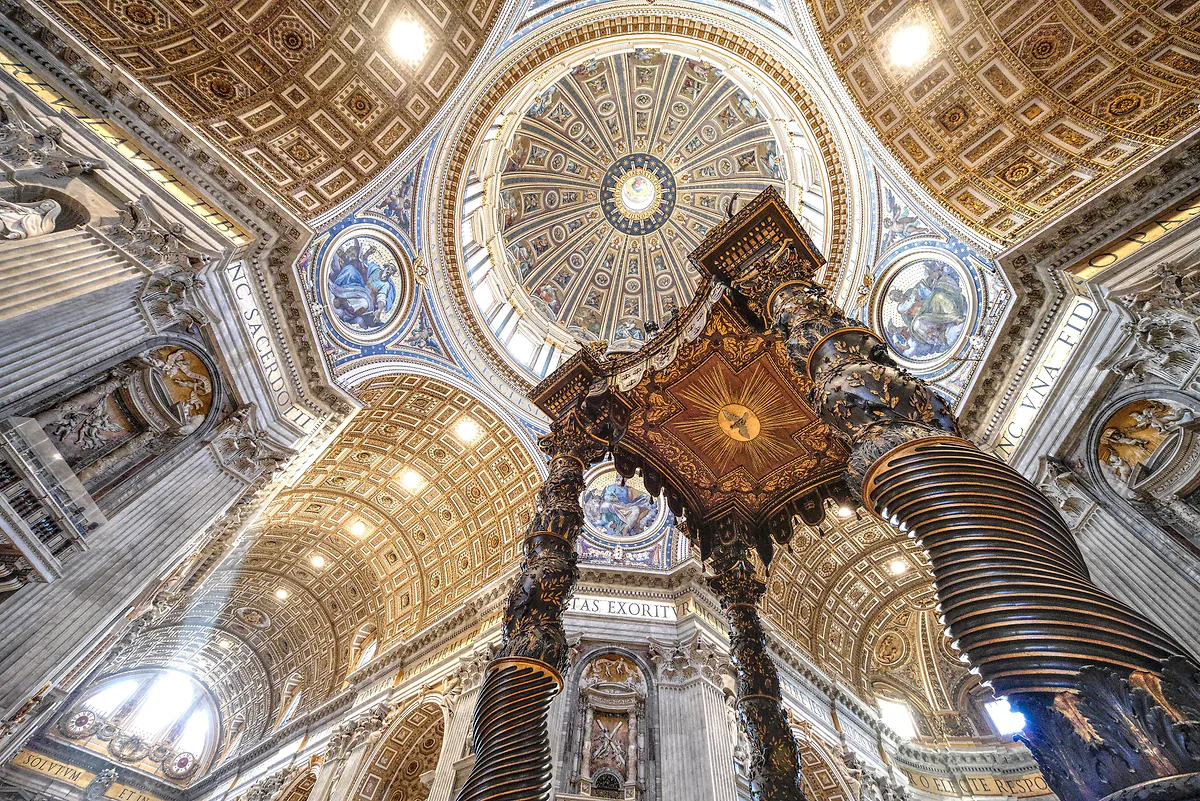
Bernini's bronze baldachin seen from below, with the dome of St Peter's and rays of light coming through its windows.
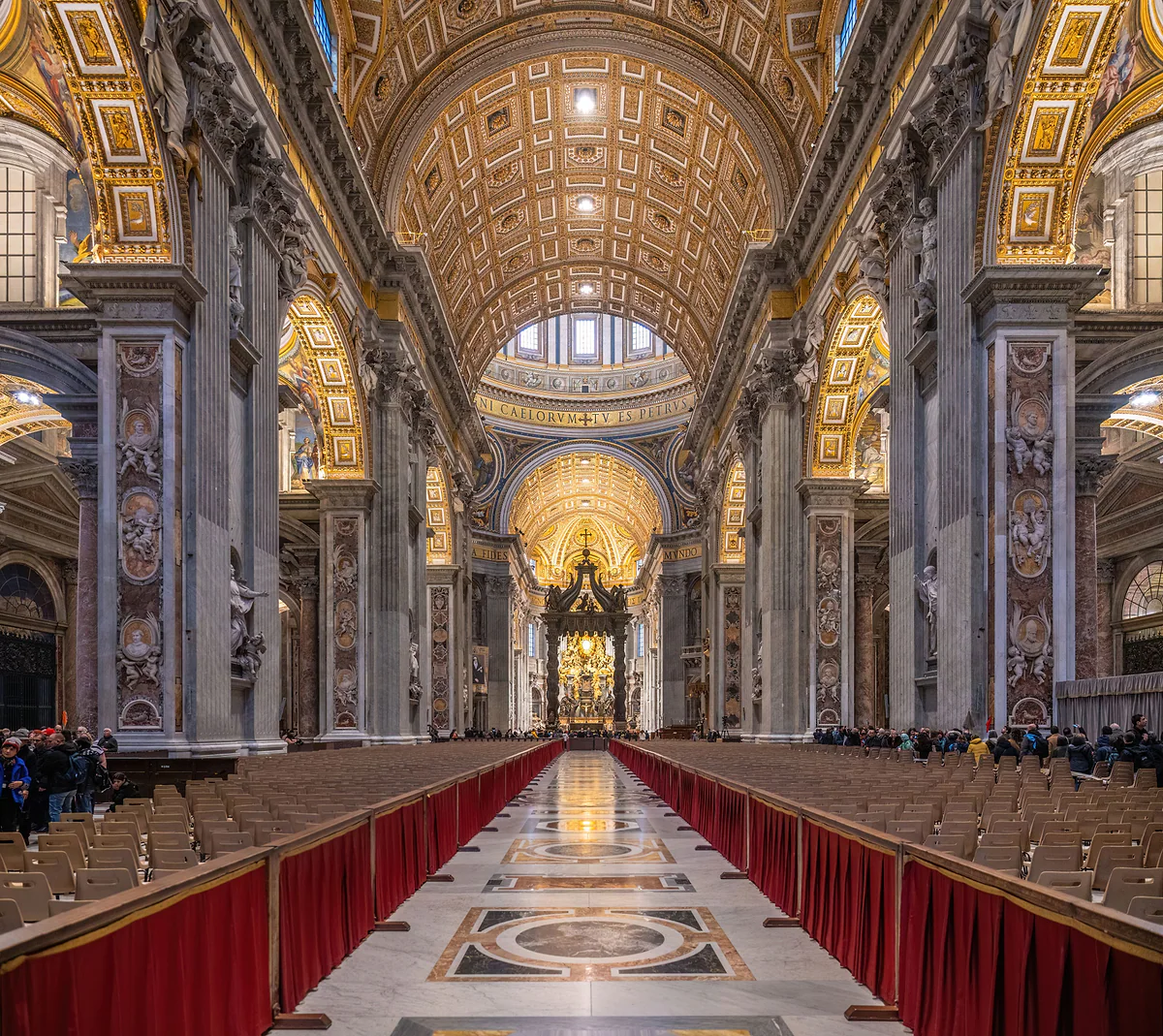
Central nave of St Peter's Basilica with its gilded coffered vault and Bernini's baldachin at the far end.
The Chair in figures
| Fact | Figure |
|---|---|
| Artist | Gian Lorenzo Bernini |
| Commissioned by | Alexander VII |
| Finished | 1666, after 10 years' work |
| Weight of the bronzes | 74 tonnes |
| Overall height | 14.74 m |
| Dove in the window | About 20 m up |
| Wooden chair | With Carolingian ivory friezes, 9th century |
| Restoration of the Glory | Finished in November 2024 |
Fabbrica di San Pietro and Vatican News.
Mass at the Altar of the Chair
| Day | Times |
|---|---|
| Weekdays | 11:00, 12:00, 17:00 and 18:00 |
| Feast days | 09:00, 10:30 (chapter Mass), 12:30, 16:00 and 17:00 |
Timetable published by the Fabbrica di San Pietro. It can change for papal celebrations.
Test yourself
True or false?
0/4 Pick before you peek.
-
Bernini's Chair is a bronze seat for the pope to sit on.
See the answer
False. It's a reliquary monument. Inside is a wooden chair with 9th-century ivories, the one that gives it its name.
-
Bernini took ten years to make the Chair.
See the answer
True. The Fabbrica di San Pietro says he finished it in 1666 after ten years' work.
-
The dove in the apse is painted on the wall.
See the answer
False. It's in the window, about twenty metres up, and the light comes through it.
-
Bernini's Glory was restored after the baldachin, in 2024.
See the answer
True. According to Vatican News, the restoration of the Glory of the Chair finished in November 2024, after the baldachin.
- Year Bernini finished the Chair
- 1666
- Weight of the monument's bronzes
- 74 t
- Height of the ensemble
- 14.74 m
- Candles, at least, that light it every 22 February
- 100
0 of 88 Vatican City guides
Your next stamp
- Baldachin
- St Peter's Basilica
- Bernini's colonnade
- Facade and balcony
- St Peter's Square
- Obelisk
- Sistine Chapel
- Things to do
- One day
- Tickets
- Two days
- Vatican Museums
- St Peter's Dome
- Vatican Necropolis
- Vatican Gardens
- Swiss Guard
- Seeing the Pope
- How to visit
- Castel Gandolfo
- Where to eat
- Free and cheap
- Apostolic Palace
- Scams to avoid
- Getting there
- Money and payments
- Exclusive experiences
- Papal audience
- Angelus
- Who painted it
- Where the Pope lives
- Where to stay
- Dress code
- Facts
- Opening hours
- Map
- Flag
- Post office and stamps
- Is it a country?
- Vatican Grottoes
- History
- Pietà
- Ceiling
- Last Judgement
- Raphael Rooms
- Architecture and architects
- Gallery of Maps
- Holy Door
- Library and Archives
- Bramante Staircase
- Mass at St Peter's
- Pio Clementino Museum
- Papal blessing
- Vatican Pinacoteca
- Catacombs
- Gallery of Tapestries
- Gallery of the Candelabra
- Egyptian and Etruscan Museums
- Vatican Museums map
- How long you need
- Night opening
- Chiaramonti and Braccio Nuovo
- Christmas
- Anima Mundi Museum
- Easter
- Carriage Pavilion
- Gift shops and souvenirs
- With kids
- Best time to visit
- Courtyard of the Pine Cone
- Photography
- Train station
- Accessible travel
- Vatican Observatory
- Borgia Apartment
- Modern art collection
- Papal Palace
- Barberini Gardens
- Facts
- Getting there
- Holy See
- Lake Albano
- Police and army
- Passport
- Pharmacy, shop and petrol
- What Vatican means
- Papal tombs
- List of popes
Frequently asked questions
What is the Chair of St Peter?
It's the gilded bronze monument Bernini built at the end of the basilica's apse to hold an ancient wooden chair, a symbol of the authority of the Bishop of Rome. He finished it in 1666, after ten years' work, for Alexander VII.
Where is the Chair of St Peter located?
At the far end of St Peter's Basilica, in the apse, directly behind the baldachin. From the entrance you see it at the end of the nave, framed between the baldachin's bronze columns.
What's inside Bernini's Chair of St Peter?
A wooden chair with Carolingian ivory friezes from the 9th century, according to the Fabbrica di San Pietro. Bernini enclosed it in a bronze reliquary shaped like a throne.
How heavy is the Chair of St Peter?
The bronzes weigh 74 tonnes and the ensemble is 14.74 metres high. The dove in the window is about 20 metres above the floor.
When is the feast of the Chair of St Peter?
On 22 February. That day the monument is lit with more than a hundred candles, according to the Fabbrica. It's the best day of the year to see it.
Can you go to Mass at the Altar of the Chair?
Yes, and it's free. Weekday Masses are at 11:00, 12:00, 17:00 and 18:00, feast days at 09:00, 10:30, 12:30, 16:00 and 17:00. No ticket needed, just the basilica's security check.
By
Tourism graduate with a master’s in Tourism Management and Planning from the University of Málaga, who has travelled across Europe. He writes every guide from official sources and his own judgement.
Published on . Facts checked on .
Sources
Photos: Dnalor 01 (CC BY-SA 3.0); Lviatour (CC BY-SA 4.0); Wilfredor (CC0), via Wikimedia Commons.