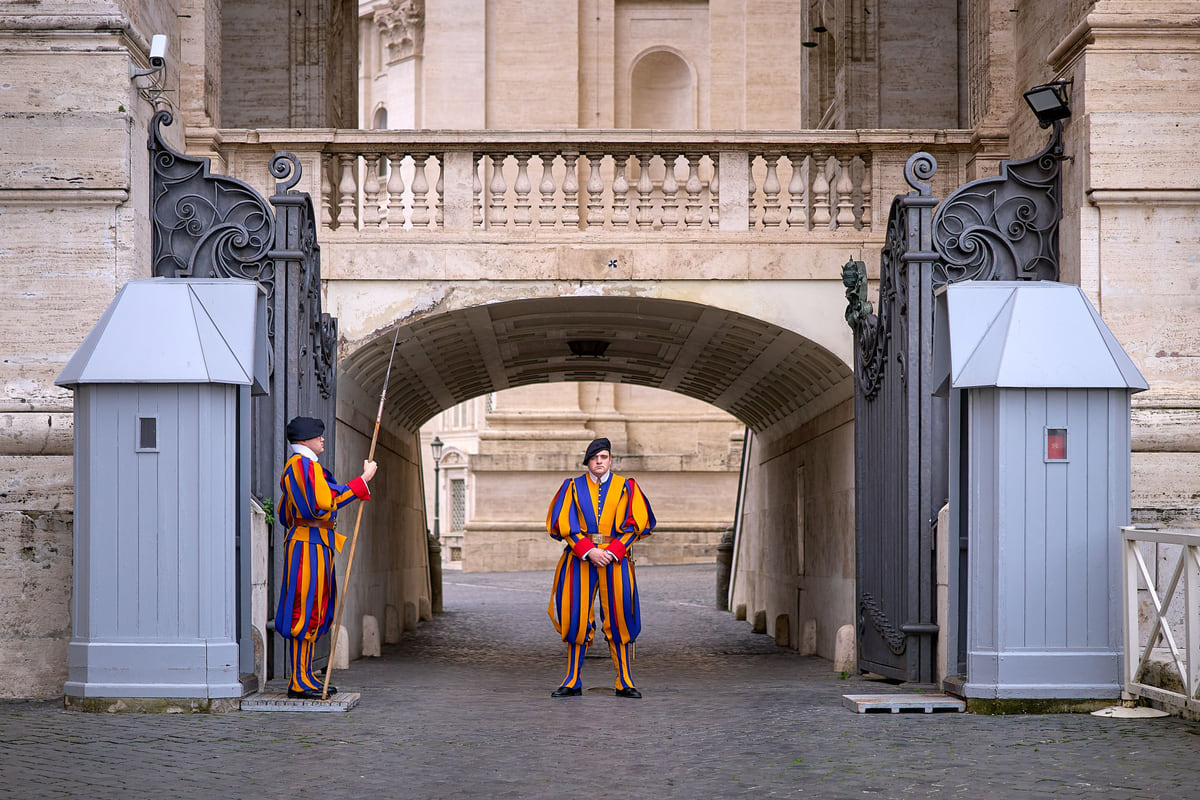
Who guards the Pope, and why they are Swiss
The Pontifical Swiss Guard, explained

The short answer
The Swiss Guard has protected the Pope since 22 January 1506. Its strength is 135 men, 85 of them halberdiers, all Swiss Catholics, single when they join and aged 19 to 30.
You can see them on duty for free at the Arch of the Bells, the Bronze Door and St Anne's Gate, all around St Peter's Square.
Swiss Guard in figures
- Founded
- 22 January 1506, under Julius II
- Strength
- 135 men
- Commander
- Colonel Christoph Graf, since 2015
- Swearing-in
- Every 6 May
- Where to see them
- Arch of the Bells, Bronze Door, St Anne's Gate
- Cost
- Free, from the street and the square
In 30 seconds
Full read: 5 min
- Since 22 January 1506 the Pope has been guarded by the Pontifical Swiss Guard, now 135 Swiss soldiers under Colonel Christoph Graf.
- Watching them costs nothing and you don't book. I rate the Arch of the Bells first, St Anne's Gate second and the Bronze Door third.
- Recruits must be Swiss, practising Catholic men, single and aged 19 to 30, and have already been through Swiss Army recruit school.
- The blue, red and yellow striped uniform is the work of Commander Jules Repond, head of the corps from 1910 to 1921, not Michelangelo.
- I wouldn't go out of my way for them. I'd pass them between the basilica and the Museums and check the plume colour to work out who's in charge.
I wouldn't make a special trip, but I would fit them into the day. Leaving the basilica I'd pass the Arch of the Bells, and on the walk to the Museums St Anne's Gate, looking at the colour of the helmet plume, because it tells you each guard's rank.
My ranking, scored
Where to see the Swiss Guard, best first
My own scores out of 10. I weigh how easy each post is to reach without queues or checks, how clearly you see the guard and the photo you come away with. All three posts are free; the swearing-in comes last because it isn't a tourist event.
0 of 4 seen
-
Arch of the Bells
To the left of the basilica, with a sentry box either side of the arch. It's the post in the photo on this page and the best-framed, and you see it leaving St Peter's without a detour.
8.9 out of 10
-
St Anne's Gate
It faces Via di Porta Angelica, so you see it from a normal street without entering the square. It sits between the colonnade and the Museums entrance.
8.4 out of 10
-
The Bronze Door
At the far end of the right-hand colonnade. It's further from the crowds and the photo shows less detail, but it's the door linked to papal audience tickets.
7.6 out of 10
-
Swearing-in day, 6 May
The most important ceremony in the Guard's year, with recruits, families and dignitaries. That's exactly why I wouldn't plan around it; for a traveller it's a lucky coincidence at best.
4.5 out of 10
What I would book ahead
- Places to stayBooking.com Staying in Prati, near St Anne's Gate You'd see the Swiss Guard for free on the way to the Museums. From Prati, St Anne's Gate and Viale Vaticano are a short walk away.
- Places to stayBooking.com Borgo, by the Arch of the Bells If the trip revolves around the Vatican, I'd stay in Borgo, passing the Arch of the Bells every time you leave the basilica.
Step by step
-
The Arch of the Bells
To the left of St Peter's Basilica, straight ahead as you come out, with guards at the gate into the Vatican.
Free
-
The Bronze Door
At the far end of the right-hand colonnade of St Peter's Square, the formal entrance to the Apostolic Palace.
-
St Anne's Gate
Facing Via di Porta Angelica, on the Rome side of the wall and on the walk to the Vatican Museums entrance.
Essential, optional and skippable
Unmissable
- A photo at the Arch of the Bells as you come out of St Peter's, the best-framed of the three posts
- St Anne's Gate on the walk from the colonnade round to the Museums entrance
- The plume colour on each helmet, which tells a halberdier (red) from an officer (dark violet) or the commander (white)
If you have time
I would skip
- Paying for a tour to see them, since the posts are free to see and the fee only covers the guide
- Turning up at a set time for a formal changeover, as there's no official timetable for one
- Planning your trip around the 6 May swearing-in, which is the corps' own ceremony with families
- Asking them to pose or blocking their way for a picture, because they're on duty
Notebook
Worth knowing about Swiss Guard
-
01 Most beautiful
The best photo is outside the basilica
The Arch of the Bells, to the left of the façade of St Peter's, is the post I rate most for a picture. Sentry boxes, old stone and the striped uniform in one frame, right in front of you as you leave.
St Peter's Basilica -
02 To save money
Seeing them costs nothing
No ticket, no booking and no security check to see the Guard at their posts. If someone sells you a tour to see them, you're paying for the guide. Along with the square and the basilica, it's some of the best of the Vatican for free.
Is the Sistine Chapel free? -
03 My tip
St Anne's Gate, on the way to the Museums
It opens onto Via di Porta Angelica, an ordinary Rome street outside the square. Walking from the colonnade to the Vatican Museums entrance you pass close by, so the photo costs you no extra time.
Vatican Museums -
04 My tip
On a Wednesday, watch the Bronze Door
The door at the end of the right-hand colonnade is guarded, and unofficial websites say it's also where the free paper tickets for the papal audience are collected. Two things in one spot.
Papal audience
The Swiss Guard in numbers
| Figure | Value |
|---|---|
| Strength | 135 (9 officers, 41 NCOs and 85 halberdiers) |
| Expansion | From 110 to 135, approved by Pope Francis in 2018 |
| Guards living inside the walls | 104 (as of 31 December 2024) |
| Recruits sworn in, 2026 | 28, before Leo XIV |
| Killed in the Sack of Rome (6 May 1527) | 147 of 189 |
Sources: Pontifical Swiss Guard, the Holy See and the Governorate of Vatican City State, checked on 24 September 2026.
For me the Swiss Guard is the quickest way to grasp how odd the Vatican is. A country of 0.44 km² trusts the safety of its head of state to 135 soldiers from another country, dressed in stripes and holding halberds, and it has done so since 1506. Seeing them is free and needs no booking. Understanding why they’re there takes five minutes, and it makes the photo you take afterwards far more interesting.
Where to see the Swiss Guard for free
No ticket needed, and the ranking above puts the posts in my order. The Arch of the Bells is to the left of St Peter’s Basilica and is where this page’s photo was taken. The Bronze Door closes off the right-hand colonnade of St Peter’s Square, and unofficial sites say it’s where papal audience tickets are handed out. St Anne’s Gate faces Via di Porta Angelica, on the Rome side of the wall.
My advice is not to treat it as an outing. St Anne’s Gate is on the walk between the square and the Vatican Museums entrance, and the Arch of the Bells is straight ahead as you leave the basilica. A photo from a respectful distance, without blocking anyone, is normally fine, but they’re on duty and they don’t pose.
If you’re British, the obvious comparison is the Changing of the Guard. Don’t picture Buckingham Palace. I haven’t found an official timetable for the changeover, so I’m not going to send you there for a particular hour. You see them as you pass, and that’s the point.
Why do the Swiss guard the Pope?
The short answer is that Julius II hired them and no Pope since has wanted to let them go. On 22 January 1506, 150 Swiss soldiers under Captain Kaspar von Silenen marched into Rome, and the Pope blessed them on arrival. The Guard still treats that as its founding date. How that year fits into the history of the Vatican, the age of Julius II and the Renaissance, I cover separately.
The long answer involves a massacre. On 6 May 1527 imperial troops stormed the city in the Sack of Rome. Of the 189 guards on the roll, 147 were killed defending the Pope. The 42 who survived got Clement VII to Castel Sant’Angelo along the Passetto, the raised corridor linking the Apostolic Palace to the castle, and saved his life.
What strikes me is that there’s no practical logic behind it at all. Nobody chose the Swiss in a modern procurement exercise. It’s a loyalty from 1527 that every Pope has chosen to honour, and the corps still runs its calendar around that date.
If you are staying the night, see the best hotel deals in Prati, Rome for your dates: the well-placed rooms go fast.
Michelangelo didn’t design the uniform
It’s the most repeated story about the Guard, and the Guard’s own website puts it straight. Today’s dress uniform was essentially designed by Commander Jules Repond, who led the corps from 1910 to 1921, taking his cue from frescoes by Raphael. The blue, red and yellow are the traditional Medici colours. So they have nothing to do with the yellow and white of the Vatican flag. I actually prefer the true version, because it turns a costume that looks Renaissance into a very clever early twentieth-century recreation.
Look at the helmet when you’re close. It’s a silver morion, and the plume gives away the rank. Red for halberdiers, dark violet for officers and white for the commander. Spot a white plume and you’re looking at the man in charge.
Swiss Guard requirements
The Guard publishes its conditions of entry, and they’re about as narrow as any uniformed job I know of. Every recruit must be Swiss, a practising Catholic, male, single on joining and aged 19 to 30. The reference height is 1.74 m. On top of that you need a completed apprenticeship with the federal AFC certificate or the school-leaving maturità, Swiss Army recruit school behind you and a commitment of at least 27 months.
The detail I find most telling is the double filter. Nationality and faith aren’t enough; you have to arrive already trained as a soldier by your own country. The Vatican doesn’t teach anyone to stand guard. It recruits people who already can.
Marriage comes later. Under the reform Pope Francis approved in 2018, any guard may ask to marry after five years of service. The same reform took the establishment from 110 to 135, still the official figure in 2026, made up of 9 officers, 41 NCOs and 85 halberdiers under Colonel Christoph Graf, in command since 2015. You’ll see higher numbers quoted online, but I haven’t found any expansion approved after 2018, so 135 is the figure I use.
Before you fix your dates, compare train and coach tickets to Rome: the same journey can cost very different amounts from one day to the next.
Pay and weapons, what I know and what I don’t
Two of the most searched questions are what a Swiss Guard earns and what weapons they carry. Here’s the honest position. Pay isn’t listed in the Guard’s published conditions, and I won’t repeat numbers nobody stands behind. Weapons are similar. The official site presents the halberd as the Guard’s emblem, the long pole with an axe blade you see in every photo, but in what I’ve read it doesn’t say what else is carried on duty. I’d rather leave a gap than fill it with a guess.
What is clear is that the sentry box is the smallest part of the job. The Guard’s official duties are the security of the Pope and his residence, travelling with him, watching the state’s official entrances, ceremonial duties and protecting the College of Cardinals when the see is vacant. They also loom large in the census. At 31 December 2024, 246 citizens lived inside the walls, and 104 of them were Swiss Guards. Who else lives in there, starting with Leo XIV himself, I cover in where the Pope lives in 2026.
Swearing-in day and a barracks still waiting
Recruits take their oath every 6 May, on the anniversary of the Sack, with families and dignitaries present. In 2026, 28 were sworn in before Leo XIV. It’s the corps’ own day rather than a show, so I wouldn’t plan my dates for it. If you happen to be in Rome, count yourself lucky.
The barracks, inside the Vatican, have had a rebuilding plan since 7 December 2023. The Pius IX-era façades on Via di Porta Angelica and Via Sant’Anna will stay, and the rest will be demolished. According to the Italian agency ANSA, as of May 2026 work hadn’t begun, won’t start before 2027, and the budget had risen from 45 to 70 million Swiss francs, more than 76 million euros. For visitors nothing changes, since the street frontage stays put. And if you want the Guard in context with everything else, it’s scored alongside the other sights in things to do in Vatican City.
So you do not lose the morning at the ticket office, browse tickets and tours in Swiss Guard on GetYourGuide.
If you would rather go at your own pace, see the car hire deals in Rome: the earlier you book, the more cars are left to choose from.
If you are staying the night, see the best hotel deals in Prati, Rome for your dates: the well-placed rooms go fast.
Who can join the Swiss Guard
| Requirement | Condition |
|---|---|
| Nationality | Swiss |
| Faith | Practising Catholic |
| Sex and marital status | Male, single on joining |
| Age | 19 to 30 |
| Reference height | 1.74 m |
| Education | Completed apprenticeship (Swiss AFC certificate) or school-leaving maturità |
| Military service | Swiss Army recruit school completed |
| Commitment | At least 27 months |
Conditions as published by the Pontifical Swiss Guard.
- Year Julius II welcomed the first Swiss guards
- 1506
- Guards on the establishment since the 2018 reform
- 135
- Guards killed defending the Pope in the 1527 Sack of Rome
- 147 of 189
- Guards living inside the walls at 31 December 2024
- 104
- Minimum length of service on joining
- 27 months
0 of 93 Vatican City guides
Your next stamp
- Police and army
- Free and cheap
- Library and Archives
- Facts
- Gallery of Maps
- Dress code
- Seeing the Pope
- Sistine Chapel
- Things to do
- One day
- Tickets
- Two days
- Vatican Museums
- St Peter's Basilica
- St Peter's Square
- St Peter's Dome
- Vatican Necropolis
- Vatican Gardens
- How to visit
- Castel Gandolfo
- Guided tours
- Where to eat
- Apostolic Palace
- Scams to avoid
- Getting there
- Money and payments
- Exclusive experiences
- Papal audience
- Angelus
- Who painted it
- Where the Pope lives
- Where to stay
- Facts
- Opening hours
- Map
- Flag
- Post office and stamps
- Is it a country?
- Vatican Grottoes
- History
- Pietà
- Baldachin
- Ceiling
- Chair of St Peter
- Last Judgement
- Raphael Rooms
- The Creation of Adam
- Architecture and architects
- Holy Door
- Bramante Staircase
- Facade and balcony
- Mass at St Peter's
- Pio Clementino Museum
- Papal blessing
- Vatican Pinacoteca
- Catacombs
- Gallery of Tapestries
- Gallery of the Candelabra
- Egyptian and Etruscan Museums
- Obelisk
- Vatican Museums map
- Bernini's colonnade
- How long you need
- Night opening
- Chiaramonti and Braccio Nuovo
- Christmas
- Anima Mundi Museum
- Easter
- Carriage Pavilion
- Gift shops and souvenirs
- With kids
- Best time to visit
- Courtyard of the Pine Cone
- Photography
- Train station
- Accessible travel
- Vatican Observatory
- Borgia Apartment
- Modern art collection
- Papal Palace
- Barberini Gardens
- Getting there
- Holy See
- Lake Albano
- Passport
- Pharmacy, shop and petrol
- What Vatican means
- Papal tombs
- List of popes
- Pope Leo XIV
- Conclave
- The Pope in Spain
Swiss Guard: questions and answers
Why do the Swiss guard the Vatican?
Because Pope Julius II hired them. On 22 January 1506, 150 Swiss soldiers under Kaspar von Silenen marched into Rome and received his blessing, and the corps has served every Pope since. Its reputation was sealed on 6 May 1527, when 147 guards died defending Clement VII during the Sack of Rome.
Are the Swiss Guard actually Swiss?
Yes, every one of them. Swiss nationality is the first condition of entry, alongside being a practising Catholic man, single on joining and aged 19 to 30. Recruits must also have completed Swiss Army recruit school.
How many Swiss Guards are there?
135. The official establishment is 9 officers, 41 non-commissioned officers and 85 halberdiers, commanded by Colonel Christoph Graf since 2015. The figure rose from 110 under the reform Pope Francis approved in 2018, and I haven't found any later increase.
What are the requirements for the Swiss Guard?
Swiss nationality, the Catholic faith, being male, single and between 19 and 30, and a reference height of 1.74 m. You also need a vocational certificate or school-leaving qualification, Swiss Army recruit school behind you and a commitment of at least 27 months.
What is a Swiss Guard's salary?
The Guard doesn't publish pay in its conditions of entry, and I'm not going to repeat figures that nobody puts their name to. What it does publish is the minimum commitment, 27 months, and that guards may marry after five years of service.
Did Michelangelo design the Swiss Guard uniform?
No, that's a myth the Guard itself corrects. The dress uniform worn today was essentially designed by Commander Jules Repond, who led the corps from 1910 to 1921, drawing on frescoes by Raphael. The blue, red and yellow are the traditional Medici colours.
What weapons do the Swiss Guard carry?
The halberd is the weapon the Guard itself presents as its emblem. Beyond that, the official site doesn't spell out in what I've read what else they carry on duty, so I won't guess.
Where do Swiss Guards live?
In their barracks inside the Vatican. At 31 December 2024, 104 of the 246 citizens living within the walls were Swiss Guards. A new barracks has been designed, but building work is not expected to start before 2027.

Questions about Swiss Guard? Write to me
If your question is not answered here, write to me and I will look it up in the official sources.
My email sergiolepone@gmail.com
By
Tourism graduate with a master’s in Tourism Management and Planning from the University of Málaga, who has travelled across Europe. He writes every guide from official sources and his own judgement.
Published on . Updated on . Facts checked on .
Sources
Some links in this guide are affiliate links: if you book through them, the site earns a commission at no extra cost to you. Affiliate disclosure
Photos: Radek Kucharski (CC BY 4.0), via Wikimedia Commons.