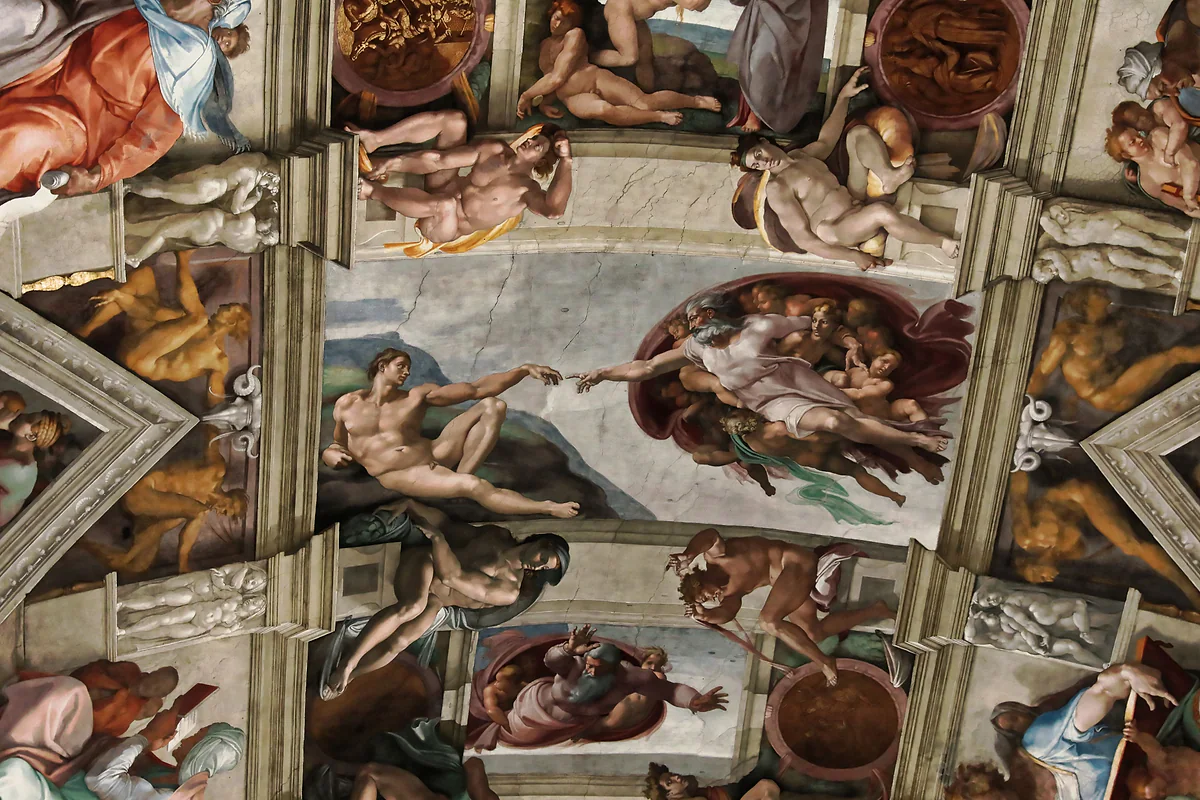
Michelangelo, 1508-1512
The Sistine Chapel ceiling, and how to read it from the floor
Michelangelo painted the Sistine Chapel ceiling in fresco between 1508 and 1512 for Pope Julius II. Down the centre run nine scenes from Genesis, from the Separation of Light and Darkness to the Drunkenness of Noah, with the Creation of Adam fourth from the altar, framed by seven prophets and five sibyls. You see it on a Vatican Museums ticket, from €20.
In 30 seconds
Full read: 5 min
- Michelangelo painted the Sistine Chapel ceiling in fresco between May 1508 and October 1512, commissioned by Pope Julius II.
- Nine Genesis scenes run down the centre from altar to entrance, and the Creation of Adam is the fourth counting from the altar.
- Around them are seven prophets and five sibyls, twenty ignudi, four corner pendentives and fourteen lunettes with Christ's ancestors.
- Photos and phones are banned inside, so I'd learn the order of the scenes before walking in.
- It's included in the Vatican Museums ticket, €20 at the desk or €25 online with a time slot, and free on the last Sunday of the month.
I'd walk in knowing three things, because once inside you can't look anything up. The scenes run from the altar to the entrance, the Creation of Adam is the fourth, and Jonah, right above the altar, is the figure on the whole ceiling that impresses me most. With that in your head, the rest falls into order.

Before you go
What I would keep in mind
-
01 Most beautiful
The Creation of Adam, where it belongs
For me the scene gains enormously when you see it between the Separation of Land and Water and the Creation of Eve, as part of the sequence rather than cropped onto a T-shirt. It's the fourth scene counting from the altar.
Sistine Chapel -
02 My tip
Learn it first, phones stay away inside
Photos, video and phone use are all banned in the Sistine Chapel, and guides aren't allowed to talk inside. I'd memorise the order of the nine scenes before going in, in the galleries on the way if need be.
Visiting Vatican City in 2026 -
03 To save money
Free on the last Sunday, with a catch
On the last Sunday of each month the Museums are free from 9:00 to 14:00, last entry 12:30. It isn't the day I'd pick to study a ceiling in peace, but it's the only official way to pay nothing.
Is the Sistine Chapel free? -
04 Watch out
Nobody sells a queue-free ceiling
The «skip the line» option is the €5 online booking fee already built into the €25 ticket. The Museums warn about lookalike websites charging markedly more, so I'd only buy on tickets.museivaticani.va.
Vatican scams and tourist traps to avoid in 2026 -
05 Worth the splurge
If you'll spend more, buy the time slot
The official ticket office doesn't sell a private Sistine Chapel visit. What is worth paying for is the 8:00 booking, the first of the day, so you reach the ceiling ahead of the tour groups.
Vatican tickets 2026
My priorities
Unmissable
- Finding the Creation of Adam, fourth from the altar, and reading the rest outwards from it
- Looking up at Jonah above the altar, the figure that seems to tip out of the ceiling
- Booking the 8:00 slot to see the ceiling before the tour groups arrive
If you have time
- Seeking out the prophets and sibyls, the part of the ceiling most people skip
- Comparing the Flood, from the early months, with the Separation of Light, from the last
- Turning to the altar wall for the Last Judgement, painted more than twenty years later
- See who painted the walls before Michelangelo
What I would book
- Places to stayBooking.com Prati, to see the ceiling before the groups The 08:00 booking is the one I'd pay for to see the ceiling before the groups arrive, and from Prati you can walk to Viale Vaticano.
- Tours and ticketsGetYourGuide A guided tour that briefs you beforehand Guides can't speak inside the chapel, so they explain it in the galleries first. It's the alternative to learning the order yourself, and I'd check that entry is included.
My ranking, scored
What I'd look at on the ceiling, in order
My own scores out of 10. They weigh how much each part impresses from the floor, more than twenty metres below, and what it tells you about how Michelangelo worked. It's a plan for where to put your eyes on a no-photo visit, not an academic verdict.
0 of 9 seen
-
The Creation of Adam
God's finger and Adam's about to touch, the passing of the breath of life in the official description. God arrives held up by angels and wrapped in a cloak, and Adam is painted like an athlete at rest.
9.8 out of 10
-
Jonah, above the altar
He's painted leaning back against the curve of the wall, and from below he seems to tip out of the ceiling. He's the prophet of the Resurrection, and the figure that impresses me most.
9.4 out of 10
-
Original Sin and Expulsion
Two moments in one panel, as its title says, the sin and the leaving of Paradise. It's the sixth scene and closes the block devoted to the origin of mankind.
9.0 out of 10
-
The Delphic Sibyl
One of the two sibyls with her own page on the Museums website, alongside the Libyan. The prophets and sibyls are the part of the ceiling people give least time to, and I think that's a mistake.
8.8 out of 10
-
The Flood
One of the first things he painted, and mould appeared through inexperience. He redid much of the scene, and the islet on the right survives from the first version.
8.6 out of 10
-
Separation of Light and Darkness
The first Genesis scene, above the altar, and among the last he painted. Compare it with the Flood at the other end and you see how far his painting moved in four years.
8.4 out of 10
-
The four corner pendentives
Judith and Holofernes, David and Goliath, the Brazen Serpent and the Punishment of Haman, in the corners. They tell four rescues of the people of Israel and hardly anyone lowers their gaze to them.
8.0 out of 10
-
Ignudi and medallions
Twenty nudes beside the smaller scenes, with oak garlands and acorns alluding to the Della Rovere arms, Julius II's family, plus ten medallions of painted bronze.
7.7 out of 10
-
Lunettes of Christ's ancestors
Fourteen lunettes with Christ's genealogy, five on each long side and two at each end. Michelangelo destroyed two of his own to paint the Last Judgement on the altar wall.
7.3 out of 10
The Sistine Chapel ceiling is the most photographed ceiling on earth and, oddly, one of the hardest to see in person, because inside you can’t use your phone or listen to a guide. Whatever you haven’t learnt beforehand, you won’t work out up there. The chapel overview lives in my Sistine Chapel guide. This page is something else, a plan of the ceiling to read from the floor, one scene at a time.
From a starry sky to nine scenes from Genesis
Before Michelangelo, the vault was a blue sky scattered with stars by Pier Matteo d’Amelia. In May 1504 a long crack opened, Bramante fitted iron ties in the space above, and the damage forced a redecoration. Julius II gave the job to Michelangelo, and the contract was signed on 8 May 1508.
What that contract said is, to me, the most revealing part of the whole story. It called for twelve apostles in the pendentives and ornament elsewhere. Michelangelo dismissed it as «cosa povera», a poor thing, asked for a new commission, and the Pope gave him a free hand. In a letter of 1523 he put it simply, the Pope gave him a new commission to do as he wished. Treccani notes that this freedom may have concerned the area and payments more than the subject, and the Museums suggest court theologians probably helped. Even so, going from twelve apostles to more than a thousand square metres of plaster, as Benedict XVI described it in 2012, is quite a leap.
How is the Sistine Chapel ceiling laid out?
Within a painted architectural frame, the central band holds nine Genesis scenes, grouped in threes as the origin of the universe, of mankind and of evil. The biblical order starts above the altar with the Separation of Light and Darkness and ends by the entrance with the Drunkenness of Noah. The table above lists them one by one.
One detail helps me enormously when looking. Michelangelo painted them backwards, beginning with the three Noah scenes by the entrance and finishing above the altar. Walk the band from the door towards the far end and you’re watching his painting develop over four years. Another quirk is that the Sacrifice of Noah comes before the Flood, though in the Bible it follows it, and that’s the order on the ceiling and on the official site.
Around the band sit four further layers. Twelve enthroned prophets and sibyls, the ignudi with their medallions, the lunettes and webs with Christ’s ancestors, and the pendentives in the four corners.
The Creation of Adam, up close
It’s the fourth scene from the altar. The Museums describe it as the creation of man in God’s image, with the breath of life passing through the touch of the fingers. God leans towards Adam, carried by angels in flight and wrapped in a cloak that Treccani describes as crowded with heavenly spirits. Adam is painted like an athlete at rest, waking into life and holding out his left forefinger.
I’m very taken with Condivi’s reading. He was the biographer guided by Michelangelo himself, and he saw a command in the gesture too, as though God were handing Adam the rules of what he should and shouldn’t do. Only one preparatory drawing is known for Adam’s body, plus several studies of the hands, one of them in the British Museum.
A word of warning. There are theories about a brain hidden in God’s cloak and about who the figure under his arm might be. The official site mentions neither, and I’d leave them as what they are, interpretations.
Seven prophets, five sibyls and Jonah leaning back
Prophets and sibyls alternate along the long sides, with Zechariah over the entrance and Jonah over the altar on the short ends. The prophets are Zechariah, Joel, Isaiah, Ezekiel, Daniel, Jeremiah and Jonah, and the sibyls the Delphic, Erythraean, Cumaean, Persian and Libyan. Beneath each throne, children hold a tablet bearing the name, so you can identify them without a guide. Treccani measures them at between 2.60 and nearly 3 metres, and you can see them grow as Michelangelo worked along the vault.
If I had to keep one figure from the whole ceiling, it would be Jonah. He’s painted leaning back against the curve of the wall, and from below he seems to lurch out of the vault. Joel has been proposed as a portrait of Bramante, though that’s only a hypothesis.
His own scaffold, mould in the Flood and four years
Bramante had designed a scaffold hung from ropes that meant drilling holes in the vault, and Michelangelo turned it down. He built his own in timber, resting on the sides of the windows, with a large sheet stretched beneath it, so the Pope couldn’t see the work until it was unveiled. The idea that he painted lying flat on his back is a cliché I haven’t found in any reliable source, so I won’t pass it on as fact.
What is documented is the early stumble. In the Flood, mould appeared because he was new to fresco, and he had to redo much of it, with the islet on the right surviving from the first attempt. By August 1510 half was done, and the whole ceiling on 31 October 1512, and the next day Julius II said Mass in the chapel. Meanwhile, a few metres away, Raphael was painting the Raphael Rooms, and seeing both on the same day is one of the best things the Vatican Museums offer.
The colours you see today
The full restoration of the chapel’s frescoes ran from 1979 to 1999, with the ceiling cleaned during the 1980s under Gianluigi Colalucci. Centuries of lamp soot came off, along with glues brushed on in old restorations to brighten the colours that had ended up darkening them. Out came vivid, shot colours and details nobody could read before, such as Eleazar’s golden hair under a dark, opaque layer. It was controversial, because touches some critics believed were Michelangelo’s own were removed too. I side with Treccani’s point that bright colour was already his hallmark before he reached Rome.
How to look at it inside, without photos or a phone
In the Sistine Chapel, photos and video on any device are banned (where you can shoot is covered in Vatican photography rules), phones can’t be used, silence is expected and guides can’t explain anything inside. My plan has three passes. First I find the Creation of Adam to get my bearings. Then I walk the central band from end to end, counting off the nine scenes. Finally I drop my eyes to the thrones, the corners and the lunettes, where hardly anyone looks.
For the rest of the visit, remember that the chapel is the last stop on the route. Last entry is 18:00 Monday to Saturday, and staff begin moving people out at 19:30, so I’d book the first slot through Vatican City tickets and go with shoulders and knees covered, as I explain in the Vatican dress code.
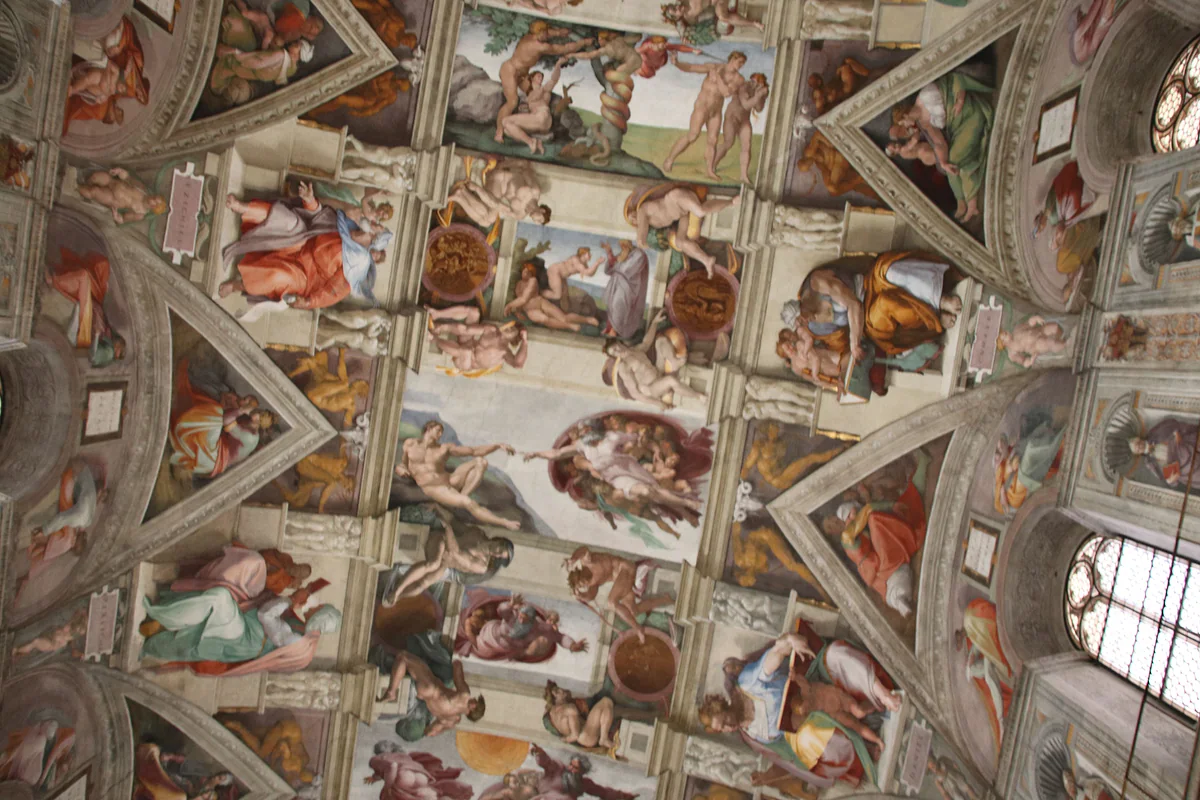
The Sistine Chapel ceiling painted by Michelangelo, with the Genesis scenes, including The Creation of Adam, and the prophets and sibyls.
The nine scenes from Genesis, altar to entrance
| No. | Scene | Genesis | Group |
|---|---|---|---|
| 1 | Separation of Light and Darkness | Gen 1:1-5 | Origin of the universe |
| 2 | Creation of the Sun, Moon and Plants | Gen 1:11-19 | Origin of the universe |
| 3 | Separation of Land and Water | Gen 1:9-10 | Origin of the universe |
| 4 | Creation of Adam | Gen 1:26-27 | Origin of mankind |
| 5 | Creation of Eve | Gen 2:18-25 | Origin of mankind |
| 6 | Original Sin and Expulsion from Paradise | Gen 3:1-13 and 22-24 | Origin of mankind |
| 7 | Sacrifice of Noah | Gen 8:15-20 | Origin of evil |
| 8 | The Flood | Gen 6:5 - 8:20 | Origin of evil |
| 9 | Drunkenness of Noah | Gen 9:20-27 | Origin of evil |
Order and references from the Vatican Museums website. The Sacrifice of Noah comes before the Flood even though it follows it in the Bible. Michelangelo painted them in reverse, starting with the Noah scenes by the entrance.
Tickets and hours to see the ceiling (2026)
| What | Detail |
|---|---|
| Full ticket | €20 at the desk, €25 online with a time slot |
| Reduced (ages 7 to 18 and students up to 25) | €10 at the desk, €15 online |
| Monday to Saturday | 08:00-20:00, last entry 18:00 |
| Last Sunday of the month | 09:00-14:00, free, last entry 12:30 |
| Other Sundays | Closed |
The Museums ticket includes the Sistine Chapel and is valid only on the day of issue. The only official online seller is tickets.museivaticani.va.
- Years Michelangelo spent painting the ceiling
- 1508-1512
- Genesis scenes in the central band
- 9
- Prophets and sibyls enthroned around them
- 12
- Of painted plaster, per Benedict XVI in 2012
- 1,000+ m²
- Museums ticket at the desk, Sistine Chapel included
- €20
0 of 88 Vatican City guides
Your next stamp
- Sistine Chapel
- Who painted it
- Last Judgement
- Facts
- Gallery of Tapestries
- Pietà
- Gallery of Maps
- Raphael Rooms
- Things to do
- One day
- Tickets
- Two days
- Vatican Museums
- St Peter's Basilica
- St Peter's Square
- St Peter's Dome
- Vatican Necropolis
- Vatican Gardens
- Swiss Guard
- Seeing the Pope
- How to visit
- Castel Gandolfo
- Where to eat
- Free and cheap
- Apostolic Palace
- Scams to avoid
- Getting there
- Money and payments
- Exclusive experiences
- Papal audience
- Angelus
- Where the Pope lives
- Where to stay
- Dress code
- Opening hours
- Map
- Flag
- Post office and stamps
- Is it a country?
- Vatican Grottoes
- History
- Baldachin
- Chair of St Peter
- Architecture and architects
- Holy Door
- Library and Archives
- Bramante Staircase
- Facade and balcony
- Mass at St Peter's
- Pio Clementino Museum
- Papal blessing
- Vatican Pinacoteca
- Catacombs
- Gallery of the Candelabra
- Egyptian and Etruscan Museums
- Obelisk
- Vatican Museums map
- Bernini's colonnade
- How long you need
- Night opening
- Chiaramonti and Braccio Nuovo
- Christmas
- Anima Mundi Museum
- Easter
- Carriage Pavilion
- Gift shops and souvenirs
- With kids
- Best time to visit
- Courtyard of the Pine Cone
- Photography
- Train station
- Accessible travel
- Vatican Observatory
- Borgia Apartment
- Modern art collection
- Papal Palace
- Barberini Gardens
- Facts
- Getting there
- Holy See
- Lake Albano
- Police and army
- Passport
- Pharmacy, shop and petrol
- What Vatican means
- Papal tombs
- List of popes
Frequently asked questions
Who painted the ceiling of the Sistine Chapel?
Michelangelo, for Pope Julius II. He signed the contract on 8 May 1508 and finished on 31 October 1512. The official website suggests court theologians probably helped with the programme, and Treccani thinks assistants painted in the Flood, so I wouldn't say he did it entirely alone.
When was the Sistine Chapel ceiling painted?
Over about four years, from 1508 to 1512. The first half was done by August 1510 and the whole ceiling on 31 October 1512. Julius II said Mass in the chapel the next day, 1 November, All Saints' Day.
What are the paintings on the Sistine Chapel ceiling?
Down the centre, nine Genesis scenes in three groups of three, the origin of the universe, of mankind and of evil. Around them sit seven prophets and five sibyls on thrones, twenty ignudi with medallions, Christ's ancestors in the lunettes and four rescues of Israel in the corners.
Where is the Creation of Adam in the Sistine Chapel?
In the central band of the ceiling, fourth scene counting from the altar, between the Separation of Land and Water and the Creation of Eve. It sits roughly halfway along the chapel, and I'd use it to get my bearings before following the rest.
What does the Creation of Adam mean?
According to the Museums, the creation of man in God's image, with the breath of life passing through the touch of the fingers. Condivi, the biographer guided by Michelangelo himself, also saw a command in it, as if God were giving Adam the rules of what to do and not do. The brain theory and debates over the figure under God's arm aren't on the official site.
Did Michelangelo paint the ceiling lying on his back?
It's a cliché I haven't found in any reliable source, so I wouldn't repeat it as fact. What the sources do say is that he rejected Bramante's hanging scaffold, because it meant drilling holes in the vault, and built his own wooden one resting on the window sides.
Can you take photos of the Sistine Chapel ceiling?
No. Inside the Sistine Chapel, photos and video on any device and phone use are banned, silence is required and attendants can make you delete what you've shot. Elsewhere in the Museums, personal photos without flash are fine.
By
Tourism graduate with a master’s in Tourism Management and Planning from the University of Málaga, who has travelled across Europe. He writes every guide from official sources and his own judgement.
Published on . Facts checked on .
Sources
Photos: Burkhard Mücke (fotografía); Miguel Ángel (obra) (Public domain); Gary Todd from Xinzheng, China (Public domain), via Wikimedia Commons.