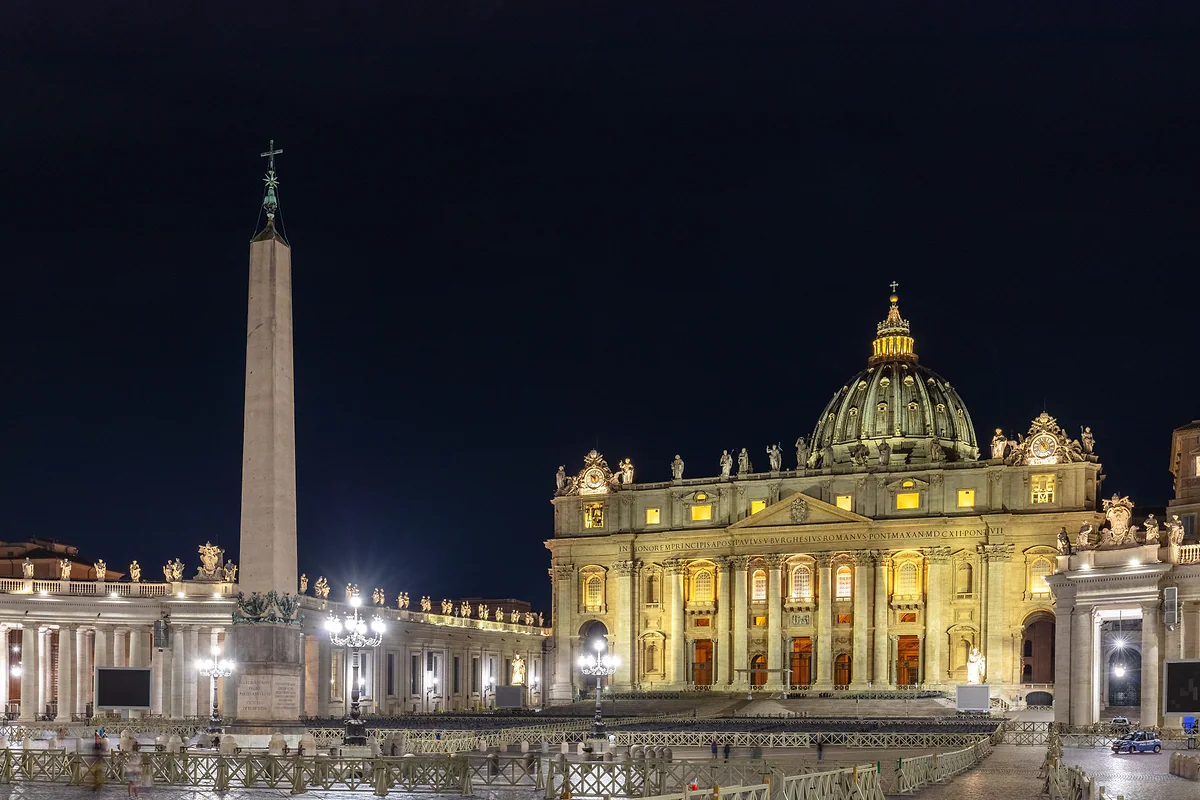
330 tonnes of granite without a single hieroglyph
The Vatican obelisk, from Caligula's circus to the middle of St Peter's Square
The obelisk in St Peter's Square is red granite, 25.36 metres tall without its base and 330 tonnes in weight. Caligula brought it to Rome for his private circus, and in 1586 Domenico Fontana moved it to the centre of the square using 907 men, 75 horses and 44 winches. It's free to see at any hour, with an 1817 meridian line and wind rose set into the paving at its foot.
In 30 seconds
Full read: 4 min
- The Vatican obelisk is red granite, 25.36 m tall without its base and 330 tonnes in weight.
- Caligula brought it to Rome for his private circus, and Sixtus V moved it to the centre of the square in 1586.
- Domenico Fontana shifted it with 907 men, 75 horses and 44 winches, according to the Holy See.
- It's the only obelisk in Rome without hieroglyphs, and an 1817 meridian line and wind rose run from its foot.
- It's free to see at any hour, because the square never closes.
Don't settle for the long-range photo. I'd walk up to the base to read the exorcism carved into it, follow the grey granite strip of the meridian, and have a small laugh at the 'west' someone spelt in English in 1817.

Before you go
What I would keep in mind
-
01 Most beautiful
The obelisk lines up the whole square
It sits on the axis of the basilica and both fountains, and Bernini drew his colonnade around it. Stand on one of the discs marking the centre of each curve and the whole design clicks into place.
Bernini's colonnade in St Peter's Square -
02 My tip
Catch noon on the meridian
The strip of grey granite running from the base is an 1817 meridian line. At solar noon the shadow of the cross falls on it, and the two end discs mark the solstices on 22 June and 22 December.
Vatican Observatory at Castel Gandolfo -
03 To save money
Free, day or night
The square has no ticket office and no opening hours, so you can see the obelisk at dawn, late at night or in the middle of an audience. It's one of the best things in the Vatican that costs nothing.
Is the Sistine Chapel free? -
04 My tip
At Christmas the crib sits at its foot
Since 1982, on John Paul II's wish, the square's nativity scene is set up beside the obelisk's base. In December you get obelisk, crib and tree in a single shot.
Vatican Christmas
My priorities
Unmissable
- Read the inscriptions on the base, the removal story and the exorcism
- Follow the meridian line out to one of the solstice discs
- Look back from a 'centre of the colonnade' disc with the obelisk on the axis
If you have time
- Hunt for the English 'west' in the wind rose, on the basilica side
- See it from above, from the terrace of the dome
- Read up on who built the facade behind it
I would skip
- Repeating the removal figures that do the rounds online, which don't match the official ones
- Trying to study the base on an audience Wednesday or at Sunday noon
What I would book
My ranking, scored
What to look for on and around the obelisk
My own scores out of 10. They weigh what you can genuinely see from the square and what it tells you about the obelisk's story. Everything is within a hundred metres and all of it is free.
0 of 6 seen
-
The plain granite shaft
It's the only obelisk in Rome with no hieroglyphs and the second tallest in the city. That smooth surface is exactly what makes it odd among Rome's obelisks.
9.2 out of 10
-
The lions and the cross
The bronze lions at the base were made when Sixtus V moved it in 1586, and he was the one who swapped the bronze ball on top for a cross.
8.8 out of 10
-
Gilj's meridian line
70.79 metres of grey granite with marble discs, using the obelisk as its gnomon. A sundial the size of half the square.
8.5 out of 10
-
The inscriptions on the base
North and south sides tell the story of the move. East and west carry lines from the exorcism used to consecrate a pagan monument.
8.1 out of 10
-
The wind rose and its 'west'
Sixteen marble discs in the paving naming the winds. On the basilica side it says 'west' in English and on the opposite side 'est', not 'east', a slip the Vatican's own site points out.
7.9 out of 10
-
The two matching fountains
The right-hand one is Maderno's, rebuilt by Bernini from 1667; the left-hand near-copy ran from 1689. Both sit in line with the obelisk.
7.6 out of 10
Most people treat the obelisk in St Peter’s Square like a lamp post, something glimpsed from a distance on the way to the queue. I think it’s the oldest and most travelled object in the whole Vatican, older than the basilica, the colonnade and Christian Rome itself. If Pliny’s clue is right it’s close to four thousand years old, it has changed cities three times and it ended up working as a sundial. Below is what the Holy See’s fact sheet tells us, and what to look for around the base.
Three cities before this square
Its origins are uncertain, and the Holy See says so plainly. In his Natural History, Pliny the Elder describes an obelisk at Heliopolis raised by a pharaoh he calls Nencoreus, perhaps Amenemhat II. Between 30 and 28 BC Cornelius Gallus used it to decorate the Forum Julium in Alexandria. Then Caligula, emperor from AD 37 to 41, had it shipped to Rome for his private circus, on the very ground the state now occupies.
That circus is why the story matters. Tradition says Peter was martyred beside it, and both basilicas rose over his grave nearby. So the obelisk is the only survivor still standing from the landscape around that death. The story of this hill before it became the Vatican is told in my page on Vatican history.
How do you move 330 tonnes in 1586?
With engineering, patience and a small army. Sixtus V wanted the obelisk at the centre of the square and gave the job to Domenico Fontana, his trusted architect. The official sheet puts the operation at 907 men, 75 horses and 44 winches. You’ll see other figures online, 800 men and 160 horses among them, but I’m sticking with the Holy See’s.
The stone deserved the effort. The red granite shaft is 25.36 metres, the base 8.25, and the whole thing weighs 330 tonnes. It’s the second tallest obelisk in Rome and the only one without hieroglyphs, which to me is its oddest feature, because in a city full of carved obelisks this one is smooth.
Sixtus V also Christianised it. He removed the bronze ball from the tip and put up the cross, and commissioned the bronze lions and inscriptions at the base. Later, in 1723, Innocent XIII added bronze festoons and eagles on each face.
What’s written on the base
This is where most visitors walk straight past, and they shouldn’t. The inscriptions on the north and south faces record the move. Those on the east and west carry lines from the exorcism spoken when the obelisk was consecrated. A pagan monument turned round with words, in full public view. Cardinal Silvio Antoniano wrote the texts. For me it’s the detail that best sums up the late 16th-century Vatican, which didn’t destroy the ancient world so much as reuse it with a new story attached.
Since 1982, at John Paul II’s wish, the square’s nativity scene has been set up at the foot of the obelisk. If you’re in Rome in December, it all comes together, as I explain in my page on Christmas at the Vatican.
A seventy-metre sundial
In 1817 a Vatican astronomer, Mgr Filippo Luigi Gilj, made the obelisk into a gnomon. He laid a straight line of grey granite 70.79 metres long, set with marble discs, running from the base towards the right-hand colonnade. At noon the shadow of the cross falls on it and shows the sun’s declination. The two end discs mark the solstices on 22 June and 22 December, and five more mark the signs of the zodiac in pairs.
The same year Gilj set out the wind rose, sixteen marble discs around the obelisk naming the compass points and their winds. It has a slip the Vatican’s own website mentions with some amusement. On the basilica side it reads ‘west’, in English, while the opposite side reads ‘est’ rather than ‘east’. There are no other foreign words. Finding it is a great game with children. And if the astronomy hooks you, the Vatican later had an observatory of its own, which you can now visit at the Vatican Observatory in Castel Gandolfo.
How I’d look at it
The obelisk has no ticket office and no hours. You’ll see it free at any time, and at night, with the basilica lit up behind it, it’s even better. I’d do three things. First, stand on one of the two discs marking the centre of each curve, to see how Bernini’s colonnade arranges itself around the obelisk. Then walk up to the base to read the inscriptions and find the lions. Finally, follow the meridian out to whichever solstice disc is closer.
On audience Wednesdays and at the Sunday Angelus the base disappears behind barriers and crowds, so that’s not the moment to study it. The fountains, the travertine strip marking the border and the square’s weekly rhythm all sit on the main page for St Peter’s Square.
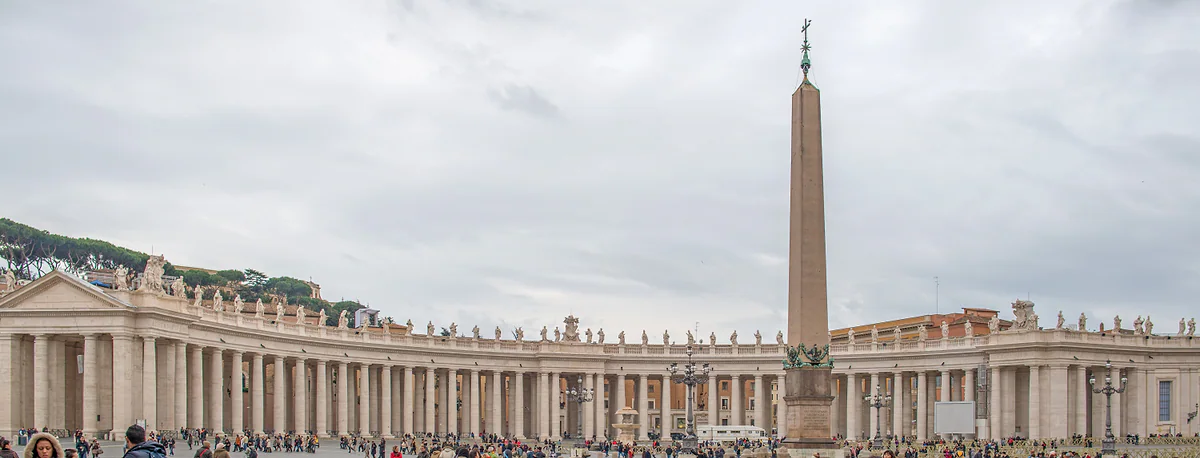
Bernini's colonnade encircles St Peter's Square with the Egyptian obelisk in the centre, on a cloudy day.
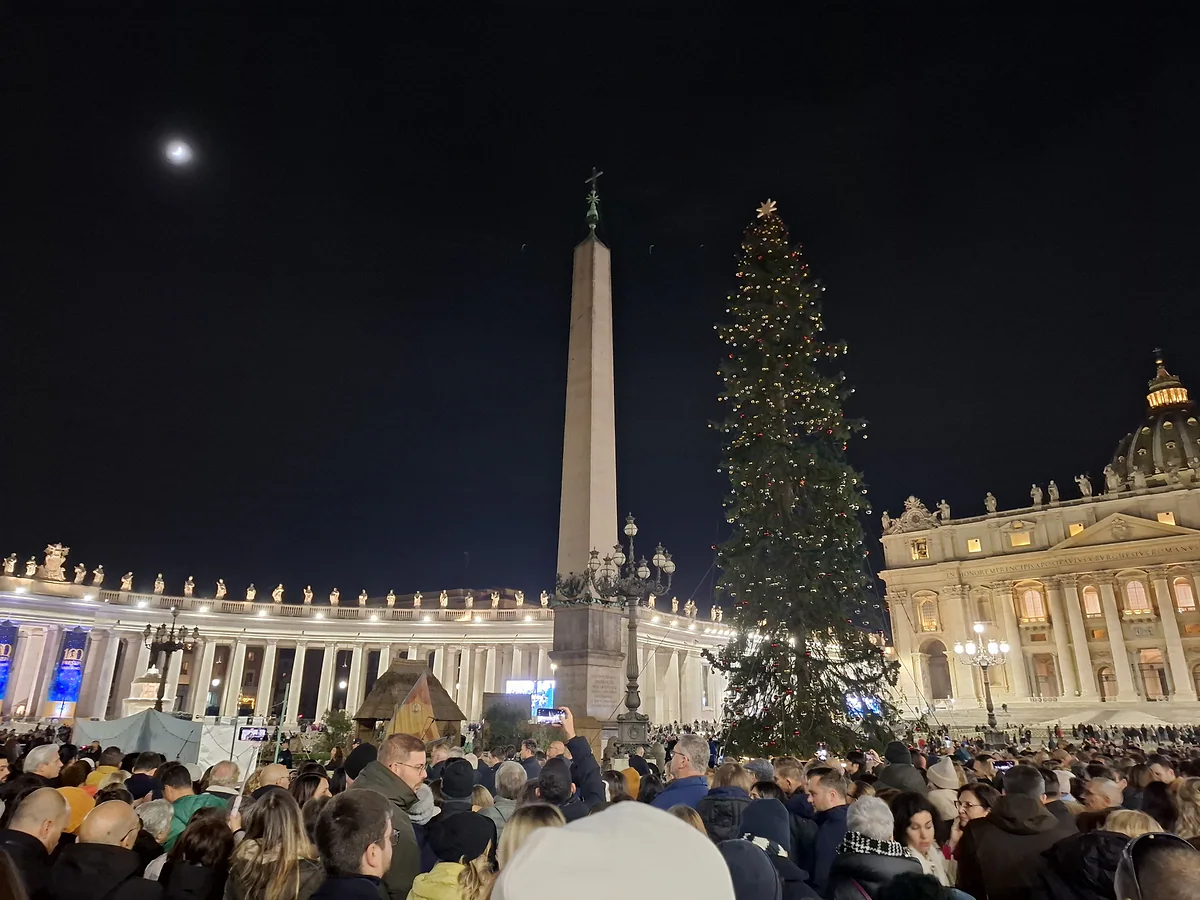
St Peter's Square at night at Christmas, with the big lit tree beside the obelisk, the nativity scene below and Bernini's colonnade full of people.
The Vatican obelisk in figures
| Fact | Figure |
|---|---|
| Material | Red granite |
| Height of the shaft | 25.36 m |
| Base | 8.25 m |
| Weight | 330 tonnes |
| Likely origin | Heliopolis; according to Pliny, the pharaoh 'Nencoreus', perhaps Amenemhat II |
| Arrival in Rome | Caligula (AD 37-41), for his circus |
| Moved to the centre of the square | 1586, Domenico Fontana for Sixtus V |
| Manpower for the move | 907 men, 75 horses and 44 winches |
From the Holy See's official fact sheet (vatican.va). Other sites quote 800 men, 160 horses and 45 winches, which the official source doesn't give.
Around the obelisk
| Feature | Maker and date | What it is |
|---|---|---|
| Meridian line | Mgr Filippo Luigi Gilj, 1817 | A 70.79 m granite strip marking local noon |
| Wind rose | Gilj, 1817 | Sixteen discs naming the compass points and winds |
| Festoons and eagles | 1723, Innocent XIII | Bronzes added to each face |
| Right-hand fountain | Maderno 1614, rebuilt by Bernini from 1667 | Opened in 1677 |
| Left-hand fountain | Bernini, for Clement X | Working from 1689 |
Official Holy See fact sheets on St Peter's Square, checked on 27-09-2026.
Test yourself
True or false?
0/4 Pick before you peek.
-
The Vatican obelisk is covered in Egyptian hieroglyphs.
See the answer
False. Quite the opposite. The Holy See's fact sheet says it's the only obelisk in Rome with no hieroglyphic inscriptions at all.
-
The obelisk was already on Vatican ground in Roman imperial times.
See the answer
True. Caligula brought it to decorate his private circus on the land where Vatican City stands. Sixtus V only moved it to the middle of the square.
-
There has always been a cross on top of the obelisk.
See the answer
False. It used to have a bronze ball. Sixtus V replaced it with the cross when he had it moved in 1586.
-
The obelisk is the gnomon of a sundial laid into the paving.
See the answer
True. The 1817 meridian line, 70.79 metres long, uses the shadow of the obelisk's cross to mark noon and the solstices.
- Height of the red granite shaft
- 25.36 m
- Weight of the obelisk, per the Holy See
- 330 t
- Men who moved it in 1586, with 75 horses
- 907
- Length of the meridian line using it as a gnomon
- 70.79 m
0 of 88 Vatican City guides
Your next stamp
- St Peter's Square
- Bernini's colonnade
- St Peter's Basilica
- Architecture and architects
- Facade and balcony
- Map
- Vatican Grottoes
- Facts
- Sistine Chapel
- Things to do
- One day
- Tickets
- Two days
- Vatican Museums
- St Peter's Dome
- Vatican Necropolis
- Vatican Gardens
- Swiss Guard
- Seeing the Pope
- How to visit
- Castel Gandolfo
- Where to eat
- Free and cheap
- Apostolic Palace
- Scams to avoid
- Getting there
- Money and payments
- Exclusive experiences
- Papal audience
- Angelus
- Who painted it
- Where the Pope lives
- Where to stay
- Dress code
- Facts
- Opening hours
- Flag
- Post office and stamps
- Is it a country?
- History
- Pietà
- Baldachin
- Ceiling
- Chair of St Peter
- Last Judgement
- Raphael Rooms
- Gallery of Maps
- Holy Door
- Library and Archives
- Bramante Staircase
- Mass at St Peter's
- Pio Clementino Museum
- Papal blessing
- Vatican Pinacoteca
- Catacombs
- Gallery of Tapestries
- Gallery of the Candelabra
- Egyptian and Etruscan Museums
- Vatican Museums map
- How long you need
- Night opening
- Chiaramonti and Braccio Nuovo
- Christmas
- Anima Mundi Museum
- Easter
- Carriage Pavilion
- Gift shops and souvenirs
- With kids
- Best time to visit
- Courtyard of the Pine Cone
- Photography
- Train station
- Accessible travel
- Vatican Observatory
- Borgia Apartment
- Modern art collection
- Papal Palace
- Barberini Gardens
- Getting there
- Holy See
- Lake Albano
- Police and army
- Passport
- Pharmacy, shop and petrol
- What Vatican means
- Papal tombs
- List of popes
Frequently asked questions
Why is there an obelisk in St Peter's Square?
Because it was already here. Caligula brought it from Egypt to decorate his private circus on this very ground, next to which tradition places Peter's martyrdom. In 1586 Sixtus V moved it to the centre of the new square and topped it with a cross.
How tall is the Vatican obelisk?
The granite shaft is 25.36 metres and weighs 330 tonnes, according to the Holy See's fact sheet. The base adds 8.25 metres. With base and cross it's well over 30 metres, but the official source doesn't give an exact overall figure.
How old is the Vatican obelisk?
Nobody knows for sure. Pliny the Elder mentions an obelisk raised at Heliopolis by a pharaoh he calls Nencoreus, possibly Amenemhat II, who reigned around 1929-1895 BC. It was reused in Alexandria between 30 and 28 BC before Caligula shipped it to Rome.
Is the Vatican obelisk Egyptian?
Yes. The Holy See's own sheet traces it to Heliopolis and then Alexandria before Caligula brought it to Rome. What makes it unusual is that it's the only obelisk in Rome with no hieroglyphs on it.
Who moved the obelisk to the centre of St Peter's Square?
The architect Domenico Fontana, for Pope Sixtus V, in 1586. The official figures for the job are 907 men, 75 horses and 44 winches. The bronze lions at the base date from that operation.
Is the obelisk really a sundial?
In a way. In 1817 the Vatican astronomer Filippo Luigi Gilj laid a 70.79-metre meridian line in the paving that uses the obelisk as its gnomon. The shadow of the cross marks local noon and the time of year.
By
Tourism graduate with a master’s in Tourism Management and Planning from the University of Málaga, who has travelled across Europe. He writes every guide from official sources and his own judgement.
Published on . Facts checked on .
Sources
Photos: Diego Delso (CC BY-SA 4.0); Bengt Nyman (CC BY 2.0); Cruz.croce (CC0), via Wikimedia Commons.