A name older than the popes
What 'Vatican' means, from the Ager Vaticanus to St Peter's hill
The name Vatican is far older than the popes. Under Rome's kings and the Republic, the land on the right bank of the Tiber was called the Ager Vaticanus, and the form Vaticanum is recorded from the 2nd century AD. Its origin is unclear. An ancient explanation links it to 'vates', a seer, another to an old settlement called Vaticum, and Varro to a god of newborn babies.
In 30 seconds
Full read: 4 min
- The name Vatican comes from the Ager Vaticanus, the land on the Tiber's right bank under Rome's kings and Republic.
- The form Vaticanum is recorded from the 2nd century, centuries before the popes lived there.
- Its meaning is disputed. Modern scholars trace it to a settlement called Vaticum.
- The ancient explanation linked it to 'vates', a seer, and Varro to a god of newborn babies.
- The state stands on a low rise of the ancient Montes Vaticani, where Peter's grave lies.
I think it's only honest to admit nobody knows for sure what Vatican means. What we do know is more interesting. The name belonged to the place long before the popes arrived, and they inherited it along with Peter's grave, which lay on that hill.

Before you go
What I would keep in mind
-
01 Most beautiful
The hill you don't notice
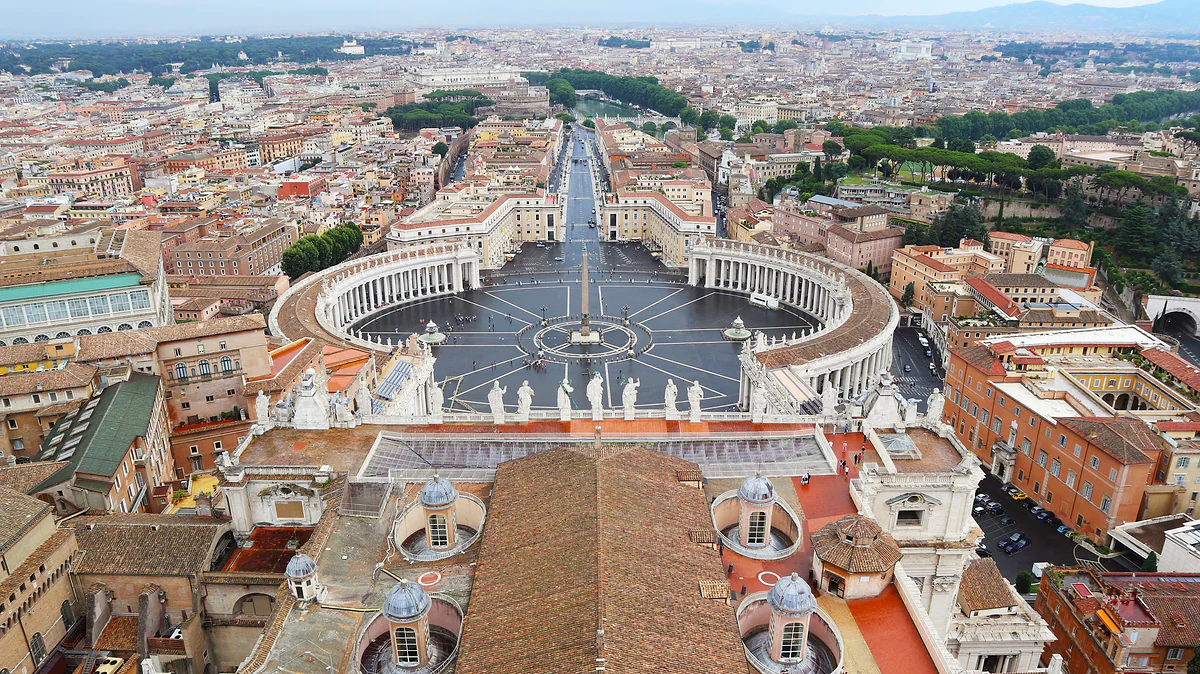
The Vatican sits on a low rise, part of the ancient Montes Vaticani. The best way to sense it is to climb the dome and watch the ground rise towards the gardens.
St Peter's Dome -
02 My tip
The obelisk was already in the Ager Vaticanus
Caligula brought it for his circus in his mother's gardens, on this very ground. It's all that still stands of the Roman Vatican.
Vatican obelisk -
03 My tip
Borgo and Prati have stories too
Borgo comes from the Saxon 'Burg', a walled village, and Prati from the meadows beside Hadrian's Mausoleum. The district's names tell its history just as the Vatican's does.
Borgo Pio -
04 Watch out
Be wary of the one-line etymology
Plenty of sites state flatly that Vatican means 'place of prophecy'. That's just one of three theories, the oldest, and not the one scholars favour today.
Vatican City facts
My priorities
Unmissable
If you have time
I would skip
- Treating a single etymology as settled, when there's no agreement
- Confusing the Vatican Hill with the seven hills of ancient Rome
My ranking, scored
Theories about the name, most accepted first
My reading, scored out of 10, of what the Treccani Enciclopedia Italiana records. There's no settled answer, so the score reflects how far each explanation convinces modern scholars according to that source.
0 of 3 seen
-
An old settlement called Vaticum
Modern scholars derive Vaticanum from a settlement, Vaticum, just as Labicanum comes from Labicum. Treccani presents this as the modern view.
8.0 out of 10
-
'Vates' and 'vaticinium'
The ancient explanation linked it to seers and prophecy. It's the most repeated online, but not the most accepted.
5.5 out of 10
-
A god of newborn babies
Varro tied it to a god who protected a baby's first cries. It was already disputed in antiquity.
4.0 out of 10
What Vatican means looks like a question with an easy answer, and it isn’t. Let me be honest from the outset. There’s no certain answer, and anyone who gives you just one without caveats is simplifying. What there is, though, is a lovely story about a name that existed centuries before the popes and that they inherited along with a grave.
A name older than the Church
According to the Governorate’s website, under Rome’s kings and the Republic the area was known as the Ager Vaticanus. It was a wide stretch of land on the right bank of the Tiber, reaching north as far as the mouth of the Cremera and at least to the Janiculum. The form Vaticanum is recorded from the 2nd century AD and referred to an area similar to today’s state.
It was countryside outside the city. There were villas, the gardens of Agrippina, Caligula’s mother, and large cemeteries along the roads. Caligula laid out a circus there for his charioteers, which Nero later enlarged, and adorned it with the obelisk now in the square. That stone is the only survivor of the Roman landscape, and it has its own page, the Vatican obelisk.
A marsh between two bridges
There’s a line on the state’s own website that changes how I picture the place. It says that in antiquity «Vatican» meant the marshy land on the right bank of the Tiber between Ponte Milvio and today’s Ponte Sisto. So a low, waterlogged strip running several kilometres along the river, not one particular hill or shrine. Treccani adds that the old ager was far larger than what we now call the Vatican, and that the name gradually narrowed to the high ground by the Tiber.
The circus I mentioned had a name of its own. The Governorate calls it the Gaianum and describes it as a small circus built for charioteers to train in, later reworked by Nero. This was no grand arena for crowds like the Circus Maximus, but a practice track on an unappealing edge of town. I find it a good reminder that the most visited spot in Rome began as the city’s soggy outskirts.
If you walk north along the river today from Ponte Sisto, you’re roughly tracing the edge of that ancient Vatican. I cover the neighbouring district on that route in what to see in Borgo.
What does the word Vatican mean?
This is where the theories come in, all of them from the Treccani Enciclopedia Italiana, not a Vatican source but a serious reference. The ancient explanation linked the name to ‘vates’ and ‘vaticinium’, seers and prophecy. It’s the one most repeated online, which is why so many sites say Vatican means ‘place of prophecy’.
Modern scholars instead derive it from an old settlement called Vaticum, in the same way Labicanum comes from Labicum. And Varro, the Roman scholar, connected it to a god who protected a newborn baby’s first cries, an idea already argued over in antiquity. The settlement theory seems the most sensible to me, but there’s no official etymology, so I’d rather give you all three.
The Vatican Hill
The state stands on a low rise near the right bank of the Tiber which, according to the Governorate, was part of the Montes Vaticani, the colle Vaticano of antiquity. It isn’t one of the seven hills of classical Rome, which were on the other side of the river. It was, precisely, outside.
And that explains why the name ended up belonging to the Church. Peter was buried in a grave on the southern slope of that hill, facing Nero’s circus, according to the Fabbrica di San Pietro. A small monument was built over it in the 2nd century, and around AD 324 Constantine’s basilica. To stand on that slope, you have to go down into the Vatican necropolis.
From hill to district to state
Between 848 and 852 Pope Leo IV walled the area after the Saracen raid of 846, and that ‘civitas Leoniana’ is the origin of the Borgo district, whose name comes from the Saxon ‘Burg’, a walled village. Next door is Prati, named after the meadows beside Hadrian’s Mausoleum. The three names, Vatican, Borgo and Prati, describe the landscape before the city.
The current official name, Vatican City State, is much more recent. It was born with the Lateran Pacts of 1929. The whole story is in my guide to Vatican history, and if you like these small details, there are more among the Vatican City facts.
The other names you’ll see
On your trip you’ll meet several versions of the same name. In Italian it’s Città del Vaticano, and the full official name is Vatican City State. On addresses and post, the postcode 00120 Città del Vaticano. Online, the .va domain, which according to IANA is run by the Governorate and dates from 11 September 1995. On passports, the code VAT, shared by the Holy See and the state.
On the road it has its own letters too. The Vatican vehicle register uses two, SCV for cars belonging to the state and Holy See bodies, and CV for those of citizens and people granted Vatican plates, and the international code is V. The official site doesn’t spell out what each abbreviation stands for, so I won’t make it up. And the phone code is a curiosity in itself. The ITU keeps +379 set aside for it, though calls still go through the Italian code. And don’t mix any of this up with the Holy See, which is the Church’s government, not a synonym, as I explain in Holy See and Vatican City.
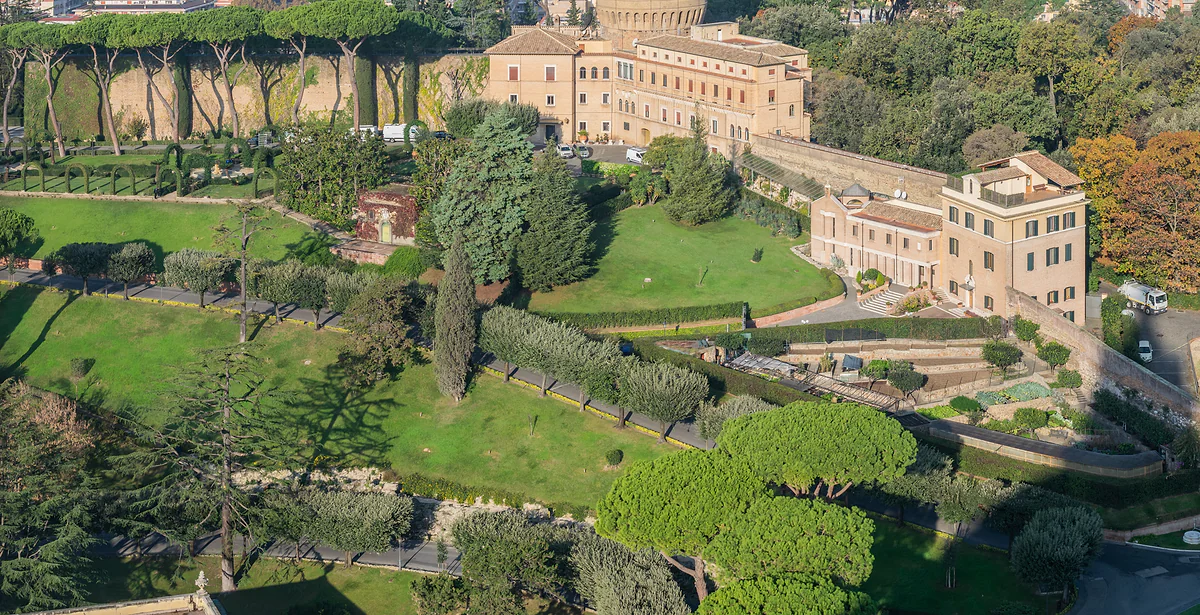
The Vatican Gardens seen from the dome of St Peter's, with lawns, pine trees and Vatican buildings.
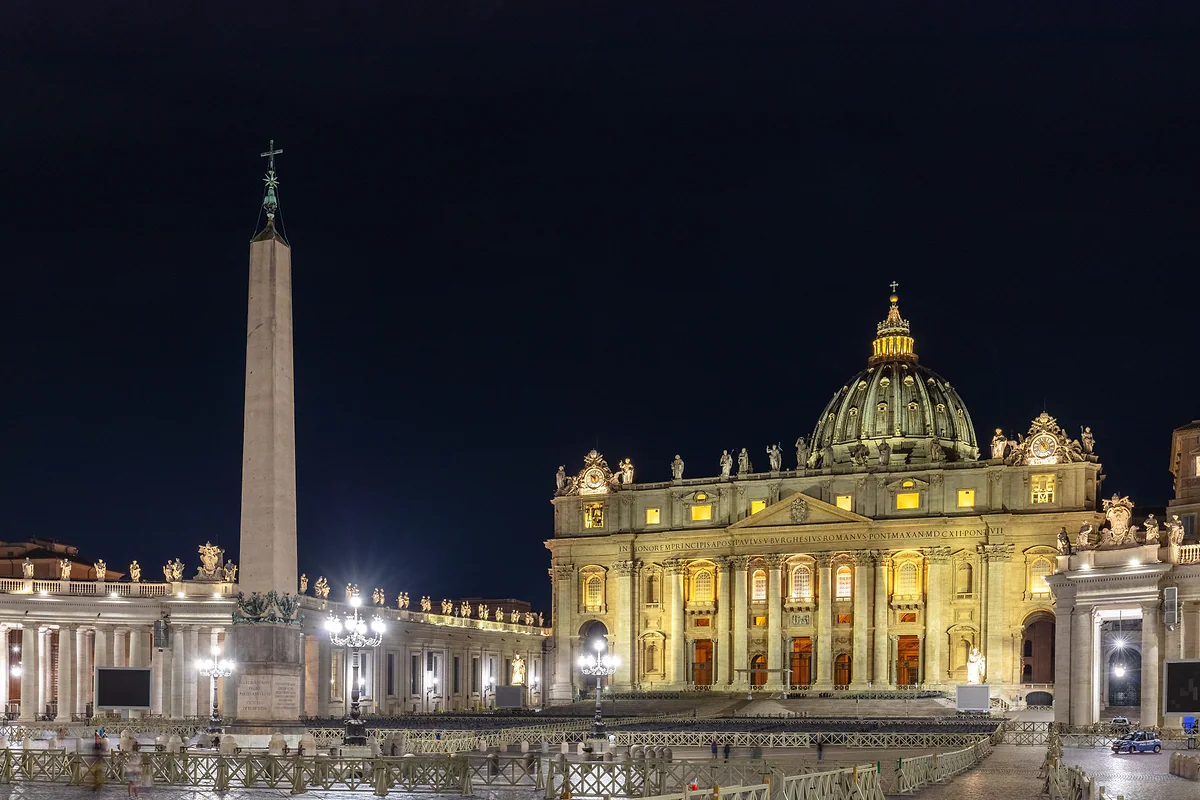
The obelisk in St Peter's Square and the illuminated basilica at night, with Bernini's colonnade on the left.
From the Ager Vaticanus to Vatican City
| Period | What was there |
|---|---|
| Kings and Republic | The Ager Vaticanus, stretching to the Cremera and at least the Janiculum |
| 1st century AD | Villas, Agrippina's gardens and the circus of Caligula and Nero |
| 2nd century AD | The form Vaticanum appears; a shrine over Peter's grave |
| About AD 324 | Constantine builds the first basilica over the grave |
| 848-852 | Leo IV walls the area, the 'civitas Leoniana' |
| 1929 | Vatican City State is born |
Governorate of the state (history and geography), Fabbrica di San Pietro and Rome's Sovrintendenza Capitolina.
The three explanations of the name
| Theory | What it says | Who holds it |
|---|---|---|
| Vaticum | From an old settlement, as Labicanum from Labicum | Modern scholars |
| Vates, vaticinium | A link to seers and prophecy | The ancient explanation |
| A god | A deity protecting a newborn's first cries | Varro |
Treccani Enciclopedia Italiana (Giuseppe Lugli, 1937), not an official source but a standard reference. There's no official etymology of Vatican.
Test yourself
True or false?
0/4 Pick before you peek.
-
The name Vatican was created by the popes.
See the answer
False. It's much older. The area was already called the Ager Vaticanus under Rome's kings and Republic.
-
There's an official etymology of the word Vatican.
See the answer
False. No. Three theories are in play, and the Treccani encyclopaedia notes the origin has been disputed since antiquity.
-
Peter's grave is on the slope of the Vatican Hill.
See the answer
True. According to the Fabbrica di San Pietro, it's a grave on the hill's southern slope, facing Nero's circus.
-
The Vatican is one of Rome's seven hills.
See the answer
False. It's on the Tiber's right bank, outside ancient Rome, and in Roman times it lay beyond the city.
- First records of the form Vaticanum
- 2nd c. AD
- Theories about where the name comes from
- 3
- Years of Leo IV's Leonine walls
- 848-852
- Year Vatican City State was born
- 1929
0 of 88 Vatican City guides
Your next stamp
- Is it a country?
- Map
- Flag
- Facts
- Holy See
- History
- Library and Archives
- Sistine Chapel
- Things to do
- One day
- Tickets
- Two days
- Vatican Museums
- St Peter's Basilica
- St Peter's Square
- St Peter's Dome
- Vatican Necropolis
- Vatican Gardens
- Swiss Guard
- Seeing the Pope
- How to visit
- Castel Gandolfo
- Where to eat
- Free and cheap
- Apostolic Palace
- Scams to avoid
- Getting there
- Money and payments
- Exclusive experiences
- Papal audience
- Angelus
- Who painted it
- Where the Pope lives
- Where to stay
- Dress code
- Facts
- Opening hours
- Post office and stamps
- Vatican Grottoes
- Pietà
- Baldachin
- Ceiling
- Chair of St Peter
- Last Judgement
- Raphael Rooms
- Architecture and architects
- Gallery of Maps
- Holy Door
- Bramante Staircase
- Facade and balcony
- Mass at St Peter's
- Pio Clementino Museum
- Papal blessing
- Vatican Pinacoteca
- Catacombs
- Gallery of Tapestries
- Gallery of the Candelabra
- Egyptian and Etruscan Museums
- Obelisk
- Vatican Museums map
- Bernini's colonnade
- How long you need
- Night opening
- Chiaramonti and Braccio Nuovo
- Christmas
- Anima Mundi Museum
- Easter
- Carriage Pavilion
- Gift shops and souvenirs
- With kids
- Best time to visit
- Courtyard of the Pine Cone
- Photography
- Train station
- Accessible travel
- Vatican Observatory
- Borgia Apartment
- Modern art collection
- Papal Palace
- Barberini Gardens
- Getting there
- Lake Albano
- Police and army
- Passport
- Pharmacy, shop and petrol
- Papal tombs
- List of popes
Frequently asked questions
What does the word Vatican mean?
Nobody agrees. An ancient explanation links it to 'vates' and 'vaticinium', seer and prophecy; modern scholars derive it from an old settlement called Vaticum; and Varro tied it to a god of newborn babies. What's certain is that it named the area, the Ager Vaticanus, before the popes.
Where does the name Vatican come from?
From the Ager Vaticanus, the name given under Rome's kings and Republic to the land on the right bank of the Tiber. The form Vaticanum is recorded from the 2nd century AD, according to the Governorate.
What is the Vatican Hill?
The low rise near the right bank of the Tiber on which the state stands, part of what antiquity called the Montes Vaticani or colle Vaticano. On its southern slope, facing Nero's circus, lies Peter's grave.
Is the Vatican one of the seven hills of Rome?
No. It's on the right bank of the Tiber, outside ancient Rome, and in Roman times it was an area of villas, gardens and cemeteries beyond the city. That's why Peter could be buried there.
Does Vatican mean 'place of prophecy'?
That's one theory, the ancient one, linking it to 'vates', a seer. But it isn't the only one or the one scholars favour today, which traces it to a settlement called Vaticum. There's no official etymology.
When did it become Vatican City?
Vatican City State was created by the Lateran Pacts, signed on 11 February 1929, and came into being in practice when ratifications were exchanged on 7 June that year.
What do the Vatican's SCV and CV number plates mean?
According to the Governorate, SCV plates go on cars belonging to the state and Holy See bodies, and CV plates on those of citizens and people granted Vatican registration. The country's international code is V. The official site doesn't spell out the abbreviations.
By
Tourism graduate with a master’s in Tourism Management and Planning from the University of Málaga, who has travelled across Europe. He writes every guide from official sources and his own judgement.
Published on . Updated on . Facts checked on .
Sources
Photos: Maksim Sokolov (maxergon.com) (CC BY-SA 4.0); Krzysztof Golik (CC BY-SA 4.0); Diego Delso (CC BY-SA 4.0), via Wikimedia Commons.