Van Gogh and Matisse on the way to the Sistine
The Vatican's modern art collection, the museum nobody expects
The Vatican Museums' Modern and Contemporary Art Collection was opened by Paul VI on 23 June 1973 and holds some 8,000 works from the late 19th and 20th centuries. There's Van Gogh, Bacon, Chagall, De Chirico, Fontana, Dalí and a whole room of Matisse. It's included with a Museums ticket, on the route from the Borgia Apartment to the Sistine Chapel.
In 30 seconds
Full read: 3 min
- The Vatican Museums have a Modern and Contemporary Art Collection of about 8,000 works.
- Paul VI opened it on 23 June 1973, nine years after receiving artists in the Sistine Chapel.
- It includes Van Gogh, Bacon, Chagall, De Chirico, Fontana and Dalí, plus a Matisse room since 2011.
- You see it on the route from the Borgia Apartment to the Sistine Chapel, at no extra cost.
- It's the part of the Museums most people walk past, and for me the biggest surprise.
For me this collection is the big surprise of the Museums, and the most wasted. People walk through it with their eyes fixed on the Sistine. If you've got twenty minutes spare, spend them here, starting with the Matisse room, because you won't see him in this context anywhere else.

Before you go
What I would keep in mind
-
01 Most beautiful
The Matisse room
Since 2011 he's had a room of his own, with works on the making of the Vence Chapel that his son Pierre Matisse gave the Vatican in 1980. It's the most spiritual Matisse you'll see.
Borgia Apartment in the Vatican Museums -
02 My tip
It's on your way, no detour
The works on show run from the Borgia Apartment to the Sistine Chapel. It isn't a detour, it's the corridor you walk anyway. You just have to decide to stop.
the Vatican Museums map -
03 To save money
No extra charge
There's no separate ticket. It comes with the standard Museums entry, €20 at the desk or €25 booked online, and it's free on the last Sunday of the month.
Vatican tickets 2026 -
04 My tip
It was born in the Sistine Chapel
The collection grew out of Paul VI's meeting with artists on 7 May 1964, in the Sistine itself. Seeing it just before you walk into the chapel closes the circle.
Sistine Chapel facts
My priorities
Unmissable
- Step into the Matisse room and its Vence Chapel works
- Notice how the modern works sit beneath Pinturicchio's frescoes
If you have time
- Look out for Van Gogh, Bacon and Chagall along the way
- Compare it with the Pinacoteca, which stops where this begins
I would skip
- Walking the rooms with your eyes on the Sistine
- Using flash, banned throughout the Museums
What I would book
My ranking, scored
The names I'd look for in the collection
My own scores out of 10. They weigh how unexpected it is to find that artist in the Vatican and what it adds for someone passing through. I only name artists the Museums' official site mentions.
0 of 6 seen
-
Henri Matisse
A room of his own since 2011 with the Vence Chapel material, donated by his son in 1980. The most complete and coherent part of the collection.
9.5 out of 10
-
Vincent van Gogh
Finding Van Gogh on the way to the Sistine throws almost everyone. It's the name that makes people stop.
9.0 out of 10
-
Francis Bacon
The most unsettling painter of the 20th century inside the Vatican. For me the sharpest contrast of the whole visit.
8.6 out of 10
-
Marc Chagall
His dreamlike biblical world sits naturally in the popes' palace.
8.2 out of 10
-
Salvador Dalí
Mostly worth hunting down for the sheer curiosity of seeing him here.
7.9 out of 10
-
De Chirico, Carrà, Fontana, Burri, Manzù and Capogrossi
The Italian 20th-century core that gives the collection its backbone.
7.5 out of 10
Hardly anyone goes into the Vatican Museums looking for Van Gogh, and yet there he is, on the same route that leads to the Sistine Chapel. The Modern and Contemporary Art Collection is, for me, the museum’s big surprise and also its most wasted part. Here’s where it came from, who’s in it and how to see it without missing the Sistine.
A pope who wanted to make peace with the art of his time
The collection has a named father and a date. On 7 May 1964 Paul VI received artists in the Sistine Chapel and told them something unusual for a pope, that the Church and contemporary art had drifted apart and needed to come closer again, as they once had been. That meeting led to an invitation to the art world, and the invitation led to donations.
The legwork fell to his private secretary, Mgr Pasquale Macchi, who spent about ten years gathering works given by artists, collectors and public and private bodies. They joined a small group of 20th-century pieces that had entered the Vatican Pinacoteca in the late 1950s under Pius XII. On 23 June 1973 Paul VI opened the collection.
Which artists are there?
Today there are about 8,000 paintings, sculptures and prints, from the late 19th century through much of the 20th. The Museums’ official site highlights Van Gogh, Bacon, Chagall, Carrà, De Chirico, Manzù, Capogrossi, Fontana, Burri and Matisse, and another of its pages adds Dalí. Only a selection is on display, so don’t expect all 8,000.
The highlight for me is Matisse. Since 2011 he’s had a whole room of works connected with the making of the Vence Chapel, which came to the Vatican in 1980 as a gift from his son, Pierre Matisse. To me it’s a quieter, more spiritual Matisse than most people expect.
A 20th-century museum inside a 15th-century palace
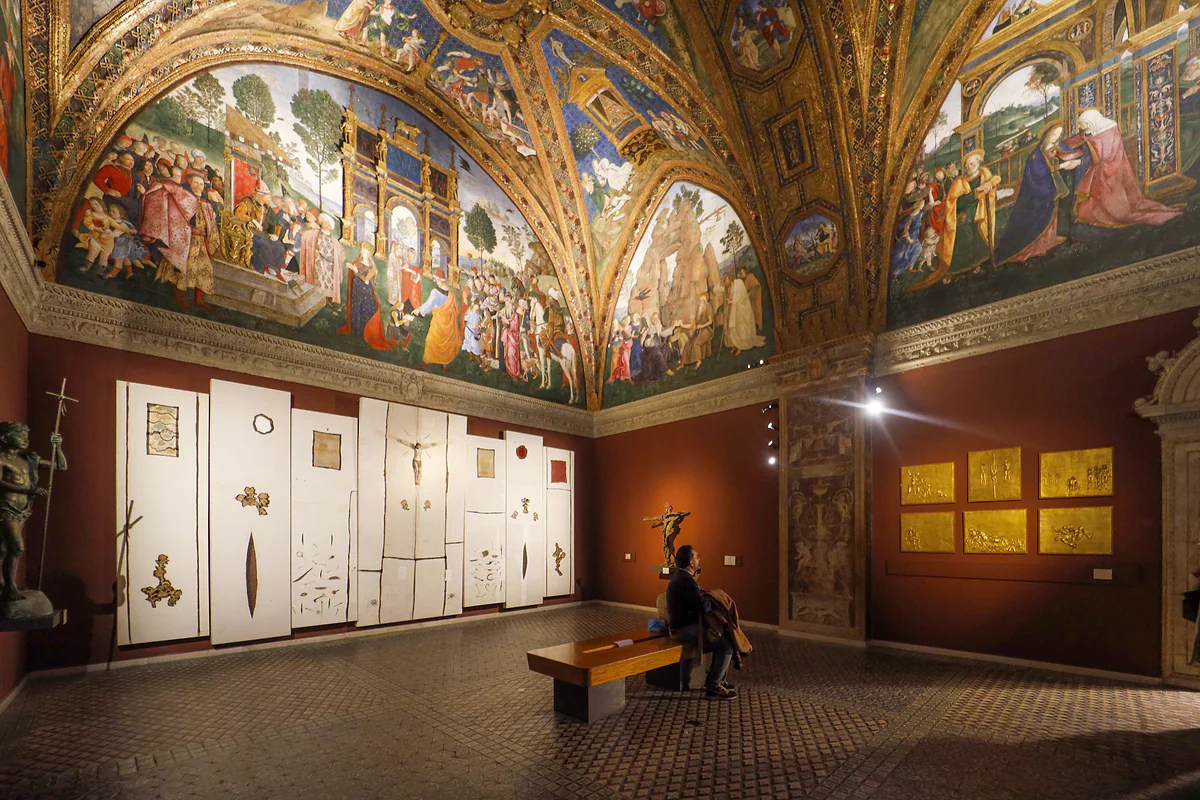
What I find most interesting isn’t only the works but where they hang. The display runs from the Borgia Apartment to the Sistine Chapel, so in several rooms you’ll see 20th-century painting beneath the gilded lunettes Pinturicchio painted for Alexander VI. Some visitors find it a clash. I find it a conversation between eras you won’t get in any other museum.
And there’s a detail that closes the circle. The collection was born of that 1964 meeting in the Sistine, and its route ends right at the Sistine’s door. When you walk in, remember that a pope once asked artists to come back from that very spot. It’s one of the Sistine Chapel facts that rarely gets told.
How to see it without missing the Sistine
There’s no separate ticket. You see it on the normal Vatican Museums ticket, and for nothing on the last Sunday of the month. The problem isn’t money, it’s pace. The flow of people pushes you towards the Sistine and it’s hard to stop.
Here’s my advice. Go in on the first slot, at 08:00, and keep twenty minutes in hand. Start with the Matisse room, look out for Van Gogh and Bacon along the way and don’t try to see everything. If you arrive at midday with the route packed, at least don’t walk past Matisse.
Is it worth it if you know nothing about modern art?
I think so, and that’s exactly why. You don’t need to know Burri or Capogrossi to be struck by a 20th-century canvas under a ceiling painted for a 15th-century pope. It’s the part of the museum that tells you least about how you’re supposed to feel, and after hours of queued-for masterpieces I find that a relief.
With children or teenagers it’s often the stretch they get most, because they recognise colours and shapes they’ve seen elsewhere. And if you’re travelling with someone who glazes over in classical galleries, the Matisse room might be where they make peace with the day. To plan the rest of it, with the Sistine Chapel straight after, my guide to how long the Vatican Museums take will help.
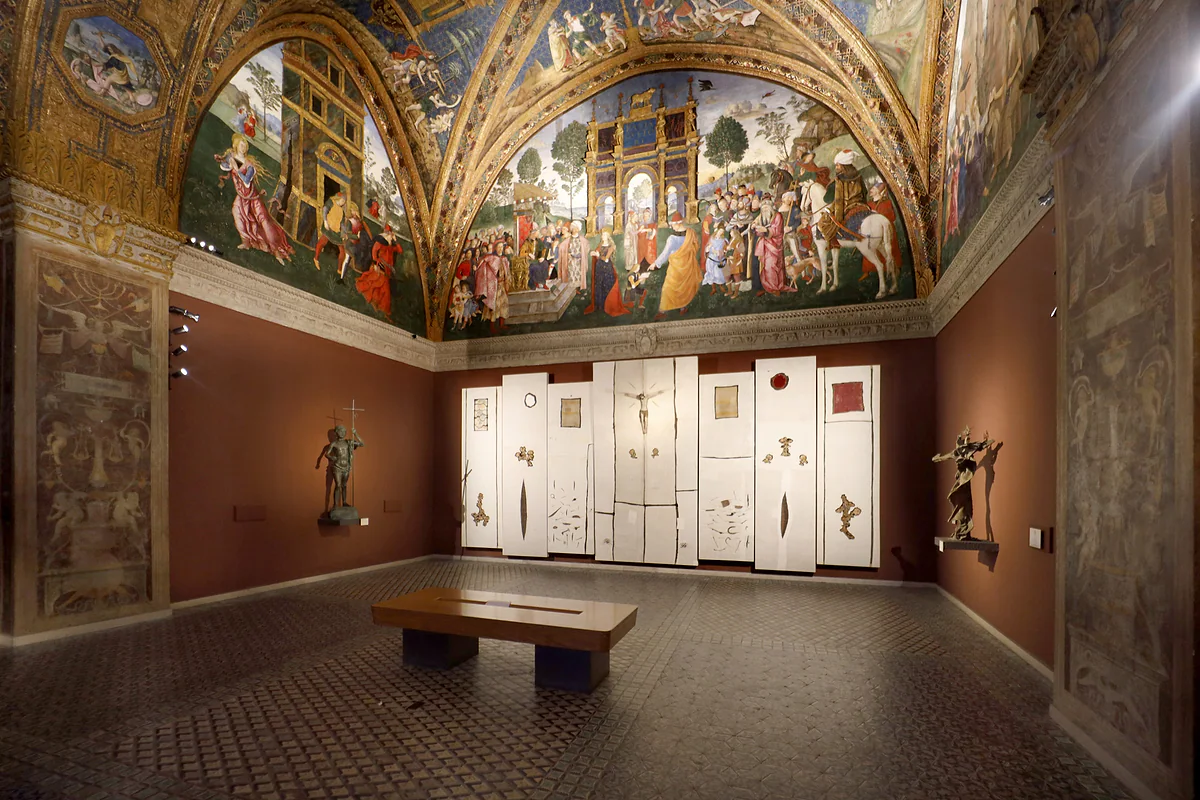
The Hall of the Saints in the Borgia Apartment, with Pinturicchio frescoes in the lunettes and contemporary artworks on the walls.
The collection in figures
| Fact | Detail |
|---|---|
| The idea | Paul VI, after receiving artists in the Sistine on 07-05-1964 |
| Opened | 23-06-1973 |
| Assembled by | Mgr Pasquale Macchi, Paul VI's secretary, over about ten years |
| Earlier core | 20th-century works in the Pinacoteca from the late 1950s, under Pius XII |
| Size | About 8,000 paintings, sculptures and prints |
| Matisse room | Since 2011, Vence Chapel works donated in 1980 |
| Where to see it | From the Borgia Apartment to the Sistine Chapel |
Vatican Museums, Modern and Contemporary Art Collection page.
Test yourself
True or false?
0/4 Pick before you peek.
-
The Vatican Museums only hold ancient and Renaissance art.
See the answer
False. They have a collection of about 8,000 modern and contemporary works, opened in 1973.
-
The modern collection grew out of a meeting with artists in the Sistine Chapel.
See the answer
True. Paul VI received artists in the Sistine on 7 May 1964 and called for the Church and contemporary art to come closer.
-
You need a separate ticket to see the Vatican's modern art.
See the answer
False. It's included in the standard Museums ticket and sits on the way to the Sistine.
-
Matisse has a room of his own in the Vatican Museums.
See the answer
True. Since 2011, with Vence Chapel works donated in 1980 by his son Pierre Matisse.
- Approximate works in the collection
- 8,000
- Year it opened, under Paul VI
- 1973
- Year of the meeting with artists in the Sistine
- 1964
- Opening of the Matisse room
- 2011
0 of 88 Vatican City guides
Your next stamp
- Gallery of Tapestries
- Anima Mundi Museum
- Vatican Museums map
- Gallery of Maps
- Vatican Pinacoteca
- Sistine Chapel
- Gallery of the Candelabra
- Chiaramonti and Braccio Nuovo
- Things to do
- One day
- Tickets
- Two days
- Vatican Museums
- St Peter's Basilica
- St Peter's Square
- St Peter's Dome
- Vatican Necropolis
- Vatican Gardens
- Swiss Guard
- Seeing the Pope
- How to visit
- Castel Gandolfo
- Where to eat
- Free and cheap
- Apostolic Palace
- Scams to avoid
- Getting there
- Money and payments
- Exclusive experiences
- Papal audience
- Angelus
- Who painted it
- Where the Pope lives
- Where to stay
- Dress code
- Facts
- Opening hours
- Map
- Flag
- Post office and stamps
- Is it a country?
- Vatican Grottoes
- History
- Pietà
- Baldachin
- Ceiling
- Chair of St Peter
- Last Judgement
- Raphael Rooms
- Architecture and architects
- Holy Door
- Library and Archives
- Bramante Staircase
- Facade and balcony
- Mass at St Peter's
- Pio Clementino Museum
- Papal blessing
- Catacombs
- Egyptian and Etruscan Museums
- Obelisk
- Bernini's colonnade
- How long you need
- Night opening
- Christmas
- Easter
- Carriage Pavilion
- Gift shops and souvenirs
- With kids
- Best time to visit
- Courtyard of the Pine Cone
- Photography
- Train station
- Accessible travel
- Vatican Observatory
- Borgia Apartment
- Papal Palace
- Barberini Gardens
- Facts
- Getting there
- Holy See
- Lake Albano
- Police and army
- Passport
- Pharmacy, shop and petrol
- What Vatican means
- Papal tombs
- List of popes
Frequently asked questions
Is there modern art in the Vatican Museums?
Yes, plenty. The Modern and Contemporary Art Collection, opened in 1973, has about 8,000 works from the late 19th and 20th centuries, with names such as Van Gogh, Bacon, Chagall, De Chirico, Fontana, Dalí and Matisse.
Where is the Vatican's modern art collection?
The works on display run from the Borgia Apartment to the Sistine Chapel, on the standard Museums route. You don't leave the route or pay extra.
Is there a Van Gogh in the Vatican?
Yes. The Museums' official site names Van Gogh among the major artists in the Modern and Contemporary Art Collection, which you see with a standard ticket.
Is there a Dalí in the Vatican Museums?
Yes, the Vatican Museums list Dalí among the artists in their modern art collection, alongside Van Gogh, Bacon, Chagall, De Chirico, Fontana and Matisse.
Why does the Vatican have a modern art collection?
Because of Paul VI. On 7 May 1964 he received artists in the Sistine Chapel, regretted the gap between the Church and the art of its time and asked for a rapprochement. His secretary, Pasquale Macchi, spent ten years gathering the donations that became the collection.
What's in the Matisse room?
Works connected with the making of the Vence Chapel, which entered the Vatican collection in 1980 thanks to a gift from his son, Pierre Matisse. The room opened in 2011.
By
Tourism graduate with a master’s in Tourism Management and Planning from the University of Málaga, who has travelled across Europe. He writes every guide from official sources and his own judgement.
Published on . Facts checked on .
Sources
Photos: Fabrizio Garrisi (CC BY-SA 4.0); Fabrizio Garrisi (CC BY-SA 4.0), via Wikimedia Commons.