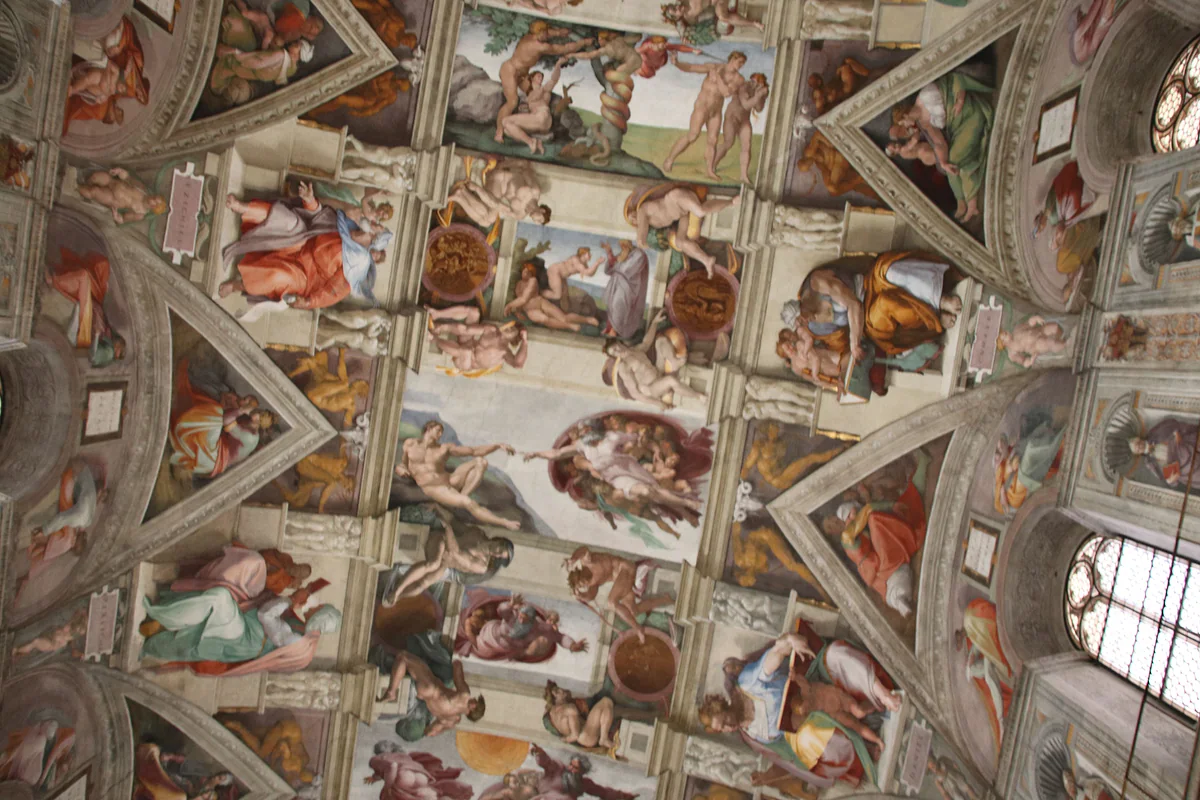
Michelangelo wasn't alone, and he wasn't first
Who painted the Sistine Chapel, wall by wall and ceiling by ceiling
Several artists painted the Sistine Chapel in three campaigns. In 1481-1482 Perugino, Botticelli, Ghirlandaio and Cosimo Rosselli, with Signorelli among their helpers, painted the walls. Michelangelo painted the ceiling from 1508 to 1512, about four years, and the Last Judgement from 1536 to 1541. The original starry ceiling was by Pier Matteo d'Amelia.
In 30 seconds
Full read: 3 min
- Michelangelo didn't paint the Sistine Chapel alone; several painters worked on it in three campaigns.
- Perugino, Botticelli, Ghirlandaio and Cosimo Rosselli painted the walls in 1481-1482.
- Michelangelo painted the ceiling between 1508 and 1512, about four years, for Julius II.
- The Last Judgement is his too, 1536 to 1541, and Daniele da Volterra added draperies after 1564.
- Leonardo da Vinci painted nothing in the chapel, however often people ask.
It seems unfair to me that the Sistine Chapel gets boiled down to Michelangelo. I'd walk in, give the ceiling a minute, then lower my eyes to the walls, where Botticelli, Perugino and Ghirlandaio worked side by side in the same room a generation earlier. That's the bit nearly everyone misses.

Before you go
What I would keep in mind
-
01 Most beautiful
Two walls, two lives side by side
One wall tells the life of Moses and the other the life of Christ, painted together by four workshops in 1481-1482. Reading them as a conversation across the room is what I love most about it.
Sistine Chapel -
02 My tip
Read up before you go in
Guards keep you moving and talking isn't allowed, so I'd read this before entering. Five minutes per wall and you've met all four 15th-century painters.
Sistine Chapel facts -
03 To save money
Free on the last Sunday of the month
Museum entry, Sistine Chapel included, is free on the last Sunday of each month, 09:00 to 14:00, last entry 12:30. In 2026 that leaves 25-10, 29-11 and 27-12.
Is the Sistine Chapel free? -
04 Watch out
Nobody explains it inside
Guides aren't allowed to talk inside the chapel. Be wary of any tour promising commentary in the Sistine itself, because the explaining happens beforehand.
Vatican scams and tourist traps to avoid in 2026
My priorities
Unmissable
- Look up at Michelangelo's ceiling from the middle of the room
- Lower your eyes to the 15th-century walls of Moses and Christ
- See the Last Judgement on the altar wall, cleaned in 2026
If you have time
I would skip
- Only looking up and missing the 15th-century walls altogether
- Taking photos or talking loudly, both banned inside the chapel
What I would book
- Tours and ticketsGetYourGuide Museums and Sistine Chapel with a guide Since nothing can be explained inside the chapel, a guide who tells you beforehand who painted each wall changes the visit.
- Places to stayBooking.com Prati, for the Museums' first hour At 08:00 the chapel is calmer and you can find the walls without being jostled. From Prati you walk there.
My ranking, scored
The Sistine Chapel's painters, by what they left on view
My own scores out of 10. They weigh how much of the chapel is theirs today and what it adds to your visit. It isn't a talent ranking; the four 15th-century painters are huge names playing an away game here.
0 of 6 seen
-
Michelangelo
The ceiling, over a thousand square metres of plaster painted between 1508 and 1512, and the Last Judgement over the altar, 1536 to 1541. Most of what you look at is his.
9.9 out of 10
-
Pietro Perugino
One of the four masters of the 1481-1482 walls, and the one who trained Pinturicchio. His frescoes on the altar wall were lost to make room for the Last Judgement.
8.6 out of 10
-
Sandro Botticelli
One of the four wall painters of 1481-1482. The name that most surprises visitors who came only for Michelangelo.
8.4 out of 10
-
Domenico Ghirlandaio
The third of the wall team, with the stories of Moses and Christ shared out among the four workshops.
7.9 out of 10
-
Cosimo Rosselli
The fourth master of the walls, working with assistants such as Biagio di Antonio and Bartolomeo della Gatta.
7.2 out of 10
-
Daniele da Volterra
He didn't paint a scene, he painted over one. After the 1564 decision to cover nudity, he added the draperies to the Last Judgement.
5.5 out of 10
Ask who painted the Sistine Chapel and almost everyone says Michelangelo, which isn’t wrong, just incomplete. Some of the finest artists of the Renaissance painted it in three campaigns decades apart. Michelangelo came last and took the glory, rightly, but once inside you’ll be looking at the work of at least five masters. Here’s who did each part, and how long it took.
Before Michelangelo, a sky and four workshops
Pope Sixtus IV della Rovere, who gave the chapel its name, rebuilt an earlier chapel, the Cappella Magna, from 1477. The building was put up by Giovannino de’ Dolci and Baccio Pontelli, according to the Holy See, and consecrated on 15 August 1483. The ceiling had no figures then. It was a starry sky painted by Pier Matteo d’Amelia.
The walls went to a first-rate team. Between 1481 and 1482 Pietro Perugino, Sandro Botticelli, Domenico Ghirlandaio and Cosimo Rosselli worked there, with assistants such as Biagio di Antonio, Bartolomeo della Gatta and Luca Signorelli. They painted the stories of Moses on one wall and of Christ on the other, a series of papal portraits and, lower down, painted curtains. Pinturicchio came out of that circle too, trained in Perugino’s workshop, and went on to decorate the Borgia Apartment.
This is the part I most like to stand up for. You have Botticelli and Perugino in the same room, and most people leave without having looked at them.
The ceiling, four years of Michelangelo
A crack that split the vault in 1504 was what pushed Julius II to have it repainted. He gave the job to Michelangelo, under a contract dated 8 May 1508. The first plan was twelve apostles in the spandrels and ornamental patterns elsewhere. Michelangelo thought it a ‘poor thing’ and won a new brief with far more freedom.
The first half was done by August 1510, and the ceiling was finished on 31 October 1512. The next day, All Saints, Julius II said Mass beneath it. In 2012 Benedict XVI described it as roughly four years’ work over a thousand-plus square metres. What he painted, scene by scene, is on my page about the Sistine Chapel ceiling.
Whether he did it alone is another matter, and here I’d rather be careful. Sources disagree on whether his assistants got onto the scaffold, and there’s a serious case that one or two worked on the Flood, the scene he had to redo because of mould. The design and the main hand are his, that much is certain. And the old line about him painting flat on his back isn’t something I’ve found in any reliable source.
The Last Judgement, twenty years on
Michelangelo came back to paint the altar wall. Clement VII commissioned it at the end of 1533, but Paul III set it in motion. The scaffold went up in April 1535 and the painting ran from 1536 to autumn 1541. To make room, frescoes by Perugino on that wall were lost, along with two lunettes Michelangelo had painted himself.
In 1564 the order came to cover the nudity, and Daniele da Volterra added the cloths. He’s the last name on the list, even if his contribution was covering up. The fresco in detail, and the cleaning it had between February and March 2026, are on my page about the Last Judgement.
And no, not Leonardo
One of the most common searches is whether Leonardo da Vinci painted in the Sistine Chapel. He didn’t. He doesn’t appear in any Museums source as one of its painters. If you want Leonardo in the Vatican, he’s in the Pinacoteca, with his St Jerome.
How to look at it, knowing all this
Inside you can’t talk or take photos, and guides can’t explain, so the homework comes first. I’d go in this order. A minute for the ceiling, because you won’t be able to help it. Another for the Last Judgement at the far end. And the rest of your time on the walls, Moses on one side and Christ on the other, with the four 15th-century workshops facing each other. For more to carry in your head there are the Sistine Chapel facts, and for tickets, hours and getting there, my guide to the Sistine Chapel.
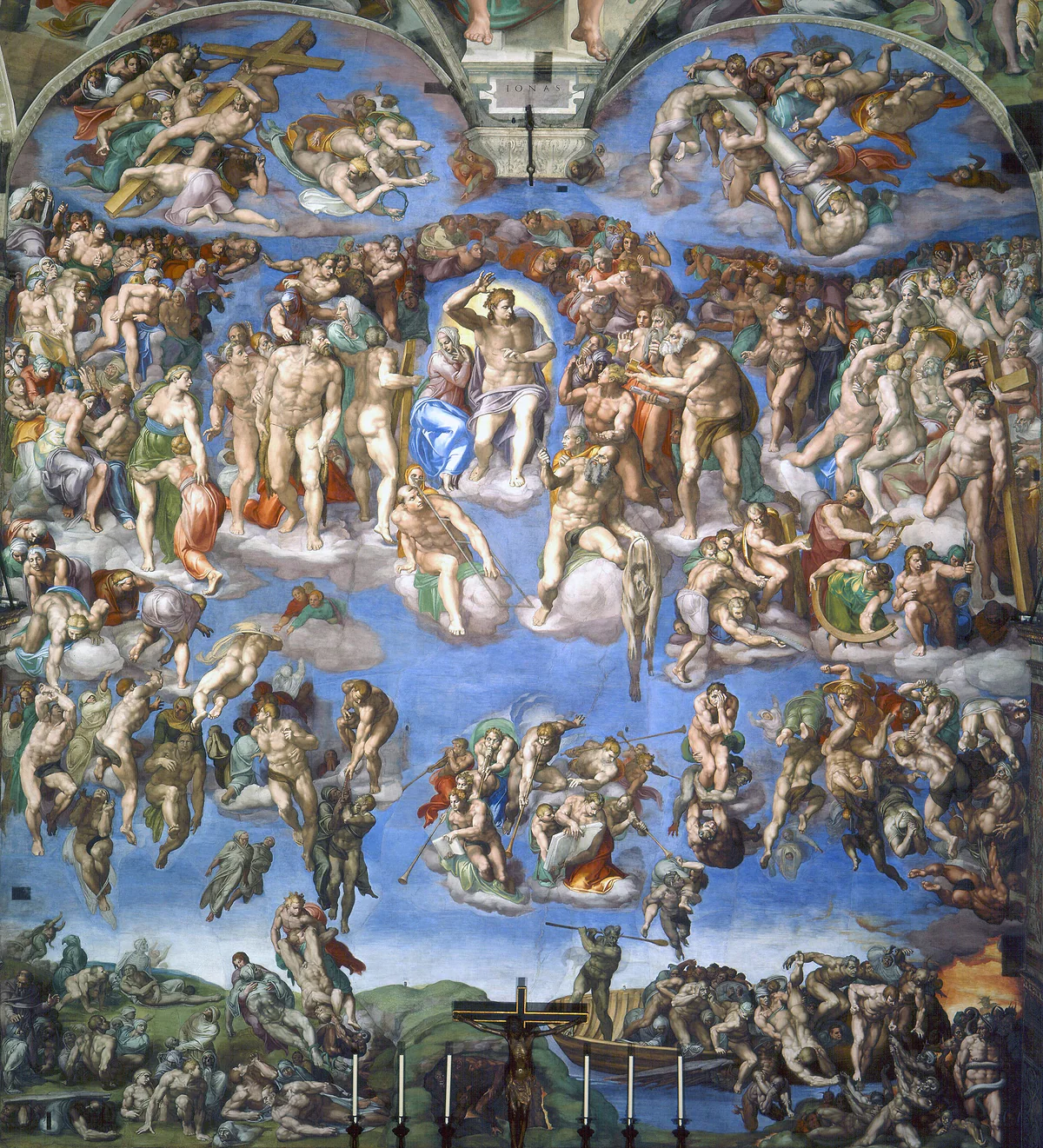
Michelangelo's Last Judgement on the altar wall of the Sistine Chapel, with Christ the judge at the centre, the saved rising and the damned falling.
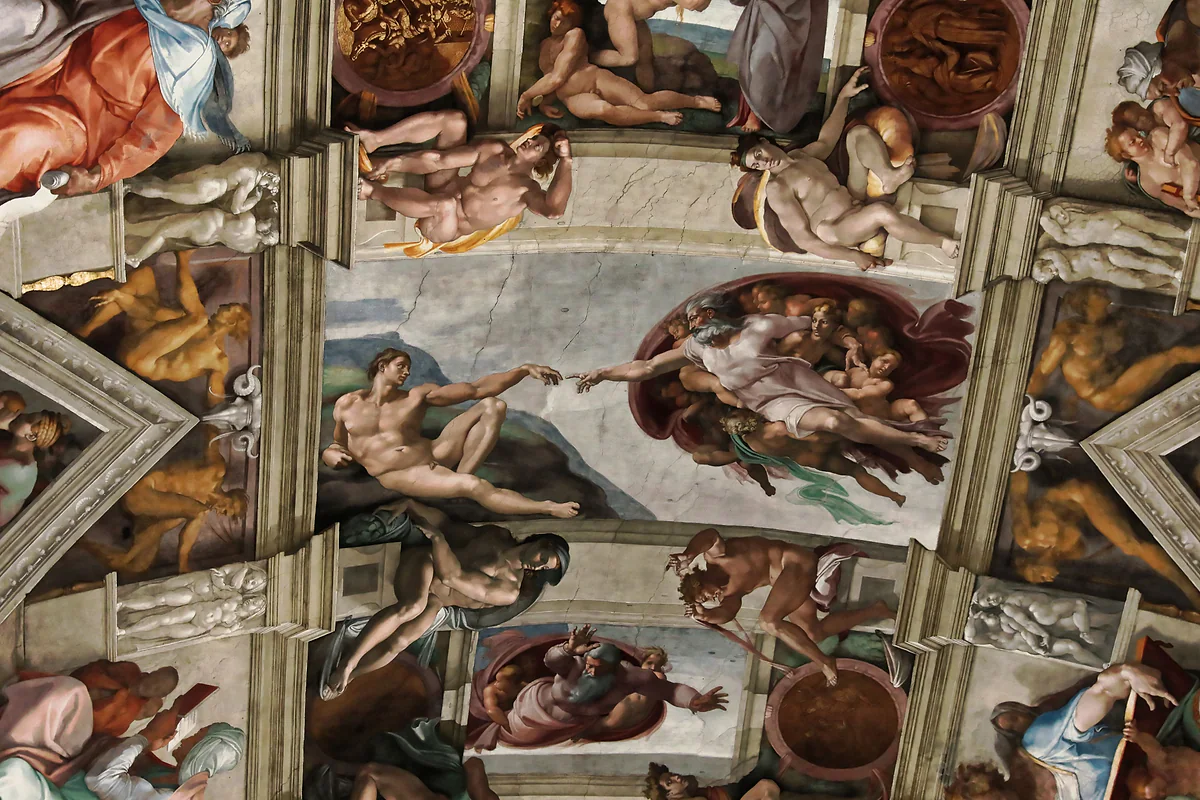
The Creation of Adam on the Sistine Chapel ceiling by Michelangelo, surrounded by painted ignudi and medallions.
Who painted what in the Sistine Chapel
| Area | Painters | Years |
|---|---|---|
| Original starry ceiling | Pier Matteo d'Amelia | 15th century, replaced in 1508 |
| Walls (stories of Moses and Christ, popes, painted curtains) | Perugino, Botticelli, Ghirlandaio and Cosimo Rosselli, with Signorelli, Biagio di Antonio and Bartolomeo della Gatta | 1481-1482 |
| Ceiling | Michelangelo | 1508-1512 |
| Last Judgement | Michelangelo | 1536-1541 |
| Draperies over the Judgement's nudes | Daniele da Volterra | After 1564 |
Vatican Museums data. The building itself was put up for Sixtus IV from 1477 by Giovannino de' Dolci and Baccio Pontelli, according to the Holy See.
How long did Michelangelo take?
| Work | Start | Finish | Time taken |
|---|---|---|---|
| Ceiling | Contract of 08-05-1508 | 31-10-1512 | About four years |
| Last Judgement | Scaffold up April 1535, painting from 1536 | Autumn 1541 | About five and a half years |
Vatican Museums and Holy See. The first half of the ceiling was done by August 1510.
Test yourself
True or false?
0/4 Pick before you peek.
-
Michelangelo was the first artist to paint the Sistine Chapel.
See the answer
False. Perugino, Botticelli, Ghirlandaio and Rosselli painted the walls in 1481-1482, more than twenty years earlier, and the ceiling already had a starry sky.
-
Michelangelo took about four years to paint the ceiling.
See the answer
True. He signed the contract on 8 May 1508 and finished on 31 October 1512. Benedict XVI spoke of 'about four years'.
-
Leonardo da Vinci painted part of the Sistine Chapel.
See the answer
False. He doesn't appear in any Museums source as one of the chapel's painters. His work in the Vatican is the St Jerome in the Pinacoteca.
-
Frescoes by Perugino were lost to make way for the Last Judgement.
See the answer
True. The Vatican Museums confirm it. The altar wall had works by Perugino that disappeared under the Judgement.
- Painting campaigns, 1481-82, 1508-12 and 1536-41
- 3
- Michelangelo's time on the ceiling
- 4 years
- Of painted plaster on the ceiling, per Benedict XVI
- 1,000+ m²
- 15th-century masters on the walls
- 4
0 of 88 Vatican City guides
Your next stamp
- Ceiling
- Sistine Chapel
- Last Judgement
- Pietà
- Facts
- Borgia Apartment
- Architecture and architects
- Gallery of Tapestries
- Things to do
- One day
- Tickets
- Two days
- Vatican Museums
- St Peter's Basilica
- St Peter's Square
- St Peter's Dome
- Vatican Necropolis
- Vatican Gardens
- Swiss Guard
- Seeing the Pope
- How to visit
- Castel Gandolfo
- Where to eat
- Free and cheap
- Apostolic Palace
- Scams to avoid
- Getting there
- Money and payments
- Exclusive experiences
- Papal audience
- Angelus
- Where the Pope lives
- Where to stay
- Dress code
- Opening hours
- Map
- Flag
- Post office and stamps
- Is it a country?
- Vatican Grottoes
- History
- Baldachin
- Chair of St Peter
- Raphael Rooms
- Gallery of Maps
- Holy Door
- Library and Archives
- Bramante Staircase
- Facade and balcony
- Mass at St Peter's
- Pio Clementino Museum
- Papal blessing
- Vatican Pinacoteca
- Catacombs
- Gallery of the Candelabra
- Egyptian and Etruscan Museums
- Obelisk
- Vatican Museums map
- Bernini's colonnade
- How long you need
- Night opening
- Chiaramonti and Braccio Nuovo
- Christmas
- Anima Mundi Museum
- Easter
- Carriage Pavilion
- Gift shops and souvenirs
- With kids
- Best time to visit
- Courtyard of the Pine Cone
- Photography
- Train station
- Accessible travel
- Vatican Observatory
- Modern art collection
- Papal Palace
- Barberini Gardens
- Facts
- Getting there
- Holy See
- Lake Albano
- Police and army
- Passport
- Pharmacy, shop and petrol
- What Vatican means
- Papal tombs
- List of popes
Frequently asked questions
Who painted the Sistine Chapel?
Several painters. The walls were painted in 1481-1482 by Perugino, Botticelli, Ghirlandaio and Cosimo Rosselli, helped by artists such as Luca Signorelli. Michelangelo painted the ceiling between 1508 and 1512 and the Last Judgement between 1536 and 1541.
Who painted the ceiling of the Sistine Chapel?
Michelangelo, for Pope Julius II, under a contract dated 8 May 1508. He finished in October 1512 and the pope inaugurated it with Mass on 1 November. Before that the ceiling was a starry sky by Pier Matteo d'Amelia.
How long did it take Michelangelo to paint the Sistine Chapel?
The ceiling took about four years, from 1508 to 1512. The Last Judgement took roughly another five and a half, from 1536 to autumn 1541. More than twenty years separate the two.
Did Michelangelo paint the Sistine Chapel on his own?
Nobody can say for certain, and I won't pretend otherwise. Sources disagree on whether his assistants got onto the scaffold, though a leading Italian encyclopaedia thinks some worked on the Flood. What's certain is that the design and the main hand are his.
How many artists painted the Sistine Chapel?
At least five painted major parts, Perugino, Botticelli, Ghirlandaio and Cosimo Rosselli on the walls, and Michelangelo on the ceiling and altar wall, plus assistants such as Signorelli. Add Pier Matteo d'Amelia for the lost starry ceiling and Daniele da Volterra for the later draperies.
Did Leonardo da Vinci paint in the Sistine Chapel?
No. Leonardo doesn't appear among the chapel's painters in any Vatican Museums source. The Museums do have a work of his, the St Jerome in the Pinacoteca.
Why is it called the Sistine Chapel?
After Pope Sixtus IV della Rovere, who rebuilt the older Cappella Magna from 1477. It was consecrated on 15 August 1483 and dedicated to the Assumption.
By
Tourism graduate with a master’s in Tourism Management and Planning from the University of Málaga, who has travelled across Europe. He writes every guide from official sources and his own judgement.
Published on . Facts checked on .
Sources
Photos: Gary Todd from Xinzheng, China (Public domain); Miguel Ángel (obra); reproducción de dominio público (Public domain); Burkhard Mücke (fotografía); Miguel Ángel (obra) (Public domain), via Wikimedia Commons.