No army since 14 September 1970
Who guards the Vatican, a country with no army and two forces of its own
Vatican City has no army. On 14 September 1970 Paul VI abolished every military corps except the Swiss Guard, which protects the pope with 135 men. The police force is the Gendarmerie Corps, founded in 1816, which guards the state's five entrances together with the Guard. In St Peter's Square, however, the Italian police normally take charge.
In 30 seconds
Full read: 4 min
- Vatican City has had no army since Paul VI abolished its military corps on 14 September 1970.
- Only the Swiss Guard remained, 135 men protecting the pope and the entrances.
- The police force is the Gendarmerie Corps, founded in 1816 and so named since 2002.
- In St Peter's Square and at the basilica security check, the Italian police normally operate.
- It has its own courts, first instance, appeal and cassation, judging in the pope's name.
I think this is one of the most useful oddities to grasp before you go. Whoever checks your bag in the square is Italian police, whoever you see with a halberd is the Swiss Guard and whoever patrols inside is the Gendarmerie. Knowing who's who saves you arguing with the wrong person.

Before you go
What I would keep in mind
-
01 My tip
The basilica security check is Italian police
The scanners in the right-hand curve of the square are run by Italy's Polizia di Stato, not the Vatican. That's the queue that builds in high season.
St Peter's Basilica -
02 Most beautiful
The Swiss Guard, the last armed corps
Paul VI abolished the other military corps in 1970 and kept only the Swiss Guard, founded in 1506. Seeing them at their posts is free.
Swiss Guard at the Vatican -
03 Watch out
Nobody in uniform sells tickets
Neither the Gendarmerie nor the Swiss Guard sells tours or queue jumps. If someone official-looking offers you anything in the street, be wary.
Vatican scams and tourist traps to avoid in 2026 -
04 My tip
Non-tourist areas need a pass at St Anne's
If you need the Vatican Pharmacy, access is arranged at the Permit Office by St Anne's Gate, with photo ID.
Vatican pharmacy
My priorities
Unmissable
- Know that the square check is Italian police, and travel light
- See the Swiss Guard at the Arch of the Bells as you leave the basilica
If you have time
I would skip
- Asking guards on duty to pose or blocking their way
- Mixing up Gendarmerie and Swiss Guard, or asking anyone for tickets
My ranking, scored
Who you'll meet, most likely first
My own scores out of 10, for how likely an ordinary visitor is to deal with each force during a visit. It isn't a measure of importance.
0 of 5 seen
-
Italian police in the square
They run the basilica security check and patrol the square, which the Lateran Treaty leaves normally open and under their control.
9.5 out of 10
-
Swiss Guard
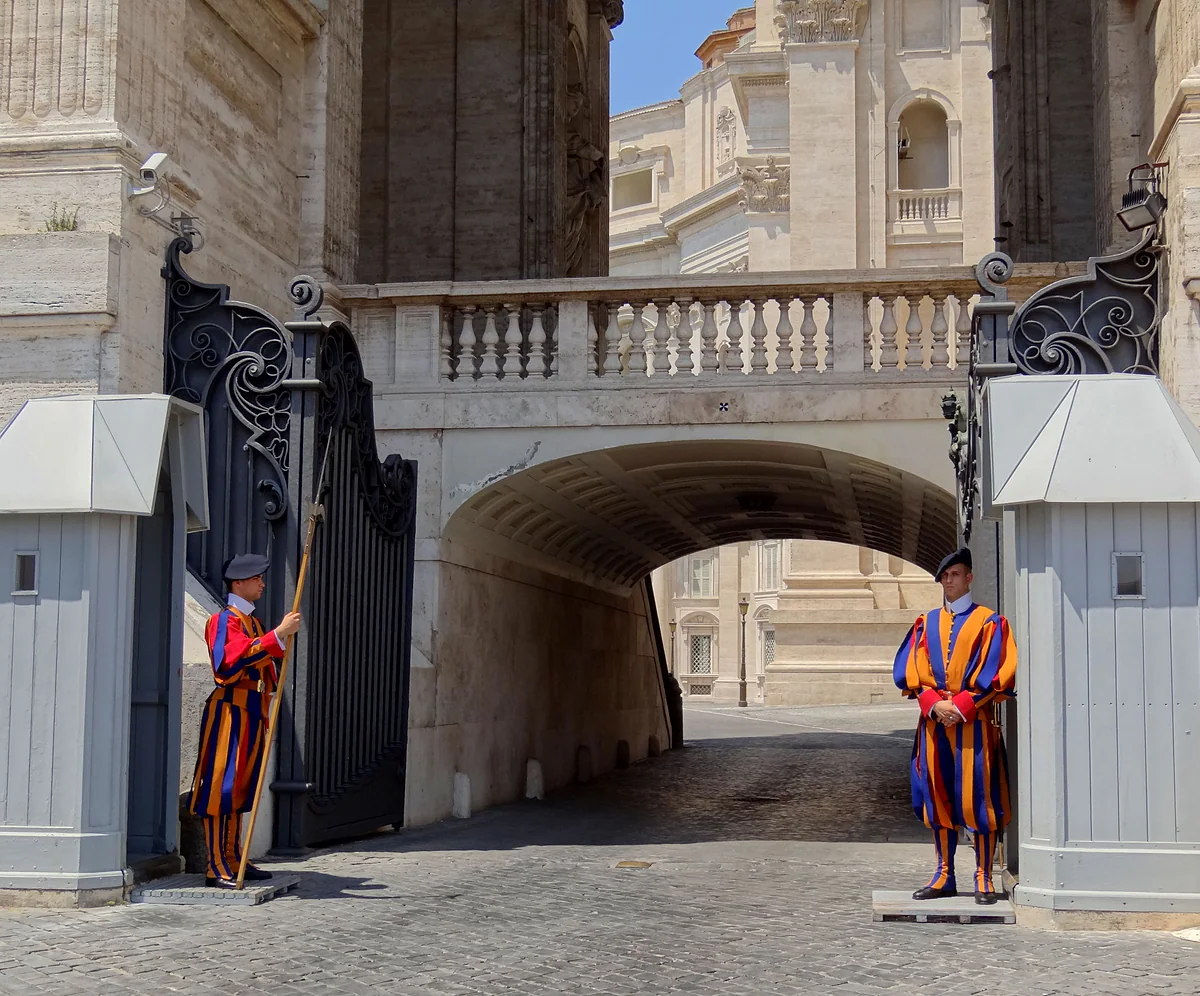
You'll see them at the Arch of the Bells, the Bronze Door and St Anne's Gate. They protect the pope and the entrances; they don't hand out fines.
8.8 out of 10
-
Gendarmerie
The state's police, responsible for public order, security and criminal investigation. They share the entrances with the Guard and work inside the territory.
7.5 out of 10
-
Museum attendants
Not police, but they're the ones who'll ask for silence or make you delete a photo in the Sistine Chapel.
7.0 out of 10
-
Vatican fire brigade
It exists and answers to the same directorate as the Gendarmerie. With luck you won't need it.
3.0 out of 10
One of my favourite Vatican questions is whether it has an army. The short answer is no, but behind it is a rather curious division of labour between three forces, one Swiss, one Vatican and one Italian. For a traveller it matters more than you’d think, because which one you deal with depends on where you’re standing. Here’s how it works.
Does the Vatican have an army?
No. In September 1970 Paul VI disbanded the state’s remaining military corps, keeping only the Pontifical Swiss Guard, and a December law made it official. Before then the popes had other armed corps in their service. On top of that, Article 24 of the 1929 Lateran Treaty says Vatican City will always be neutral and inviolable territory.
What remains is the Swiss Guard, founded on 22 January 1506 under Julius II. Today it has 135 men, 9 officers, 41 NCOs and 85 halberdiers. It protects the pope, his home and his journeys, mans the state’s gates, performs honour duties and guards the cardinals when there’s no pope. For the history, the entry requirements and where to see them, go to my page on the Swiss Guard.
The Vatican’s police is the Gendarmerie
Public order, security and criminal investigation inside the state fall to the Gendarmerie Corps. It began in 1816, after the Congress of Vienna, as the Papal Carabinieri, created by Pius VII when the Papal States still stretched from Emilia-Romagna down to Lazio. It fought until Rome fell in 1870, and since 2 January 2002 it has been called the Gendarmerie Corps of Vatican City State. Together with the fire brigade it answers to the Directorate of Security Services and Civil Protection.
According to the Governorate’s website there are five entrances to the state, guarded jointly by the Swiss Guard and the Gendarmerie. Non-tourist areas, such as the Vatican pharmacy, need a pass, issued at St Anne’s on sight of your ID.
Who polices St Peter’s Square?
This is the quirk that confuses people most. Though it is Vatican soil, the 1929 treaty leaves the square open and under Italian police authority, right up to where the basilica steps begin. According to the Fabbrica itself, Italy’s Polizia di Stato runs the basilica scanners in the right-hand curve. In high season that’s what creates the queue, as I explain when covering St Peter’s Basilica.
My practical tip is to travel light. The basilica has no left-luggage, and the less you carry, the faster you get through the scanner.
Its own courts, and three cells
The Vatican has its own justice system. It has three levels of court, first instance, appeal and cassation, plus a prosecution office.
On prisons there’s less official information. ACI Stampa, a news agency, reports three small cells in the Gendarmerie building for short stays only, with any real sentence served in Italy and paid for by the Vatican. Article 22 of the Lateran Treaty provides for Italy to punish on its territory crimes committed in the Vatican if the Holy See asks. I haven’t seen an official source describing the cells, so take that with the caution it deserves.
What the Gendarmerie does beyond patrolling
Its job goes well beyond what you see on the street. According to the Governorate, on top of public order and criminal investigation it acts as border police and tax police, handles security at papal ceremonies, audiences and meetings, and protects the pope wherever he goes. That includes pastoral visits around Italy and trips abroad, so when you see the pope in another country, part of the security around him comes from here. It’s also a member of INTERPOL, sharing information on crime.
The name has changed almost as often as the city. In 1849 the carabinieri became the Reggimento dei Veliti Pontifici and then the Papal Gendarmerie. The 1970 reform stripped its military status and turned it into the Central Security Office, and in 1991 it became the State Security Corps. To me that sequence is the clearest sign of a Vatican that stopped thinking of itself as an armed power and started thinking like a state that only needs a police force.
The fire brigade, the state’s third corps
Hardly anyone knows the Vatican has its own firefighters. There was a fire corps under the Papal States, but the current unit was set up by Pius XII in 1941, in the middle of the war. Today there are 30 of them, led by a coordinating officer, and besides fighting fires they handle prevention, check the fire equipment in the palaces and work with the Gendarmerie on civil protection. They even cover the helipad when the pope flies in.
Their station is inside the Vatican Palaces, reached from the Belvedere Courtyard, so it isn’t something you’ll see on a visit. They celebrate their patron saints, St Barbara and St Leo IV, on 4 December. The building that houses them is covered in the Apostolic Palace.
What it means for your visit
In practice you’ll cross paths with all three. The Italian police in the square and at the check. The Swiss Guard at their sentry boxes, who neither fine you nor sell anything. And the Gendarmerie, inside. Nobody in uniform will offer you tickets or tours, so if someone does, apply what I cover in Vatican scams to avoid. Why a state this size needs a police force at all comes down to its sovereignty, covered in is the Vatican a country?.
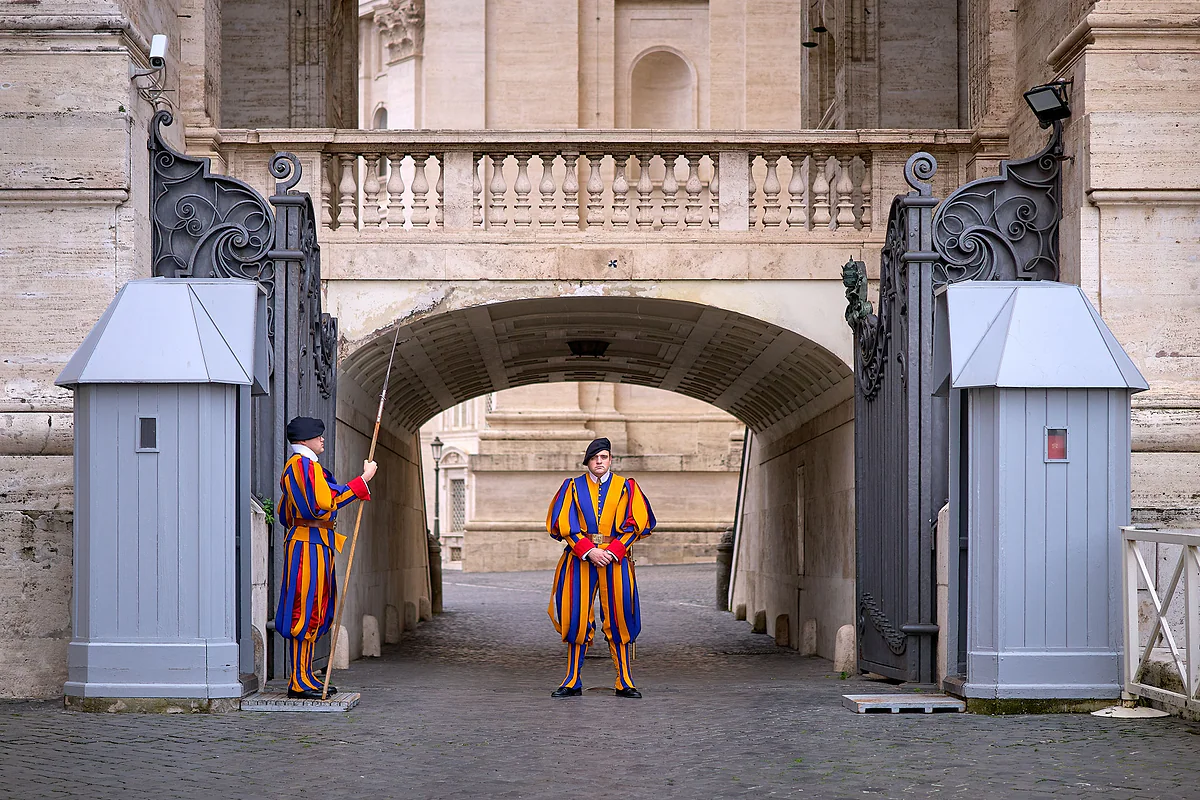
Two Swiss Guards in blue, yellow and red striped uniforms guard the Arch of the Bells, beside their sentry boxes.
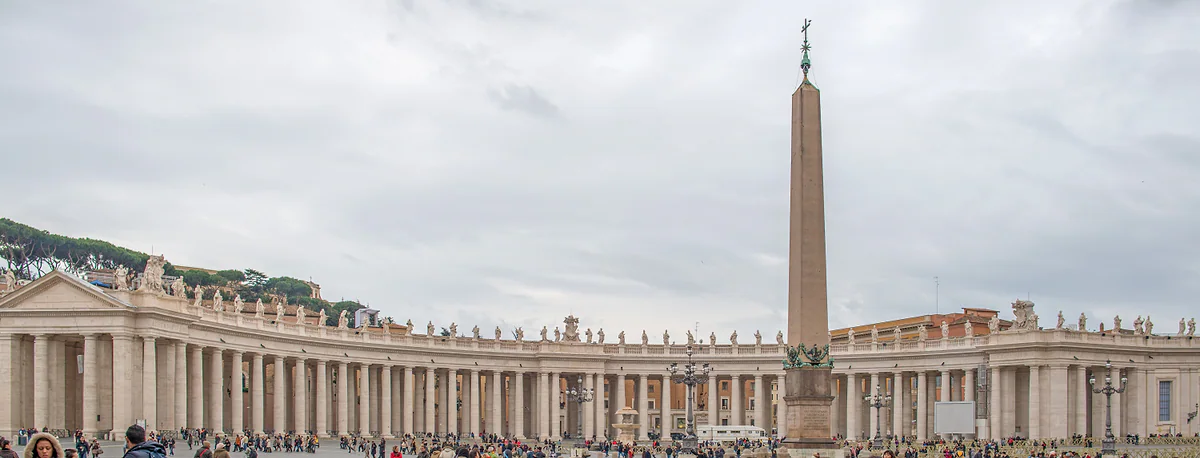
Bernini's colonnade encircles St Peter's Square with the Egyptian obelisk in the centre, on a cloudy day.
The security forces, one by one
| Force | Role | Since |
|---|---|---|
| Pontifical Swiss Guard | Security of the pope and his residence, entrances, honour duties | 22-01-1506 |
| Gendarmerie Corps | Public order, security and criminal investigation | 1816 as the Papal Carabinieri; current name since 02-01-2002 |
| Fire Brigade | Civil protection and fires | Same directorate as the Gendarmerie |
| Italian police | Policing St Peter's Square and the basilica check | Under the 1929 Lateran Treaty |
Governorate of the state, Pontifical Swiss Guard, Fabbrica di San Pietro and the Lateran Treaty.
Its own courts
| Body | Role |
|---|---|
| Tribunal | First instance |
| Court of Appeal | Second instance |
| Court of Cassation | Final instance |
| Office of the Promoter of Justice | Prosecution |
The courts judge in the pope's name, according to the Governorate.
Test yourself
True or false?
0/4 Pick before you peek.
-
The Vatican has a small army besides the Swiss Guard.
See the answer
False. Paul VI abolished every military corps except the Swiss Guard in 1970. The Gendarmerie is a police force, not an army.
-
The Swiss Guard is the Vatican's police force.
See the answer
False. The police are the Gendarmerie Corps. The Swiss Guard protects the pope, his residence and the entrances.
-
The St Peter's Basilica security check is carried out by the Italian police.
See the answer
True. According to the Fabbrica di San Pietro, Italy's Polizia di Stato runs it in the right-hand curve of the square.
-
Vatican City has its own courts.
See the answer
True. It has a Tribunal, a Court of Appeal and a Court of Cassation, plus the Office of the Promoter of Justice.
- Year the military corps were abolished
- 1970
- Swiss Guards on strength
- 135
- Founding of the Gendarmerie as Papal Carabinieri
- 1816
- Entrances guarded by the Guard and Gendarmerie
- 5
0 of 88 Vatican City guides
Your next stamp
- Swiss Guard
- Passport
- Facts
- Is it a country?
- St Peter's Square
- Bernini's colonnade
- Catacombs
- Post office and stamps
- Sistine Chapel
- Things to do
- One day
- Tickets
- Two days
- Vatican Museums
- St Peter's Basilica
- St Peter's Dome
- Vatican Necropolis
- Vatican Gardens
- Seeing the Pope
- How to visit
- Castel Gandolfo
- Where to eat
- Free and cheap
- Apostolic Palace
- Scams to avoid
- Getting there
- Money and payments
- Exclusive experiences
- Papal audience
- Angelus
- Who painted it
- Where the Pope lives
- Where to stay
- Dress code
- Facts
- Opening hours
- Map
- Flag
- Vatican Grottoes
- History
- Pietà
- Baldachin
- Ceiling
- Chair of St Peter
- Last Judgement
- Raphael Rooms
- Architecture and architects
- Gallery of Maps
- Holy Door
- Library and Archives
- Bramante Staircase
- Facade and balcony
- Mass at St Peter's
- Pio Clementino Museum
- Papal blessing
- Vatican Pinacoteca
- Gallery of Tapestries
- Gallery of the Candelabra
- Egyptian and Etruscan Museums
- Obelisk
- Vatican Museums map
- How long you need
- Night opening
- Chiaramonti and Braccio Nuovo
- Christmas
- Anima Mundi Museum
- Easter
- Carriage Pavilion
- Gift shops and souvenirs
- With kids
- Best time to visit
- Courtyard of the Pine Cone
- Photography
- Train station
- Accessible travel
- Vatican Observatory
- Borgia Apartment
- Modern art collection
- Papal Palace
- Barberini Gardens
- Getting there
- Holy See
- Lake Albano
- Pharmacy, shop and petrol
- What Vatican means
- Papal tombs
- List of popes
Frequently asked questions
Does the Vatican have an army?
No. On 14 September 1970 Paul VI abolished every military corps except the Pontifical Swiss Guard, confirmed by a law of 15 December that year. The Lateran Treaty also declares Vatican City neutral and inviolable territory.
What is the Vatican police force called?
The Gendarmerie Corps of Vatican City State. It began in 1816 as the Papal Carabinieri under Pius VII and has had its current name since 2 January 2002. It handles public order, security and criminal investigation.
Are the Swiss Guards the Vatican's police?
No. The police are the Gendarmerie. The Swiss Guard is a separate corps protecting the pope and his residence, and the only armed corps Paul VI kept in 1970. People mix them up because the Guard is the one in all the photos.
Who polices St Peter's Square?
Normally the Italian police. The square is Vatican territory, but the Lateran Treaty keeps it open to the public and subject to Italian police powers, which stop at the foot of the basilica steps.
Does the Vatican have a prison?
According to the ACI Stampa news agency, there are three small cells in the Gendarmerie building, not meant for long sentences, and sentences are served in Italy. The Lateran Treaty lets Italy punish crimes committed in the Vatican if the Holy See asks.
How many soldiers are in the Swiss Guard?
135 men, with 9 officers, 41 NCOs and 85 halberdiers, according to the Holy See. Numbers rose from 110 to 135 with the 2018 reform.
Does the Vatican have its own fire brigade?
Yes. The current corps was created by Pius XII in 1941 and today has 30 firefighters under a coordinating officer. They fight fires, handle prevention and civil protection with the Gendarmerie, and cover the helipad when the pope arrives.
By
Tourism graduate with a master’s in Tourism Management and Planning from the University of Málaga, who has travelled across Europe. He writes every guide from official sources and his own judgement.
Published on . Updated on . Facts checked on .
Sources
Photos: Bjørn Christian Tørrissen (CC BY-SA 3.0); Radek Kucharski (CC BY 4.0); Bengt Nyman (CC BY 2.0), via Wikimedia Commons.