State symbols, from official sources
The Vatican flag and the history it carries
The Vatican City flag is split vertically into two halves, yellow at the hoist and white at the fly, with crossed keys beneath the papal tiara on the white half. Yellow and white were adopted in 1808, replacing the earlier yellow and red, and the current flag was first raised on 8 June 1929.
What I like most about this flag is that its colours are older than the country. Yellow and white go back to 1808 and the state was born in 1929, so the flag you see flying carries more than a century of history from before Vatican City existed.

Before you go
What I would keep in mind
-
01 My tip
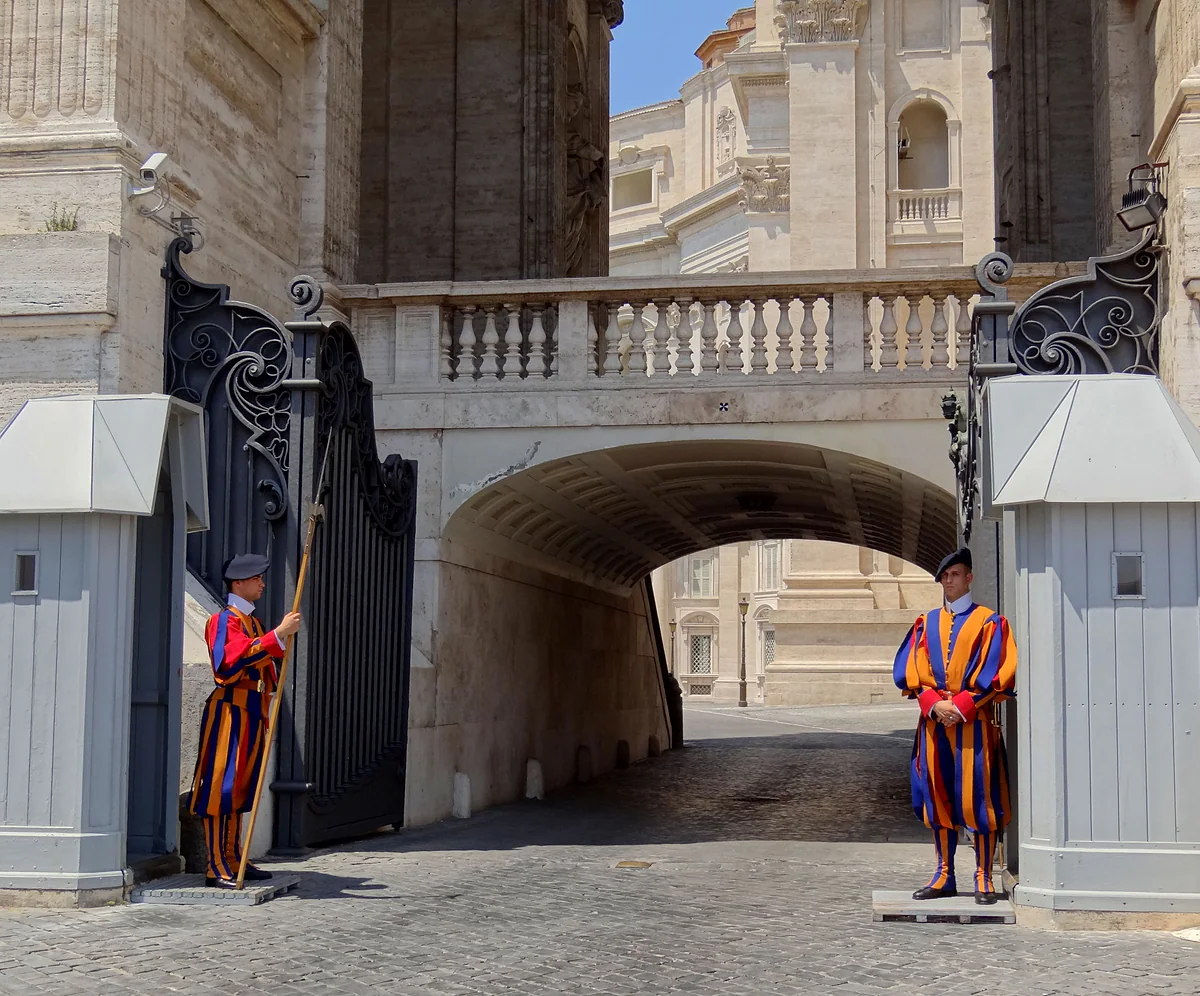
The Swiss Guard doesn't wear the flag's colours
The Guard's dress uniform is blue, red and yellow, the traditional Medici colours, and was essentially designed by commander Jules Repond. It isn't taken from the flag, and it isn't by Michelangelo either, which the Guard itself calls a myth.
Swiss Guard at the Vatican -
02 Most beautiful
An 1869 anthem for a 1929 state
The Pontifical March is by Charles Gounod, was first performed on 11 April 1869 and became the official anthem on 16 October 1949 under Pius XII. It has words in Italian and in Latin, and the Latin version opens with «O felix Roma».
Vatican City history -
03 Money
The state has its own coins and stamps too
The Vatican uses the euro but mints its own coins in Italy, capped at one million euros a year, and runs its own post office with its own postmark. It's the easiest way to take home something issued by the state.
Vatican post office and stamps -
04 My tip
The flag arrived with the state, in June 1929
The Lateran Pacts were signed on 11 February 1929, ratifications were exchanged on 7 June and the flag went up for the first time the next day. Why the Vatican counts as a country is explained separately.
Is Vatican City a country?
What I would book
- Places to stayBooking.com Staying in Borgo, just past the colonnade For a trip built around the Vatican, I'd stay in Borgo. The square is a few minutes' walk away, and you can see it again in the evening light.
- Places to stayBooking.com Prati, if the Vatican is one day of your trip If the Vatican is one stop on a wider Rome trip, I'd go for Prati, with line A and the Museums entrance within easy walking distance.
You’d spot the Vatican flag from across a room, yet very few people can tell you much about it. It’s one of the few things in the state that owes nothing to Michelangelo or Bernini, and I think it sums up the Vatican’s story rather neatly, pairing colours from 1808 with a country from 1929. Here’s what it looks like, where it comes from, what the law says about it and which other official symbols go with it. For the country as a whole, start with my Vatican City guide.
What it looks like, half by half
The flag is divided vertically into two halves. The one at the hoist is yellow and the one at the fly is white. On the white half sit two crossed keys with the papal tiara above them, which the state’s website calls by its Italian name, the Triregno.
Flag specialists describe it as square, like Switzerland’s, and the model drawing attached to the law shows it that way. The official website, however, never writes the proportion down in figures. My honest version is square according to its official drawing, with no text that explains it.
Why yellow and white?
This is the part I find most interesting. Yellow and white were adopted in 1808, taking over from an earlier pairing of yellow and red. In other words, when Vatican City was born in 1929 its colours had already been in use for 121 years. The flag wasn’t invented for the state. The state inherited a pair of colours and turned them into a national flag.
The official website doesn’t say why those two colours were chosen or what each one stands for, and I’m not going to plug the gap with a theory. Plenty of interpretations do the rounds, but none carries an official signature, and on a page that prides itself on sources I’d rather tell you that than a nice story.
When was the Vatican flag first raised?
On 8 June 1929, according to the Governorate. The date isn’t random. Cardinal Pietro Gasparri and Benito Mussolini put their names to the Lateran Pacts on 11 February 1929, and the ratifications were exchanged on 7 June, which is when the state began to exist in practice. The flag went up the following day. The stated aim of those pacts was to give the Holy See “absolute and visible” independence, and a flag of its own strikes me as the most literal way of making it visible. Some unofficial sources give 7 June as the adoption date, but the first raising, which is the date the state publishes, was the 8th.
If you want the before and after, it’s in the history of the Vatican, and why this really is a country, in is Vatican City a country?.
Coat of arms and seal, set down in law
The flag isn’t a matter of habit. The state’s Fundamental Law sets out the flag, the coat of arms and the seal with graphic models in its annexes, as the 2023 law already did. On 31 July 2026 Leo XIV issued a brand new Fundamental Law, replacing the previous one entirely, and article 24 keeps all three symbols. Article 1 of the same law restates that the Pope holds “the fullness of governing power”, so these are the symbols of a state whose head is the Pope himself.
For a traveller this has one small practical consequence. If a souvenir stall sells you a flag with different proportions or extra elements, it isn’t the official one. Where to shop with more confidence is in Vatican gift shops. The design that counts is the one in the annex.
An anthem older than the country
The anthem follows the same pattern as the colours, because it too predates the state. It’s the Pontifical March, or Pontifical Hymn, composed by Charles Gounod in 1869 and first performed on 11 April that year. Pius XII made it the official anthem on 16 October 1949, twenty years after the Lateran Pacts.
It has two sets of words. The Italian lyrics are by Monsignor Antonio Allegra and the Latin ones by Raffaello Lavagna, opening with “O felix Roma”.
Where to look for the state’s symbols on your visit
I haven’t found an official source listing which flagpoles fly the flag, so I won’t point you to a particular balcony. What I can point you to is where the state issues things in its own name. There are the stamps and postmark of Poste Vaticane, at the office in St Peter’s Square, and the Vatican euro coins, minted in Italy with a cap of one million euros a year, which I cover in Vatican post office and stamps.
And a tip for your photos. The Swiss Guard doesn’t wear the flag’s colours. Its dress uniform is blue, red and yellow, the traditional colours of the Medici, and was essentially designed by commander Jules Repond in the early twentieth century. If anyone tells you Michelangelo drew it, the Guard itself says that’s a myth.
The state's official symbols
| Symbol | What it is | Dates |
|---|---|---|
| Flag | Split vertically, yellow at the hoist and white with the keys under the tiara | Colours from 1808; first raised 08-06-1929 |
| Coat of arms and seal | Set by the Fundamental Law with graphic models in an annex | Kept in the law of 31-07-2026 (art. 24) |
| Anthem | Pontifical March (Pontifical Hymn), music by Charles Gounod | First performed 11-04-1869; official since 16-10-1949 |
| Anthem lyrics | Italian by Mgr Antonio Allegra; Latin by Raffaello Lavagna | The Latin opens with «O felix Roma» |
From the Governorate's website (vaticanstate.va) and the 2023 and 2026 Fundamental Laws published on vatican.va.
0 of 88 Vatican City guides
Your next stamp
- History
- Is it a country?
- Facts
- Dress code
- Holy See
- How to visit
- Map
- Sistine Chapel
- Things to do
- One day
- Tickets
- Two days
- Vatican Museums
- St Peter's Basilica
- St Peter's Square
- St Peter's Dome
- Vatican Necropolis
- Vatican Gardens
- Swiss Guard
- Seeing the Pope
- Castel Gandolfo
- Where to eat
- Free and cheap
- Apostolic Palace
- Scams to avoid
- Getting there
- Money and payments
- Exclusive experiences
- Papal audience
- Angelus
- Who painted it
- Where the Pope lives
- Where to stay
- Facts
- Opening hours
- Post office and stamps
- Vatican Grottoes
- Pietà
- Baldachin
- Ceiling
- Chair of St Peter
- Last Judgement
- Raphael Rooms
- Architecture and architects
- Gallery of Maps
- Holy Door
- Library and Archives
- Bramante Staircase
- Facade and balcony
- Mass at St Peter's
- Pio Clementino Museum
- Papal blessing
- Vatican Pinacoteca
- Catacombs
- Gallery of Tapestries
- Gallery of the Candelabra
- Egyptian and Etruscan Museums
- Obelisk
- Vatican Museums map
- Bernini's colonnade
- How long you need
- Night opening
- Chiaramonti and Braccio Nuovo
- Christmas
- Anima Mundi Museum
- Easter
- Carriage Pavilion
- Gift shops and souvenirs
- With kids
- Best time to visit
- Courtyard of the Pine Cone
- Photography
- Train station
- Accessible travel
- Vatican Observatory
- Borgia Apartment
- Modern art collection
- Papal Palace
- Barberini Gardens
- Getting there
- Lake Albano
- Police and army
- Passport
- Pharmacy, shop and petrol
- What Vatican means
- Papal tombs
- List of popes
Frequently asked questions
What colours are on the Vatican City flag?
Yellow and white, in two vertical halves, with yellow next to the flagpole. On the white half are crossed keys and the tiara. The two colours were adopted in 1808, replacing the yellow and red used before.
What does the Vatican flag mean?
The state's official website describes it but doesn't assign a meaning to each element. What it does explain is where the colours come from and that the white half carries crossed keys beneath the tiara, which it calls the Triregno. I'd rather stop there than repeat symbolism nobody official has put their name to.
When was the Vatican flag adopted?
The current flag was first raised on 8 June 1929, the day after ratifications of the Lateran Pacts were exchanged, which is when the state came into being in practice. The colours are older, from 1808. The Fundamental Law of 31 July 2026 keeps it unchanged.
Why is the Vatican flag square?
Flag specialists describe it as square, like Switzerland's, and that's how it appears in the graphic model attached to the Fundamental Law. The official website, though, doesn't state the proportion in writing or give a reason, so I won't make one up.
What is the Vatican City national anthem?
The Pontifical March, also called the Pontifical Hymn, with music by Charles Gounod. It was first performed on 11 April 1869 and has been the official anthem since 16 October 1949, by decision of Pius XII. The Italian lyrics are by Mgr Antonio Allegra and the Latin ones by Raffaello Lavagna.
Who decides what the Vatican flag looks like?
The state's Fundamental Law, which sets out the flag, coat of arms and seal with graphic models in its annexes. Leo XIV issued a new one on 31 July 2026 and kept all three symbols in article 24, with no change to the design.
By
Tourism graduate with a master’s in Tourism Management and Planning from the University of Málaga, who has travelled across Europe. He writes every guide from official sources and his own judgement.
Published on . Facts checked on .
Sources
Photos: Bjørn Christian Tørrissen (CC BY-SA 3.0), via Wikimedia Commons.