Number 21 on the map, in the basement
Anima Mundi, the Vatican museum that looks beyond Europe
Anima Mundi is the ethnological museum of the Vatican Museums, number 21 on the map, in the basement. It grew out of the 1925 Jubilee Missionary Exhibition, was founded by Pius XI in 1926 and holds over 80,000 objects from Africa, the Americas, Asia, Europe and Oceania. Redisplayed since 2019, it's on the standard ticket. On 29-09-2026 it's shut from 08:00 to 11:30.
In 30 seconds
Full read: 3 min
- Anima Mundi is the ethnological museum of the Vatican Museums, number 21 on the map, in the basement.
- It grew out of the 1925 Missionary Exhibition, was founded by Pius XI in 1926 and has been in the Museums since 1973.
- It holds more than 80,000 objects from five continents and has been redisplayed since 2019.
- It's on the standard ticket; on 29-09-2026 it's closed from 08:00 to 11:30.
- I'd give it about twenty minutes and pair it with the Carriage Pavilion.
I'd add it if you've done the Vatican before, or if you've got children who've had their fill of frescoes. It's one of the few corners of the museums with no queue, and the modern display genuinely helps you look.

Before you go
What I would keep in mind
-
01 Most beautiful
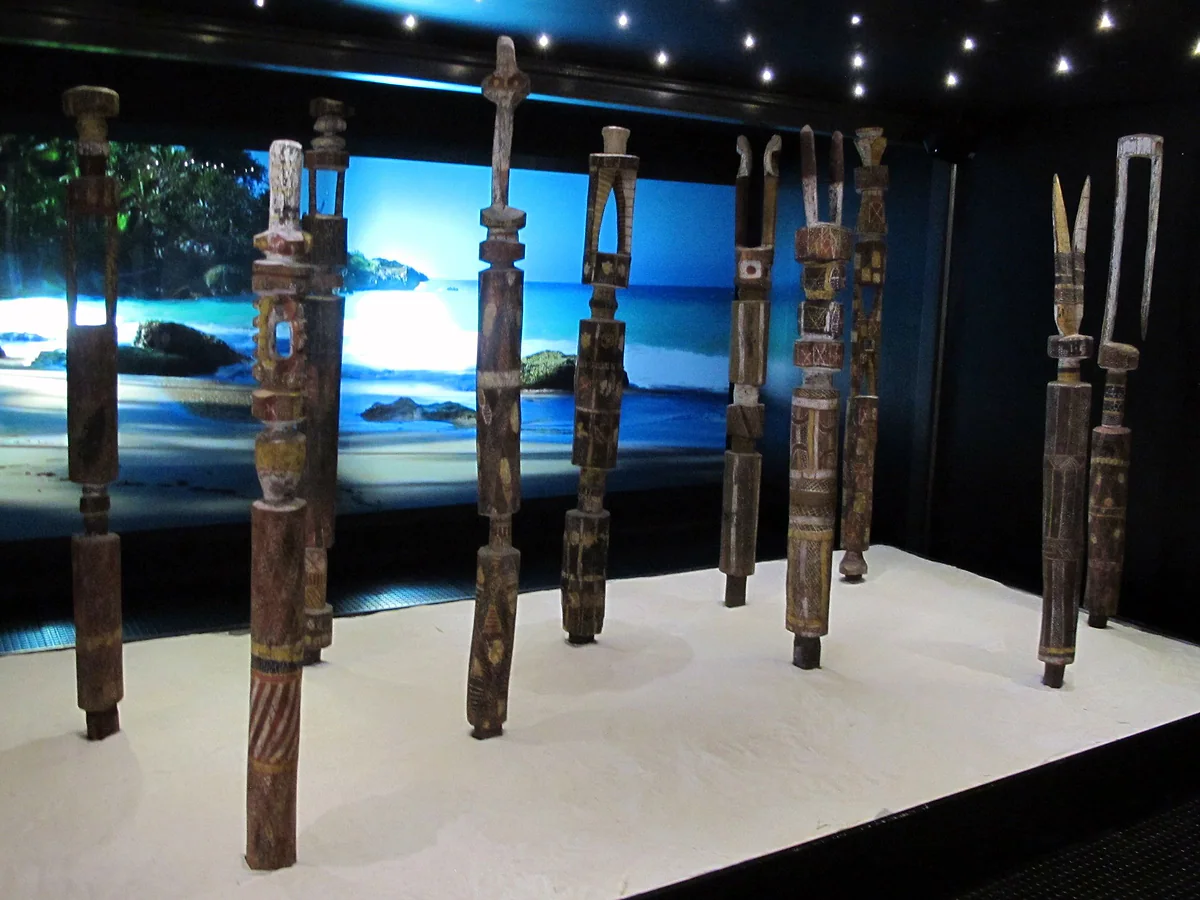
Funeral poles that were never meant to last
Pukumani poles are carved by the Tiwi people of Melville Island for a funeral and then left to rot. The Vatican's were made for display and rank among the oldest surviving in any museum.
-
02 My tip
On 29 September, not before 11:30
The official website lists a partial closure of Anima Mundi on Tuesday 29-09-2026 from 08:00 to 11:30. If you're on the first slot that day, save it for the end.
Vatican opening hours 2026 -
03 To save money
No supplement, no separate booking
The ethnological museum comes with the standard Museums ticket, €20 at the desk or €25 online, and on the last Sunday of each month it's free from 09:00 to 14:00.
Is the Sistine Chapel free? -
04 My tip
Pair it with the carriages on the same floor
The map puts Anima Mundi (21) and the Carriage Pavilion (22) together in the basement. With children, those two stops work better than yet another marble gallery.
the Carriage Pavilion
My priorities
Unmissable
- The Tiwi people's Pukumani funeral poles
- The painted stones of the Wandjina Song Cycle
If you have time
- The Oceania room, with objects that seem to float
- The Carriage Pavilion, on the same level
What I would book
- Places to stayBooking.com Prati, to start early with time to spare Adding the basement to the essentials makes for a longer day. Staying in Prati gets you to the first slot on foot.
- Tours and ticketsGetYourGuide A guided tour first, the basement on your own Guided tours rarely come down here. I'd do the essentials with a guide and then head back to Anima Mundi independently.
My ranking, scored
What I'd look for in Anima Mundi
My own scores out of 10, weighing what surprises someone fresh from Raphael and Michelangelo. Facts from the official pages; the website doesn't say which collection pieces are currently on show apart from the poles and painted stones, so I've marked the rest as collection.
0 of 5 seen
-
The Pukumani funeral poles
Carved and painted by the Tiwi people in the early 20th century. According to the museums, the poles with heads stand for women and those with arms for men.
9.2 out of 10
-
The Wandjina Song Cycle
Stones painted around 1913 by Paul Miuron in Australia's Kimberley as a gift for the pope. The first time an Aboriginal artist put his world on something portable.
8.8 out of 10
-
The Oceania display
Opened in 2019, with objects that seem to float in mid-air. It's what Pope Francis came to open and it shows best how the museum has changed.
8.3 out of 10
-
The Qing phoenix crown (collection)
An 18th or 19th-century Chinese court diadem worked with blue kingfisher feathers, which arrived with the 1925 exhibition.
7.9 out of 10
-
The god Tu from Mangareva (collection)
A late 18th-century carving with four legs bent at the knee. The museums say it's the only one of its kind.
7.7 out of 10
Anima Mundi is the museum almost nobody realises is inside the Vatican Museums. It’s down in the basement, well away from the line running from the Pio Clementino to the Sistine, and it holds something you don’t expect in the house of Raphael and Michelangelo, sacred and everyday objects from peoples on five continents. For me it’s among the most rewarding parts of the complex for a second visit or a trip with children, and here’s why. If you’re still sorting out the basics, see [the Vatican Museums in three hours] first(/en/vatican-city/vatican-museums/).
An exhibition that turned into a museum
It all began with the 1925 Jubilee. Pius XI wanted a Missionary Exhibition in the Vatican to show how far the missions reached and, at the same time, the cultural, artistic and spiritual traditions of every people. Missionaries acted as go-betweens and the response was huge. The show opened on 24 December 1924, closed on 9 January 1926, drew more than a million people and filled twenty-six pavilions with over 100,000 works.
Its success won the pope over. On 12 November 1926 he founded an Ethnological Museum, which opened at the Lateran on 21 December 1927 with some 80,000 pieces chosen from the exhibition. In 1963 it had to close because the palace went to the Diocese of Rome, and the collection sat in storage until 1973, when Paul VI gave it a home inside the Vatican Museums.
What changed in 2019?
The museum has been rebuilt piece by piece. In 2019 the first areas of the new Anima Mundi opened, with Mater Amazonia and Oceania, and Pope Francis came to inaugurate them on 18 October. He called it a living house, open to all, with its doors flung wide to the peoples of the world. The Americas and Africa followed in December 2022, and Asia is now in preparation, including a Forest of Buddhas to compare Buddhist statues from across the continent.
What I like most is how things are shown. In Oceania the objects seem to hang in mid-air, with none of the storeroom feel so many ethnographic museums used to have. There’s also deeper work going on, which the website describes in detail, tracing the descendants of the people who sent each piece in 1925 to give them back its story. The current curator, Nadia Fiussello, is the first woman to run the museum.
Poles that are left to rot
If you only take in one part, make it Oceania. Pukumani funeral poles are carved by the Tiwi of Melville Island for the ceremonies that follow a death, with dances and songs, and once those are over the poles are left to decay. According to the museums, the ones with heads represent women and the ones with arms represent men. The Vatican’s set was made for display and ranks among the oldest kept in any museum in the world.
Close by are the stones of the Wandjina Song Cycle, painted around 1913 by Paul Miuron at a mission in Australia’s Kimberley as a gift for the pope. The museums present them as the first time an Aboriginal artist carried the world of his homeland onto something portable, a world that until then lived in rock paintings.
What else the collection holds
The collection runs past 80,000 objects and spans the Palaeolithic to the present. Among the pieces the website singles out are a South African stone tool about two million years old, a Qing court crown made with kingfisher feathers, a Mexica feathered serpent, a samurai suit of armour from the Shimazu clan and a Kota reliquary guardian from Gabon. The website doesn’t say which of these are on display right now, so I wouldn’t make a beeline for any of them.
Where it fits in a day at the museums
I’d give it around twenty minutes and pair it with the Carriage Pavilion, which is on the same level. With children, those two stops beat any marble gallery, and I’ve got more ideas in the Vatican with kids. Watch out for Tuesday 29 September 2026, when the museum is shut from 08:00 to 11:30. To place it, look for number 21 on the Vatican Museums map.
The museum in numbers
| What | Detail |
|---|---|
| Official map | No. 21, basement |
| Origin | 1925 Jubilee Missionary Exhibition, 24-12-1924 to 09-01-1926 |
| Founded | 12-11-1926, Pius XI; opened at the Lateran on 21-12-1927 |
| In the Vatican Museums | Since 1973, after closing at the Lateran in 1963 |
| New display | Oceania and Mater Amazonia in 2019; the Americas and Africa in December 2022 |
| Collection | More than 80,000 objects, from the Palaeolithic to today |
From the official museum page and its department page on the Vatican Museums website.
Tickets and hours (2026)
| What | Detail |
|---|---|
| Standard ticket | €20 at the desk, €25 booked online |
| Reduced | €10 at the desk, €15 online |
| Monday to Saturday | 08:00-20:00, last entry 18:00 |
| Last Sunday of the month | 09:00-14:00, free, last entry 12:30 |
| Partial closure | Tuesday 29-09-2026, 08:00 to 11:30 |
No ticket of its own. The partial closure is listed under temporary closures on the official website.
Test yourself
True or false?
0/4 Pick before you peek.
-
The 1925 Missionary Exhibition that started the museum drew more than a million visitors.
See the answer
True. It opened on 24-12-1924, closed on 09-01-1926 and passed a million visitors, with more than 100,000 works in twenty-six pavilions, according to the museums.
-
The ethnological museum has always been inside the Vatican Museums.
See the answer
False. It opened in the Lateran Palace in 1927, closed there in 1963 and only reached the Vatican Museums in 1973.
-
Pukumani poles are carved to last for centuries.
See the answer
False. They're made for a funeral ceremony and then left to decay. The Vatican's were made for display, which is why they're among the oldest to survive.
-
A woman is running the museum for the first time in its history.
See the answer
True. Nadia Fiussello, curator since August 2024, is according to the museums the first woman to head it.
- Objects, at least, in the collection
- 80,000
- Year Pius XI founded the museum
- 1926
- Visitors to the 1925 Missionary Exhibition, and more
- 1,000,000
- The museum's number on the official map
- No. 21
0 of 88 Vatican City guides
Your next stamp
- Vatican Museums
- Modern art collection
- Egyptian and Etruscan Museums
- Pio Clementino Museum
- Gallery of Maps
- Chiaramonti and Braccio Nuovo
- How long you need
- Vatican Pinacoteca
- Sistine Chapel
- Things to do
- One day
- Tickets
- Two days
- St Peter's Basilica
- St Peter's Square
- St Peter's Dome
- Vatican Necropolis
- Vatican Gardens
- Swiss Guard
- Seeing the Pope
- How to visit
- Castel Gandolfo
- Where to eat
- Free and cheap
- Apostolic Palace
- Scams to avoid
- Getting there
- Money and payments
- Exclusive experiences
- Papal audience
- Angelus
- Who painted it
- Where the Pope lives
- Where to stay
- Dress code
- Facts
- Opening hours
- Map
- Flag
- Post office and stamps
- Is it a country?
- Vatican Grottoes
- History
- Pietà
- Baldachin
- Ceiling
- Chair of St Peter
- Last Judgement
- Raphael Rooms
- Architecture and architects
- Holy Door
- Library and Archives
- Bramante Staircase
- Facade and balcony
- Mass at St Peter's
- Papal blessing
- Catacombs
- Gallery of Tapestries
- Gallery of the Candelabra
- Obelisk
- Vatican Museums map
- Bernini's colonnade
- Night opening
- Christmas
- Easter
- Carriage Pavilion
- Gift shops and souvenirs
- With kids
- Best time to visit
- Courtyard of the Pine Cone
- Photography
- Train station
- Accessible travel
- Vatican Observatory
- Borgia Apartment
- Papal Palace
- Barberini Gardens
- Facts
- Getting there
- Holy See
- Lake Albano
- Police and army
- Passport
- Pharmacy, shop and petrol
- What Vatican means
- Papal tombs
- List of popes
Frequently asked questions
What is the ethnological museum in the Vatican?
It's the Anima Mundi Ethnological Museum, inside the Vatican Museums. It holds more than 80,000 objects from peoples around the world, many of them sent for the 1925 Missionary Exhibition, and since 2019 it has had a new display arranged by continent.
Where is the Anima Mundi museum?
In the basement of the Vatican Museums, number 21 on the official map, on the same level as the Carriage Pavilion (22).
Why is it called Anima Mundi?
It's the name given to the new museum that has opened in stages since 2019, when Pope Francis inaugurated the first rooms and called it a living house, open to the peoples of the whole world. It used to be the Missionary Ethnological Museum.
Is Anima Mundi included in the Vatican Museums ticket?
Yes. There's no separate ticket or supplement. It's covered by the standard ticket, €20 at the desk or €25 online, which also includes the Sistine Chapel.
Is Anima Mundi open on 29 September 2026?
Only partly. The official website says it's closed that Tuesday from 08:00 to 11:30, so from then on you can visit as normal.
How long do you need for the Vatican ethnological museum?
There's no official figure. I'd give it about twenty minutes, focused on Oceania and the Pukumani poles, and a bit longer with children.
By
Tourism graduate with a master’s in Tourism Management and Planning from the University of Málaga, who has travelled across Europe. He writes every guide from official sources and his own judgement.
Published on . Facts checked on .
Sources