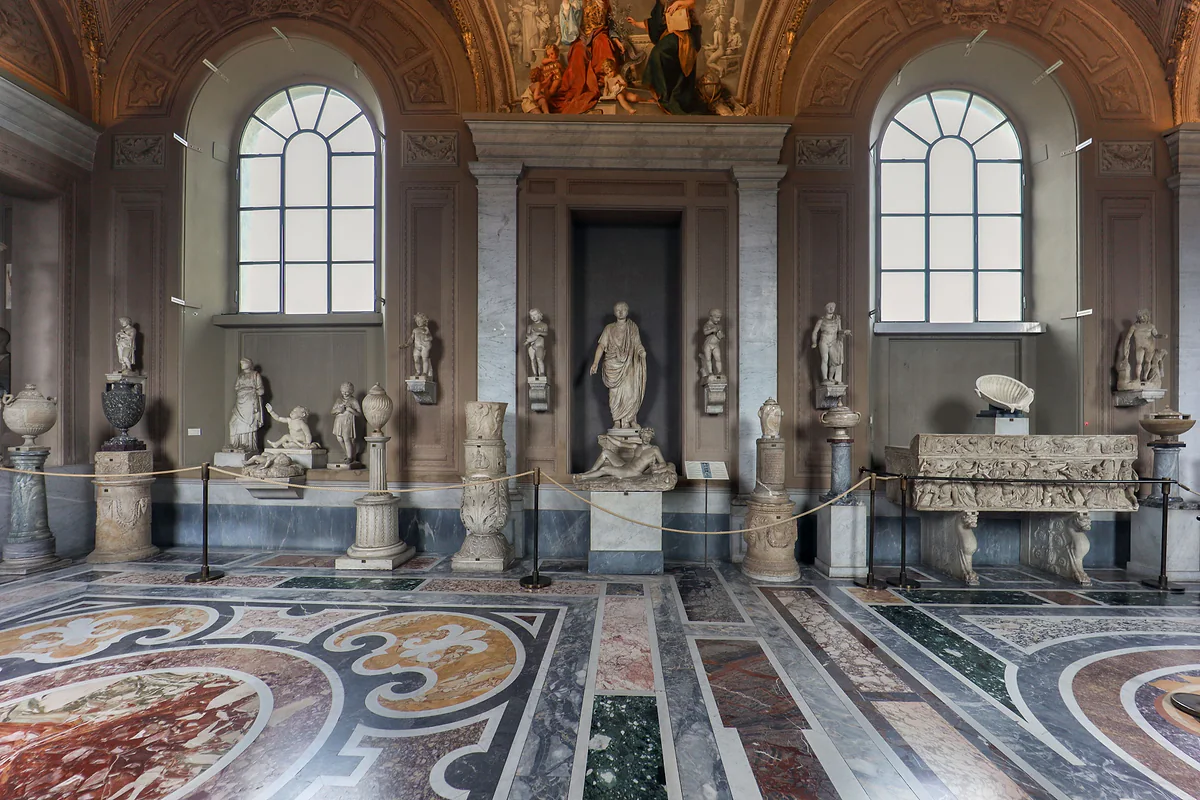
Number 6 on the map, just before the Tapestries
The Gallery of the Candelabra, first stretch of the long gallery
The Gallery of the Candelabra is number 6 on the Vatican Museums map, on the second floor, and the official website files it under the Pio Clementino Museum. It's named after the marble candelabra which, paired with coloured marble columns, divide it into six sections. Pius VI laid it out in 1785-1788 and Leo XIII redid all the decoration.
In 30 seconds
Full read: 3 min
- The Gallery of the Candelabra is number 6 on the Vatican Museums map and opens the long gallery on the second floor.
- It takes its name from the marble candelabra which, with coloured columns, split it into six sections.
- Pius VI laid it out in 1785-1788 and Leo XIII redecorated it, with paintings by Torti and Seitz.
- Its highlight is a Persian warrior, a Roman copy of a bronze dedicated by Attalus II.
- It's covered by the Museums ticket, and I'd give it about ten minutes.
Here I'd look down before looking up. Leo XIII's coloured marble inlay is some of the finest work on the whole second floor, and the crowd walks straight over it. The only long stop I'd make is the Persian warrior.

Before you go
What I would keep in mind
-
01 Most beautiful
A corridor arranged like a drawing room
The sculptures were placed like furniture, symmetrical with the architecture. Each marble candelabrum and its columns mark a new section, and the inlaid floor keeps the same rhythm.
-
02 My tip
Find the warrior raising his sword
A Persian in a Phrygian cap leans back with his sword arm up. He's a Roman copy of one of the bronze groups Attalus II set up in Athens and Pergamon, dug up in Rome between 1503 and 1512.
Pio Clementino Museum -
03 To save money
Included in the free last-Sunday tour
The gallery is part of the free last-Sunday opening, 09:00 to 14:00, and that day's official guided tour, €20 with headset, walks through it on the way to the Tapestries and Maps.
Is the Sistine Chapel free? -
04 Watch out
No separate ticket, no supplement
There's no ticket just for the Candelabra. If a resale site bundles it in as an extra, it's the normal Museums ticket at a mark-up.
Vatican tickets 2026
My priorities
Unmissable
- The Persian warrior and his last-ditch defence
- The coloured marble inlay on the floor
If you have time
- Leo XIII's vault, section by section
- The bronze gate that once led into the gallery
What I would book
- Places to stayBooking.com Prati, to walk the long gallery early The Candelabra, Tapestries and Maps clog up by mid-morning. Staying in Prati puts the first slot within walking distance.
- Tours and ticketsGetYourGuide A small-group tour of the upper galleries If you'd rather have company, check the tour includes entry and doesn't sprint through the second floor.
My ranking, scored
What I'd look at in the Candelabra
My own scores out of 10, for someone passing through on the way to Raphael with a few minutes to spare. Facts from the museums' official page; the scores are opinion.
0 of 5 seen
-
The Persian warrior
His face carries the horror of defeat, and the piece links back to Marathon in 490 BC. A Roman copy from about AD 110-120 of a bronze from the so-called Lesser Attalid Dedication.
9.0 out of 10
-
The inlaid floors
Coloured marble by Giuseppe Rinaldi and Luigi Medici, part of Leo XIII's scheme. It's where the luxury of the whole project shows best.
8.4 out of 10
-
Leo XIII's vault
Paintings by Domenico Torti and Ludwig Seitz within Annibale Angelini's design, almost a century after Pius VI set the gallery up.
8.0 out of 10
-
The candelabra and columns
They give the gallery its name and rhythm. Counting the six sections is the easiest way to keep your bearings.
7.6 out of 10
-
The bronze gate
The original way into the gallery, still in place. Easy to miss unless you know it's there.
6.9 out of 10
The Gallery of the Candelabra is the first part of the long gallery on the second floor, and nearly everyone treats it as a mere entrance hall to the Tapestries and the Maps. I think that’s a small but costly mistake, because ten well-spent minutes get you a sculpture with a real story and one of the loveliest floors in the building. Here’s what it is, what to look at and how it fits into the Vatican Museums route.
Where the name comes from
The name is right in front of you. Monumental marble candelabra, each paired with coloured marble columns, split the gallery into six sections. It’s more than decoration, because it works as a compass. Count the sections and you always know how far you are from the Tapestries.
The official website files it under the Pio Clementino, home of the Laocoön, even though it has its own number on the map and is on a different floor. That makes sense, since it was set up by the same Pius VI who gave that museum half its name, between 1785 and 1788.
A marble salon made a century later
What you see today isn’t Pius VI’s work. Leo XIII, pope from 1878 to 1903, had the whole decoration redone to a design by Annibale Angelini. The paintings are by Domenico Torti and Ludwig Seitz, and the marble inlay by Giuseppe Rinaldi and Luigi Medici. The official page adds a detail that explains the feel of the place. The works were arranged like furniture, following a symmetry that matches the architecture, and visitors came in through a monumental bronze gate that is still there.
That’s why I’d tell you to look down. The coloured marble floor is the part of the scheme that has aged best and the one that gets fewest photos, because people have their phones aimed at the vault or at the doorway at the far end. Stand at the start of any section and follow the pattern to the next candelabrum, and the whole corridor suddenly reads as one design rather than a string of objects.
Which piece shouldn’t you miss?
If you stop only once, make it the Persian warrior. He wears a Phrygian cap and is caught in a final attempt to defend himself, leaning back with his right arm raised and sword in hand. The museums single out his face, and rightly so, because it conveys the horror of defeat without needing a label.
The back story is even better. He’s thought to be a Roman copy, from around AD 110-120, of one of four bronze groups that Attalus II of Pergamon dedicated around 160-150 BC on the Athenian Acropolis and at Pergamon, the so-called Lesser Attalid Dedication, celebrating Greek victories. This warrior would belong to the Marathon group, the battle of 490 BC. He turned up in Rome between 1503 and 1512, with other pieces from the same set, while the building now called Palazzo Madama was going up.
Its place on the route, and the minutes it deserves
On the official map it’s number 6. You arrive from the Etruscan Museum, number 5, after climbing up from the Pio Clementino, and ahead lies the Gallery of Tapestries, with the Gallery of Maps beyond. It’s a one-way stretch, so what you skip here stays skipped. The official tours, both the last-Sunday one and the «Arte e Fede» tour, pass through as part of what they call the upper galleries, and few of them pause for more than a couple of minutes. On your own, that’s exactly the margin you have to get ahead and look properly.
I’d give it ten minutes. Three for the warrior, a couple for the floor and the rest for counting sections and glancing up. It’s covered by the standard ticket, flash-free photos are allowed and the last Sunday of every month costs nothing. If you’re short of time, I’ve split the minutes across all these rooms in how long the Vatican Museums take.
The gallery in numbers
| What | Detail |
|---|---|
| Official map | No. 6, second floor, after the Etruscan Museum (5) and before the Tapestries (7) |
| Belongs to | The Pio Clementino, according to the official website |
| Laid out | Pius VI, 1785-1788 |
| Redecorated | Leo XIII; design by Annibale Angelini |
| Paintings | Domenico Torti and Ludwig Seitz |
| Marble inlay | Giuseppe Rinaldi and Luigi Medici |
From the official gallery page and its highlighted work on the Vatican Museums website.
Tickets and hours (2026)
| What | Detail |
|---|---|
| Standard ticket | €20 at the desk, €25 booked online |
| Reduced | €10 at the desk, €15 online |
| Monday to Saturday | 08:00-20:00, last entry 18:00 |
| Last Sunday of the month | 09:00-14:00, free, last entry 12:30 |
No ticket of its own. It's covered by the Museums ticket, which includes the Sistine Chapel.
Test yourself
True or false?
0/3 Pick before you peek.
-
The official website counts the Gallery of the Candelabra as part of the Pio Clementino Museum.
See the answer
True. The museums' page groups it with the Pio Clementino, although on the map it has its own number, 6, on the second floor.
-
The decoration you see today is Pius VI's original.
See the answer
False. Pius VI set the gallery up in 1785-1788, but Leo XIII completely redid the decoration, to a design by Annibale Angelini with paintings by Torti and Seitz.
-
The Persian warrior is an original Greek bronze.
See the answer
False. It's most likely a Roman marble copy from AD 110-120 of one of the bronze groups Attalus II of Pergamon dedicated around 160-150 BC.
- Sections divided by candelabra and columns
- 6
- Gallery laid out under Pius VI
- 1785-1788
- The gallery's number on the official map
- No. 6
0 of 88 Vatican City guides
Your next stamp
- Gallery of Maps
- Gallery of Tapestries
- Vatican Museums
- Modern art collection
- Pio Clementino Museum
- Vatican Museums map
- Vatican Pinacoteca
- Raphael Rooms
- Sistine Chapel
- Things to do
- One day
- Tickets
- Two days
- St Peter's Basilica
- St Peter's Square
- St Peter's Dome
- Vatican Necropolis
- Vatican Gardens
- Swiss Guard
- Seeing the Pope
- How to visit
- Castel Gandolfo
- Where to eat
- Free and cheap
- Apostolic Palace
- Scams to avoid
- Getting there
- Money and payments
- Exclusive experiences
- Papal audience
- Angelus
- Who painted it
- Where the Pope lives
- Where to stay
- Dress code
- Facts
- Opening hours
- Map
- Flag
- Post office and stamps
- Is it a country?
- Vatican Grottoes
- History
- Pietà
- Baldachin
- Ceiling
- Chair of St Peter
- Last Judgement
- Architecture and architects
- Holy Door
- Library and Archives
- Bramante Staircase
- Facade and balcony
- Mass at St Peter's
- Papal blessing
- Catacombs
- Egyptian and Etruscan Museums
- Obelisk
- Bernini's colonnade
- How long you need
- Night opening
- Chiaramonti and Braccio Nuovo
- Christmas
- Anima Mundi Museum
- Easter
- Carriage Pavilion
- Gift shops and souvenirs
- With kids
- Best time to visit
- Courtyard of the Pine Cone
- Photography
- Train station
- Accessible travel
- Vatican Observatory
- Borgia Apartment
- Papal Palace
- Barberini Gardens
- Facts
- Getting there
- Holy See
- Lake Albano
- Police and army
- Passport
- Pharmacy, shop and petrol
- What Vatican means
- Papal tombs
- List of popes
Frequently asked questions
Why is it called the Gallery of the Candelabra?
Because of the monumental marble candelabra which, together with coloured marble columns, divide it into six sections. That's how the Vatican Museums' own page explains the name.
Where is the Gallery of the Candelabra in the Vatican Museums?
On the second floor, number 6 on the official map. It's the first stretch of the long gallery that carries on through the Tapestries and the Maps towards the Raphael Rooms.
What should I see in the Gallery of the Candelabra?
I'd look at the Persian warrior, a Roman copy of a bronze dedicated by Attalus II, the marble inlay on the floor and the vault painted by Domenico Torti and Ludwig Seitz in Leo XIII's day.
Is the Gallery of the Candelabra part of the Pio Clementino Museum?
Yes, the official website groups it with the Pio Clementino, even though it has its own number on the map, 6, and sits on a different floor.
Do I need a separate ticket for the Gallery of the Candelabra?
No. It's covered by the standard Vatican Museums ticket, €20 at the desk or €25 online, and it's free on the last Sunday of each month.
By
Tourism graduate with a master’s in Tourism Management and Planning from the University of Málaga, who has travelled across Europe. He writes every guide from official sources and his own judgement.
Published on . Facts checked on .
Sources
Photos: Fabrizio Garrisi (CC BY-SA 4.0), via Wikimedia Commons.