Town in the Mitrovica region
Vushtrri, the town that kept its bridge and lost its river
Vushtrri (Vučitrn in Serbian) is a town of 28,150 people about 24 km from Pristina as the crow flies, in a municipality of 61,528. It has a nine-arched, 135-metre stone bridge protected as a Special Zone, a fortress tower right in the centre and a late 14th-century hammam, all three recorded by the Ministry of Culture.
In 30 seconds
Full read: 3 min
- Vushtrri has 28,150 people and lies about 24 km from Pristina, on the road to Mitrovica.
- Its nine-arched old bridge is a Special Protective Zone and lost its river in the 20th century.
- The fortress, hammam and Gazi Ali Bey mosque are all in the old core, within walking distance.
For me, Vushtrri is the best way into the north. Bridge, fortress and hammam fit into a morning on foot, the town sits by the Pristina to Mitrovica road and it carries no special warnings. I'd pair it with Mitrovica, ten kilometres up the road.

Before you go
What I would keep in mind
-
01 Most beautiful
A 135-metre bridge that crosses nothing
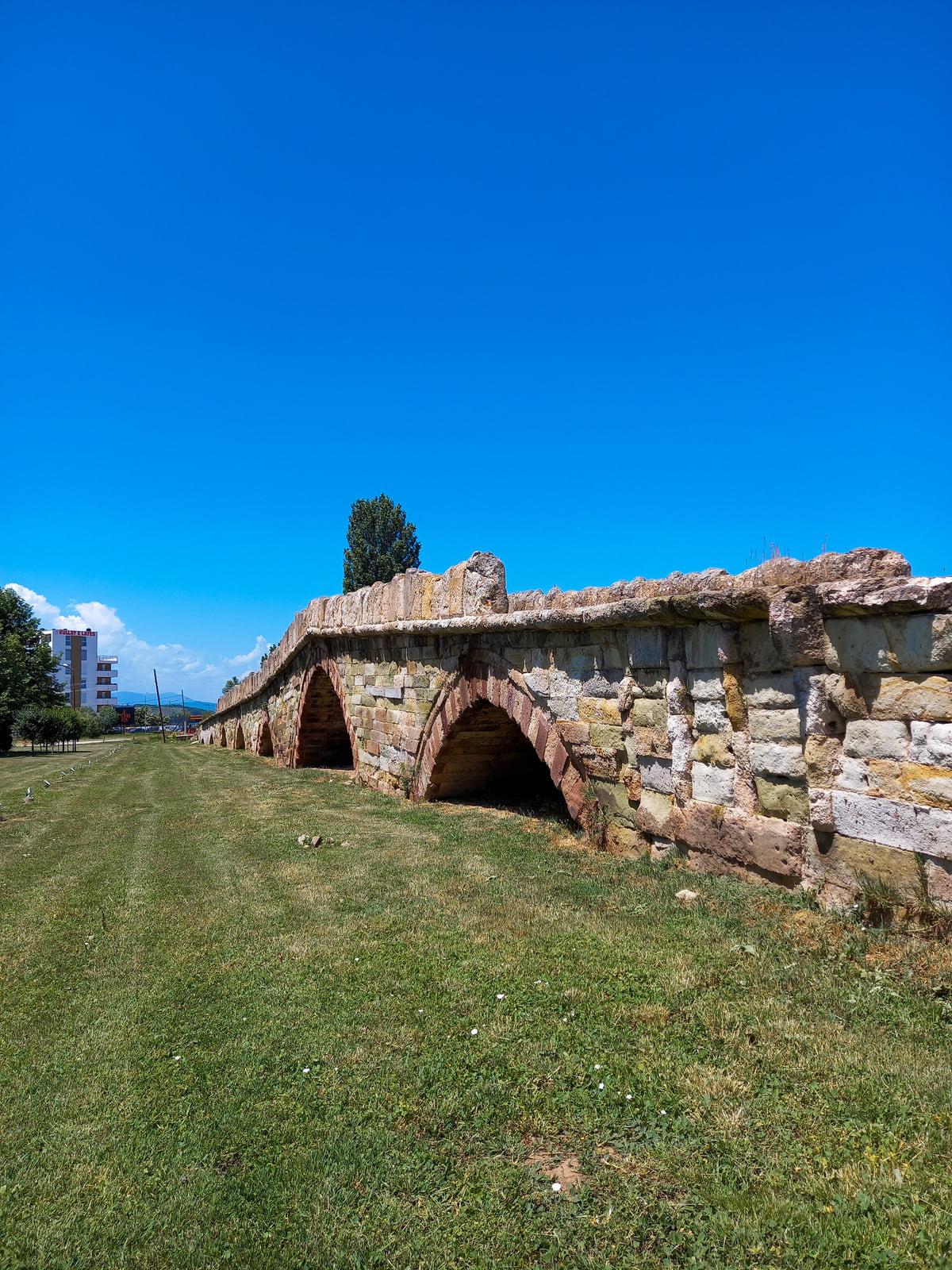
Nine arches, 6 metres wide and a cobbled deck. The Sitnica shifted course in the 20th century and left it dry, according to the Ministry of Culture.
Vushtrri bridge -
02 Most beautiful
The fortress that became a cinema
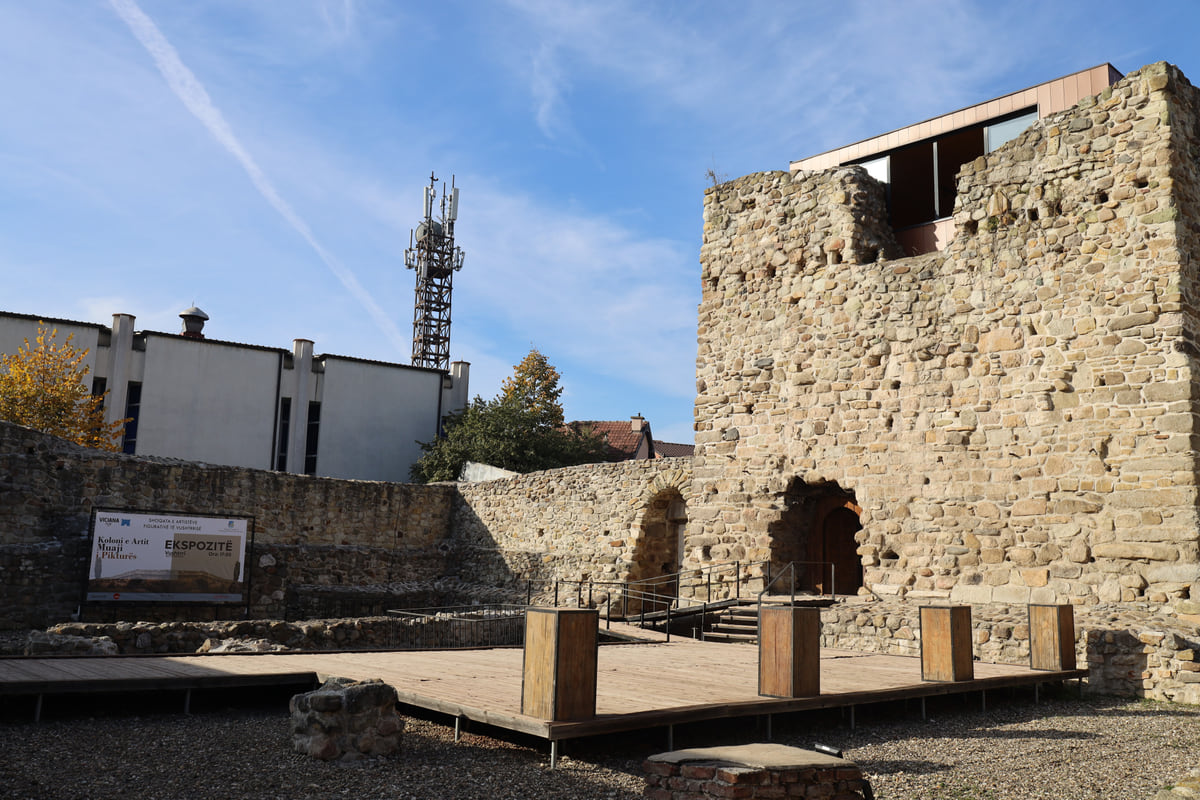
The tower in the centre was a prison from 1918 to 1922 and, from 1955 to 1958, a summer cinema and restaurant. It was restored in 2013 and 2014.
Vushtrri fortress -
03 To save money
All on foot, all from outside
Bridge, fortress, hammam and mosque are in the old core, about 600 metres from bridge to tower. I found no published tickets or opening hours.
-
04 Getting there
A Vushtrri bell in Pristina
The 1764 bell in Pristina's clock tower was brought from Vushtrri on the orders of Jashar Pasha, according to the Ministry of Culture.
Pristina clock tower -
05 Getting there
Mitrovica, ten kilometres north
Mitrovica rounds off the day, with its 18th-century hammam and the ruins of St Peter's at Stan Tërg on the outskirts.
Mitrovica
What I would book
My ranking, scored
What I'd see in Vushtrri
My own marks out of 10, based on the Ministry of Culture's record for each site, its protection and how well it reads on a walk round.
0 of 5 seen
-
Old stone bridge
14th century according to the Ministry, nine arches, 135 metres and a Special Protective Zone. A bridge without a river is not something you see every day.
8.4 out of 10
-
Fortress (Kalaja)
A two-storey tower with a defensive platform and curtain wall in the centre. Permanently protected and restored in 2013 and 2014.
7.8 out of 10
-
Gazi Ali Bey hammam
A late 14th to early 15th-century bathhouse with a 17th-century porous volcanic-stone entrance and three low domes. Restored in 2013 and 2014.
7.0 out of 10
-
Mahmut Pasha Gjinolli house
A late 19th-century house by the River Tërstena, with a small rooftop dome where the clock once sat. It has served as the town hall and a clinic.
6.2 out of 10
-
Gazi Ali Bey mosque
A hundred metres from the hammam. The present building was rebuilt after 1999 without its original features, the Ministry says, so I'd see it in passing.
5.6 out of 10
If I had to persuade someone that northern Kosovo deserves a day, I’d start with Vushtrri. It has something genuinely unusual, a nine-arched medieval bridge with no river beneath it, and five minutes’ walk away a fortress that doubled as a summer cinema in the 1950s. Everything has a Ministry of Culture record, and everything is on foot.
A mid-sized town on the road north
Vushtrri (Vučitrn in Serbian) counted 28,150 residents in 2024 and its municipality 61,528, against 69,870 back in 2011. Those are Statistics Agency numbers, and the same source splits the municipality into 67 settlements, Stanoc i Epërm (2,282) and Maxhunaj (1,978) being the largest after the town. The OSCE’s 2018 profile gave an area of roughly 344 km² and described farming, small trade and woodworking as the local economy.
OpenStreetMap puts it some 24 km from Pristina and 10 from Mitrovica in a straight line. The Ministry of Culture places the village of Pestovë beside the main Pristina to Mitrovica road, about 4 km short of town, where a rescue dig in 2005 uncovered part of the foundations of a Roman country villa. If you’re driving up from Pristina in a hire car, that’s the road, on the right-hand side like the rest of the Continent.
The old bridge, the reason to come
West of town, on the old road to Mitrovica, stands Vushtrri’s stone bridge, Ura e Vjetër e Gurit to the Ministry of Culture. The record gives a 14th-century date, nine arches, a span of 135 by 6 metres and a cobbled deck. In the 20th century the River Sitnica moved away and left it high and dry, and the Ministry describes it bluntly as a bridge without a river. The authors it cites disagree on who built it, some naming the Vojinović family while an Ottoman archive from 1791 credits Mahmut Pasha. Since 2008 it has been a Special Zone by law, listed as the medieval Vojinović bridge.
To sleep close to everything, search places to stay in Pristina on Expedia and filter by area before price.
The fortress and the old core
In the centre, about 600 metres from the bridge, is Vushtrri fortress, a square two-storey tower topped by a defensive platform, with a curtain wall to the west. Its sandstone and river-stone walls passed to the Ottomans in 1455, and it later served as a prison, an arms store and, from 1955 to 1958, a cinema and restaurant. It was restored in 2013 and 2014.
The rest lies around it. The Gazi Ali Bey hammam dates from the late 14th and early 15th centuries and went up in two phases, with a 17th-century entrance in porous volcanic stone and three older low domes; its floors were white marble. It has been out of use since the 1970s and was restored alongside the fortress. A hundred metres away, the Gazi Ali Bey mosque was rebuilt after 1999 without its original features, according to the Ministry itself.
Of the houses, two stand out for me. Shaban Aga’s, from the late 19th or early 20th century, is a traditional town house with a jettied timber-framed upper floor and an enclosed çardak gallery, still lived in by the family. Mahmut Pasha Gjinolli’s, by the River Tërstena, has a small rooftop dome where the clock used to be; after the Second World War it housed the municipal offices and, in the 1960s and 70s, a clinic. Both are seen from outside, since people live in them.
A link between Vushtrri and the capital
Here’s a detail I enjoy. According to the Ministry of Culture, the 1764 bell in Pristina’s clock tower was brought from Vushtrri on the orders of Jashar Pasha. See both and you have the story that ties them together.
If you are short on time, see the best tours in Pristina and pick one that fits your day.
Around town and how to plan it
On the outskirts the Ministry protects two fortified hilltop sites it dates to the Iron Age, Duboc, on a hill in the Çiçavica range, and Stroc, known as Gradina, with walls up to 2 metres thick. The environment agency has also protected the Gjelbishtë thermo-mineral spring as a natural monument since 2016.
My plan would be simple. Morning in Vushtrri, bridge first and then fortress and hammam, and afternoon in Mitrovica. Sleep in Pristina. For the wider north, everything is set out in the Mitrovica region guide, with Skënderaj about 17 km to the west.
To sleep close to everything, search places to stay in Pristina on Booking.com and filter by area before price.
The stone tower of Vushtrri fortress and its low curtain wall, with a wooden stage in the courtyard and town-centre buildings behind
Vushtrri in figures
| Detail | Value |
|---|---|
| Town population (2024) | 28,150 |
| Municipality (2024 / 2011) | 61,528 / 69,870 |
| Settlements | 67 |
| Municipal area (OSCE, 2018) | About 344 km² |
| Sites in the Ministry of Culture database | 17 |
Kosovo Agency of Statistics (2024 census) and the Ministry of Culture database, checked on 3 October 2026; area from the OSCE's 2018 municipal profile.
Vushtrri's historic core
| Site | Period | Protection |
|---|---|---|
| Old stone bridge | 14th century | Permanent and Special Zone (2008) |
| Fortress (Kulla e Vjetër) | 14th century | Permanent |
| Gazi Ali Bey hammam | Late 14th to early 15th century | Permanent and temporary |
| Gazi Ali Bey mosque | Mid-15th century (rebuilt) | Permanent and temporary |
| Shaban Aga house | Late 19th or early 20th century | Temporary |
Kosovo Ministry of Culture, records 8707, 8708, 8706, 8700 and 9127. No opening hours or admission charges published.
Test yourself
True or false?
0/3 Pick before you peek.
-
Vushtrri's fortress was once used as a summer cinema.
See the answer
True. The Ministry of Culture says it served as a cinema and restaurant from 1955 to 1958, and the metal fittings that held the screen can still be seen on the tower.
-
Vushtrri's old bridge has five arches.
See the answer
False. It has nine. Some authors cited by the Ministry believe it began with five and gained four more later.
-
Vushtrri's hammam still works as a bathhouse.
See the answer
False. It has been out of use since the 1970s, according to the Ministry of Culture, and was restored in 2013 and 2014.
- Town population in 2024
- 28,150
- Length of the old stone bridge
- 135 m
- Arches on the bridge
- 9
- Sites in the Ministry of Culture database
- 17
Map
Where Vushtrri is
The Bjeshkët e Nemuna mountains close off the west and the Sharr the south; in the middle lies the Pristina plain. Every number opens its guide.
 1Mitrovica Region 2Mitrovica 3Vushtrri 4Skënderaj 5Zvečan 6Leposavić 7Zubin Potok
 Map data © OpenStreetMap contributors (ODbL)
- 1Mitrovica RegionOne of Kosovo's seven statistical regions
- 2MitrovicaNorthern Kosovo's main town, on the River Ibar
- 3VushtrriTown in the Mitrovica region
- 4SkënderajMunicipality in the Mitrovica region
- 5ZvečanNorthern municipality, Mitrovica region
- 6LeposavićNorthern municipality, Mitrovica region
- 7Zubin PotokNorthern municipality, Mitrovica region
What to see
What to see in Vushtrri
0 of 208 Kosovo guides
Your next stamp
- Prizren
- Mitrovica Region
- Vushtrri Stone Bridge
- Vushtrri Fortress
- Castles in Kosovo
- Fushë Kosovë
- Prizren stone bridge
- Gjakova Grand Bazaar
- Gjeravica
- Places to visit
- Pristina region
- Visoki Dečani Monastery
- Bjeshkët e Nemuna National Park
- Hadum Mosque
- Things to do
- Most beautiful places
- Sheh Danjolli tekke
- Prettiest villages
- Tailors' Bridge
- Rugova Canyon
- UNESCO sites
- Gjakova
- Map
- Where is Kosovo
- Regions
- Municipalities
- Cities
- Gračanica Monastery
- Mitrovica
- Patriarchate of Peć
- Pristina
- Rugova via ferrata
- Population
- Podujeva
- Radavc Cave
- Size
- Bajrakli Mosque
- Devič Monastery
- Gazimestan
- Ibar Bridge
- Is it a country?
- Istog
- One day in Pristina
- Peja
- Prizren region
- Ulpiana
- Gadime Cave
- Klina
- Name
- Deçan
- Flag
- Isa Boletini Complex
- Novo Brdo Fortress
- History
- Junik
- Lake Batllava
- Zvečan Fortress
- Banjska Monastery
- Ferizaj region
- Languages
- Rahovec
- Ferizaj
- Religion
- Sokolica Monastery
- Currency
- Lake Gazivoda
- Štrpce
- Brezovica
- EU membership
- Entry requirements
- Skiing in Kosovo
- Kaçanik
- Serbian border
- Gračanica
- Guesthouses in Rugova
- Hotels in Peja
- Kaçanik fortress
- Newborn monument
- North Mitrovica
- One day in Prizren
- Peja bazaar
- Peja region
- Public holidays
- Velika Hoča
- Facts
- Gjakova region
- Hani i Elezit
- Hotels in Gjakova
- National Library
- Obiliq
- Zočište Monastery
- Drenas
- Mother Teresa Cathedral
- Shtime
- Skënderaj
- Lipjan
- Mother Teresa Boulevard
- Zvečan
- Kosovo Museum
- Leposavić
- Novo Brdo
- Emin Gjiku Ethnological Museum
- Janjevo
- Zubin Potok
- Imperial Mosque
- Pristina Clock Tower
- Pristina Old Bazaar
- Great Hammam of Pristina
- Bogë
- Germia Park
- Getting there
- Lake Radoniq
- Prizren Fortress
- Bear Sanctuary Prishtina
- Drelaj
- Flights
- Sinan Pasha Mosque
- Hotels in Pristina
- Pristina airport
- Buses
- Grand Hotel Pristina
- Our Lady of Ljeviš
- Prizren hammam
- Swiss Diamond Hotel
- Tirana to Pristina
- League of Prizren
- Restaurants in Pristina
- Skopje to Pristina
- Belgrade to Pristina
- Prizren Archaeological Museum
- Balkans itinerary
- St George's Cathedral
- Church of the Holy Saviour
- Getting around
- Holy Archangels Monastery
- Trains
- Car hire
- Day trips
- Marash
- Driving
- Sharr National Park
- Taxis
- Distances
- Prevalla
- Dragash
- Road trip
- Brod
- Prices and budget
- On a budget
- Restelica
- Free things to do
- Mirusha waterfalls
- Malisheva
- Safety
- Mamusha
- Scams
- Healthcare
- National parks in Kosovo
- Nightlife
- Suhareka
- Mobile and roaming
- Mountains in Kosovo
- Mushtisht
- Hiking in Kosovo
- Korisha
- Packing list
- DokuFest
- Peaks of the Balkans
- With kids
- Holidays
- Hotels in Prizren
- Kosovo lakes
- 3 days
- Caves and waterfalls
- Restaurants in Prizren
- 5 days
- One week
- Gjilan region
- Kosovo food
- Sunny Hill Festival
- Gjilan
- Rahovec wine
- Atik Mosque, Gjilan
- Kosovo beer
- Draganac Monastery
- Where to eat in Kosovo
- Kamenica
- Where to stay in Kosovo
- Kllokot
- Weather in Kosovo
- Best time to visit Kosovo
- Partesh
- Kosovo in winter
- Ranillug
- Kosovo in spring
- Viti
- Kosovo in summer
- Letnica
- Binač Monastery
- Kosovo in autumn
- Events in Kosovo
- Independence Day
- Kosovo monasteries
- Mosques in Kosovo
- Kullas in Kosovo
- Museums in Kosovo
- Bazaars in Kosovo
Frequently asked questions
Where is Vushtrri in Kosovo?
In the Mitrovica region, north-central Kosovo, about 24 km from Pristina and 10 km from Mitrovica as the crow flies, according to OpenStreetMap. The main Pristina to Mitrovica road runs past the town.
What is there to see in Vushtrri?
The old stone bridge, with nine arches and Special Zone status; the fortress in the centre; the late 14th-century Gazi Ali Bey hammam; and Ottoman-era houses such as Shaban Aga's. It all fits into a morning on foot.
Is Vushtrri the same as Vučitrn?
Yes. Vučitrn is the Serbian name and Vushtrri the Albanian form used by the Kosovo Agency of Statistics and the Ministry of Culture.
Why is there no river under Vushtrri's bridge?
Because the River Sitnica changed course in the 20th century, according to the Ministry of Culture, leaving the bridge dry. The Ministry itself calls it a natural phenomenon, a bridge without a river.
What is the population of Vushtrri?
28,150 in town and 61,528 in the municipality at the 2024 census, down from 69,870 in 2011, according to the Kosovo Agency of Statistics. The municipality has 67 settlements.
By
Tourism graduate with a master’s in Tourism Management and Planning from the University of Málaga, who has travelled across Europe. He writes every guide from official sources and his own judgement.
Published on . Facts checked on .
Sources
Some links in this guide are affiliate links: if you book through them, the site earns a commission at no extra cost to you. Affiliate disclosure
Photos: Berishasinan (CC BY-SA 4.0); KushtrimHoti7 (CC BY 4.0), via Wikimedia Commons.