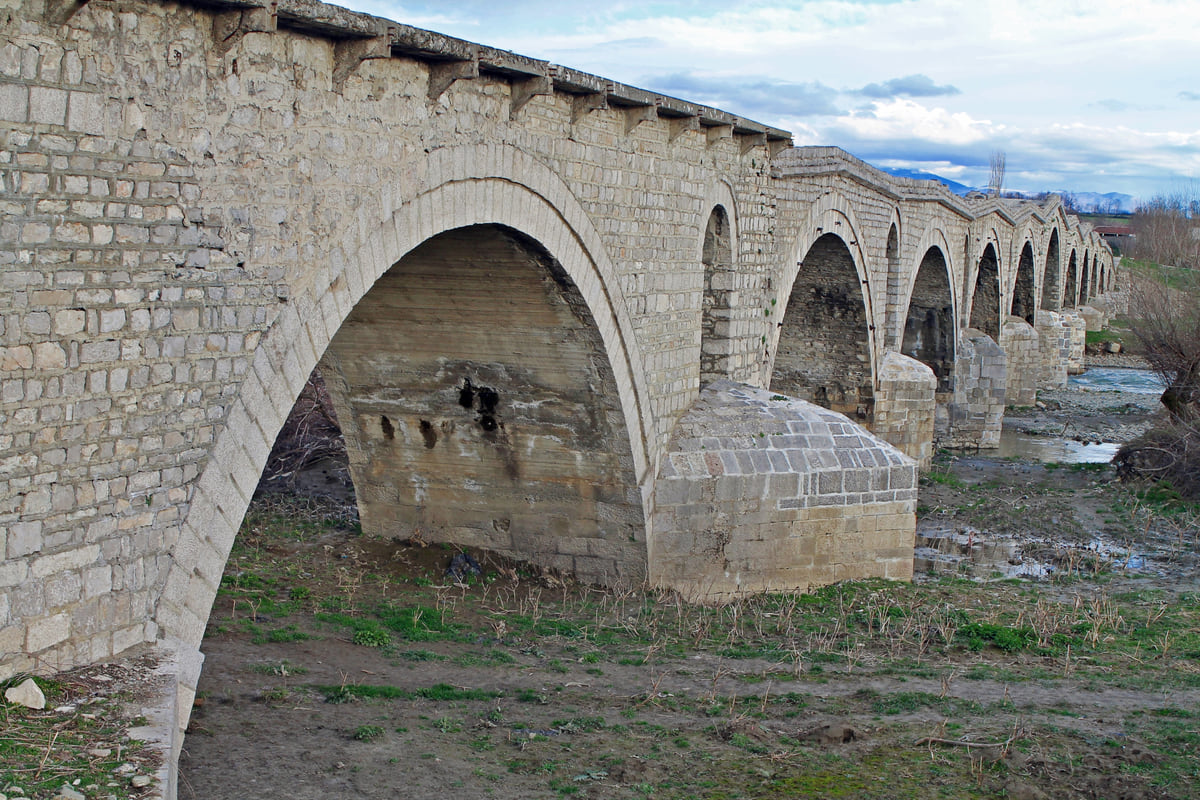
18th-century Ottoman bridge
The Tailors' Bridge, eleven arches over the Erenik
The Tailors' Bridge (Ura e Terziut, also Ura e Terzive) crosses the River Erenik at km 7 of the Gjakova to Prizren road, in the village of Bishtazhin. Gjakova's tailors' guild built it in the 18th century; it is 192.8 m long, has 11 stone arches and has been permanently protected since 1962.
In 30 seconds
Full read: 2 min
- The Tailors' Bridge crosses the Erenik 7 km from Gjakova, on the Prizren road.
- It is 18th century and was paid for by Gjakova's tailors' guild.
- It is 192.8 m long with 11 stone arches.
- It has been permanently protected since 1962.
Pull over carefully and walk down to the bank to see it side-on. From the deck you cannot take in the 11 arches, and they are exactly what makes it special.

Before you go
What I would keep in mind
-
01 Most beautiful
Eleven arches of different sizes
According to its official record it has 11 semicircular arches of varying size and ten relieving openings between them, all in local stone.
Gjakova -
02 My tip
On the way to Prizren
It sits at km 7 of the Gjakova to Prizren road, so it makes a natural stop if you are driving between the two towns.
Prizren -
03 Most beautiful
Two more bridges in town
Gjakova itself keeps the 127 m Tanners' Bridge and the Taliq Bridge of 1816, both protected and open only to pedestrians.
Gjakova Grand Bazaar
What I would book
There are famous Ottoman bridges in the Balkans, and then there are bridges like this one, barely known outside the area and nearly 200 m long. For me the Tailors’ Bridge is the best reason to leave Gjakova for Prizren at an easy pace rather than doing the journey in one go.
A bridge paid for by a guild
The Tailors’ Bridge (Ura e Terziut in the official database, Ura e Terzive on OpenStreetMap) crosses the River Erenik at km 7 of the road from Gjakova to Prizren, beside the village of Bishtazhin, home to 317 people in 2024 according to ASK. Its official record says Gjakova’s tailors’ guild built it in the 18th century, hence the name, since terzi means tailor.
The same record explains that it mattered a great deal economically, linking trade routes between provinces of the Ottoman Empire. It has been under permanent protection since 22 December 1962.
Eleven arches and almost two hundred metres
What sets it apart is its shape. It is built of local stone and has 11 semicircular arches of different sizes, with ten relieving openings between them. It is 192.8 m long and 5.0 to 5.1 m wide. The record calls it a feat of construction for its time, given how little money and technology its builders had.
The last restoration it mentions dates from 1982, by the provincial institute for the protection of monuments then based in Pristina. Today, according to the DTK, it is in good condition, although it lacks regular maintenance.
Once your dates are set, check which hotels are still free in Gjakova before prices climb.
How to see it
There is no ticket and no opening time, since it is a bridge in use. I would pull over carefully nearby and walk down to the bank to see it side-on, which is when you can count the arches properly. Take care on the road after rain, since the FCDO warns rural routes deteriorate in bad weather, avoid heading back after dark, and note that a rental’s green card is not valid here.
Gjakova’s other bridges
If bridges are your thing, two more in town have permanent protection. The Tanners’ Bridge (Ura e Tabakëve), to the south, is 127 m long with seven arches and now carries only pedestrians. The Taliq Bridge, beside the Gjakova Grand Bazaar, is small at 26 m, and an inscription dates it to 1816. According to its record, the Taliq Bridge was built by the tanners’ guild in their own quarter; it has one large arch and two small ones near the banks, with a relieving opening between them, and is 4.05 m wide. The Tanners’ Bridge linked the town with the villages to the south and, beyond them, Albanian towns such as Shkodra and Kukës, and its arches span 14 to 16 m. Between the three you get a sense of how goods moved through this part of Kosovo, and if you carry on south, Prizren has another stone bridge of a very different kind. And if these bridges appeal, the nine-arched Vushtrri bridge is the territory’s other great example, with the quirk that the river no longer runs beneath it.
If you would rather have a local show you round, book a guided tour in Tailors' Bridge and choose by the reviews.
Once your dates are set, check which hotels are still free in Gjakova before prices climb.
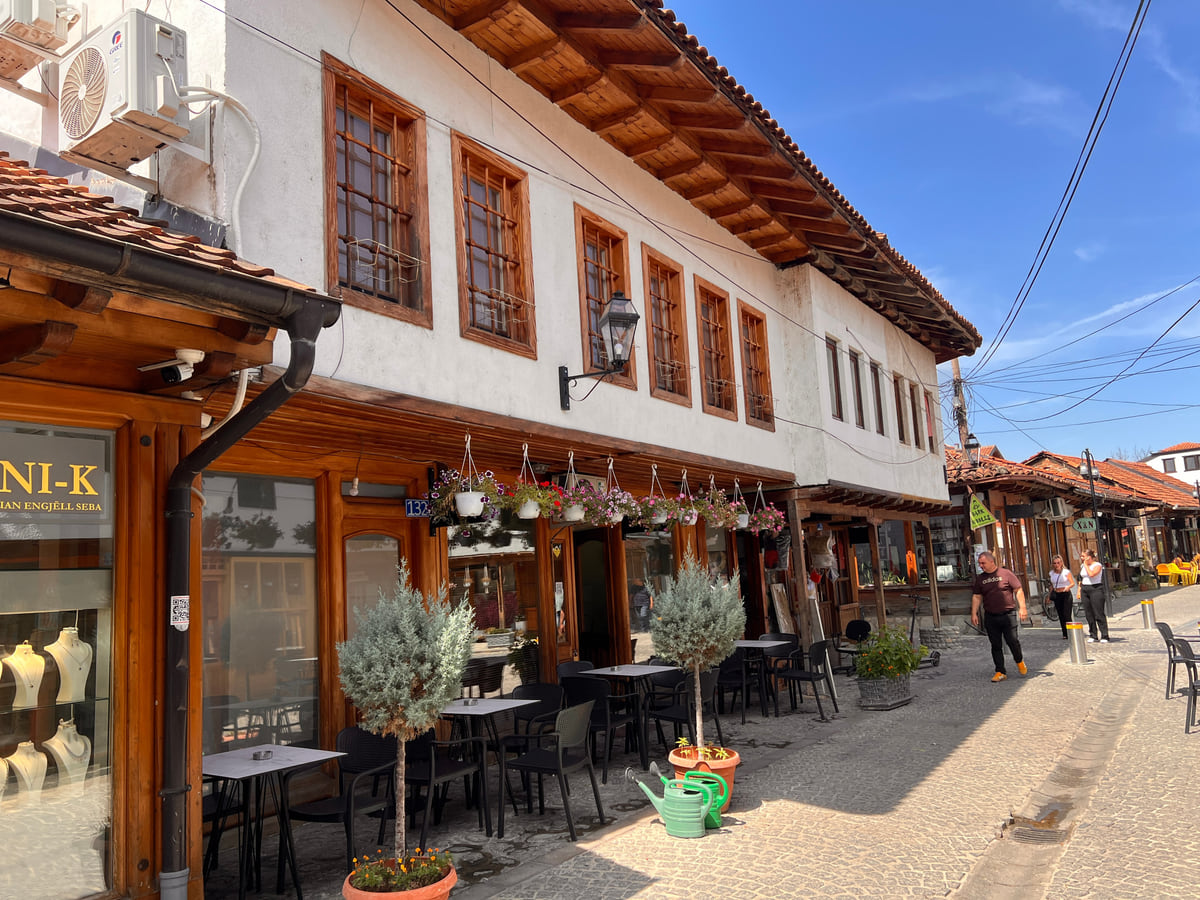
A street in the Grand Bazaar of Gjakova lined with two-storey timber houses, café terraces and potted olive trees
Gjakova's Ottoman bridges
| Bridge | Period | Length | Arches | Where |
|---|---|---|---|---|
| Tailors' (Ura e Terziut) | 18th century | 192.8 m | 11 | Bishtazhin, km 7 towards Prizren |
| Tanners' (Ura e Tabakëve) | 17th-18th century | 127 m | 7 | South of town, over the Erenik |
| Taliq (Ura e Taliqit) | 1816 | 26 m | 1 large and 2 small | By the Grand Bazaar, over the Krena |
Source: DTK, Culture Ministry records 2861, 2810 and 2858. All three are under permanent protection.
Test yourself
True or false?
0/3 Pick before you peek.
-
The Tailors' Bridge is more than 150 metres long.
See the answer
True. It measures 192.8 m according to the Culture Ministry's heritage database.
-
It was built by Gjakova's tanners.
See the answer
False. The tailors' guild built it. The tanners have their own bridge, the Ura e Tabakëve, in town.
-
The bridge spans the River Erenik.
See the answer
True. The DTK places it over the Erenik, at km 7 of the Gjakova to Prizren road.
- Length (DTK)
- 192.8 m
- Arches
- 11
- Permanent protection
- 1962
- Last restoration on record
- 1982
Map
Where Tailors' Bridge is
The Bjeshkët e Nemuna mountains close off the west and the Sharr the south; in the middle lies the Pristina plain. Every number opens its guide.
 1Gjakova Grand Bazaar 2Hadum Mosque 3Sheh Danjolli tekke 4Tailors' Bridge 5Gjakova
 Map data © OpenStreetMap contributors (ODbL)
0 of 208 Kosovo guides
Your next stamp
- Gjakova
- Prizren stone bridge
- Vushtrri Stone Bridge
- One day in Prizren
- Gjakova Grand Bazaar
- Prizren
- Bazaars in Kosovo
- Gjeravica
- Places to visit
- Pristina region
- Visoki Dečani Monastery
- Bjeshkët e Nemuna National Park
- Hadum Mosque
- Mitrovica Region
- Things to do
- Most beautiful places
- Sheh Danjolli tekke
- Prettiest villages
- Rugova Canyon
- UNESCO sites
- Map
- Where is Kosovo
- Regions
- Municipalities
- Cities
- Gračanica Monastery
- Mitrovica
- Patriarchate of Peć
- Pristina
- Rugova via ferrata
- Fushë Kosovë
- Population
- Vushtrri
- Podujeva
- Radavc Cave
- Size
- Bajrakli Mosque
- Devič Monastery
- Gazimestan
- Ibar Bridge
- Is it a country?
- Istog
- One day in Pristina
- Peja
- Prizren region
- Ulpiana
- Gadime Cave
- Klina
- Name
- Vushtrri Fortress
- Deçan
- Flag
- Isa Boletini Complex
- Novo Brdo Fortress
- History
- Junik
- Lake Batllava
- Zvečan Fortress
- Banjska Monastery
- Ferizaj region
- Languages
- Rahovec
- Ferizaj
- Religion
- Sokolica Monastery
- Currency
- Lake Gazivoda
- Štrpce
- Brezovica
- EU membership
- Entry requirements
- Skiing in Kosovo
- Kaçanik
- Serbian border
- Gračanica
- Guesthouses in Rugova
- Hotels in Peja
- Kaçanik fortress
- Newborn monument
- North Mitrovica
- Peja bazaar
- Peja region
- Public holidays
- Velika Hoča
- Facts
- Gjakova region
- Hani i Elezit
- Hotels in Gjakova
- National Library
- Obiliq
- Zočište Monastery
- Drenas
- Mother Teresa Cathedral
- Shtime
- Skënderaj
- Lipjan
- Mother Teresa Boulevard
- Zvečan
- Kosovo Museum
- Leposavić
- Novo Brdo
- Emin Gjiku Ethnological Museum
- Janjevo
- Zubin Potok
- Imperial Mosque
- Pristina Clock Tower
- Pristina Old Bazaar
- Great Hammam of Pristina
- Bogë
- Germia Park
- Getting there
- Lake Radoniq
- Prizren Fortress
- Bear Sanctuary Prishtina
- Drelaj
- Flights
- Sinan Pasha Mosque
- Hotels in Pristina
- Pristina airport
- Buses
- Grand Hotel Pristina
- Our Lady of Ljeviš
- Prizren hammam
- Swiss Diamond Hotel
- Tirana to Pristina
- League of Prizren
- Restaurants in Pristina
- Skopje to Pristina
- Belgrade to Pristina
- Prizren Archaeological Museum
- Balkans itinerary
- St George's Cathedral
- Church of the Holy Saviour
- Getting around
- Holy Archangels Monastery
- Trains
- Car hire
- Day trips
- Marash
- Driving
- Sharr National Park
- Taxis
- Distances
- Prevalla
- Dragash
- Road trip
- Brod
- Prices and budget
- On a budget
- Restelica
- Free things to do
- Mirusha waterfalls
- Malisheva
- Safety
- Mamusha
- Scams
- Healthcare
- National parks in Kosovo
- Nightlife
- Suhareka
- Mobile and roaming
- Mountains in Kosovo
- Mushtisht
- Hiking in Kosovo
- Korisha
- Packing list
- DokuFest
- Peaks of the Balkans
- With kids
- Holidays
- Hotels in Prizren
- Kosovo lakes
- 3 days
- Caves and waterfalls
- Restaurants in Prizren
- 5 days
- One week
- Gjilan region
- Kosovo food
- Sunny Hill Festival
- Gjilan
- Rahovec wine
- Atik Mosque, Gjilan
- Kosovo beer
- Draganac Monastery
- Where to eat in Kosovo
- Kamenica
- Where to stay in Kosovo
- Kllokot
- Weather in Kosovo
- Best time to visit Kosovo
- Partesh
- Kosovo in winter
- Ranillug
- Kosovo in spring
- Viti
- Kosovo in summer
- Letnica
- Binač Monastery
- Kosovo in autumn
- Events in Kosovo
- Independence Day
- Kosovo monasteries
- Mosques in Kosovo
- Kullas in Kosovo
- Castles in Kosovo
- Museums in Kosovo
Frequently asked questions
Where is the Terzi Bridge?
In the village of Bishtazhin, at km 7 of the Gjakova to Prizren road, over the River Erenik.
How long is the Tailors' Bridge?
192.8 m long and 5.0 to 5.1 m wide, with 11 arches, according to the Culture Ministry's heritage database.
Why is it called the Tailors' Bridge?
Because Gjakova's guild of tailors (terzi) built it in the 18th century, according to its official record.
Can you walk across it?
No official rule stops you, and the record says it is in good condition. Take care, though, as it also notes a lack of regular maintenance.
When was the Terzi Bridge restored?
The last restoration its record mentions was in 1982, by the then provincial institute for the protection of monuments based in Pristina.
By
Tourism graduate with a master’s in Tourism Management and Planning from the University of Málaga, who has travelled across Europe. He writes every guide from official sources and his own judgement.
Published on . Facts checked on .
Sources
Some links in this guide are affiliate links: if you book through them, the site earns a commission at no extra cost to you. Affiliate disclosure
Photos: GentiBehramaj (CC BY-SA 4.0); Bdx (CC0), via Wikimedia Commons.