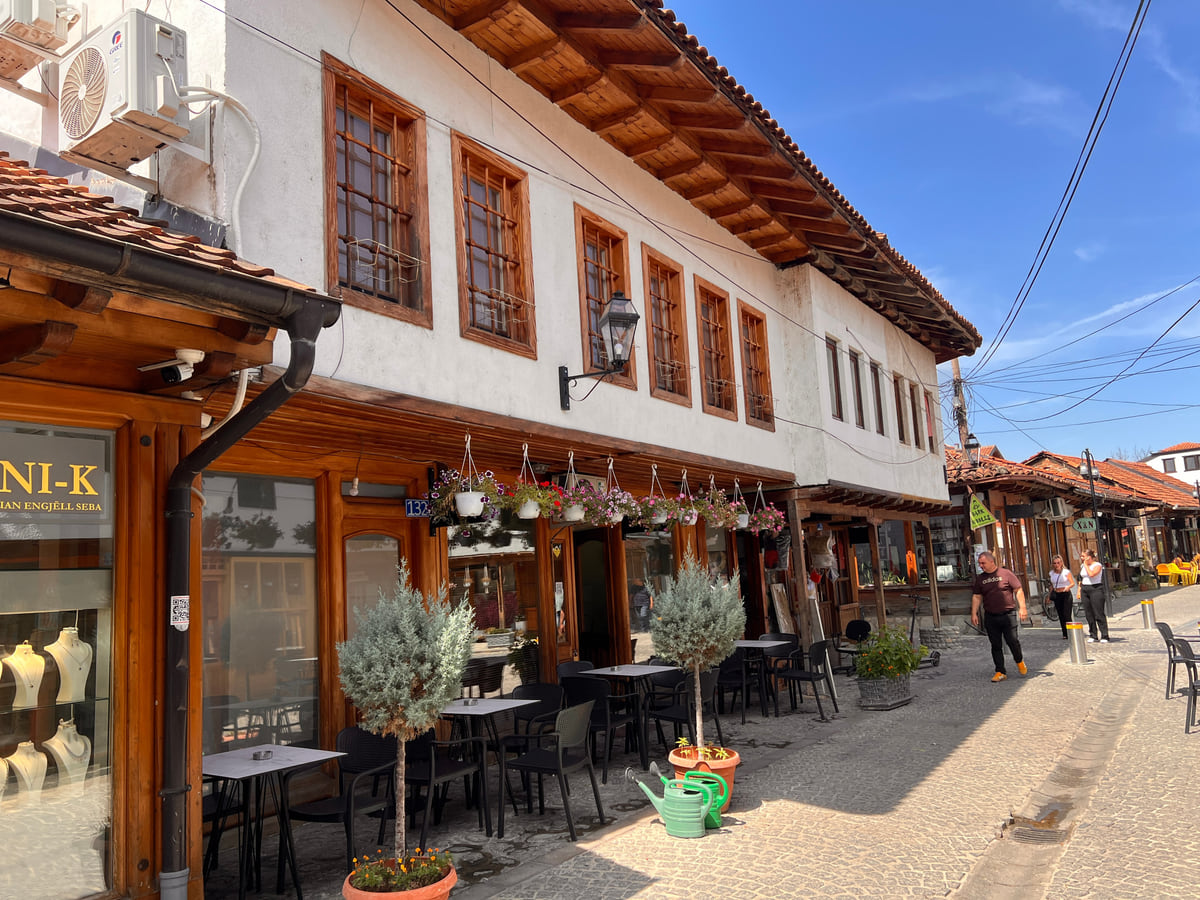
16th-century Ottoman ensemble
Çarshia e Madhe, the bazaar that never closed
Gjakova's Grand Bazaar (Çarshia e Madhe) is a 16th-century Ottoman urban ensemble with 525 buildings of interest, under permanent protection since 19 February 1955 according to the Culture Ministry's heritage database. Inside it are the Hadum Mosque, the clock tower, Hani i Haraqisë and the Sheh Emin tekke.
In 30 seconds
Full read: 3 min
- Çarshia e Madhe is Gjakova's 16th-century Ottoman centre.
- It has 525 buildings of interest and permanent protection since 1955.
- Inside are the Hadum Mosque, Hani i Haraqisë and the clock tower.
- Entry is free; it is a public street.
Walk it twice, once in the morning with the workshops open and once as the light fades. And step into the courtyards of the hans; from the street you cannot grasp what this bazaar was.

Before you go
What I would keep in mind
-
01 Most beautiful
The mosque the town grew from
Where the bazaar's two main streets cross stands the Hadum Mosque of 1585, with its library, Koranic school and cemetery.
Hadum Mosque -
02 Worth the splurge
A han for 100 travellers
Hani i Haraqisë was a caravan inn; an 1838 traveller described it with room for about 100 guests and their animals. Today it is a hotel.
hotels in Gjakova -
03 To save money
Strolling costs nothing
The bazaar is a public street. You pay only for what you buy or eat, and no official source publishes reference prices.
free things to do in Kosovo -
04 Money
Keep your card in sight
The FCDO advises keeping your card in view when paying in shops and restaurants and using ATMs inside banks. Bring euros rather than pounds.
Kosovo currency
What I would book
Some Ottoman bazaars have turned into stage sets, and then there is Gjakova’s Çarshia e Madhe, still a street of shops, workshops and cafés. For me it is the place in Kosovo where you best understand how a merchant town worked a couple of centuries ago.
What the official record says
The ministry’s DTK inventory lists it as a 16th-century urban ensemble, under permanent protection since 19 February 1955. It counts 525 buildings of interest and explains that the bazaar gathered the town’s crafts, trade and administration. Today it describes it as a historic, tourist, craft and trading complex, built from local materials such as stone, timber, adobe, old tiles and lead.
The same record calls it the largest bazaar in south-east Europe. I have no comparative measurement to back that up, so I attribute it. What I can say is that it is big, and that it does not end after one street.
What lies inside
At the crossing of the bazaar’s two main streets you’ll find the Hadum Mosque, built in 1585, the building with which, in the local story, the town began. Next door, Hani i Haraqisë served for centuries as the merchants’ inn. According to the DTK, Ami Boué wrote about it in 1835, and three years later another visitor described Gjakova’s great han as holding about 100 guests and their animals. It has an old han, built after the mosque, and a new one of 1901, and today works as a hotel and events venue.
The 30 m clock tower stands on the open space known as Fusha e Sahatit. Fire destroyed it in 1912; the rebuild, timed for the centenary, stands near the old footings and reuses the inscribed stones on its west face. In the upper part of the bazaar, the Kryepazar, the 18th-century Sheh Emin tekke of the Sadi order is still in use. The other one I’d look for, the Gjakova tekke of Sheikh Danjolli, is Rifai, 19th-century, and stands at the entrance to town from Peja.
Once your dates are set, check which hotels are still free in Gjakova before prices climb.
Hans, kullas and a lost school
The Çarshia e Jupave complex is another case of reuse. The DTK says the Batusha family built it in the 18th century, that its three-storey kulla burned in 1999 and that it was rebuilt to match the original. It now has a café on the ground floor, a meeting room and restaurant on the first and rooms on the second.
Not everything survived. The Medresa e Madhe, the great religious school completed in 1748, ran for 250 years, and all that is left is one outer wall, conserved after the last war. At the entrance to the old bazaar there is also the early 18th-century Sylejman Vokshi kulla, under permanent protection.
How to walk it
Entry is free, since these are public streets. I would start at the Hadum Mosque, head down to the clock tower and then lose myself in the side streets, looking into any courtyard that is open. Allow an hour for the walk and two or three with stops.
There are no official shop hours or reference prices, so I cannot tell you what to buy or how much to pay. The practical advice comes from the FCDO, which suggests keeping your card in sight when paying and using ATMs inside banks; change pounds before you travel or withdraw euros on arrival. Heading out towards Prizren, at kilometre 7 you’ll find the Terzi Bridge, paid for by the town’s tailors’ guild in the 18th century. For the wider town, see my Gjakova guide, and to compare it with Prizren, Peja and Pristina, see bazaars in Kosovo.
If you would rather have a local show you round, book a guided tour in Gjakova Grand Bazaar and choose by the reviews.
Once your dates are set, check which hotels are still free in Gjakova before prices climb.
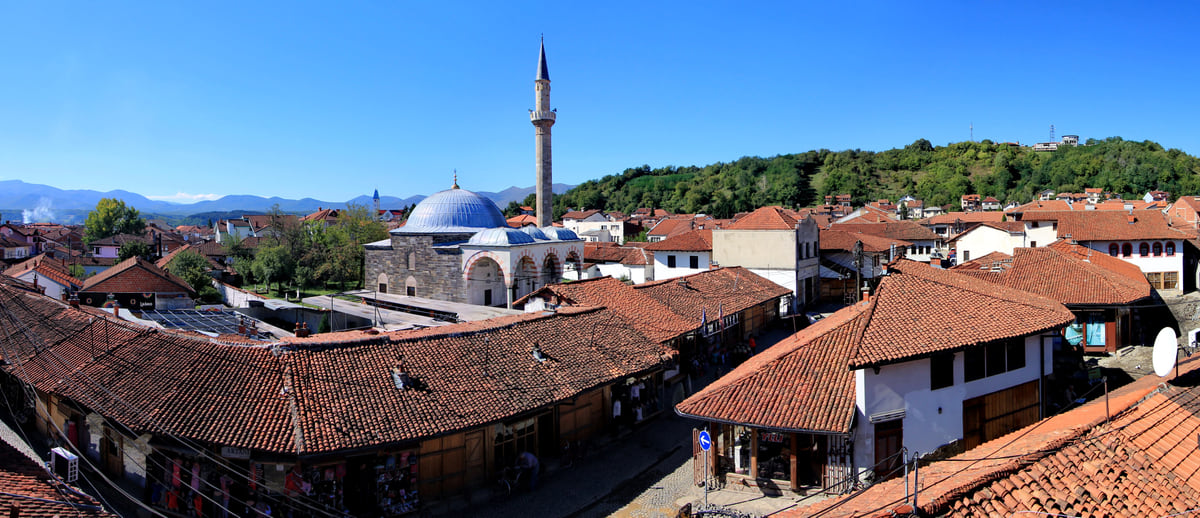
Panorama of the Grand Bazaar of Gjakova with the Hadum Mosque, its blue dome and minaret above the rooftops
Protected buildings in and beside the bazaar
| Building | Period | What it was and is |
|---|---|---|
| Hadum Mosque and complex | 1585 | Mosque, Koranic school, library and cemetery |
| Hani i Haraqisë | Old han after the mosque; new han of 1901 | Caravan inn; now a hotel and events venue |
| Çarshia e Jupave | 18th century, rebuilt | Three-storey kulla; now a hotel, café and shops |
| Clock tower | Rebuilt after burning in 1912 | 30 m tower on the Fusha e Sahatit |
| Sheh Emin tekke | 18th century | Tekke of the Sadi order, still in use |
| Medresa e Madhe | Completed 1748 | Religious school for 250 years; one wall survives |
Source: DTK, Culture Ministry heritage database (records 1259, 2066, 2864, 2711, 8467, 2381 and 2870). Opening times: no official figure.
Test yourself
True or false?
0/3 Pick before you peek.
-
Gjakova's Grand Bazaar has been protected since the 1950s.
See the answer
True. The DTK has listed it under permanent protection since 19 February 1955.
-
The bazaar's clock tower is the 19th-century original.
See the answer
False. It burned in 1912 and was rebuilt for the centenary near the old foundations, with original stones set into the west front.
-
Some historic buildings in the bazaar now work as hotels.
See the answer
True. The DTK names Hani i Haraqisë and the Çarshia e Jupave complex as hotels.
- Buildings of interest (DTK)
- 525
- Year of permanent protection
- 1955
- Hadum Mosque
- 1585
- Height of the clock tower
- 30 m
Map
Where Gjakova Grand Bazaar is
The Bjeshkët e Nemuna mountains close off the west and the Sharr the south; in the middle lies the Pristina plain. Every number opens its guide.
 1Gjakova Grand Bazaar 2Hadum Mosque 3Sheh Danjolli tekke 4Tailors' Bridge 5Gjakova
 Map data © OpenStreetMap contributors (ODbL)
0 of 208 Kosovo guides
Your next stamp
- Gjakova
- Bazaars in Kosovo
- Hadum Mosque
- Pristina Old Bazaar
- Sheh Danjolli tekke
- Hotels in Gjakova
- Mosques in Kosovo
- Gjakova region
- Gjeravica
- Places to visit
- Pristina region
- Visoki Dečani Monastery
- Bjeshkët e Nemuna National Park
- Mitrovica Region
- Things to do
- Most beautiful places
- Prettiest villages
- Tailors' Bridge
- Rugova Canyon
- UNESCO sites
- Map
- Where is Kosovo
- Regions
- Municipalities
- Cities
- Gračanica Monastery
- Mitrovica
- Patriarchate of Peć
- Pristina
- Prizren
- Rugova via ferrata
- Fushë Kosovë
- Population
- Vushtrri
- Podujeva
- Radavc Cave
- Size
- Bajrakli Mosque
- Devič Monastery
- Gazimestan
- Ibar Bridge
- Is it a country?
- Istog
- One day in Pristina
- Peja
- Prizren region
- Ulpiana
- Vushtrri Stone Bridge
- Gadime Cave
- Klina
- Name
- Vushtrri Fortress
- Deçan
- Flag
- Isa Boletini Complex
- Novo Brdo Fortress
- History
- Junik
- Lake Batllava
- Zvečan Fortress
- Banjska Monastery
- Ferizaj region
- Languages
- Rahovec
- Ferizaj
- Religion
- Sokolica Monastery
- Currency
- Lake Gazivoda
- Štrpce
- Brezovica
- EU membership
- Entry requirements
- Skiing in Kosovo
- Kaçanik
- Serbian border
- Gračanica
- Guesthouses in Rugova
- Hotels in Peja
- Kaçanik fortress
- Newborn monument
- North Mitrovica
- One day in Prizren
- Peja bazaar
- Peja region
- Public holidays
- Velika Hoča
- Facts
- Hani i Elezit
- National Library
- Obiliq
- Zočište Monastery
- Drenas
- Mother Teresa Cathedral
- Shtime
- Skënderaj
- Lipjan
- Mother Teresa Boulevard
- Zvečan
- Kosovo Museum
- Leposavić
- Novo Brdo
- Emin Gjiku Ethnological Museum
- Janjevo
- Zubin Potok
- Imperial Mosque
- Pristina Clock Tower
- Great Hammam of Pristina
- Bogë
- Germia Park
- Getting there
- Lake Radoniq
- Prizren Fortress
- Bear Sanctuary Prishtina
- Drelaj
- Flights
- Sinan Pasha Mosque
- Hotels in Pristina
- Pristina airport
- Prizren stone bridge
- Buses
- Grand Hotel Pristina
- Our Lady of Ljeviš
- Prizren hammam
- Swiss Diamond Hotel
- Tirana to Pristina
- League of Prizren
- Restaurants in Pristina
- Skopje to Pristina
- Belgrade to Pristina
- Prizren Archaeological Museum
- Balkans itinerary
- St George's Cathedral
- Church of the Holy Saviour
- Getting around
- Holy Archangels Monastery
- Trains
- Car hire
- Day trips
- Marash
- Driving
- Sharr National Park
- Taxis
- Distances
- Prevalla
- Dragash
- Road trip
- Brod
- Prices and budget
- On a budget
- Restelica
- Free things to do
- Mirusha waterfalls
- Malisheva
- Safety
- Mamusha
- Scams
- Healthcare
- National parks in Kosovo
- Nightlife
- Suhareka
- Mobile and roaming
- Mountains in Kosovo
- Mushtisht
- Hiking in Kosovo
- Korisha
- Packing list
- DokuFest
- Peaks of the Balkans
- With kids
- Holidays
- Hotels in Prizren
- Kosovo lakes
- 3 days
- Caves and waterfalls
- Restaurants in Prizren
- 5 days
- One week
- Gjilan region
- Kosovo food
- Sunny Hill Festival
- Gjilan
- Rahovec wine
- Atik Mosque, Gjilan
- Kosovo beer
- Draganac Monastery
- Where to eat in Kosovo
- Kamenica
- Where to stay in Kosovo
- Kllokot
- Weather in Kosovo
- Best time to visit Kosovo
- Partesh
- Kosovo in winter
- Ranillug
- Kosovo in spring
- Viti
- Kosovo in summer
- Letnica
- Binač Monastery
- Kosovo in autumn
- Events in Kosovo
- Independence Day
- Kosovo monasteries
- Kullas in Kosovo
- Castles in Kosovo
- Museums in Kosovo
Frequently asked questions
What is the Gjakova old bazaar?
The town's historic centre, a 16th-century Ottoman ensemble of streets lined with shops and workshops. The DTK counts 525 buildings of interest and has protected it permanently since 1955.
Is it the biggest bazaar in the Balkans?
Its official record calls it the largest in south-east Europe. I have no comparative survey to confirm it, so I pass it on as the Culture Ministry puts it.
How long do you need for Gjakova's bazaar?
An hour to walk it, two or three if you go into the Hadum Mosque, look into the hans' courtyards and stop for a drink.
Do you pay to enter the bazaar?
No. It is an area of public streets. You only pay for what you buy or eat.
What can you buy in the Gjakova bazaar?
The official record describes a craft and trading bazaar still in use, but I have no source on what is sold today or at what price. Browse, compare and pay in euros.
By
Tourism graduate with a master’s in Tourism Management and Planning from the University of Málaga, who has travelled across Europe. He writes every guide from official sources and his own judgement.
Published on . Facts checked on .
Sources
Some links in this guide are affiliate links: if you book through them, the site earns a commission at no extra cost to you. Affiliate disclosure
Photos: Bdx (CC0); Shkëlzen Rexha (Valed Promotion) (CC BY-SA 3.0), via Wikimedia Commons.