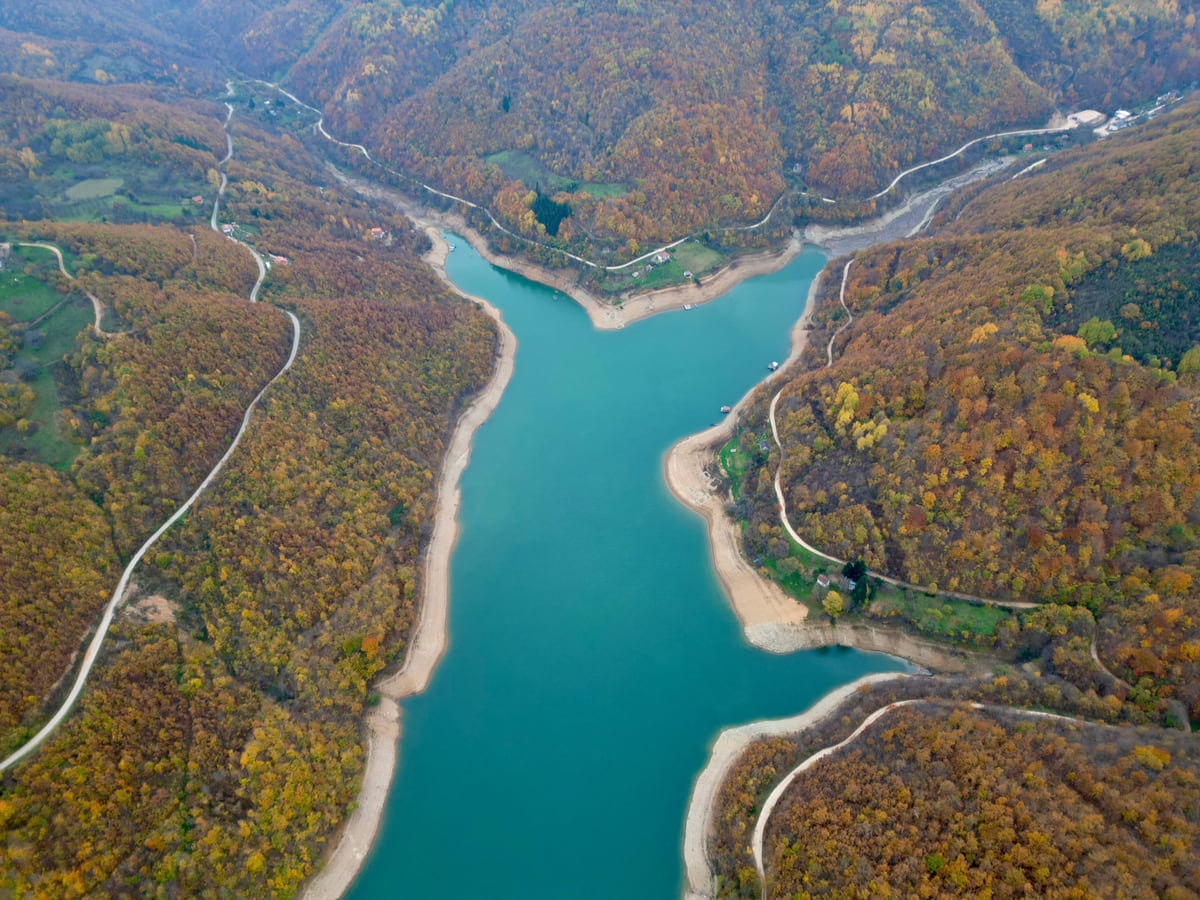
Artificial lake, Zubin Potok municipality
Lake Gazivoda, the great reservoir of Zubin Potok
Lake Gazivoda (Ujmani in Albanian, Gazivode in Serbian) is the largest in the Kosovo Agency of Statistics' table of lakes, at 9.1 km². It's an artificial reservoir in Zubin Potok municipality. According to the Office of the Prime Minister, its dam is 107 m high, was built between 1973 and 1979, and the lake holds around 350 million cubic metres.
In 30 seconds
Full read: 3 min
- Gazivoda is the largest lake in the Kosovo Agency of Statistics' table, at 9.1 km².
- It's a reservoir behind a 107 m dam built between 1973 and 1979, holding around 350 million m³.
- There are no official swimming or boating rules, and the lakeside hotel and beach bar were demolished in 2026.
I find Gazivoda more interesting as scenery and engineering than as a beach day, all the more since the lakeside hotel and beach bar were knocked down in 2026. I'd take it in from the car and the viewpoints, by day, with the FCDO advice read.

Before you go
What I would keep in mind
-
01 Most beautiful
The biggest lake in the official table
At 9.1 km², Gazivoda beats Radoniq (5.96), Batllava (3.27) and Badoc (2.57) in the Kosovo Agency of Statistics' table.
Lake Radoniq -
02 My tip
The lake behind Kosovo's lights and taps
Through the 49 km Ibër-Lepenc canal, the lake feeds the power stations that make up to 90% of Kosovo's electricity and treatment works in nine municipalities serving over 500,000 people, says the Prime Minister's Office.
-
03 Getting there
Zubin Potok, about 8 km away
The lake's municipality has 61 settlements and the 14th-century Duboki Potok monastery, a Special Protective Zone.
Zubin Potok -
04 Getting there
Batlava, the Pristina region's lake
If reservoirs interest you, Batlava, at 3.27 km², is the big lake of the Pristina region and supplies the capital with water.
Batlava Lake
Gazivoda is Kosovo’s largest body of water according to its Statistics Agency, and nearly everything you can say about it from official sources is engineering. That doesn’t bother me. A reservoir held back by a dam more than a hundred metres tall has its own appeal if you know what you’re looking at.
Names and size
The Statistics Agency calls it Gazivoda; in Albanian it’s known as Ujmani (Liqeni i Ujmanit on OpenStreetMap) and in Serbian as Gazivode. Its lakes table gives it 9.1 km², ahead of Radoniq at 5.96, Lake Batlava at 3.27 and Badoc at 2.57. It lies in Zubin Potok municipality, whose town is about 8 km from the centre of the lake, and roughly 23 km from Mitrovica as the crow flies.
The sources disagree on its length. The OSCE’s 2018 profile says 24 km; Kosovo’s Office of the Prime Minister, in August 2026, said about 22. I’m giving you both.
The dam in numbers
On 4 August 2026 the Office of the Prime Minister published a fairly complete technical description. The dam stands 107 metres high and about 500 long, with a crest roughly 10 metres wide, and has four emergency spillway gates able to release 1,200 cubic metres a second. The lake holds about 350 million cubic metres, rising to 370, and bathymetry puts the depth by the dam at about 101 metres. According to the same source, the dam was built between 1973 and 1979 and the reservoir filled in that final year; the OSCE gives 1977 as the construction date.
To sleep close to everything, search places to stay in Pristina on Expedia and filter by area before price.
What it’s for
The figure that best explains this lake came from the Office of the Prime Minister on 4 August 2026, when it opened the rehabilitated Ibër-Lepenc canal. The 49 km canal carries water from the lake down to Pristina, irrigates the Kosovo plain, feeds the power stations that produce up to 90% of the territory’s electricity and supplies treatment works in nine municipalities serving more than 500,000 people. The work cost €18 million, rebuilt 37 sections and added a 30,000 cubic metre reserve tank for emergencies.
The dam also has its own hydropower plant, 35 MW from two 17.5 MW turbines, built between 1977 and 1981, which produced 70 GWh in 2025 and 60 GWh in the first seven months of 2026. It’s run by the public company Ibër-Lepenc, which is working with the French Development Agency on a plan to modernise the dam and canal by 2027. The OSCE, for its part, counts the lake among Zubin Potok’s main tourist draws. I see it as the piece that keeps much of Kosovo’s power and water running, and that’s the angle that makes it worth a look.
How to see it
I’m not going to make things up here. No official website I’ve read covers bathing, boating, fishing or staying on the shore, nor visits to the dam. What has changed is the shoreline. In 2025 Kosovo’s government placed the lake and Mokra Gora mountain under protection as an area of special natural value, and in summer 2026 Ibër-Lepenc began demolishing buildings it says were put up without permission on its land, around eleven weekend cottages on 21 July and, on the 30th, the Jezero hotel and the beach bar below it, which locals in Zubin Potok used as their beach, according to Radio Free Europe and N1. The owners say court cases are still pending. For you the upshot is simple, don’t count on a hotel or any facilities by the water.
The FCDO says the north has improved since 2024 but remains politically sensitive, and it names Zubin Potok among the municipalities at risk of protests. If you’ve driven your own car from the UK, your green card won’t count here; third-party cover is sold at the border crossing. My plan would be a day’s drive from Mitrovica, stopping wherever the road gives you a view of the water, and heading back via Zvečan. It’s a long day at the wheel, and the FCDO’s advice to avoid driving after dark is worth heeding up here.
If you are short on time, see the best tours in Lake Gazivoda and pick one that fits your day.
To sleep close to everything, search places to stay in Pristina on Booking.com and filter by area before price.
Lake Gazivoda and its dam in figures
| Detail | Value | Source |
|---|---|---|
| Area | 9.1 km² | Kosovo Agency of Statistics |
| Length | 24 km / about 22 km | OSCE (2018) / Office of the Prime Minister (2026) |
| Dam | 107 m high, about 500 m long, crest about 10 m wide | Office of the Prime Minister |
| Volume | 350 million m³, up to 370 | Office of the Prime Minister |
| Depth by the dam | About 101 m (bathymetry) | Office of the Prime Minister |
| Construction | 1977 / dam 1973-1979, filled in 1979 | OSCE / Office of the Prime Minister |
| Spillways | Four gates, 1,200 m³/s | Office of the Prime Minister |
| Hydropower plant | 35 MW from two 17.5 MW turbines; built 1977-1981 | Office of the Prime Minister |
| Electricity output | 70 GWh in 2025; 60 GWh from January to July 2026 | Office of the Prime Minister |
| Ibër-Lepenc canal | 49 km to Pristina; rehabilitated for €18 million in 2026 | Office of the Prime Minister |
| Drinking water | Treatment works in 9 municipalities, over 500,000 people | Office of the Prime Minister |
Checked on 3, 11 and 12 October 2026. The OSCE and the Office of the Prime Minister differ on the dam's length and date; both are given.
Test yourself
True or false?
0/3 Pick before you peek.
-
The Gazivoda dam is more than 100 metres high.
See the answer
True. Kosovo's Office of the Prime Minister gives it a height of 107 metres and a length of about 500.
-
Batllava is Kosovo's largest lake.
See the answer
False. Gazivoda is, at 9.1 km². Batllava covers 3.27 km² according to the Statistics Agency.
-
Gazivoda's water supplies the Kosova A and Kosova B power stations.
See the answer
True. The Office of the Prime Minister names it as one of the main uses, alongside households and industry.
Map
Where Lake Gazivoda is
The Bjeshkët e Nemuna mountains close off the west and the Sharr the south; in the middle lies the Pristina plain. Every number opens its guide.

0 of 208 Kosovo guides
Your next stamp
- Lake Radoniq
- Kosovo lakes
- Zubin Potok
- Lake Batllava
- Size
- Gjeravica
- Mirusha waterfalls
- Gjakova Grand Bazaar
- Places to visit
- Pristina region
- Visoki Dečani Monastery
- Bjeshkët e Nemuna National Park
- Hadum Mosque
- Mitrovica Region
- Things to do
- Most beautiful places
- Sheh Danjolli tekke
- Prettiest villages
- Tailors' Bridge
- Rugova Canyon
- UNESCO sites
- Gjakova
- Map
- Where is Kosovo
- Regions
- Municipalities
- Cities
- Gračanica Monastery
- Mitrovica
- Patriarchate of Peć
- Pristina
- Prizren
- Rugova via ferrata
- Fushë Kosovë
- Population
- Vushtrri
- Podujeva
- Radavc Cave
- Bajrakli Mosque
- Devič Monastery
- Gazimestan
- Ibar Bridge
- Is it a country?
- Istog
- One day in Pristina
- Peja
- Prizren region
- Ulpiana
- Vushtrri Stone Bridge
- Gadime Cave
- Klina
- Name
- Vushtrri Fortress
- Deçan
- Flag
- Isa Boletini Complex
- Novo Brdo Fortress
- History
- Junik
- Zvečan Fortress
- Banjska Monastery
- Ferizaj region
- Languages
- Rahovec
- Ferizaj
- Religion
- Sokolica Monastery
- Currency
- Štrpce
- Brezovica
- EU membership
- Entry requirements
- Skiing in Kosovo
- Kaçanik
- Serbian border
- Gračanica
- Guesthouses in Rugova
- Hotels in Peja
- Kaçanik fortress
- Newborn monument
- North Mitrovica
- One day in Prizren
- Peja bazaar
- Peja region
- Public holidays
- Velika Hoča
- Facts
- Gjakova region
- Hani i Elezit
- Hotels in Gjakova
- National Library
- Obiliq
- Zočište Monastery
- Drenas
- Mother Teresa Cathedral
- Shtime
- Skënderaj
- Lipjan
- Mother Teresa Boulevard
- Zvečan
- Kosovo Museum
- Leposavić
- Novo Brdo
- Emin Gjiku Ethnological Museum
- Janjevo
- Imperial Mosque
- Pristina Clock Tower
- Pristina Old Bazaar
- Great Hammam of Pristina
- Bogë
- Germia Park
- Getting there
- Prizren Fortress
- Bear Sanctuary Prishtina
- Drelaj
- Flights
- Sinan Pasha Mosque
- Hotels in Pristina
- Pristina airport
- Prizren stone bridge
- Buses
- Grand Hotel Pristina
- Our Lady of Ljeviš
- Prizren hammam
- Swiss Diamond Hotel
- Tirana to Pristina
- League of Prizren
- Restaurants in Pristina
- Skopje to Pristina
- Belgrade to Pristina
- Prizren Archaeological Museum
- Balkans itinerary
- St George's Cathedral
- Church of the Holy Saviour
- Getting around
- Holy Archangels Monastery
- Trains
- Car hire
- Day trips
- Marash
- Driving
- Sharr National Park
- Taxis
- Distances
- Prevalla
- Dragash
- Road trip
- Brod
- Prices and budget
- On a budget
- Restelica
- Free things to do
- Malisheva
- Safety
- Mamusha
- Scams
- Healthcare
- National parks in Kosovo
- Nightlife
- Suhareka
- Mobile and roaming
- Mountains in Kosovo
- Mushtisht
- Hiking in Kosovo
- Korisha
- Packing list
- DokuFest
- Peaks of the Balkans
- With kids
- Holidays
- Hotels in Prizren
- 3 days
- Caves and waterfalls
- Restaurants in Prizren
- 5 days
- One week
- Gjilan region
- Kosovo food
- Sunny Hill Festival
- Gjilan
- Rahovec wine
- Atik Mosque, Gjilan
- Kosovo beer
- Draganac Monastery
- Where to eat in Kosovo
- Kamenica
- Where to stay in Kosovo
- Kllokot
- Weather in Kosovo
- Best time to visit Kosovo
- Partesh
- Kosovo in winter
- Ranillug
- Kosovo in spring
- Viti
- Kosovo in summer
- Letnica
- Binač Monastery
- Kosovo in autumn
- Events in Kosovo
- Independence Day
- Kosovo monasteries
- Mosques in Kosovo
- Kullas in Kosovo
- Castles in Kosovo
- Museums in Kosovo
- Bazaars in Kosovo
Frequently asked questions
Where is Gazivoda lake?
In Zubin Potok municipality, northern Kosovo. OpenStreetMap puts the centre of the lake at 42.9488, 20.5995, about 8 km from Zubin Potok town and 23 km from Mitrovica as the crow flies.
What is the largest lake in Kosovo?
Gazivoda, at 9.1 km² according to the Kosovo Agency of Statistics. Next come Radoniq at 5.96, Batllava at 3.27 and Badoc at 2.57.
Is Lake Gazivoda natural?
No, it's a reservoir. Kosovo's Office of the Prime Minister says the dam was built between 1973 and 1979 and the lake filled in 1979; the OSCE gives 1977 as the construction date.
What is Lake Gazivoda used for?
It supplies households and industry, especially the Kosova A and Kosova B power stations, according to the Office of the Prime Minister, and feeds a hydroelectric plant whose power goes across Kosovo, according to the OSCE.
Can you swim in Lake Gazivoda?
I've found no official rules on swimming, boating or fishing. What I do know is that at the end of July 2026 the Jezero hotel and its beach bar, Zubin Potok's de facto beach, were demolished, so don't count on facilities on the shore, and ask in the village before you go in.
By
Tourism graduate with a master’s in Tourism Management and Planning from the University of Málaga, who has travelled across Europe. He writes every guide from official sources and his own judgement.
Published on . Updated on . Facts checked on .
Sources
- Kosovo Agency of Statistics, lakes of Kosovo
- Office of the Prime Minister of Kosovo, visit to the Ujman dam (4 August 2026)
- Kosovo Ministry of Economy, Ujman dam and power plant (5 August 2026)
- OSCE Mission in Kosovo, municipal profiles 2018
- OpenStreetMap, Jezero Gazivode / Liqeni i Ujmanit
- Office of the Prime Minister, Ibër-Lepenc canal rehabilitation (4 August 2026)
- Office of the Prime Minister, Ujman hydropower plant (4 August 2026)
Some links in this guide are affiliate links: if you book through them, the site earns a commission at no extra cost to you. Affiliate disclosure