Serbian Orthodox heritage and protected zones
Kosovo's Orthodox monasteries, from Dečani to Draganac
Four medieval monuments in Kosovo are on UNESCO's World Heritage List, three monasteries and one church, all on the In Danger list since 2006. They are Visoki Dečani, the Patriarchate of Peć, Gračanica and Our Lady of Ljeviš. A 2008 law, 03/L-039, also wraps Special Protective Zones round other Orthodox monasteries and churches, from Sokolica to Draganac.
In 30 seconds
Full read: 3 min
- Four Orthodox monuments in Kosovo are on UNESCO's list, on the In Danger list since 2006.
- They are Dečani, the Patriarchate of Peć and Gračanica monasteries, and the Church of Our Lady of Ljeviš.
- Law 03/L-039 of 2008 sets Special Protective Zones around these and other monasteries and churches.
- No opening times or ticket prices are published by an official source.
With a single day for monasteries, I'd do Visoki Dečani and the Patriarchate of Peć, which sit close together in the west. Gračanica takes a morning from Pristina. Wherever you go, treat them as living communities rather than ticketed museums.

Before you go
What I would keep in mind
-
01 Most beautiful
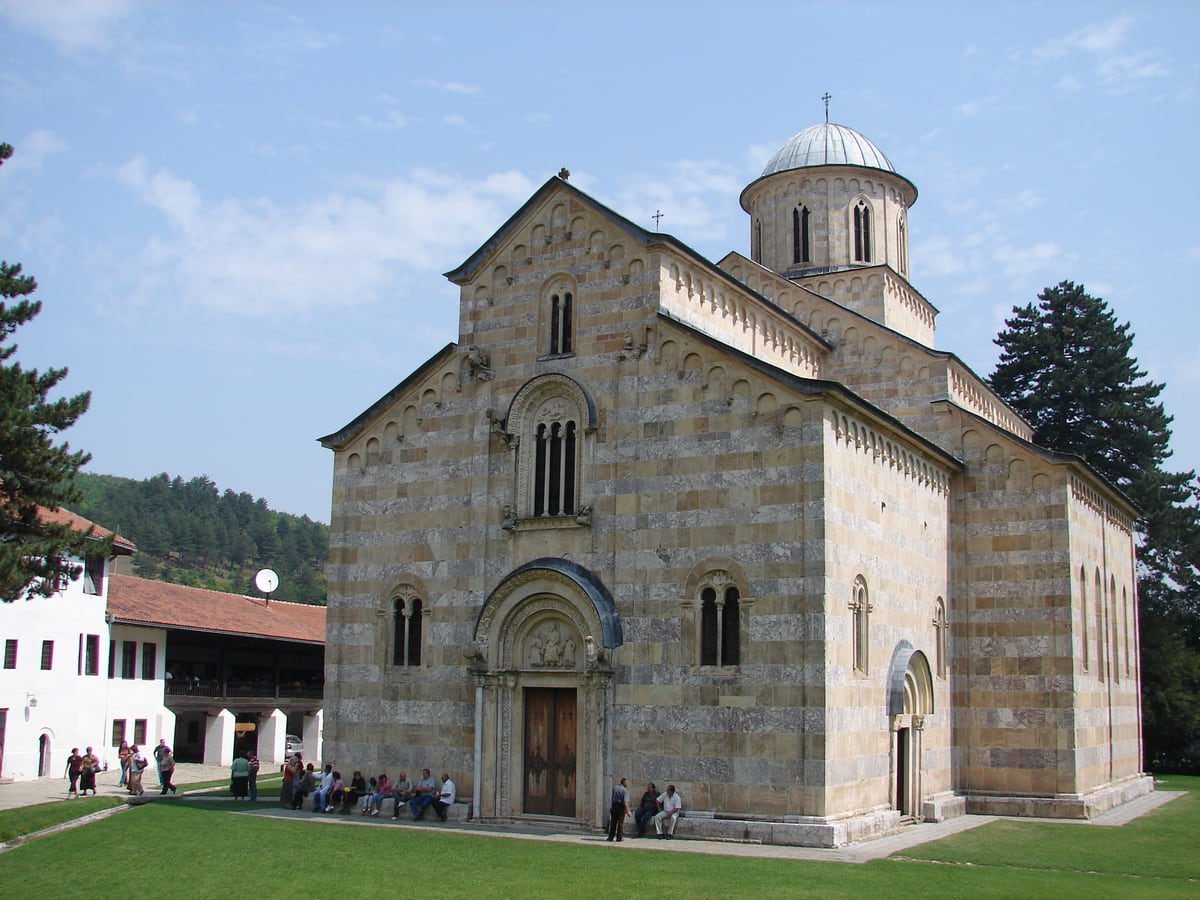
Visoki Dečani, a king's mausoleum
UNESCO describes it as the monastery built in the mid-14th century for the Serbian king Stefan Dečanski, who is buried there. It was the first to be listed, in 2004.
Visoki Dečani Monastery -
02 Most beautiful
Gračanica, five domes on Pristina's doorstep
The Ministry of Culture record describes a 14th-century church of the Virgin with five domes on a cross-in-square plan, built over a 6th-century basilica.
Gračanica monastery -
03 My tip
What the law rules out nearby
Industry, mining and building that clears woodland are banned inside the zones, and bars, hotels or public events need the Serbian Orthodox Church's agreement.
Draganac Monastery -
04 Getting there
The eastern pair, Draganac and Binač
The law protects two in the Gjilan region. Draganac is still inhabited, while Binač at Buzovik is a 14th-century ruin with a 100 m perimeter.
Binač Monastery -
05 My tip
The north, with the FCDO's caveat
Banjska and Sokolica are in Zvečan. The FCDO warns of a risk of protests in the northern municipalities and says conditions can change quickly.
Sokolica monastery -
06 Getting there
Štrpce, five churches with their own ring
In Shtërpcë municipality, at the foot of the Sharr mountains, Law 03/L-039 gives five Orthodox churches a 50 m protective zone each.
Štrpce
What I would book
- Places to stayBooking.com Stay in Peja for the western monasteries From Peja you have the Patriarchate in the same municipality and Dečani in the west of Kosovo, without changing hotel.
- Places to stayBooking.com Pristina as a base for Gračanica Gračanica sits right next to the capital and takes half a day.
My ranking, scored
The monasteries and churches I'd see, in order
These scores are my own. They weigh what UNESCO or each official record says, what you can actually see today and how easily it fits into a route. They're no judgement on faith or anything else.
0 of 5 seen
-
Visoki Dečani Monastery
Kosovo's first UNESCO listing (2004) and the mausoleum of King Stefan Dečanski, built in the mid-14th century according to UNESCO.
9.6 out of 10
-
Patriarchate of Peć
Four domed churches with wall paintings in Peja municipality, with 13th-century frescoes in the Church of the Holy Apostles, according to UNESCO.
9.3 out of 10
-
Gračanica Monastery
Five domes on a 14th-century cross-in-square plan and barely any distance from Pristina, which makes it the easiest to fit in.
9.2 out of 10
-
Church of Our Lady of Ljeviš
Right in the middle of Prizren, with early 14th-century frescoes that UNESCO links to the so-called Palaeologan Renaissance.
8.8 out of 10
-
Holy Archangels Monastery
Ruins of the monastery the DTK credits to Stefan Dušan in 1343, in the Lumbardhi gorge 2.5 km from Prizren.
8.0 out of 10
For me, the Orthodox monasteries are the strongest cultural reason to visit Kosovo. Four are on UNESCO’s list, and around them sits a network of smaller churches and convents protected by law. Here’s how they fit together, what each official source says and how I’d approach a visit.
The UNESCO four
UNESCO groups four buildings into a single site, the Medieval Monuments in Kosovo. It inscribed Decani Monastery first, in 2004, and in 2006 added Our Lady of Ljeviš in Prizren, the Patriarchate of Peć and Gračanica Monastery. In the same year the whole site went onto its List of World Heritage in Danger, where it remains.
UNESCO sees in all four the Byzantine and Romanesque church culture of the Balkans from the 13th to the 17th century. Dečani was built in the mid-14th century for the Serbian king Stefan Dečanski and serves as his mausoleum. The Patriarchate of Peć is a group of four domed churches with wall paintings, and the frescoes in its Church of the Holy Apostles date from the 13th century. Those at Ljeviš, from the early 14th, set the style of the so-called Palaeologan Renaissance. I go into more detail in UNESCO sites in Kosovo.
The Special Protective Zones law
In 2008 Law 03/L-039 created protected zones around the monasteries and churches of the Serbian Orthodox Church, plus other places of historical value, sorted into groups. Eighteen have boundaries drawn on an attached map, including the UNESCO four, Devič, Sokolica, Draganac, Banjska, Zočište, the Holy Archangels and the whole village of Velika Hoča. Eight more churches and monasteries get a 100 m ring, and fourteen get 50 m.
Inside those zones the law bans industry, mining and building that clears woodland, and requires the Serbian Orthodox Church’s agreement for bars, hotels, anything taller than the monastery, and public events. On the ground that shows in one obvious way, which is that many monasteries have no cafés or shops nearby.
Once your dates are set, check which hotels are still free in Peja before prices climb.
Lesser-known sites
Beyond the UNESCO list, a few places justify a detour if the subject grabs you. Holy Archangels Monastery, 2.5 km from Prizren in the Lumbardhi gorge, is the ruin of the monastery credited to Stefan Dušan in 1343 by the DTK, Kosovo’s official heritage register. Sokolica, about 10 km east of Zvečan, is dedicated to the Virgin and dated by the DTK to the 14th or 15th century.
In the east, the same database records St Nicholas’s Monastery at Strazhë, from the 16th century, roughly 8 km north of Gjilan, and the 14th-century monasteries of Moçar and Hajnoc in Kamenica. Draganac, near Gjilan, is still a working community, and Binač, in Viti, is a ruin with its own protected zone.
Visiting
No official source publishes opening times, admission or dress codes for these monasteries. I’d treat them like any active place of worship, which means going in daylight, covering shoulders and knees, keeping quiet, asking before getting the camera out and accepting that sometimes the gate will be shut.
Two pieces of official advice are worth knowing. The FCDO warns that terrorists could strike in Kosovo, with places of worship, churches among them, on the list of possible targets. For Banjska and Sokolica in the north, it also warns of a risk of protests in those municipalities and says conditions can change quickly, so check its Kosovo page before you set off. And bring travel insurance, since your GHIC is no use here.
If you would rather have a local show you round, book a guided tour in Peja and choose by the reviews.
Once your dates are set, check which hotels are still free in Peja before prices climb.
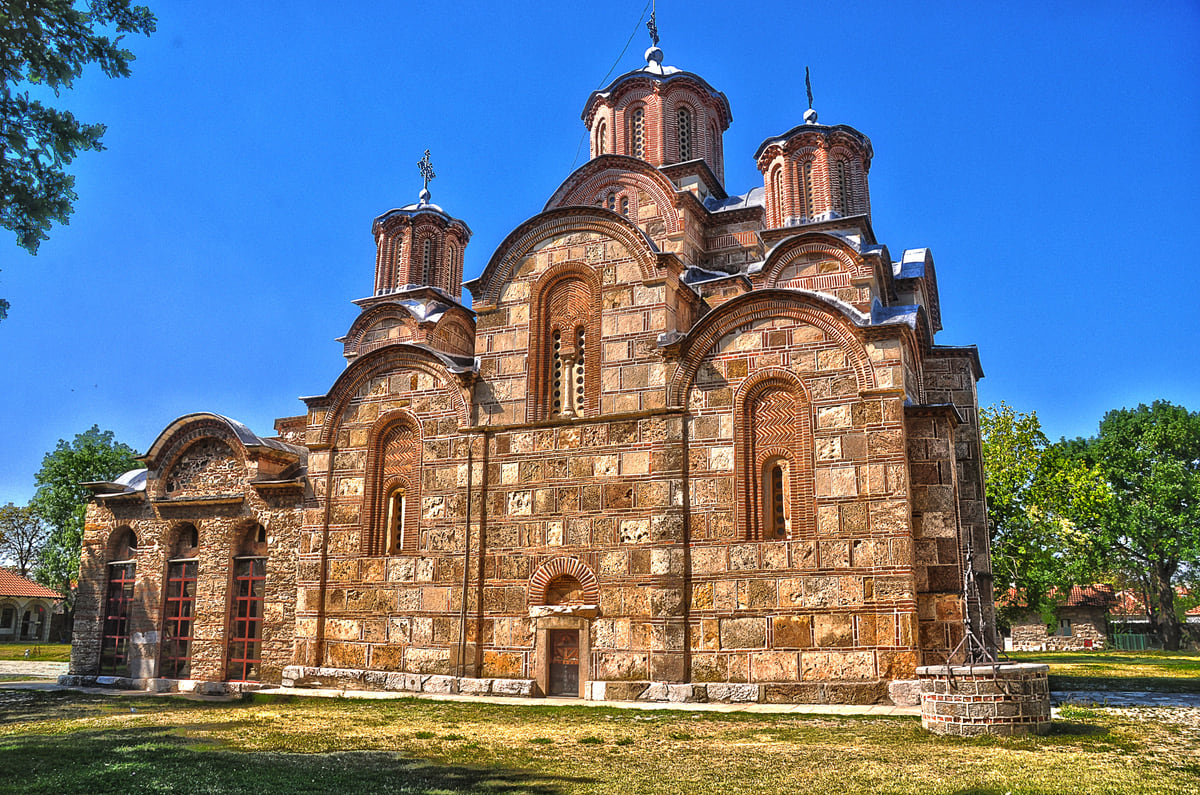
The church of Gračanica Monastery, with its stepped stone-and-brick domes, standing on a lawn under a deep blue sky
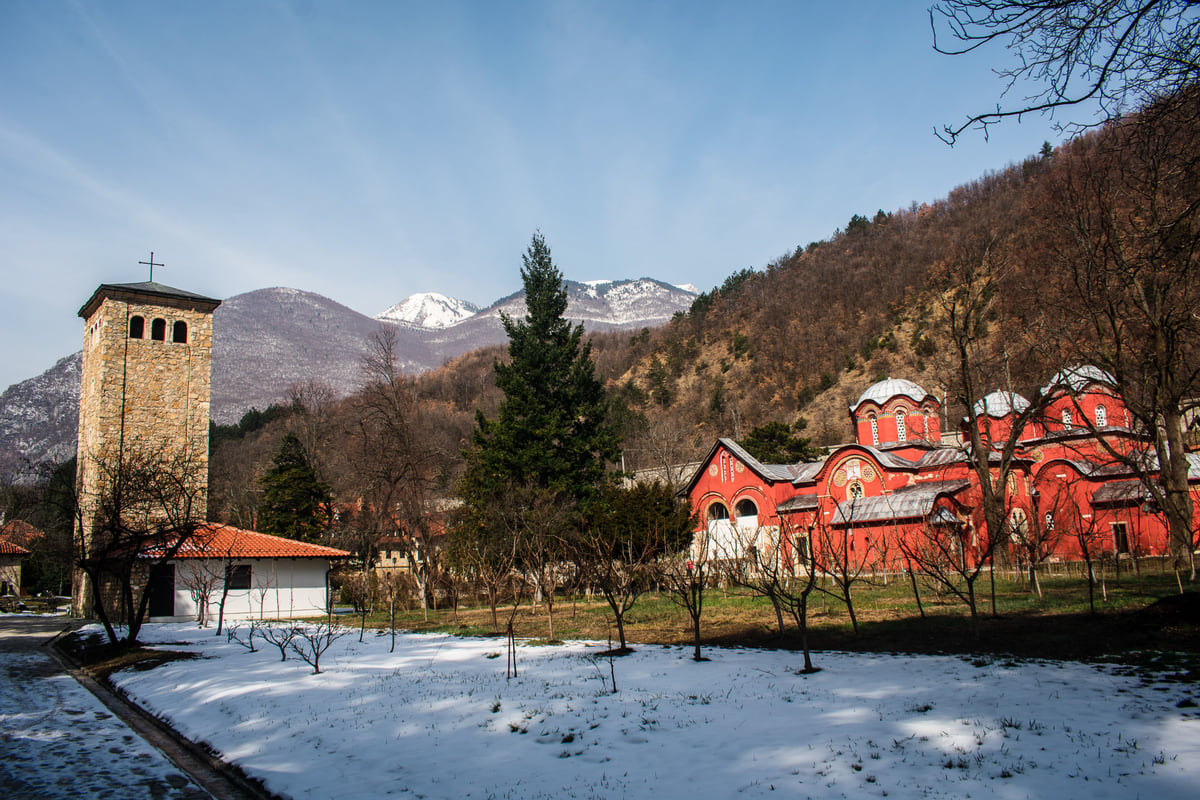
The red churches of the Patriarchate of Peć beside a stone tower, with snow-covered mountains behind in winter
The four UNESCO monuments
| Monument | Municipality | Protected area |
|---|---|---|
| Dečani Monastery | Deçan | 1.8011 ha |
| Patriarchate of Peć | Pejë | 1.5335 ha |
| Church of the Virgin of Ljeviš | Prizren | 0.1239 ha |
| Gračanica Monastery | Graçanicë | 1.2228 ha |
Source: UNESCO, Medieval Monuments in Kosovo (components 724-001 to 724-004bis). On the List of World Heritage in Danger since 2006.
Special Protective Zones under Law 03/L-039 (Article 7)
| Group | What it protects | Examples |
|---|---|---|
| 7.1 | Zone set on an attached map | Dečani, Peć, Gračanica, Devič, Sokolica, Draganac, Holy Archangels, Banjska, Zočište, Velika Hoča |
| 7.4 | 100 m around the site | Virgin of Hvosno, Holy Trinity at Mushtisht, St Uroš at Nerodime, Binač |
| 7.5 | 50 m around the site | Five churches in Shtërpcë and six in Prizren, among others |
Source: Law 03/L-039 on Special Protective Zones, 2008. Opening times, visiting rules and dress codes for each monastery: no official information as of 11 October 2026.
Test yourself
True or false?
0/3 Pick before you peek.
-
Visoki Dečani was the first site in Kosovo inscribed by UNESCO.
See the answer
True. It was inscribed in 2004, and the other three components were added in 2006, according to UNESCO.
-
Every Special Protective Zone is a fixed 100 m perimeter.
See the answer
False. The law has zones drawn on attached maps, 100 m perimeters and 50 m perimeters.
-
The church of the Holy Archangels Monastery is still standing.
See the answer
False. The heritage register describes the ruins of the monastery Stefan Dušan had built in 1343.
0 of 208 Kosovo guides
Your next stamp
- Istog
- UNESCO sites
- Places to visit
- Patriarchate of Peć
- Visoki Dečani Monastery
- Zočište Monastery
- Mitrovica Region
- Gjakova Grand Bazaar
- Gjeravica
- Pristina region
- Bjeshkët e Nemuna National Park
- Hadum Mosque
- Things to do
- Most beautiful places
- Sheh Danjolli tekke
- Prettiest villages
- Tailors' Bridge
- Rugova Canyon
- Gjakova
- Map
- Where is Kosovo
- Regions
- Municipalities
- Cities
- Gračanica Monastery
- Mitrovica
- Pristina
- Prizren
- Rugova via ferrata
- Fushë Kosovë
- Population
- Vushtrri
- Podujeva
- Radavc Cave
- Size
- Bajrakli Mosque
- Devič Monastery
- Gazimestan
- Ibar Bridge
- Is it a country?
- One day in Pristina
- Peja
- Prizren region
- Ulpiana
- Vushtrri Stone Bridge
- Gadime Cave
- Klina
- Name
- Vushtrri Fortress
- Deçan
- Flag
- Isa Boletini Complex
- Novo Brdo Fortress
- History
- Junik
- Lake Batllava
- Zvečan Fortress
- Banjska Monastery
- Ferizaj region
- Languages
- Rahovec
- Ferizaj
- Religion
- Sokolica Monastery
- Currency
- Lake Gazivoda
- Štrpce
- Brezovica
- EU membership
- Entry requirements
- Skiing in Kosovo
- Kaçanik
- Serbian border
- Gračanica
- Guesthouses in Rugova
- Hotels in Peja
- Kaçanik fortress
- Newborn monument
- North Mitrovica
- One day in Prizren
- Peja bazaar
- Peja region
- Public holidays
- Velika Hoča
- Facts
- Gjakova region
- Hani i Elezit
- Hotels in Gjakova
- National Library
- Obiliq
- Drenas
- Mother Teresa Cathedral
- Shtime
- Skënderaj
- Lipjan
- Mother Teresa Boulevard
- Zvečan
- Kosovo Museum
- Leposavić
- Novo Brdo
- Emin Gjiku Ethnological Museum
- Janjevo
- Zubin Potok
- Imperial Mosque
- Pristina Clock Tower
- Pristina Old Bazaar
- Great Hammam of Pristina
- Bogë
- Germia Park
- Getting there
- Lake Radoniq
- Prizren Fortress
- Bear Sanctuary Prishtina
- Drelaj
- Flights
- Sinan Pasha Mosque
- Hotels in Pristina
- Pristina airport
- Prizren stone bridge
- Buses
- Grand Hotel Pristina
- Our Lady of Ljeviš
- Prizren hammam
- Swiss Diamond Hotel
- Tirana to Pristina
- League of Prizren
- Restaurants in Pristina
- Skopje to Pristina
- Belgrade to Pristina
- Prizren Archaeological Museum
- Balkans itinerary
- St George's Cathedral
- Church of the Holy Saviour
- Getting around
- Holy Archangels Monastery
- Trains
- Car hire
- Day trips
- Marash
- Driving
- Sharr National Park
- Taxis
- Distances
- Prevalla
- Dragash
- Road trip
- Brod
- Prices and budget
- On a budget
- Restelica
- Free things to do
- Mirusha waterfalls
- Malisheva
- Safety
- Mamusha
- Scams
- Healthcare
- National parks in Kosovo
- Nightlife
- Suhareka
- Mobile and roaming
- Mountains in Kosovo
- Mushtisht
- Hiking in Kosovo
- Korisha
- Packing list
- DokuFest
- Peaks of the Balkans
- With kids
- Holidays
- Hotels in Prizren
- Kosovo lakes
- 3 days
- Caves and waterfalls
- Restaurants in Prizren
- 5 days
- One week
- Gjilan region
- Kosovo food
- Sunny Hill Festival
- Gjilan
- Rahovec wine
- Atik Mosque, Gjilan
- Kosovo beer
- Draganac Monastery
- Where to eat in Kosovo
- Kamenica
- Where to stay in Kosovo
- Kllokot
- Weather in Kosovo
- Best time to visit Kosovo
- Partesh
- Kosovo in winter
- Ranillug
- Kosovo in spring
- Viti
- Kosovo in summer
- Letnica
- Binač Monastery
- Kosovo in autumn
- Events in Kosovo
- Independence Day
- Mosques in Kosovo
- Kullas in Kosovo
- Castles in Kosovo
- Museums in Kosovo
- Bazaars in Kosovo
Frequently asked questions
Which are the main Serbian monasteries in Kosovo?
The three on UNESCO's list, Visoki Dečani, the Patriarchate of Peć and Gračanica, plus the Church of Our Lady of Ljeviš in Prizren. Together they make up the Medieval Monuments in Kosovo site.
Where is Decani Monastery?
In Deçan municipality in western Kosovo, near Peja and Gjakova. It was the first component UNESCO inscribed, in 2004.
What are Gracanica Monastery's opening hours?
I couldn't find hours published by an official source as of 11 October 2026. It's an inhabited monastery, so go in daylight and ask at the gate.
Is there a monastery in Peja?
Yes, the Patriarchate of Peć, a group of four domed churches with wall paintings, in Peja municipality and on UNESCO's list since 2006.
Why are Kosovo's monasteries on the In Danger list?
UNESCO added them to its List of World Heritage in Danger in 2006 and they remain on it. UNESCO's own site sets out its assessment of their state of conservation.
By
Tourism graduate with a master’s in Tourism Management and Planning from the University of Málaga, who has travelled across Europe. He writes every guide from official sources and his own judgement.
Published on . Facts checked on .
Sources
Some links in this guide are affiliate links: if you book through them, the site earns a commission at no extra cost to you. Affiliate disclosure
Photos: a.dombrowski (CC BY-SA 2.0); Sasa Micic (CC BY-SA 3.0); Tom.whitehead337 (CC BY-SA 4.0), via Wikimedia Commons.