Mdina, island of Malta
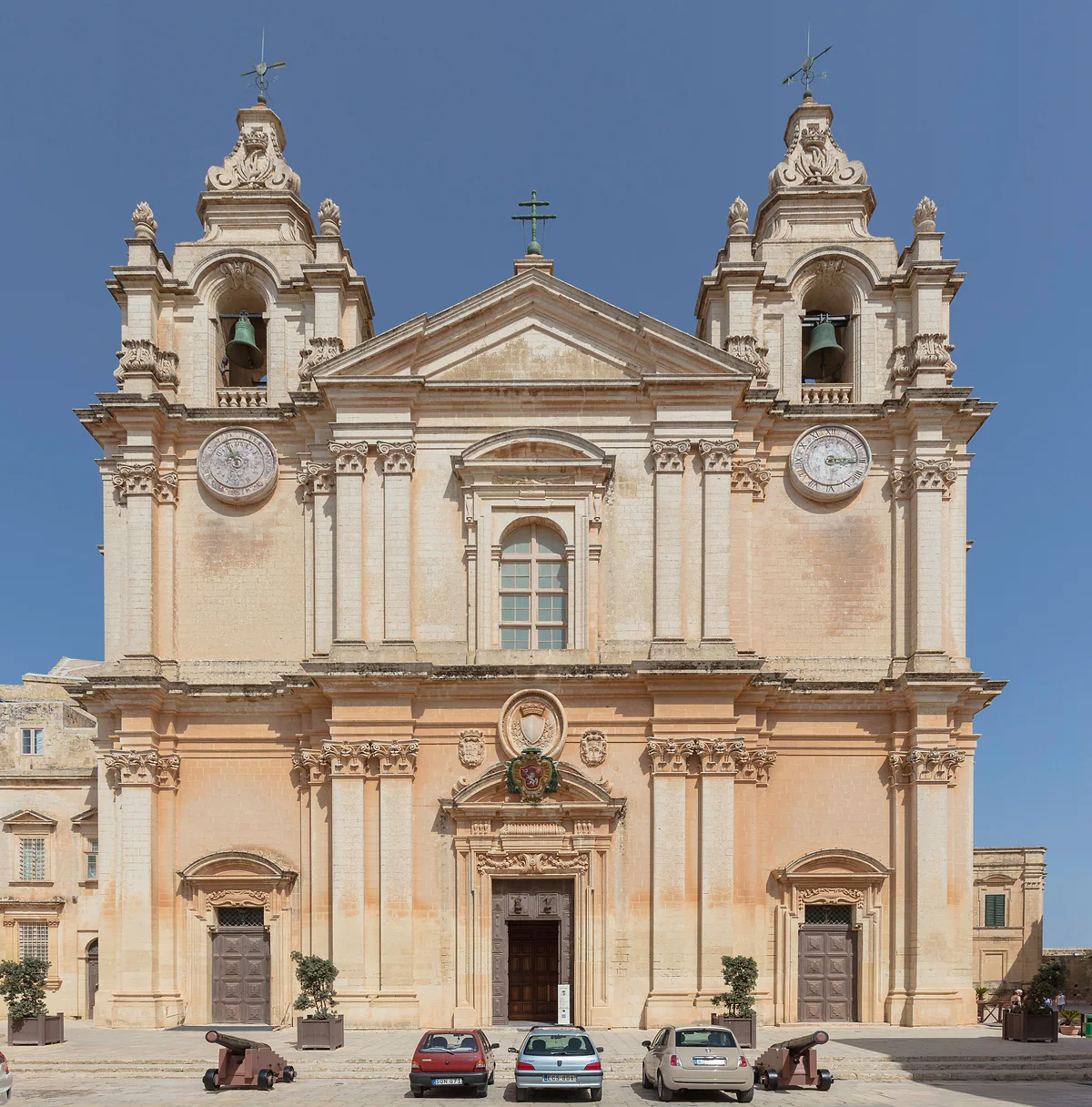
St Paul's Cathedral, Mdina, rebuilt from scratch after the 1693 earthquake
Mdina Cathedral, dedicated to St Paul, is the seat of the Archbishop of Malta. The present church was designed by Lorenzo Cafà after the 1693 earthquake and consecrated in 1703. An adult ticket costs €15 and includes the Cathedral Museum; it opens Monday to Saturday from 09:30 to 16:30, and under-12s go free.
In 30 seconds
Full read: 3 min
- Mdina Cathedral is dedicated to St Paul and is the seat of the Archbishop of Malta.
- Today's church is by Lorenzo Cafà, consecrated in 1703 after the 1693 earthquake.
- Tickets are €15 including the museum; under-12s are free.
- Open Monday to Saturday, 09:30 to 16:30; on Sundays you view it from behind a rope.
I'd buy the combined ticket and do the cathedral before the museum. Once inside, look down before you look up, because the inlaid marble tombstones tell you who ran Malta better than any label.

Before you go
What I would keep in mind
-
01 My tip
Tickets are sold at the museum
The Chapter sells tickets at the Cathedral Museum, a few metres to the right of the façade. It's a combined ticket, non-transferable and dated.
-
02 To save money
Under-12s go free
Adults pay €15, over-60s and students €10, and children under 12 nothing at all, so a family visit costs less than you might expect.
-
03 My tip
Dress code, heels and flash
It's a working church. The Chapter asks for modest dress and lends shawls at the door, asks you not to wear stiletto heels on the marble floor, and allows photos without flash.
-
04 Most beautiful
The bishop's window
High up by the high altar is a small window through which the bishop could follow Mass from his palace next door. The Chapter lists it among the building's curiosities.
-
05 Getting there
Pair it with St John's
The same Chapter looks after Mdina Cathedral and St John's Co-Cathedral in Valletta. See one and the other fills in the rest of the story.
St John's Co-Cathedral in Valletta
What I would book
Mdina Cathedral is the building that gives the city’s main square its point, and for me it’s the paid visit most worth doing inside the walls. It doesn’t have the fame of St John’s in Valletta, but it’s the older seat, it’s the archbishop’s church, and it tells a better story, that of a cathedral that fell down and was rebuilt in a single decade.
A seat with very old roots
The Metropolitan Chapter, which runs it, traces Malta’s Christian community back to letters from Pope Gregory the Great to Lucillus, Bishop of Malta, at the end of the 6th century. The first written reference to a cathedral on the island dates from 1299, shortly after Malta came under Aragonese rule. A few pieces survive from those centuries and are worth seeking out, such as the Petronilla bell, cast in Venice in 1370 and described by the Chapter as the oldest medieval bell left in Malta, and a chestnut door carved in 1535 by Cola Curmi, now at the entrance to the sacristy.
In 1944 the Bishop of Malta became a Metropolitan Archbishop and the cathedral took the Metropolitan title. The Chapter’s 29 canons serve both this church, which is also Mdina’s parish church, and St John’s Co-Cathedral in Valletta.
The 1693 earthquake and Lorenzo Cafà
The part of the story I enjoy most starts in 1679, when the Chapter commissioned a new Baroque choir from the Maltese architect Lorenzo Cafà. On 11 January 1693 an earthquake linked to Etna hit Sicily and Malta. Of the old cathedral, only that newly finished choir was left standing. On 11 April that year, with a report from the Order’s resident engineer Mederico Blondel, the Chapter decided to rebuild.
Cafà produced a wooden model and the new church was ready in 1702, a few months before he died. It was consecrated on 8 October 1703 and the dome was completed in 1705. What you see today is therefore a Baroque cathedral by one architect, which is unusual for a church with such a long history. Two palaces in the same style flank the façade, the old seminary, now the Cathedral Museum, and the bishop’s palace.
What to look out for inside
The Manno brothers finished the ceiling frescoes in 1774. The one in the dome was largely lost in another earthquake, in 1856. In 1888 the Maltese clockmaker Michelangelo Sapiano made the two clocks on the façade, one showing the time and the other the date.
I’d look for three things. The floor, with its inlaid marble tombstones, which is why the Chapter asks you not to wear stilettos. The small window high up by the high altar, from which the bishop could follow Mass from his palace without coming down. And, in the sacristy doors, the holes for the cats that kept the mice at bay. The Chapter explains that a foundation paid the sacristans to feed them, a custom that only ended recently because the cat kept setting off the alarms at night.
Tickets and opening times
The combined ticket costs €15 for adults and €10 for over-60s and students, and under-12s go free. You buy it at the Cathedral Museum, to the right of the façade, and it covers both. The cathedral opens Monday to Saturday from 09:30 to 16:30, with the last ticket at 16:15. On Sundays, between 15:00 and 17:00, the most you get is a look inside from behind a rope.
Watch out for weddings. The Chapter posts notices of early closures for services, and in September 2026 it announced two afternoons in a row closing ahead of time, so it’s worth a look at its website the evening before. Photography without flash is fine; food and drink aren’t. If you want to go in to pray rather than sightsee, the Chapter asks you to speak to a member of staff, who will take you to the Chapel of the Blessed Sacrament.
Fitting it into a day in Mdina
The cathedral stands on St Paul’s Square, in the middle of Mdina. I’d slot it in around midday, between a morning wander and Palazzo Falson, which is close by. If you’re curious about how the Order’s clergy lived outside church, St Paul’s Grotto in Rabat, with the Wignacourt Museum, is the natural follow-on, since that building began as the residence of the Knights’ chaplains. For later in the day there’s something lighter, the Mdina Dungeons, open until 21:30 from June to September.
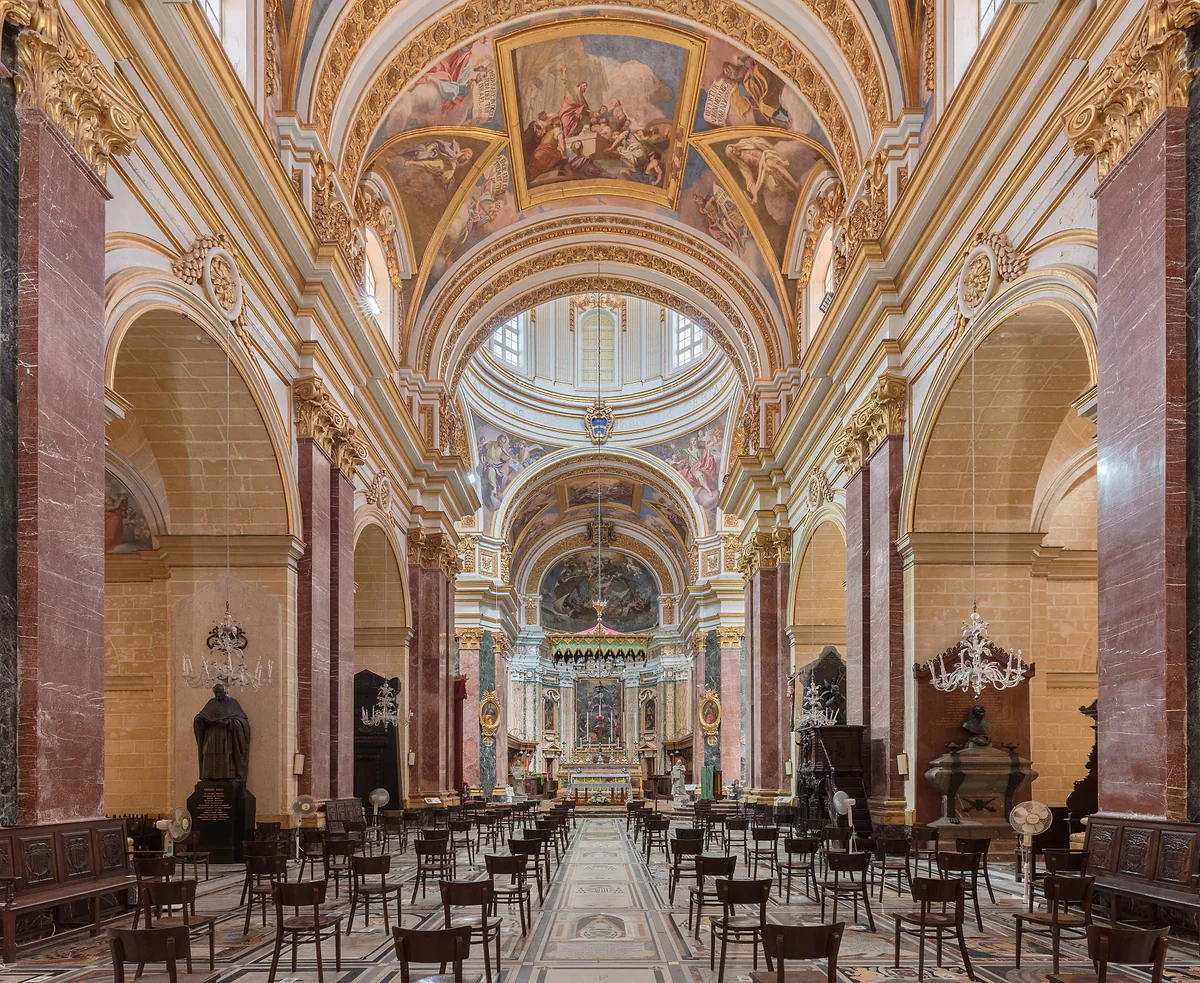
Inside St Paul's Cathedral in Mdina, with red marble pilasters, a painted vault, crystal chandeliers and the high altar at the far end.
Combined cathedral and museum ticket (Metropolitan Chapter, 2026)
| Ticket | Price |
|---|---|
| Adult | €15 |
| Senior (60+) | €10 |
| Student with valid card | €10 |
| Under 12 | Free |
Language school cards aren't accepted. Sold at the Cathedral Museum. Pre-booking on +356 21 454 697.
Cathedral opening hours
| Day | Hours |
|---|---|
| Monday to Saturday | 09:30-16:30 (last ticket 16:15) |
| Sunday | 15:00-17:00, from behind the rope only |
| Sundays in August | From 16:30, from behind the rope |
May close early for weddings, funerals and services. Weekday Mass at 09:00; Saturday at 09:00 and 18:00; Sunday at 09:30, 11:00 and 18:00.
Test yourself
True or false?
0/4 Pick before you peek.
-
Mdina Cathedral dates from the Middle Ages.
See the answer
False. The medieval building was badly damaged by the earthquake of 11 January 1693, which left only the choir standing. Today's cathedral is Baroque, by Lorenzo Cafà, consecrated in 1703.
-
A cathedral ticket also gets you into the Cathedral Museum.
See the answer
True. The Chapter sells a €15 combined ticket covering the cathedral and its museum, in the former seminary next door.
-
Mdina Cathedral once kept cats on the payroll.
See the answer
True. According to the Chapter, a small foundation paid the sacristans to feed the cats that kept the mice down. The cat holes are still in the sacristy doors.
-
The cathedral opens on Sundays like any other day.
See the answer
False. On Sundays you can only look in from behind a rope, from 15:00 to 17:00, or from 16:30 in August.
- Consecration of today's cathedral
- 1703
- Adult ticket with the museum
- €15
- Year the Petronilla bell was cast
- 1370
- Canons in the Metropolitan Chapter
- 29
Map
Where Mdina Cathedral is
Gozo lies to the north-west, across the channel the ferry crosses from Ċirkewwa, with Comino between the two islands. Every number opens its guide.
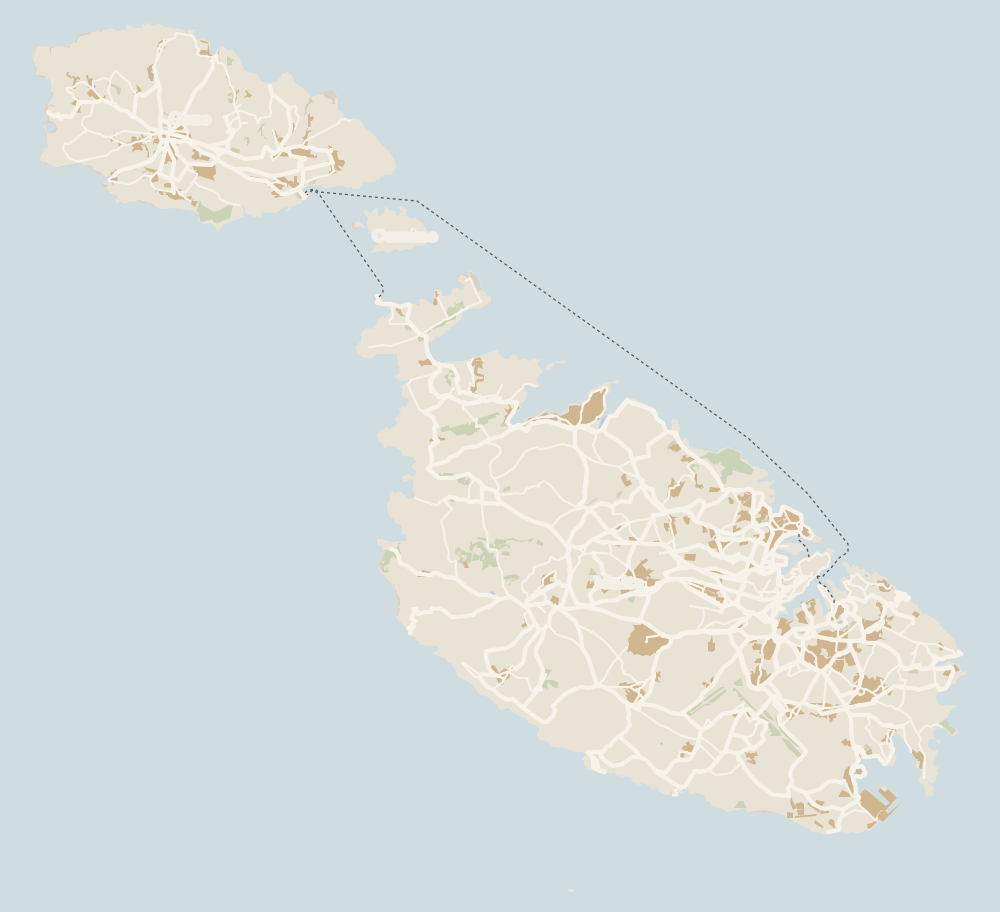 1Mdina 2Mdina Cathedral 3Palazzo Falson 4Mdina Dungeons
 Map data © OpenStreetMap contributors (ODbL)
0 of 279 Malta guides
Your next stamp
- Palazzo Falson
- Mdina Dungeons
- Rabat (Malta)
- St John's Co-Cathedral
- Churches
- St Paul's Catacombs
- Mdina
- Things to do in Malta
- Gozo
- Most beautiful places
- Comino
- Prettiest villages
- UNESCO World Heritage Sites
- Where is Malta
- The Maltese islands
- Towns and villages
- Island of Malta
- Blue Lagoon
- Fort Rinella
- Fort St Angelo
- Gardjola Gardens
- Ħal Saflieni Hypogeum
- Is Malta a country?
- Popeye Village
- Tarxien Temples
- Things to do in Gozo
- Valletta
- Esplora
- Golden Bay
- Gozo day trip
- Inquisitor's Palace
- Population
- St Mary's Tower
- Grandmaster's Palace
- How big is Malta
- Maritime Museum
- Mellieħa Bay
- Fort St Elmo
- Language
- Malta at War Museum
- Paradise Bay
- Barrakka Gardens
- Red Tower
- Religion
- Malta government
- Saluting Battery
- MUŻA
- National Museum of Archaeology
- Underground Valletta
- Lascaris War Rooms
- Casa Rocca Piccola
- Malta in one day
- Three Cities
- Victoria
- Birgu
- Manoel Theatre
- Weekend in Malta
- Xagħra
- City Gate and Parliament
- Malta in three days
- Nadur
- Senglea
- Cospicua
- Malta in four days
- Qala
- Valletta Waterfront
- Għajnsielem
- Kalkara
- Malta in five days
- Malta in a week
- Paola
- Xewkija
- Sannat
- Tarxien
- Munxar
- Żabbar
- Fgura
- Fontana
- Kerċem
- Luqa
- Floriana
- Marsa
- Mellieħa
- The Citadel, Gozo
- Żebbuġ (Gozo)
- Ġgantija Temples
- Marsalforn
- Santa Luċija
- Ramla Bay
- San Lawrenz
- Xgħajra
- Xwejni salt pans
- Calypso's Cave
- Għarb
- Żejtun
- Għasri
- Gudja
- San Blas Bay
- Għaxaq
- Ħondoq Bay
- Marsaxlokk
- Kirkop
- Marsaxlokk Fish Market
- Mqabba
- St Peter's Pool
- Marsaskala
- Qrendi
- Żurrieq
- Beaches
- Comino ferry
- EU, Schengen and the euro
- Ħaġar Qim and Mnajdra
- Mġarr (Gozo)
- Blue Grotto
- Diving
- Entry requirements
- Xewkija Rotunda
- Birżebbuġa
- Money and payments
- Safi
- Shipwrecks
- Ta' Ċenċ Cliffs
- Għar Dalam
- Mġarr ix-Xini
- Prices and budget
- Snorkelling
- Boat trips
- Malta on a budget
- Playmobil FunPark
- Xlendi
- Dwejra
- Gozo beaches
- History
- Siġġiewi
- Tipping
- Azure Window
- Domvs Romana
- Għar Lapsi
- Great Siege of 1565
- Plugs
- Limestone Heritage Park
- Second World War
- St Paul's Grotto
- Ta' Pinu Basilica
- Time zone
- Buskett Gardens
- Knights of Malta
- Mobile and roaming
- Wied il-Għasri
- Dingli
- Maltese cross
- Dingli Cliffs
- Flag
- Żebbuġ
- Coat of arms
- Mtarfa
- Balzan
- National anthem
- Lija
- Malta facts
- Game of Thrones
- Iklin
- Attard
- Film locations
- Forts and fortifications
- San Anton Gardens
- Ta' Qali Crafts Village
- Victoria Lines
- Megalithic temples
- Catacombs
- Museums
- Where to eat
- Where to stay
- Hotels in Valletta
- Restaurants in Valletta
- Hotels in Sliema
- Maltese food
- Restaurants in Marsaxlokk
- Viewpoints
- Hotels in St Julian's
- Pastizzi
- Walking and hiking
- Hotels in Buġibba and Qawra
- Maltese rabbit stew
- Safety
- Hotels in Mellieħa
- Kinnie and Cisk
- Scams
- Gozo hotels
- Nightlife
- Tap water
- Boat parties
- Holiday packages
- Tourist tax
- All inclusive
- Gay Malta
- Sightseeing passes
- Apartments
- Malta with kids
- Public holidays
- How to get there
- Luxury
- Malta for couples
- Taxis and ride-hailing
- Weather
- Best time to visit
- Cycling
- English schools
- Flights
- Flights from Madrid
- Sea temperature
- Shopping and souvenirs
- Airport
- Free walking tours
- In winter
- Airport transfers
- Day trips and tours
- In summer
- Ferry from Sicily
- In January
- Cruise stop
- In February
- In March
- In April
- In May
- Getting around
- In June
- Buses
- July
- August
- Hop on hop off
- Gozo ferry
- September
- Gozo fast ferry
- October
- November
- Valletta ferries
- Car hire
- December
- Driving
- Events
- St Paul's Bay
- Village feasts
- Buġibba
- Christmas
- Easter
- Qawra
- Carnival
- Xemxija
- Fireworks festival
- Malta National Aquarium
- Isle of MTV
- St Paul's Islands
- Mosta
- Mosta Rotunda
- Naxxar
- Palazzo Parisio
- Għargħur
- Mġarr (Malta)
- Sliema
- Ta' Ħaġrat and Skorba Temples
- Għajn Tuffieħa Bay
- Tigné Point
- Ġnejna Bay
- St Julian's
- Paceville
- St George's Bay
- Gżira
- Msida
- Ta' Xbiex
- Pietà
- Pembroke
- Swieqi
- San Ġwann
- Birkirkara
- Ħamrun
- Santa Venera
- Qormi
Frequently asked questions
How much does it cost to visit Mdina Cathedral?
€15 for adults, including the Cathedral Museum. Over-60s and students pay €10, and children under 12 go free.
What are Mdina Cathedral's opening hours?
Monday to Saturday, 09:30 to 16:30, with the last ticket sold at 16:15. On Sundays you can only view it from behind a rope, 15:00 to 17:00.
Who designed Mdina Cathedral?
The Maltese architect Lorenzo Cafà, who produced a wooden model after the 1693 earthquake. The building was finished in 1702, shortly before his death, and the dome was completed in 1705.
Can you take photos inside Mdina Cathedral?
Yes, but without flash. Food and drink aren't allowed, and the Chapter asks for modest dress, with shawls available at the entrance.
What's the difference between Mdina Cathedral and St John's Co-Cathedral?
Mdina has been the diocese's cathedral since the Middle Ages. St John's in Valletta was the Knights' church; after Napoleon expelled the Order in 1798 it passed to the Cathedral Chapter and later became a co-cathedral.
Is Mdina Cathedral wheelchair accessible?
The Chapter says access for disabled visitors is available at the cathedral. I couldn't find the equivalent information for the museum on its website.
By
Tourism graduate with a master’s in Tourism Management and Planning from the University of Málaga, who has travelled across Europe. He writes every guide from official sources and his own judgement.
Published on . Facts checked on .
Sources
Photos: Diego Delso (CC BY-SA 4.0); Diego Delso (CC BY-SA 4.0), via Wikimedia Commons.