Mġarr, western Malta
Skorba and Ta' Ħaġrat, Mġarr's quiet temples
The Skorba and Ta' Ħaġrat Temples are two megalithic sites in Mġarr, western Malta, added to the UNESCO list in 1992. Skorba also has Neolithic huts among the oldest remains on the islands. Each costs €3.50, and both open from 10:00 to 18:00 until 31 October 2026, according to Heritage Malta.
In 30 seconds
Full read: 3 min
- Skorba and Ta' Ħaġrat are two megalithic temples in Mġarr, World Heritage since 1992.
- Skorba also has Neolithic huts, among the oldest remains in Malta.
- Each costs €3.50; a combined ticket is sold online.
- They open 10:00 to 18:00 until 31 Oct 2026 and 09:00 to 17:00 in winter.
I'd see Skorba first and then Ta' Ħaġrat, in chronological order, and read up a little beforehand, because without context they're stones in a field. With it, Skorba is where you best understand who built Malta's temples.

Before you go
What I would keep in mind
-
01 Most beautiful
Where the builders lived
Skorba isn't only temples. Neolithic huts of stone and mudbrick turned up, with pottery, animal bones and fragments of female figurines. It's one of the few places that speaks of daily life.
-
02 To save money
Both for €7
Each temple costs €3.50 for adults and Heritage Malta sells a combined ticket online. Under-6s go free.
-
03 My tip
Buy tickets in the village
Heritage Malta also sells tickets at Mġarr Local Council, the Mġarr Farmers Bar and the Il-Barri and Il-Gastronawt restaurants, each with its own hours.
Mġarr (Malta) -
04 Getting there
Two temples within walking distance
Ta' Ħaġrat is in the heart of the village and Skorba on its outskirts. You can walk between them on one visit.
What I would book
Malta’s megalithic temples have a famous face, Ħaġar Qim above the sea or Ġgantija on Gozo, and a barely known one in a farming village in the west. Skorba and Ta’ Ħaġrat are that second face. They’re less striking and far less visited, but in return you see them without crowds, for very little money and in the kind of countryside their builders actually lived in.
Why two temples in one village
Both are in Mġarr, and both were added in 1992 to the megalithic temples of Malta World Heritage inscription. UNESCO counts six components in that listing, built over five thousand years ago and regarded as some of the first free-standing stone buildings anywhere. The other four are on Gozo, on the south coast and at Tarxien. Having two of the six in the same parish says a lot about how busy this corner of the island once was.
Skorba, the oldest
Heritage Malta explains that Skorba was dug fairly late, in the early 1960s, by the archaeologist David Trump, and that this turned out to be an advantage. With more modern techniques than earlier digs, it filled gaps that the first excavations had left open.
The real prize isn’t the temples but what lay beside them. Remains of several huts where the builders lived turned up, from the so-called Skorba phase, with two oval buildings of stone and mudbrick, rock floors, a paved yard, plenty of pottery, animal bones and fragments of stylised female figurines. The earliest structures date from the first phases of the Neolithic and rank among the oldest on the islands. There are also two megalithic buildings, one from the Ġgantija phase and a later one from the Tarxien phase.
Ta’ Ħaġrat, a temple under a carob tree
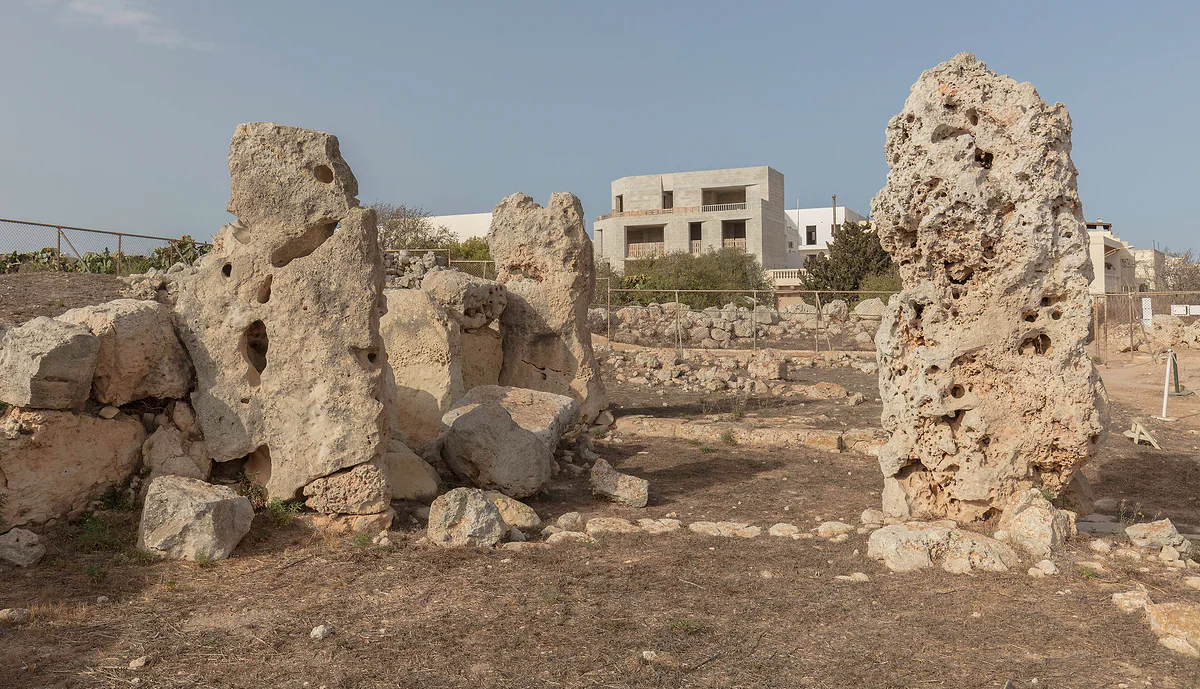
Ta’ Ħaġrat was discovered in 1917 in the very centre of the village. Before it was dug, it was a round mound of stones topped by a huge carob tree in a field. It was excavated in 1923, 1925, 1926, 1953 and 1961, and pottery from both before and after the temple period turned up, showing the site was in use before and after the building went up.
There are two buildings. The larger and older has a semicircular facade with a monumental doorway opening onto a rectangular space of roughly 2.5 by 4.5 metres, with semicircular rooms on three sides. The smaller one came later, on a similar plan with smaller stones, cut into the eastern room of its neighbour. It’s all local coralline limestone, the hard stone, and Heritage Malta invites you to picture its builders working with nothing but stone, bone and wooden tools.
Tickets, hours and where to buy
Adults pay €3.50 per temple; youths aged 12 to 17, students and anyone over 60 pay €3; and 6 to 11-year-olds pay €2.50. There’s also a combined ticket in Heritage Malta’s online shop. According to its official opening-hours images, in the season ending in October 2026 both open daily from ten until six, and in winter, from 1 November, from nine until five. Entry stops thirty minutes before closing. Unusually, tickets are also sold in the village itself, at the local council, the Mġarr Farmers Bar and two restaurants, each keeping its own hours.
To put the price in context, adult entry to Ġgantija or to Ħaġar Qim and Mnajdra is €10. Here you see two sites from the same World Heritage listing for €7, and without the coach parties.
How I’d plan it
I’d take route 44 from Valletta, start with Skorba, the older of the two, and walk on to Ta’ Ħaġrat. I’d go first thing, as both are open-air and the summer sun is fierce. Afterwards I’d head down for lunch and a swim at Ġnejna Bay, which has the 101 from the village in summer. If you’re only seeing one temple complex on your whole trip, though, my vote goes to Ħaġar Qim and Mnajdra, which I find far more striking.
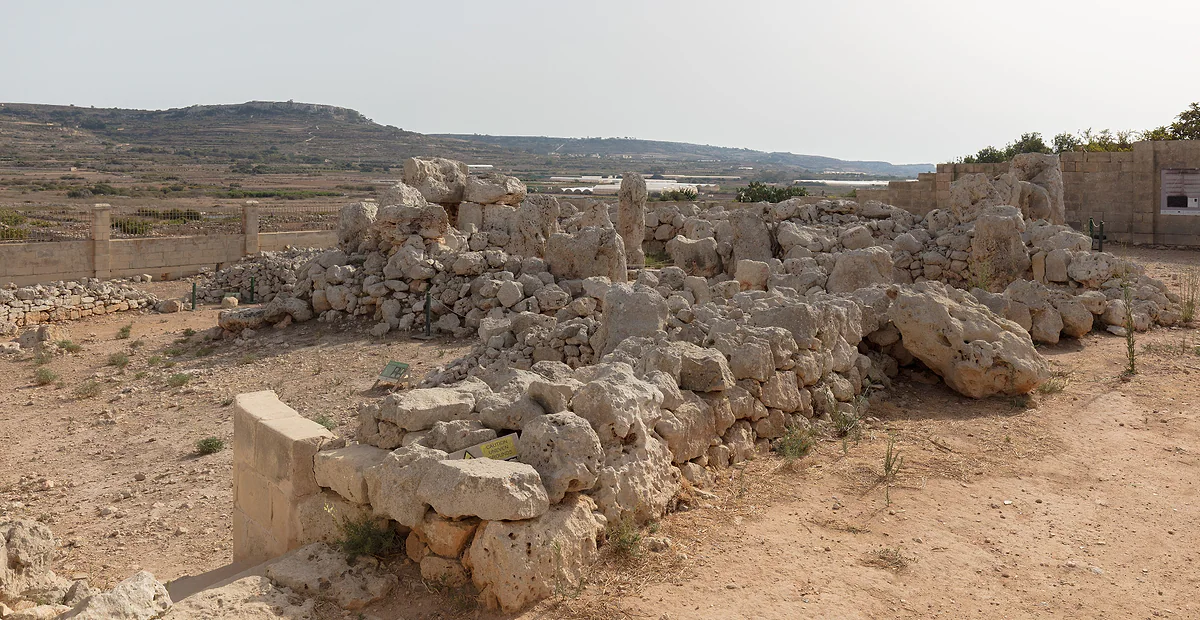
The megalithic remains of the Ta' Ħaġrat temples in Mġarr, with walls of large stone blocks among dry farmland.
Tickets (Heritage Malta, 28 Sept 2026)
| Ticket | Ta' Ħaġrat | Skorba |
|---|---|---|
| Adult (18+) | €3.50 | €3.50 |
| Youth (12-17), senior (60+) or student | €3 | €3 |
| Child (6-11) | €2.50 | €2.50 |
| Under 6 | Free | Free |
Combined ticket for both in Heritage Malta's online shop. Free for members and Heritage Malta Passport holders.
Opening hours
| Period | Hours |
|---|---|
| Until 31 Oct 2026 | 10:00-18:00, daily |
| 1 Nov 2026 to 28 Feb 2027 | 09:00-17:00, daily |
From Heritage Malta's official opening-hours images. Last entry 30 minutes before closing. Closed 1 January, Good Friday and 24, 25 and 31 December.
The two sites
| Ta' Ħaġrat | Skorba | |
|---|---|---|
| Address | Triq San Pietru, Mġarr | Triq Sant' Anna, Mġarr |
| Found or dug | Discovered in 1917 | Excavated by David Trump in the early 1960s |
| What's there | Two megalithic buildings | Two temples and Neolithic huts |
Test yourself
True or false?
0/4 Pick before you peek.
-
Ta' Ħaġrat was discovered in the 20th century.
See the answer
True. Heritage Malta dates the discovery to 1917. It was excavated in 1923, 1925, 1926, 1953 and 1961.
-
Skorba has only megalithic temples.
See the answer
False. It also has the remains of Neolithic domestic huts, and its earliest structures date from the first phases of that period.
-
Ta' Ħaġrat is built of the same soft limestone as some other temples.
See the answer
False. Heritage Malta says it's built entirely of local Upper Coralline Limestone, the hard stone.
-
Both temples are part of a UNESCO World Heritage Site.
See the answer
True. They were added in 1992 to the Megalithic Temples of Malta inscription, which UNESCO describes as six components.
- Ta' Ħaġrat discovered
- 1917
- Added to the UNESCO list
- 1992
- Adult entry to each temple
- €3.50
- Central room of the larger Ta' Ħaġrat temple
- 2.5 x 4.5 m
Map
Where Ta' Ħaġrat and Skorba Temples is
Gozo lies to the north-west, across the channel the ferry crosses from Ċirkewwa, with Comino between the two islands. Every number opens its guide.
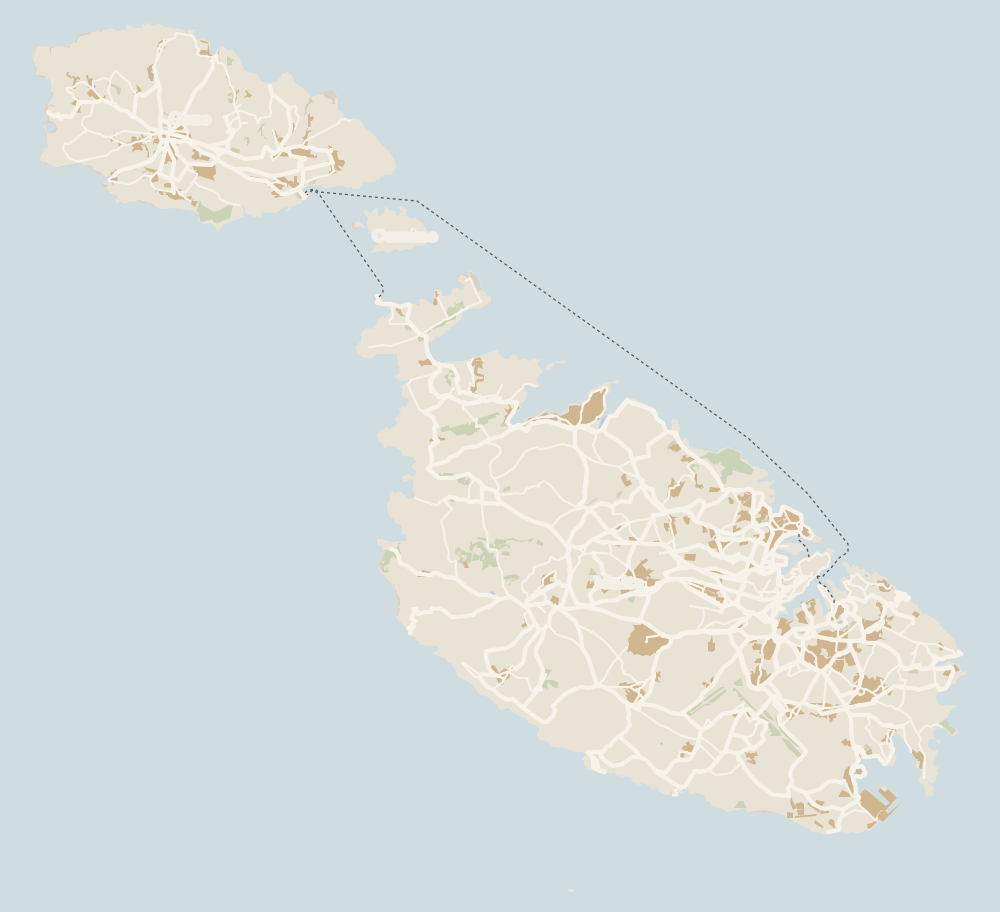 1Mġarr (Malta) 2Ta' Ħaġrat and Skorba Temples 3Għajn Tuffieħa Bay 4Ġnejna Bay
 Map data © OpenStreetMap contributors (ODbL)
0 of 279 Malta guides
Your next stamp
- Ħaġar Qim and Mnajdra
- Megalithic temples
- Mġarr (Malta)
- Ġgantija Temples
- Tarxien Temples
- UNESCO World Heritage Sites
- Mtarfa
- Malta National Aquarium
- Things to do in Malta
- Gozo
- Most beautiful places
- Comino
- Prettiest villages
- Where is Malta
- The Maltese islands
- Towns and villages
- Island of Malta
- Blue Lagoon
- Fort Rinella
- Fort St Angelo
- Gardjola Gardens
- Ħal Saflieni Hypogeum
- Is Malta a country?
- Popeye Village
- Things to do in Gozo
- Valletta
- Esplora
- Golden Bay
- Gozo day trip
- Inquisitor's Palace
- Population
- St John's Co-Cathedral
- St Mary's Tower
- Grandmaster's Palace
- How big is Malta
- Maritime Museum
- Mellieħa Bay
- Fort St Elmo
- Language
- Malta at War Museum
- Paradise Bay
- Barrakka Gardens
- Red Tower
- Religion
- Malta government
- Saluting Battery
- MUŻA
- National Museum of Archaeology
- Underground Valletta
- Lascaris War Rooms
- Casa Rocca Piccola
- Malta in one day
- Three Cities
- Victoria
- Birgu
- Manoel Theatre
- Weekend in Malta
- Xagħra
- City Gate and Parliament
- Malta in three days
- Nadur
- Senglea
- Cospicua
- Malta in four days
- Qala
- Valletta Waterfront
- Għajnsielem
- Kalkara
- Malta in five days
- Malta in a week
- Paola
- Xewkija
- Sannat
- Tarxien
- Munxar
- Żabbar
- Fgura
- Fontana
- Kerċem
- Luqa
- Floriana
- Marsa
- Mellieħa
- The Citadel, Gozo
- Żebbuġ (Gozo)
- Marsalforn
- Santa Luċija
- Ramla Bay
- San Lawrenz
- Xgħajra
- Xwejni salt pans
- Calypso's Cave
- Għarb
- Żejtun
- Għasri
- Gudja
- San Blas Bay
- Għaxaq
- Ħondoq Bay
- Marsaxlokk
- Kirkop
- Marsaxlokk Fish Market
- Mqabba
- St Peter's Pool
- Marsaskala
- Qrendi
- Żurrieq
- Beaches
- Comino ferry
- EU, Schengen and the euro
- Mdina
- Mġarr (Gozo)
- Blue Grotto
- Diving
- Entry requirements
- Mdina Cathedral
- Xewkija Rotunda
- Birżebbuġa
- Money and payments
- Palazzo Falson
- Safi
- Shipwrecks
- Ta' Ċenċ Cliffs
- Għar Dalam
- Mdina Dungeons
- Mġarr ix-Xini
- Prices and budget
- Snorkelling
- Boat trips
- Malta on a budget
- Playmobil FunPark
- Rabat (Malta)
- Xlendi
- Dwejra
- Gozo beaches
- History
- Siġġiewi
- St Paul's Catacombs
- Tipping
- Azure Window
- Domvs Romana
- Għar Lapsi
- Great Siege of 1565
- Plugs
- Limestone Heritage Park
- Second World War
- St Paul's Grotto
- Ta' Pinu Basilica
- Time zone
- Buskett Gardens
- Knights of Malta
- Mobile and roaming
- Wied il-Għasri
- Dingli
- Maltese cross
- Dingli Cliffs
- Flag
- Żebbuġ
- Coat of arms
- Balzan
- National anthem
- Lija
- Malta facts
- Game of Thrones
- Iklin
- Attard
- Film locations
- Forts and fortifications
- San Anton Gardens
- Ta' Qali Crafts Village
- Victoria Lines
- Catacombs
- Museums
- Where to eat
- Where to stay
- Churches
- Hotels in Valletta
- Restaurants in Valletta
- Hotels in Sliema
- Maltese food
- Restaurants in Marsaxlokk
- Viewpoints
- Hotels in St Julian's
- Pastizzi
- Walking and hiking
- Hotels in Buġibba and Qawra
- Maltese rabbit stew
- Safety
- Hotels in Mellieħa
- Kinnie and Cisk
- Scams
- Gozo hotels
- Nightlife
- Tap water
- Boat parties
- Holiday packages
- Tourist tax
- All inclusive
- Gay Malta
- Sightseeing passes
- Apartments
- Malta with kids
- Public holidays
- How to get there
- Luxury
- Malta for couples
- Taxis and ride-hailing
- Weather
- Best time to visit
- Cycling
- English schools
- Flights
- Flights from Madrid
- Sea temperature
- Shopping and souvenirs
- Airport
- Free walking tours
- In winter
- Airport transfers
- Day trips and tours
- In summer
- Ferry from Sicily
- In January
- Cruise stop
- In February
- In March
- In April
- In May
- Getting around
- In June
- Buses
- July
- August
- Hop on hop off
- Gozo ferry
- September
- Gozo fast ferry
- October
- November
- Valletta ferries
- Car hire
- December
- Driving
- Events
- St Paul's Bay
- Village feasts
- Buġibba
- Christmas
- Easter
- Qawra
- Carnival
- Xemxija
- Fireworks festival
- Isle of MTV
- St Paul's Islands
- Mosta
- Mosta Rotunda
- Naxxar
- Palazzo Parisio
- Għargħur
- Sliema
- Għajn Tuffieħa Bay
- Tigné Point
- Ġnejna Bay
- St Julian's
- Paceville
- St George's Bay
- Gżira
- Msida
- Ta' Xbiex
- Pietà
- Pembroke
- Swieqi
- San Ġwann
- Birkirkara
- Ħamrun
- Santa Venera
- Qormi
Frequently asked questions
How much are the Skorba and Ta' Ħaġrat Temples?
€3.50 each for adults, €3 for 12 to 17-year-olds, over-60s and students, and €2.50 for children aged 6 to 11. Under-6s go free, and there's a combined ticket online.
What are the Skorba Temples opening hours?
According to Heritage Malta's official images, 10:00 to 18:00 daily until 31 October 2026, then 09:00 to 17:00 from 1 November to 28 February 2027.
Where are the Skorba and Ta' Ħaġrat Temples?
In Mġarr, in the west of the island of Malta. Ta' Ħaġrat is on Triq San Pietru in the village centre, and Skorba on Triq Sant' Anna on the edge of the village.
Why is Skorba important?
Because it was dug late, with modern methods, and produced evidence of Neolithic home life, with huts, pottery and figurines. Its earliest remains are among the oldest in Malta.
How do I get to the Mġarr temples?
Take route 44 from the Valletta terminus to Mġarr. Ta' Ħaġrat is in the centre and Skorba is within walking distance.
Are Skorba and Ta' Ħaġrat worth visiting?
If prehistory interests you, very much so, since they're cheap and quiet. If you'll only see one temple site in Malta, I'd pick Ħaġar Qim and Mnajdra or Ġgantija, which I find far more striking.
By
Tourism graduate with a master’s in Tourism Management and Planning from the University of Málaga, who has travelled across Europe. He writes every guide from official sources and his own judgement.
Published on . Facts checked on .
Sources
Photos: Diego Delso (CC BY-SA 4.0); Diego Delso (CC BY-SA 4.0), via Wikimedia Commons.