1991-2020 norms, Luqa station
Malta weather: temperature, rain and sunshine for every month
Malta has mild winters and long, dry, hot summers. Its Meteorological Office puts the January average at 12.9°C (55°F) and July at 26.9°C (80°F), with about 543 mm of rain a year, nearly all of it between October and February. June gets 334 hours of sunshine and barely 6 mm of rain. Wind is what really shapes how it feels.
In 30 seconds
Full read: 4 min
- January averages 12.9°C (55°F) and July 26.9°C (80°F), according to Malta's Met Office.
- About 543 mm of rain falls a year, almost all between October and February; June gets 5.8 mm.
- June has 334 hours of sunshine and the sea reaches 26.1°C (79°F) in September.
- Wind is what chills the winter, and heatwaves can top 40°C.
The averages hide two things. The winter wind, which makes 13°C feel far cooler, and the July and August heat, which is punishing at midday. Given the choice, I go between April and June or in October, when the sea is still warm and the streets are bearable.

Before you go
What I would keep in mind
-
01 My tip
Keep an eye on Met Office warnings
Malta's Meteorological Office issues wind and heat warnings. In 2021 it put out 256, only one of them red, for highs of 38 to 41°C in August. In strong north-easterlies it also issues a Gregale advisory for the Grand Harbour.
-
02 Most beautiful
October's light
October keeps an average high of 25°C (77°F) and 217.7 hours of sunshine, with the sea still at 24°C. It's my favourite month for mixing sightseeing with a swim.
best time to visit Malta -
03 My tip
Saharan dust in spring
The Met Office explains that spring depressions over North Africa push dust and sand across the central Mediterranean. Expect a few milky-white skies and, now and then, muddy rain, as on 16 April 2024.
Malta in April -
04 To save money
Winter is cheaper to get around
A single bus ticket is €2 in the winter season and €2.50 in summer, and the Gozo ferry has a cheaper night fare from November to March.
Malta in winter
What I would book
Most of what you read about Malta’s weather boils down to “sunny all year”. That’s only half the story. I went to the source instead, the Meteorological Office based at the airport in Luqa, and pieced together the 1991-2020 normals from its monthly notes, because its climate tables aren’t open to the public. The result is the table above, month by month, and below is how I’d read it.
Malta’s weather through the year
Winter is short and mild. January averages 12.9°C (55°F) and February, the coldest month, 12.6°C. March climbs to 14.1°C, April to 16.4°C and May to about 20°C (68°F). June averages 24.2°C and July 26.9°C (80°F), with August bringing the highest maximums, an average high of 32°C (90°F). October is still around 21.7°C, November drops to 17.9°C and December settles at 14.5°C.
What strikes me is how steady it is. The gap between the February and July averages is just over 14 degrees, and the sea softens the extremes for most of the year. A Maltese winter behaves more like a cool spring than a proper winter.
Sunshine follows the same curve. The norm climbs from around 170 hours in January to 334.1 in June, and in June 2025 Luqa averaged 12.5 hours of bright sunshine a day. Midwinter days are shorter, with 5 to 6 hours of sun a day according to Visit Malta in 2023, which is still plenty for a day of sightseeing.
Rain falls almost entirely from October to February
The annual norm is 543 mm. The Met Office counts its rainfall year from September to August, because the first storms arrive at the tail end of summer. November is the wettest month with 89.1 mm, ahead of January’s 79.3 mm and October’s 77.6 mm. May gets 10.2 mm and June 5.8 mm. July 2023 didn’t see a single drop. In Malta in January I explain why that month, with its 79.3 mm, is also the airport’s quietest, and Malta in December runs through its three public holidays.
The averages can mislead, though. Maltese rain tends to come in short, heavy bursts rather than long grey days. On 9 February 2023, Storm Helios dropped 140.4 mm on Luqa in a single day, twice what a normal February gets in total. If you travel in winter, expect the odd day of rain and wind, with plenty of clear skies in between.
Summer heat and heatwaves
Summer is dry, long and hot. The Met Office defines a heatwave as three or more days with the maximum at least 5°C above the month’s norm, which in June means topping about 34°C (93°F). It happens more than you’d think. In 2025 there was one from 24 to 27 June, in 2022 another from 23 to 28 June, and on 30 June 2021 the thermometer reached 41.5°C (107°F).
July 2023 was the hottest month on record, averaging 29.6°C with a peak of 42.7°C. I use that for one practical rule. In July and August I plan temples and forts for early morning or late afternoon and leave midday for the sea. The whole season is covered in my guide to Malta in summer, and each month in Malta in July and Malta in August.
Wind, dust and warnings
Wind is what most guides forget. From autumn to spring it blows hard on several days a month, and in north-easterly gales the Met Office issues Gregale advisories for the Grand Harbour and Marsamxett, the two harbours that bear the brunt. In February 2026, for example, the average wind speed was 12.8 knots against a norm of 9.4.
Spring adds dust. Depressions over North Africa push sand towards the central Mediterranean, bringing hazy white skies and poor visibility on some days. On 16 April 2024 it ended in muddy “blood rain”. Worth knowing if you’re planning photos or a clifftop walk.
What to pack for Malta
My rule is simple. From November to March, layers and a windproof jacket, because 13°C with a north-westerly feels colder on your skin than on the thermometer. In April and May, short sleeves by day and something warmer after dark. From June to September, light clothes, a hat and sun cream, since the UV index already hits 10 in June. And comfortable shoes whatever the month, because stone cities like Valletta are all slopes and steps. Your UK plugs will work, by the way, since Malta uses the same three-pin socket.
If you’re trying to pick dates, I’ve laid it all out in the best time to visit Malta, and if the beach is the point, see Malta sea temperature. For the cooler months there’s Malta in winter.
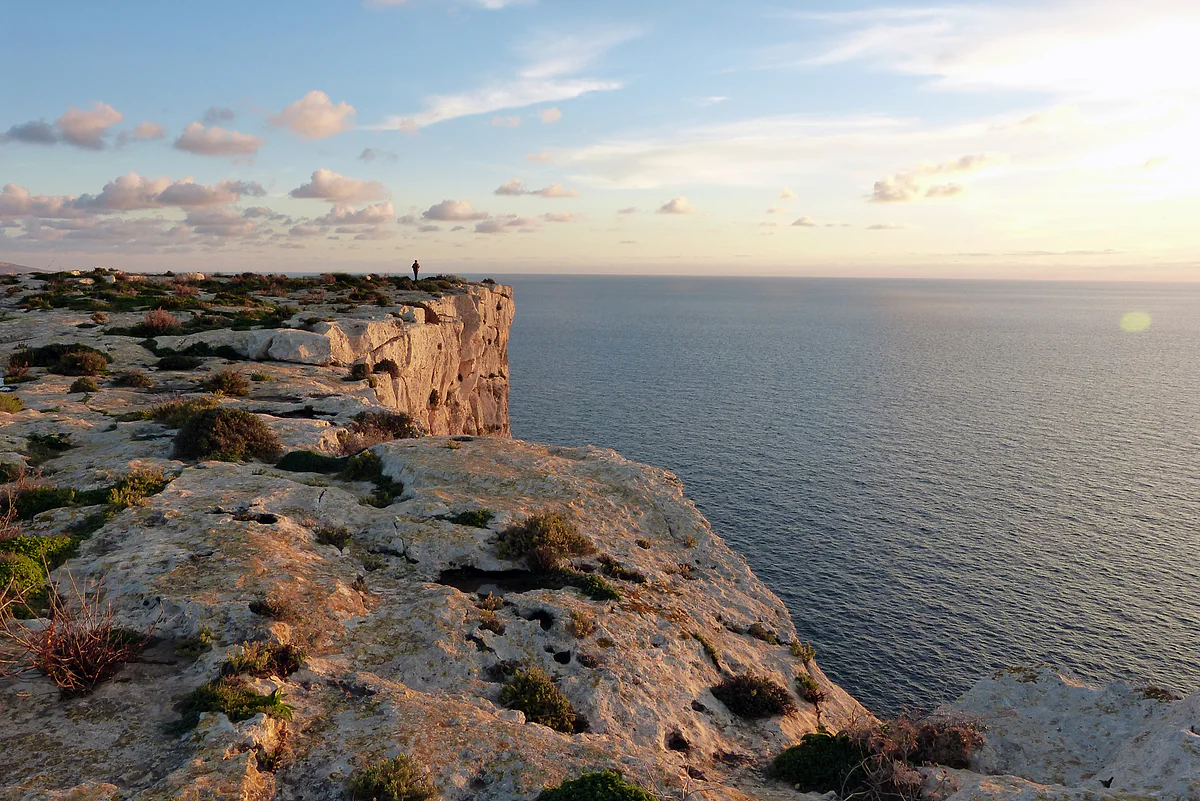
The Dingli Cliffs at sunset, the limestone dropping sheer into the Mediterranean on the south-west coast of Malta.
Malta climate month by month (Met Office, Luqa)
| Month | Average temperature | Rain | Sunshine hours | Sea |
|---|---|---|---|---|
| January | 12.9°C (55°F) | 79.3 mm | About 170 | 16.2°C (61°F) |
| February | 12.6°C (55°F) | 69 mm | About 187 | About 15.3°C (60°F) |
| March | 14.1°C (57°F) | 39.7 mm | 224.7 | 15.3°C (60°F) |
| April | 16.4°C (62°F) | 18.7 mm | 252.9 | 16.3°C (61°F) |
| May | About 20°C (68°F) | 10.2 mm | 307.2 | About 18.4°C (65°F) |
| June | 24.2°C (76°F) | 5.8 mm | 334.1 | 22°C (72°F) |
| July | 26.9°C (80°F) | 0.1 mm | No published norm | About 25.2°C (77°F) |
| August | Average high 32°C (90°F) | No published norm | No published norm | About 26.7°C (80°F) |
| September | Average high about 28.6°C (83°F) | 59.2 mm | 253.1 | 26.1°C (79°F) |
| October | 21.7°C (71°F) | 77.6 mm | 217.7 | 24°C (75°F) |
| November | 17.9°C (64°F) | 89.1 mm | No published norm | 21°C (older norm) |
| December | 14.5°C (58°F) | About 85 mm | 165.7 | About 18.3°C (65°F) |
1991-2020 norms quoted in the Malta Meteorological Office's monthly notes since 2022. Figures marked «about» are my own sums from the measured value and the gap the same note gives. The Met Office doesn't publish an open table of normals.
Records and extremes quoted by the Met Office
| Record | Value | Date |
|---|---|---|
| Lowest temperature | 1.4°C (35°F) | 29 January 1981 |
| Highest in January | 25.8°C (78°F) | 9 January 2021 |
| Highest in June | 41.5°C (107°F) | 30 June 2021 |
| Hottest month | 29.6°C average | July 2023 |
| Highest in March | 33.5°C (92°F) | 2001 |
| Wettest February | 187.9 mm | 1965 |
Test yourself
True or false?
0/4 Pick before you peek.
-
Malta gets more rain in summer than in winter.
See the answer
False. The other way round. June's norm is 5.8 mm and November's 89.1 mm, according to the Met Office. Almost all the rain falls between October and February.
-
Malta's June temperature record is above 40°C.
See the answer
True. Luqa measured 41.5°C (107°F) on 30 June 2021, the highest June reading since records for the month began in 1923.
-
It has never dropped below 5°C in Malta.
See the answer
False. On 29 January 1981 it fell to 1.4°C, the lowest temperature in the Met Office's records.
-
July 2023 was the hottest month the Met Office has recorded.
See the answer
True. It averaged 29.6°C and peaked at 42.7°C (109°F) during a ten-day heatwave.
- January average temperature
- 12.9°C
- July average temperature
- 26.9°C
- Normal rainfall in a year
- 543 mm
- Normal June sunshine
- 334.1 h
What to see
What to see in Weather
0 of 279 Malta guides
Your next stamp
- In January
- In summer
- In June
- In April
- Sea temperature
- November
- In May
- July
- Things to do in Malta
- Gozo
- Most beautiful places
- Comino
- Prettiest villages
- UNESCO World Heritage Sites
- Where is Malta
- The Maltese islands
- Towns and villages
- Island of Malta
- Blue Lagoon
- Fort Rinella
- Fort St Angelo
- Gardjola Gardens
- Ħal Saflieni Hypogeum
- Is Malta a country?
- Popeye Village
- Tarxien Temples
- Things to do in Gozo
- Valletta
- Esplora
- Golden Bay
- Gozo day trip
- Inquisitor's Palace
- Population
- St John's Co-Cathedral
- St Mary's Tower
- Grandmaster's Palace
- How big is Malta
- Maritime Museum
- Mellieħa Bay
- Fort St Elmo
- Language
- Malta at War Museum
- Paradise Bay
- Barrakka Gardens
- Red Tower
- Religion
- Malta government
- Saluting Battery
- MUŻA
- National Museum of Archaeology
- Underground Valletta
- Lascaris War Rooms
- Casa Rocca Piccola
- Malta in one day
- Three Cities
- Victoria
- Birgu
- Manoel Theatre
- Weekend in Malta
- Xagħra
- City Gate and Parliament
- Malta in three days
- Nadur
- Senglea
- Cospicua
- Malta in four days
- Qala
- Valletta Waterfront
- Għajnsielem
- Kalkara
- Malta in five days
- Malta in a week
- Paola
- Xewkija
- Sannat
- Tarxien
- Munxar
- Żabbar
- Fgura
- Fontana
- Kerċem
- Luqa
- Floriana
- Marsa
- Mellieħa
- The Citadel, Gozo
- Żebbuġ (Gozo)
- Ġgantija Temples
- Marsalforn
- Santa Luċija
- Ramla Bay
- San Lawrenz
- Xgħajra
- Xwejni salt pans
- Calypso's Cave
- Għarb
- Żejtun
- Għasri
- Gudja
- San Blas Bay
- Għaxaq
- Ħondoq Bay
- Marsaxlokk
- Kirkop
- Marsaxlokk Fish Market
- Mqabba
- St Peter's Pool
- Marsaskala
- Qrendi
- Żurrieq
- Beaches
- Comino ferry
- EU, Schengen and the euro
- Ħaġar Qim and Mnajdra
- Mdina
- Mġarr (Gozo)
- Blue Grotto
- Diving
- Entry requirements
- Mdina Cathedral
- Xewkija Rotunda
- Birżebbuġa
- Money and payments
- Palazzo Falson
- Safi
- Shipwrecks
- Ta' Ċenċ Cliffs
- Għar Dalam
- Mdina Dungeons
- Mġarr ix-Xini
- Prices and budget
- Snorkelling
- Boat trips
- Malta on a budget
- Playmobil FunPark
- Rabat (Malta)
- Xlendi
- Dwejra
- Gozo beaches
- History
- Siġġiewi
- St Paul's Catacombs
- Tipping
- Azure Window
- Domvs Romana
- Għar Lapsi
- Great Siege of 1565
- Plugs
- Limestone Heritage Park
- Second World War
- St Paul's Grotto
- Ta' Pinu Basilica
- Time zone
- Buskett Gardens
- Knights of Malta
- Mobile and roaming
- Wied il-Għasri
- Dingli
- Maltese cross
- Dingli Cliffs
- Flag
- Żebbuġ
- Coat of arms
- Mtarfa
- Balzan
- National anthem
- Lija
- Malta facts
- Game of Thrones
- Iklin
- Attard
- Film locations
- Forts and fortifications
- San Anton Gardens
- Ta' Qali Crafts Village
- Victoria Lines
- Megalithic temples
- Catacombs
- Museums
- Where to eat
- Where to stay
- Churches
- Hotels in Valletta
- Restaurants in Valletta
- Hotels in Sliema
- Maltese food
- Restaurants in Marsaxlokk
- Viewpoints
- Hotels in St Julian's
- Pastizzi
- Walking and hiking
- Hotels in Buġibba and Qawra
- Maltese rabbit stew
- Safety
- Hotels in Mellieħa
- Kinnie and Cisk
- Scams
- Gozo hotels
- Nightlife
- Tap water
- Boat parties
- Holiday packages
- Tourist tax
- All inclusive
- Gay Malta
- Sightseeing passes
- Apartments
- Malta with kids
- Public holidays
- How to get there
- Luxury
- Malta for couples
- Taxis and ride-hailing
- Best time to visit
- Cycling
- English schools
- Flights
- Flights from Madrid
- Shopping and souvenirs
- Airport
- Free walking tours
- In winter
- Airport transfers
- Day trips and tours
- Ferry from Sicily
- Cruise stop
- In February
- In March
- Getting around
- Buses
- August
- Hop on hop off
- Gozo ferry
- September
- Gozo fast ferry
- October
- Valletta ferries
- Car hire
- December
- Driving
- Events
- St Paul's Bay
- Village feasts
- Buġibba
- Christmas
- Easter
- Qawra
- Carnival
- Xemxija
- Fireworks festival
- Malta National Aquarium
- Isle of MTV
- St Paul's Islands
- Mosta
- Mosta Rotunda
- Naxxar
- Palazzo Parisio
- Għargħur
- Mġarr (Malta)
- Sliema
- Ta' Ħaġrat and Skorba Temples
- Għajn Tuffieħa Bay
- Tigné Point
- Ġnejna Bay
- St Julian's
- Paceville
- St George's Bay
- Gżira
- Msida
- Ta' Xbiex
- Pietà
- Pembroke
- Swieqi
- San Ġwann
- Birkirkara
- Ħamrun
- Santa Venera
- Qormi
Frequently asked questions
What is the weather like in Malta?
Mild in winter and hot and dry in summer. The Met Office gives a January average of 12.9°C (55°F) and a July average of 26.9°C (80°F), with about 543 mm of rain a year, mostly between October and February.
What is the coldest month in Malta?
February, averaging 12.6°C, just below January's 12.9°C. The lowest reading on record is 1.4°C, from 1981, but the north-westerly wind makes ordinary days feel colder than the numbers suggest, so pack a windproof layer.
When is the rainy season in Malta?
Autumn and winter. November's norm is 89.1 mm, January's 79.3 mm and October's 77.6 mm. From May to August it barely rains, with 10.2 mm in May and 5.8 mm in June.
How hot does Malta get in summer?
July averages 26.9°C and August has an average high of 32°C (90°F). Heatwaves push past 40°C, as with 41.5°C on 30 June 2021 and 42.7°C in July 2023.
How many hours of sunshine does Malta get?
June's norm is 334.1 hours and May's 307.2. In midwinter, Visit Malta said in 2023, you get 5 to 6 hours of sunshine a day, against around 12 in summer.
Is Malta windy?
Yes, especially from autumn to spring. March and April average around 9.5 knots, and north-easterly gales bring Gregale advisories for the Grand Harbour. Wind is what makes Maltese winters feel cold.
By
Tourism graduate with a master’s in Tourism Management and Planning from the University of Málaga, who has travelled across Europe. He writes every guide from official sources and his own judgement.
Published on . Facts checked on .
Sources
Photos: Olga Prystai (CC BY-SA 4.0); V. Epiney (CC BY-SA 2.0), via Wikimedia Commons.