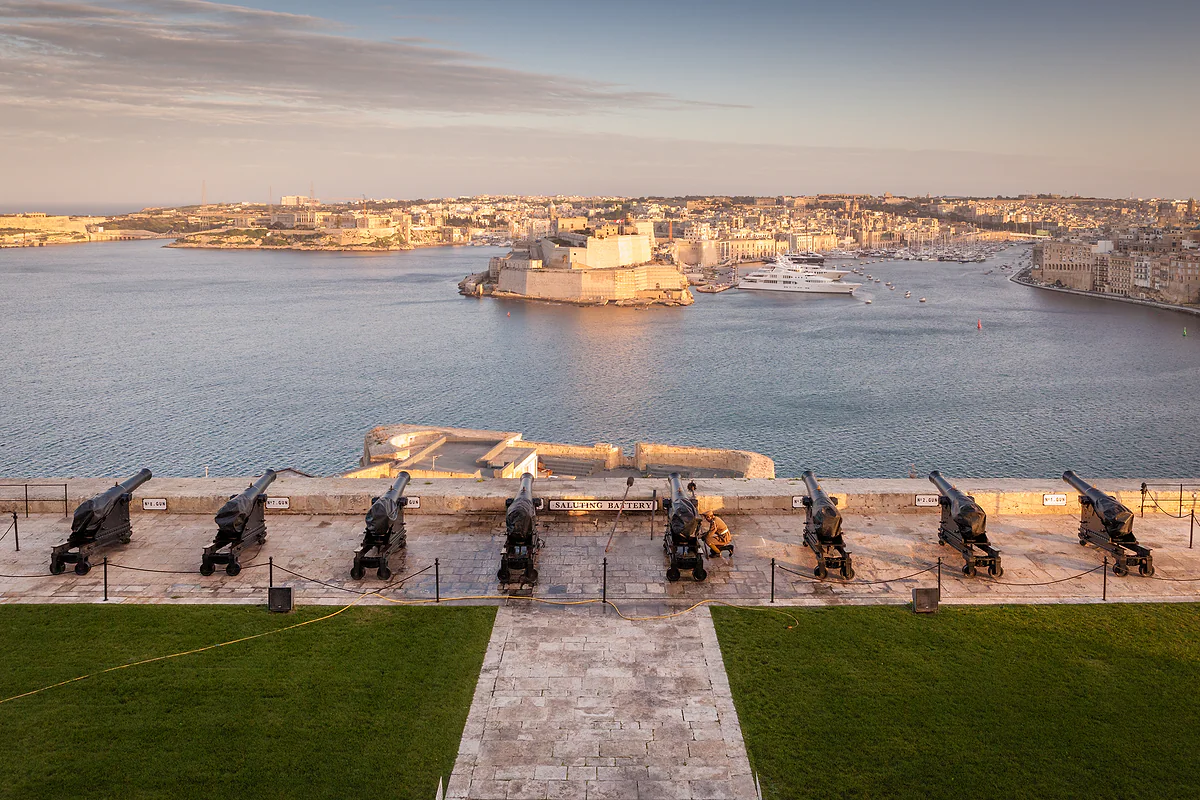
Two firings a day, Monday to Saturday
The Saluting Battery, Valletta's daily gun salute
The Saluting Battery is the line of guns below the Upper Barrakka Gardens in Valletta, fired every day at 12:00 and 16:00, Monday to Saturday. Entry costs €3 for adults and €1 for children aged 5 to 15, card payment only, and you buy your ticket in the gardens.
In 30 seconds
Full read: 4 min
- The Saluting Battery fires at 12:00 and 16:00, Monday to Saturday.
- Tickets are €3 for adults and €1 for ages 5 to 15, card only.
- You enter through the Upper Barrakka Gardens in Valletta.
- The War H.Q. Tunnels tour starts at the battery and costs €17 for adults.
I'd arrive a quarter of an hour before the 12:00 firing, as the battery asks, and watch it from inside. At €3 it's one of the cheapest tickets in Valletta, and the money goes to the volunteers who keep the guns firing.

Before you go
What I would keep in mind
-
01 Money
Cards only at the gate
The battery is a cashless venue, so on-site tickets are card-only. The same goes for Lascaris, the Malta at War Museum and Wirt Artna's other sites.
Malta currency -
02 To save money
Wirt Artna's Heritage Pass
For €50 (€95 for a family) you get one entry to each of eight sites over a week, including the battery, Lascaris, the War H.Q. Tunnels and the Malta at War Museum. It's a different product from Heritage Malta's Multisite Pass.
Heritage Malta Multisite Pass -
03 Worth the splurge
The wartime headquarters tunnels
A guided tour of the War H.Q. Tunnels leaves from the battery. They opened in 1940 as a combined headquarters and NATO used them up to 1977. Adults €17, children €7.
Malta in the Second World War -
04 My tip
No Sunday gun visits
The battery opens Monday to Saturday. If your Valletta day is a Sunday, the gun plan won't work, and nor will it on Christmas Eve, Christmas Day, New Year's Eve, New Year's Day, Good Friday or Easter.
Valletta, Malta's capital
What I would book
My ranking, scored
What I'd do at the Saluting Battery
My own scores out of 10, on what each option gives you and what it costs.
0 of 4 seen
-
Watching the 12:00 firing from inside
The reason to come. The battery asks you to arrive about 15 minutes early.
9.0 out of 10
-
The Grand Harbour view from the battery
You're on the lower terrace of Upper Barrakka, with the Three Cities and Fort St Angelo straight across.
8.6 out of 10
-
The War H.Q. Tunnels tour
Tunnels from 1940 that NATO kept using until 1977. Pricier than the battery, but far more history.
8.2 out of 10
-
Carrying on to Lascaris
The British war rooms are dug in underneath. Better value with Wirt Artna's Heritage Pass.
8.0 out of 10
Few things in Valletta are this cheap or this punctual. Twice a day, at 12:00 and 16:00, a row of guns below the Upper Barrakka Gardens fires out over the Grand Harbour. It’s over quickly, but nothing makes you feel more like you’re in a fortress city, and it costs €3.
What the Saluting Battery is
It’s the gun battery on the lower terrace of Upper Barrakka, on Battery Street. It’s looked after by the Fondazzjoni Wirt Artna, a volunteer outfit that says it couldn’t operate without the people who visit. The same foundation looks after the Lascaris War Rooms in Valletta, the Malta at War Museum in Birgu and Fort Rinella in Kalkara.
The battery fires what its website calls the daily time-gun, and it asks you to turn up about 15 minutes before 12:00 or 16:00. That isn’t fussiness; it gives you time to get in, pay and find a decent spot before things start.
Why a gun goes off at noon
The firing has more history behind it than you’d guess. VisitMalta’s listing explains that for almost 500 years these guns protected the harbour against attack from the sea, and that their position made this the island’s main saluting platform. Salutes were fired from here on state occasions, for anniversaries and religious feasts, and to greet visiting dignitaries and ships.
The noon gun dates from the 1820s. It signalled the exact time so ships’ masters could set their chronometers, which were used to work out longitude at sea until the early 20th century. Those signals ended up setting the pace of life in the city too. Then came almost half a century of silence, until Wirt Artna restored the battery with the Malta Tourism Authority. VisitMalta goes as far as calling it perhaps the oldest saluting battery still in use anywhere in the world, and while I can’t check that “perhaps”, I like that the gun still does the same job.
Getting in and what it costs
You go in through the gardens. The Lascaris website spells it out, the battery is reached through the Upper Barrakka Gardens, where you buy your ticket. Adults aged 16 and over pay €3 and children from 5 to 15 pay €1. Opening hours are 09:30 to 17:30, Monday to Saturday (last admission 17:00), and it closes for Christmas Eve and Day, New Year’s Eve and Day, Good Friday and Easter.
One thing to sort before you arrive. The desk takes cards only, because the battery is cashless, and that applies across all the Wirt Artna sites. Turn up with nothing but coins and you won’t get in.
With children, I think it’s one of Valletta’s best-value visits. It’s €1 per child, the main event happens at a fixed time you can build up to, and nobody has to shuffle quietly through galleries. Two adults and two children come to €8 all in, less than a single adult ticket for the Grandmaster’s Palace (€12).
The headquarters tunnels
A guided tour of the War H.Q. Tunnels sets off from the battery. These tunnels were opened in 1940 as a combined wartime headquarters and NATO kept using them up to 1977. It’s €17 for adults and €7 for children. The tour times on the battery’s website don’t match those on the Lascaris site, so I’d confirm them on the day before planning around one.
For me this is the obvious follow-on from the gun if the war interests you, and it pairs neatly with Lascaris underneath. The full story of Malta’s second siege is told in Malta’s Second World War.
The pass that pays for itself
If you’ll visit several Wirt Artna sites, look at its Heritage Pass. It costs €50 per person or €95 for a family, lasts a week from first use and gives you one entry to each of eight places, namely the battery itself, Lascaris and the headquarters tunnels, plus Fort Rinella, the Malta at War Museum and the Malta Time Gun Museum, with St Thomas Tower and St Peter’s Galleries rounding off the list.
The maths is simple. Lascaris (€20), the tunnels (€17) and the Malta at War Museum (€14) already add up to €51, so with those three the pass has paid off and the rest is extra. Don’t mix it up with Heritage Malta’s Multisite Pass, which is a separate product and isn’t valid here. I compare the two on Malta’s sightseeing passes.
Fitting it into your day
I’d use the 12:00 gun as the hinge of a Valletta morning. Before it, the Co-Cathedral and the Palace; after it, Lascaris or Fort St Elmo. If you miss it, the 16:00 firing works just as well.
Getting here is easy from anywhere in the city. From Castille Place you’re a couple of minutes from the gardens, and the Battery Street steps continue down towards Lascaris if you want to go straight on underground. Coming from the bus terminus, the Lascaris website suggests walking through the Ganado Gardens, which is the route it recommends from there to the war rooms below. Either way, allow a few minutes more than you think, because you still need to buy the ticket before the gun goes. The views from above and the lift down to the ferry are covered on my page about the Upper Barrakka Gardens.
Saluting Battery and War H.Q. Tunnels
| What | Adult (16+) | Child (5-15) |
|---|---|---|
| Saluting Battery | €3 | €1 |
| War H.Q. Tunnels (guided tour) | €17 | €7 |
| Wirt Artna Heritage Pass (one week, eight sites) | €50 per person | Family pass, €95 |
Monday to Saturday, 09:30 to 17:30, last admission 17:00. Closed 24, 25 and 31 December, 1 January, Good Friday and Easter Sunday. Card payment only. The battery's website and the Lascaris website list different tunnel tour times, so check before you plan around them.
Test yourself
True or false?
0/3 Pick before you peek.
-
Valletta's gun is fired three times a day.
See the answer
False. Twice, at 12:00 and 16:00, Monday to Saturday.
-
You can pay cash at the Saluting Battery.
See the answer
False. The ticket desk is card-only; the battery runs as a cashless venue.
-
NATO used the tunnels that start at the battery.
See the answer
True. The War H.Q. Tunnels opened in 1940 as a combined headquarters, and NATO used them up to 1977.
- Firings a day, at 12:00 and 16:00
- 2
- Adult ticket
- €3
- Last year NATO used the tunnels
- 1977
Map
Where Saluting Battery is
Gozo lies to the north-west, across the channel the ferry crosses from Ċirkewwa, with Comino between the two islands. Every number opens its guide.
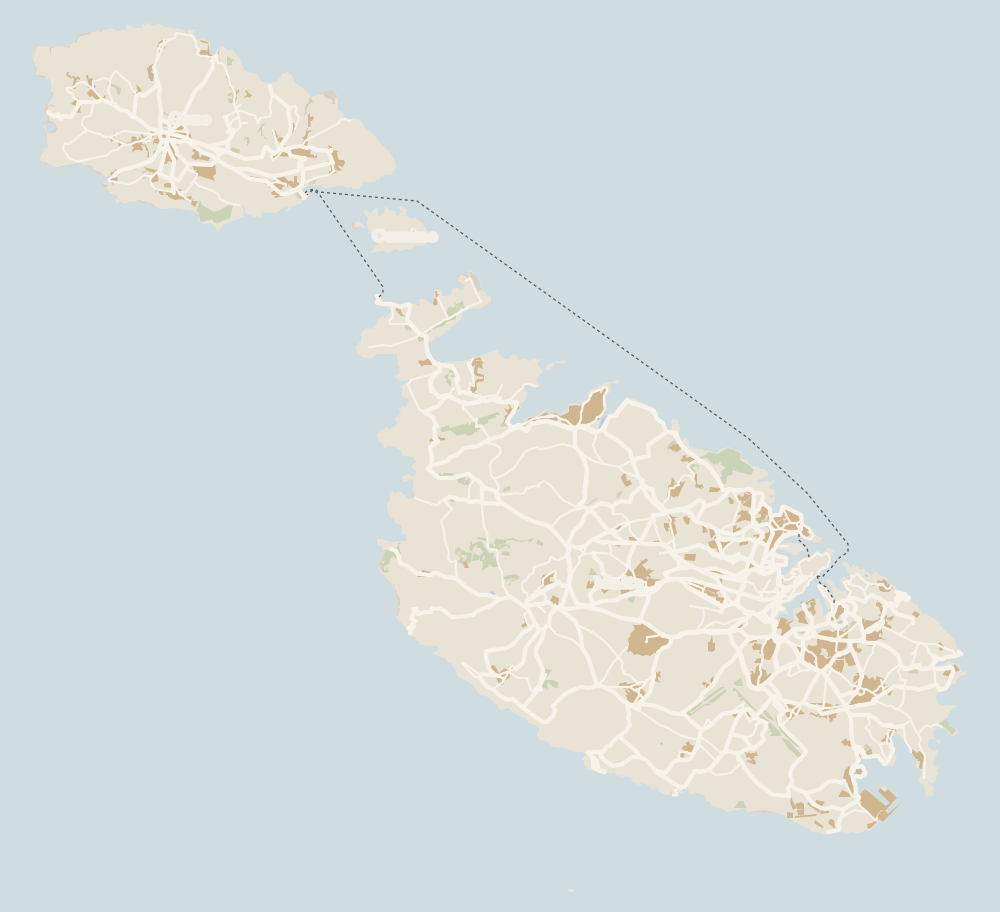 1Valletta 2St John's Co-Cathedral 3Grandmaster's Palace 4Fort St Elmo 5Barrakka Gardens 6Saluting Battery 7MUŻA 8National Museum of Archaeology 9Underground Valletta 10Lascaris War Rooms 11Casa Rocca Piccola 12Manoel Theatre 13City Gate and Parliament 14Valletta Waterfront
 Map data © OpenStreetMap contributors (ODbL)
- 1VallettaFounded 1566, on the UNESCO list since 1980
- 2St John's Co-CathedralFinished in 1577, closed on Sundays
- 3Grandmaster's PalaceHeritage Malta's most visited site
- 4Fort St ElmoFell on 23 June 1565
- 5Barrakka GardensGun salute at 12:00 and 16:00
- 6Saluting BatteryTwo firings a day, Monday to Saturday
- 7MUŻAOpened in late 2018
- 8National Museum of ArchaeologyNeolithic to Phoenician for €5
- 9Underground VallettaThree days a week, booking essential
- 10Lascaris War RoomsEisenhower's advance HQ in 1943
- 11Casa Rocca PiccolaGuided tours on the hour, 10:00 to 16:00
- 12Manoel TheatreOpened on 19 January 1732
- 13City Gate and ParliamentThe city's fifth gate, by Renzo Piano
- 14Valletta Waterfront19 Baroque warehouses from 1752
0 of 279 Malta guides
Your next stamp
- Underground Valletta
- Barrakka Gardens
- Malta in one day
- Grandmaster's Palace
- Mosta Rotunda
- Malta at War Museum
- St John's Co-Cathedral
- Fort Rinella
- Things to do in Malta
- Gozo
- Most beautiful places
- Comino
- Prettiest villages
- UNESCO World Heritage Sites
- Where is Malta
- The Maltese islands
- Towns and villages
- Island of Malta
- Blue Lagoon
- Fort St Angelo
- Gardjola Gardens
- Ħal Saflieni Hypogeum
- Is Malta a country?
- Popeye Village
- Tarxien Temples
- Things to do in Gozo
- Valletta
- Esplora
- Golden Bay
- Gozo day trip
- Inquisitor's Palace
- Population
- St Mary's Tower
- How big is Malta
- Maritime Museum
- Mellieħa Bay
- Fort St Elmo
- Language
- Paradise Bay
- Red Tower
- Religion
- Malta government
- MUŻA
- National Museum of Archaeology
- Lascaris War Rooms
- Casa Rocca Piccola
- Three Cities
- Victoria
- Birgu
- Manoel Theatre
- Weekend in Malta
- Xagħra
- City Gate and Parliament
- Malta in three days
- Nadur
- Senglea
- Cospicua
- Malta in four days
- Qala
- Valletta Waterfront
- Għajnsielem
- Kalkara
- Malta in five days
- Malta in a week
- Paola
- Xewkija
- Sannat
- Tarxien
- Munxar
- Żabbar
- Fgura
- Fontana
- Kerċem
- Luqa
- Floriana
- Marsa
- Mellieħa
- The Citadel, Gozo
- Żebbuġ (Gozo)
- Ġgantija Temples
- Marsalforn
- Santa Luċija
- Ramla Bay
- San Lawrenz
- Xgħajra
- Xwejni salt pans
- Calypso's Cave
- Għarb
- Żejtun
- Għasri
- Gudja
- San Blas Bay
- Għaxaq
- Ħondoq Bay
- Marsaxlokk
- Kirkop
- Marsaxlokk Fish Market
- Mqabba
- St Peter's Pool
- Marsaskala
- Qrendi
- Żurrieq
- Beaches
- Comino ferry
- EU, Schengen and the euro
- Ħaġar Qim and Mnajdra
- Mdina
- Mġarr (Gozo)
- Blue Grotto
- Diving
- Entry requirements
- Mdina Cathedral
- Xewkija Rotunda
- Birżebbuġa
- Money and payments
- Palazzo Falson
- Safi
- Shipwrecks
- Ta' Ċenċ Cliffs
- Għar Dalam
- Mdina Dungeons
- Mġarr ix-Xini
- Prices and budget
- Snorkelling
- Boat trips
- Malta on a budget
- Playmobil FunPark
- Rabat (Malta)
- Xlendi
- Dwejra
- Gozo beaches
- History
- Siġġiewi
- St Paul's Catacombs
- Tipping
- Azure Window
- Domvs Romana
- Għar Lapsi
- Great Siege of 1565
- Plugs
- Limestone Heritage Park
- Second World War
- St Paul's Grotto
- Ta' Pinu Basilica
- Time zone
- Buskett Gardens
- Knights of Malta
- Mobile and roaming
- Wied il-Għasri
- Dingli
- Maltese cross
- Dingli Cliffs
- Flag
- Żebbuġ
- Coat of arms
- Mtarfa
- Balzan
- National anthem
- Lija
- Malta facts
- Game of Thrones
- Iklin
- Attard
- Film locations
- Forts and fortifications
- San Anton Gardens
- Ta' Qali Crafts Village
- Victoria Lines
- Megalithic temples
- Catacombs
- Museums
- Where to eat
- Where to stay
- Churches
- Hotels in Valletta
- Restaurants in Valletta
- Hotels in Sliema
- Maltese food
- Restaurants in Marsaxlokk
- Viewpoints
- Hotels in St Julian's
- Pastizzi
- Walking and hiking
- Hotels in Buġibba and Qawra
- Maltese rabbit stew
- Safety
- Hotels in Mellieħa
- Kinnie and Cisk
- Scams
- Gozo hotels
- Nightlife
- Tap water
- Boat parties
- Holiday packages
- Tourist tax
- All inclusive
- Gay Malta
- Sightseeing passes
- Apartments
- Malta with kids
- Public holidays
- How to get there
- Luxury
- Malta for couples
- Taxis and ride-hailing
- Weather
- Best time to visit
- Cycling
- English schools
- Flights
- Flights from Madrid
- Sea temperature
- Shopping and souvenirs
- Airport
- Free walking tours
- In winter
- Airport transfers
- Day trips and tours
- In summer
- Ferry from Sicily
- In January
- Cruise stop
- In February
- In March
- In April
- In May
- Getting around
- In June
- Buses
- July
- August
- Hop on hop off
- Gozo ferry
- September
- Gozo fast ferry
- October
- November
- Valletta ferries
- Car hire
- December
- Driving
- Events
- St Paul's Bay
- Village feasts
- Buġibba
- Christmas
- Easter
- Qawra
- Carnival
- Xemxija
- Fireworks festival
- Malta National Aquarium
- Isle of MTV
- St Paul's Islands
- Mosta
- Naxxar
- Palazzo Parisio
- Għargħur
- Mġarr (Malta)
- Sliema
- Ta' Ħaġrat and Skorba Temples
- Għajn Tuffieħa Bay
- Tigné Point
- Ġnejna Bay
- St Julian's
- Paceville
- St George's Bay
- Gżira
- Msida
- Ta' Xbiex
- Pietà
- Pembroke
- Swieqi
- San Ġwann
- Birkirkara
- Ħamrun
- Santa Venera
- Qormi
Frequently asked questions
What time does the Valletta noon gun fire?
At 12:00 and 16:00, Monday to Saturday, at the Saluting Battery. The battery suggests arriving about 15 minutes before each firing.
How much is the Saluting Battery?
€3 for adults aged 16 and over and €1 for children aged 5 to 15. It's card payment only, at the ticket desk in the Upper Barrakka Gardens.
Where is the Saluting Battery in Valletta?
On Battery Street, on the lower terrace of the Upper Barrakka Gardens. You go in through the gardens themselves.
Why do they fire a gun at noon in Valletta?
Because from the 1820s the noon gun gave ships' masters the exact time to set their chronometers. Today the battery keeps it going as a tradition, along with gun salutes for important anniversaries.
Is the Saluting Battery open on Sundays?
No. It opens Monday to Saturday, 09:30 to 17:30, and also shuts on 24, 25 and 31 December, 1 January, Good Friday and Easter Sunday.
Is the Wirt Artna Heritage Pass worth it?
If you'll do Lascaris (€20), the War H.Q. Tunnels (€17) and the Malta at War Museum (€14), those three alone come to €51, so the €50 pass already pays off and the other five sites are a bonus.
By
Tourism graduate with a master’s in Tourism Management and Planning from the University of Málaga, who has travelled across Europe. He writes every guide from official sources and his own judgement.
Published on . Facts checked on .
Sources
Photos: Anton Zelenov (CC BY-SA 4.0), via Wikimedia Commons.