Malta and the EU
Is Malta in the EU? Yes, with the euro and inside Schengen
Yes, Malta has been in the European Union since 1 May 2004, in the Schengen area since 21 December 2007 and on the euro since 1 January 2008. For a British visitor that means Schengen entry rules, the 90 days in 180 limit, EES registration at the border and a GHIC for state healthcare.
In 30 seconds
Full read: 3 min
- Malta joined the EU on 1 May 2004, Schengen on 21 December 2007 and the euro on 1 January 2008.
- British visitors follow Schengen rules: 90 days in any 180, with EES registration.
- A GHIC or EHIC covers medically necessary state healthcare.
- It's in the EU, but you drive on the left and plugs are the same as in the UK.
For a British traveller, Malta is a curious mix. The paperwork is pure Schengen, yet you'll drive on the left, plug your charger straight into the wall and be understood in English everywhere. I'd sort the passport dates and leave the adaptor at home.

Before you go
What I would keep in mind
-
01 My tip
Check your passport's issue date
Because Malta follows Schengen rules, gov.uk says your passport must have been issued less than 10 years before you arrive and be valid for at least 3 months after you leave the Schengen area.
Malta entry requirements -
02 Getting there
Roaming isn't guaranteed any more
Since Brexit, surcharge-free roaming in the EU is no longer guaranteed for UK customers, according to gov.uk. Check your own network's policy before you fly.
Malta roaming -
03 Money
Pay in euros, not pounds
Visit Malta warns that shops accepting other currencies may apply conversion charges. When a card machine offers you pounds, I'd always choose euros.
Malta currency -
04 My tip
The plug is the same as at home
EU member or not, Malta uses UK-style three-pin square plugs at 230 V. Your chargers and hairdryer will work without an adaptor.
Malta plug type
Malta is in the European Union, and has been for a while. It became a member in May 2004, joined Schengen at the end of 2007 and switched to the euro in January 2008, according to the country profile the EU publishes. It’s a fair question to ask, because so much about Malta feels British, but since Brexit the answer matters more to a UK traveller than it used to.
Three dates that tell the story
The first is 2004, when Malta and its 316 km² became a member state. The other two came almost together. On 21 December 2007 it entered the Schengen area, and eleven days later, on 1 January 2008, it adopted the euro. Through that January the Maltese lira and the euro circulated side by side, and from February only the euro counted. The rate was fixed at 0.4293 lira to the euro, so one lira was worth roughly €2.33.
Today Malta has six MEPs, five members on the European Economic and Social Committee and five on the Committee of the Regions. It held the Council presidency from January to June 2017 and takes it again from July to December 2030. Its own language, Maltese, is an official EU language alongside English.
What does it mean for a British visitor?
Mostly paperwork. Malta applies Schengen rules, which gov.uk translates as a visa-free allowance of 90 days in every rolling 180, shared with any other Schengen country you visit in that window. The passport itself needs an issue date under ten years old on arrival and at least three months’ validity beyond your departure from the Schengen zone. At the border you may be asked for a return ticket and proof of funds, and on your first trip under the new Entry/Exit System you’ll give a photo and fingerprints at no cost. I’ve gathered all of it in Malta entry requirements.
For healthcare, a GHIC or an older EHIC covers medically necessary state treatment, though gov.uk stresses it’s no substitute for travel insurance. Roaming is the other change. The UK government notes that surcharge-free roaming in the EU is no longer guaranteed, so it’s down to your network; the options are in Malta roaming.
Europe on paper, British in the details
This is the side of Malta I enjoy most. You’re in the EU and the eurozone, yet the island was under British rule until 1964, became a republic within the Commonwealth in 1974 and saw the last British forces leave in 1979. That legacy is everywhere. English is an official language alongside Maltese, you drive on the left and the sockets are three-pin, just as at home. You won’t need an adaptor, and my page on Malta plug type explains the details.
Paying in euros as a UK visitor
The euro is the only legal tender, and the one thing I’d watch is being offered pounds. Visit Malta notes that hotels, larger shops and restaurants may take other currencies, with conversion charges applied. My rule is simple, and I’d always pay in euros and let my own card do the conversion. The detail, including cash, cards and cashpoints, is in Malta currency.
As a non-EU resident, you may also be able to claim back VAT on shopping when you leave the EU. Valletta Cruise Port sets out the scheme as at least €55 spent in one shop and €315 in total per departure, minus a charge of 4% or €23, depending on which works out larger.
A euro with a Maltese stamp
At the till you’ll notice some coins look different. Malta mints euros with its own designs, from the prehistoric Mnajdra temple to the Knights’ eight-pointed cross, and the old lira hasn’t been exchangeable at any bank since 2018. That, along with cards and cashpoints, is covered in Malta currency.
So is Malta part of Italy or the UK?
Neither. It’s an independent state, a single-chamber parliamentary republic in which the prime minister runs the government and the president’s role is mostly ceremonial, as the EU’s profile puts it. The Italian confusion comes from geography, with Sicily just 93 km to the north, and the British one from history. I go into it properly in is Malta a country.
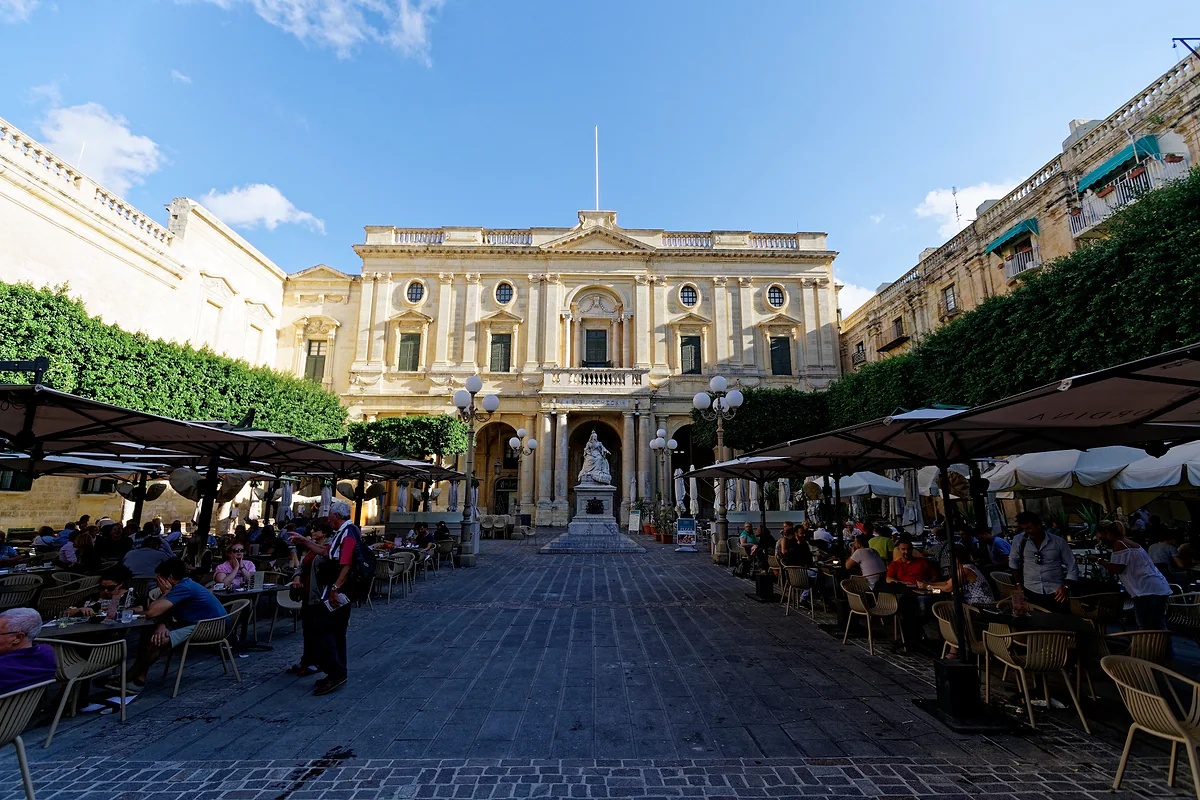
Café terraces in Republic Square, Valletta, with the statue of Queen Victoria in front of the façade of the National Library of Malta.
Malta and Europe: the key dates
| Date | Event | Source |
|---|---|---|
| 21 Sep 1964 | Independence from the United Kingdom | European Commission |
| 13 Dec 1974 | Republic within the Commonwealth | Spanish Foreign Ministry |
| 31 Mar 1979 | Last British base closes | Government of Malta |
| 1 May 2004 | Joins the European Union | europa.eu |
| 21 Dec 2007 | Joins Schengen | europa.eu |
| 1 Jan 2008 | Adopts the euro | europa.eu |
| Jan-Jun 2017 | First EU Council presidency | europa.eu |
| Jul-Dec 2030 | Next EU Council presidency | europa.eu |
Test yourself
True or false?
0/4 Pick before you peek.
-
Malta joined Schengen before it adopted the euro.
See the answer
True. It joined Schengen on 21 December 2007 and adopted the euro eleven days later, on 1 January 2008, according to the EU's own country page.
-
Maltese is an official language of the European Union.
See the answer
True. The EU lists Maltese and English as Malta's official EU languages.
-
British visitors can stay in Malta for 90 days regardless of other Schengen trips.
See the answer
False. The limit is 90 days in any 180-day period across the whole Schengen area, and earlier Schengen visits in those 180 days count towards it.
-
A GHIC covers medically necessary state healthcare in Malta.
See the answer
True. gov.uk confirms a GHIC or EHIC covers medically necessary state healthcare, though it isn't a substitute for travel insurance.
- Year Malta joined the EU
- 2004
- Year Malta adopted the euro
- 2008
- Schengen days for UK visitors
- 90/180
- Maltese MEPs
- 6
0 of 279 Malta guides
Your next stamp
- Is Malta a country?
- Money and payments
- Entry requirements
- Time zone
- Mobile and roaming
- History
- Things to do in Malta
- Gozo
- Most beautiful places
- Comino
- Prettiest villages
- UNESCO World Heritage Sites
- Where is Malta
- The Maltese islands
- Towns and villages
- Island of Malta
- Blue Lagoon
- Fort Rinella
- Fort St Angelo
- Gardjola Gardens
- Ħal Saflieni Hypogeum
- Popeye Village
- Tarxien Temples
- Things to do in Gozo
- Valletta
- Esplora
- Golden Bay
- Gozo day trip
- Inquisitor's Palace
- Population
- St John's Co-Cathedral
- St Mary's Tower
- Grandmaster's Palace
- How big is Malta
- Maritime Museum
- Mellieħa Bay
- Fort St Elmo
- Language
- Malta at War Museum
- Paradise Bay
- Barrakka Gardens
- Red Tower
- Religion
- Malta government
- Saluting Battery
- MUŻA
- National Museum of Archaeology
- Underground Valletta
- Lascaris War Rooms
- Casa Rocca Piccola
- Malta in one day
- Three Cities
- Victoria
- Birgu
- Manoel Theatre
- Weekend in Malta
- Xagħra
- City Gate and Parliament
- Malta in three days
- Nadur
- Senglea
- Cospicua
- Malta in four days
- Qala
- Valletta Waterfront
- Għajnsielem
- Kalkara
- Malta in five days
- Malta in a week
- Paola
- Xewkija
- Sannat
- Tarxien
- Munxar
- Żabbar
- Fgura
- Fontana
- Kerċem
- Luqa
- Floriana
- Marsa
- Mellieħa
- The Citadel, Gozo
- Żebbuġ (Gozo)
- Ġgantija Temples
- Marsalforn
- Santa Luċija
- Ramla Bay
- San Lawrenz
- Xgħajra
- Xwejni salt pans
- Calypso's Cave
- Għarb
- Żejtun
- Għasri
- Gudja
- San Blas Bay
- Għaxaq
- Ħondoq Bay
- Marsaxlokk
- Kirkop
- Marsaxlokk Fish Market
- Mqabba
- St Peter's Pool
- Marsaskala
- Qrendi
- Żurrieq
- Beaches
- Comino ferry
- Ħaġar Qim and Mnajdra
- Mdina
- Mġarr (Gozo)
- Blue Grotto
- Diving
- Mdina Cathedral
- Xewkija Rotunda
- Birżebbuġa
- Palazzo Falson
- Safi
- Shipwrecks
- Ta' Ċenċ Cliffs
- Għar Dalam
- Mdina Dungeons
- Mġarr ix-Xini
- Prices and budget
- Snorkelling
- Boat trips
- Malta on a budget
- Playmobil FunPark
- Rabat (Malta)
- Xlendi
- Dwejra
- Gozo beaches
- Siġġiewi
- St Paul's Catacombs
- Tipping
- Azure Window
- Domvs Romana
- Għar Lapsi
- Great Siege of 1565
- Plugs
- Limestone Heritage Park
- Second World War
- St Paul's Grotto
- Ta' Pinu Basilica
- Buskett Gardens
- Knights of Malta
- Wied il-Għasri
- Dingli
- Maltese cross
- Dingli Cliffs
- Flag
- Żebbuġ
- Coat of arms
- Mtarfa
- Balzan
- National anthem
- Lija
- Malta facts
- Game of Thrones
- Iklin
- Attard
- Film locations
- Forts and fortifications
- San Anton Gardens
- Ta' Qali Crafts Village
- Victoria Lines
- Megalithic temples
- Catacombs
- Museums
- Where to eat
- Where to stay
- Churches
- Hotels in Valletta
- Restaurants in Valletta
- Hotels in Sliema
- Maltese food
- Restaurants in Marsaxlokk
- Viewpoints
- Hotels in St Julian's
- Pastizzi
- Walking and hiking
- Hotels in Buġibba and Qawra
- Maltese rabbit stew
- Safety
- Hotels in Mellieħa
- Kinnie and Cisk
- Scams
- Gozo hotels
- Nightlife
- Tap water
- Boat parties
- Holiday packages
- Tourist tax
- All inclusive
- Gay Malta
- Sightseeing passes
- Apartments
- Malta with kids
- Public holidays
- How to get there
- Luxury
- Malta for couples
- Taxis and ride-hailing
- Weather
- Best time to visit
- Cycling
- English schools
- Flights
- Flights from Madrid
- Sea temperature
- Shopping and souvenirs
- Airport
- Free walking tours
- In winter
- Airport transfers
- Day trips and tours
- In summer
- Ferry from Sicily
- In January
- Cruise stop
- In February
- In March
- In April
- In May
- Getting around
- In June
- Buses
- July
- August
- Hop on hop off
- Gozo ferry
- September
- Gozo fast ferry
- October
- November
- Valletta ferries
- Car hire
- December
- Driving
- Events
- St Paul's Bay
- Village feasts
- Buġibba
- Christmas
- Easter
- Qawra
- Carnival
- Xemxija
- Fireworks festival
- Malta National Aquarium
- Isle of MTV
- St Paul's Islands
- Mosta
- Mosta Rotunda
- Naxxar
- Palazzo Parisio
- Għargħur
- Mġarr (Malta)
- Sliema
- Ta' Ħaġrat and Skorba Temples
- Għajn Tuffieħa Bay
- Tigné Point
- Ġnejna Bay
- St Julian's
- Paceville
- St George's Bay
- Gżira
- Msida
- Ta' Xbiex
- Pietà
- Pembroke
- Swieqi
- San Ġwann
- Birkirkara
- Ħamrun
- Santa Venera
- Qormi
Frequently asked questions
Is Malta in the EU?
Yes. It has been a member state since 1 May 2004, according to the European Union, and has six MEPs in the European Parliament.
Is Malta in the Schengen area?
Yes, since 21 December 2007. British visitors can stay without a visa for up to 90 days in any 180-day period, counting time spent in other Schengen countries.
Does Malta use the euro?
Yes, since 1 January 2008. The Maltese lira and the euro circulated together until 31 January 2008, at a fixed rate of 0.4293 lira to the euro.
Do I need a visa for Malta from the UK?
Not for tourism. gov.uk says you can visit without a visa for up to 90 days in any 180-day period, but your passport must meet the Schengen issue and expiry rules.
Is Malta part of the Commonwealth?
Spain's Foreign Ministry records that Malta became an independent republic within the Commonwealth on 13 December 1974, and it joined the EU in 2004. One doesn't rule out the other.
Can I claim VAT back when shopping in Malta?
As a non-EU resident leaving the EU, possibly. Valletta Cruise Port explains the scheme needs at least €55 spent in one shop and €315 in total per departure, with a fee of €23 or 4%, whichever is higher.
By
Tourism graduate with a master’s in Tourism Management and Planning from the University of Málaga, who has travelled across Europe. He writes every guide from official sources and his own judgement.
Published on . Facts checked on .
Sources
Photos: Diego Delso (CC BY-SA 4.0); Txllxt TxllxT (CC BY-SA 4.0), via Wikimedia Commons.