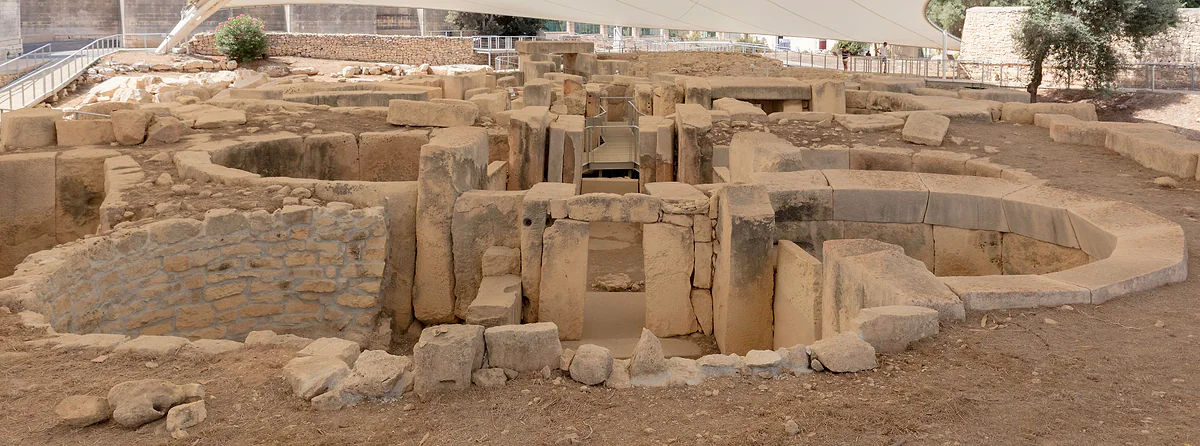
Four megalithic structures in the town
The Tarxien Temples, Neolithic Malta's spirals and carved animals
The Tarxien Temples are a complex of four late Neolithic megalithic structures, found by a farmer in 1913 and part of the Megalithic Temples of Malta World Heritage Site. They stand out for their carved spirals and animals. Tickets cost €6, and the site opens daily from 10:00 to 18:00 until 31 October 2026.
In 30 seconds
Full read: 3 min
- The Tarxien Temples are four late Neolithic megalithic structures in Tarxien.
- They belong to the Megalithic Temples of Malta World Heritage Site.
- They're known for their reliefs of spirals and domestic animals.
- Tickets are €6, dropping to €3 if you present a Hypogeum ticket at the gate.
Tarxien is the temple I'd do straight after the Hypogeum, for proximity and for the discount. But if I could, I'd drop into the National Museum of Archaeology in Valletta first, because the most delicate pieces from here are on show there.

Before you go
What I would keep in mind
-
01 To save money
Half price with a Hypogeum ticket
Show your Ħal Saflieni Hypogeum ticket when buying your Tarxien ticket at the door and you pay half. The offer doesn't apply to online purchases.
the Ħal Saflieni Hypogeum -
02 Most beautiful
The carved spirals and animals
The South Structure is rich in prehistoric art, with spirals and animals in bas-relief, goats, bulls, pigs and a ram, according to Heritage Malta.
-
03 My tip
The fragile finds are in Valletta
Heritage Malta moved the most vulnerable finds to the National Museum of Archaeology, the complex's colossal statue among them.
National Museum of Archaeology in Valletta -
04 To save money
Covered by the Multisite Pass
Unlike the Hypogeum, Tarxien is included in Heritage Malta's €60 pass, valid for 30 days.
Heritage Malta Multisite Pass
What I would book
My ranking, scored
What I'd look out for at Tarxien
My own scores out of 10, for what Tarxien has that Malta's other temples don't.
0 of 5 seen
-
The South Structure reliefs
Spirals and domestic animals in bas-relief. To my mind, what sets Tarxien apart from the island's other temples.
9.2 out of 10
-
The lower half of the colossal statue
A figure in a pleated skirt that Heritage Malta describes as standing sentinel over the South Structure.
8.7 out of 10
-
The six-chambered Central Structure
The last of the four to be built, with signs of corbelled roofing that help you picture the temple with a roof on.
8.2 out of 10
-
The hearths and blocked passages
Two hearths in the corridors and barriers between areas, suggesting not everyone could go everywhere.
7.6 out of 10
-
The Eastern Structure
The oldest part. Only the lower walls survive, but you can still make out its concave façade and five chambers.
7.0 out of 10
For me, Tarxien is the temple in Malta where the art matters most. Others impress with their setting or the sheer size of the stones; this one impresses with what’s carved into them. Spirals, goats, bulls, pigs and a ram in bas-relief, in a complex a few minutes from the Hypogeum.
Four temples found by a farmer
The complex was discovered in 1913 by a farmer, Lorenzo Despott. The excavations, from 1915 to 1919, were led by Sir Themistocles Zammit, Malta’s Director of Museums at the time. They uncovered four megalithic structures from the late Neolithic, later reused in the Early Bronze Age.
The oldest is the Eastern Structure, of which only the lower walls survive, though you can still read its concave façade and five chambers. That same eastern building follows the usual layout of these temples, a central corridor flanked by a semicircular chamber on each side. The six-chambered Central Structure was the last of the four, and it keeps evidence of corbelled roofing that helps you picture these buildings with a roof on.
The complex belongs to the Megalithic Temples of Malta, a UNESCO listing from 1980 that was widened in 1992. That’s six inscribed sites adding up to seven temples, all of which I cover in the megalithic temples of Malta.
What makes the Tarxien Temples special?
The South Structure. Heritage Malta describes it as highly decorated and rich in prehistoric art, with reliefs of spirals and domestic animals, goats, bulls, pigs and a ram. The lower part of a colossal statue of a figure in a pleated skirt stands there too, which Heritage Malta says stands sentinel to the dawn of civilisation. The large number of animal bones found, mostly in specific areas, shows how much these animals mattered.
There are other details I find fascinating. Physical barriers sometimes block the way between areas, which suggests parts of the buildings were open only to part of the community. And in the corridors of the Central Structure there are two hearths, one large and one smaller, evidence that fire was used inside. We know little of what went on here, but everything points to these being central buildings in the lives of those who used them.
The story doesn’t end with the Neolithic. After 2000 BC, in the Early Bronze Age, new arrivals turned part of the site into a cremation cemetery, leaving a rich record of customs and objects.
What’s in Valletta instead
A word to avoid disappointment. Heritage Malta moved the complex’s most vulnerable finds to the National Museum of Archaeology in Valletta for conservation, and that’s where the colossal statue from Tarxien is displayed. So I’d see the National Museum of Archaeology in Valletta first and come here afterwards, with the originals fresh in your mind.
Tarxien, Ħaġar Qim or Ġgantija?
If you’ve time for only one temple, here’s how I’d choose. Ħaġar Qim and Mnajdra are the ones for setting, in Qrendi, with a single €10 ticket for both. Ġgantija, on Gozo, is the one for colossal stones, at €10 with the Ta’ Kola windmill. Tarxien is the one for detail, the cheapest of the three at €6, and the one that pairs best with the Hypogeum, just minutes away, in a single morning. On a first trip with no time for Gozo, I’d do Tarxien with the Hypogeum and keep Ħaġar Qim for another day.
Prices, opening times and pairing it up
An adult ticket is €6, the concession rate for youths, students and over-60s is €4.50, and a child between 6 and 11 costs €3. It’s included in the Multisite Pass. The season timetable, 10:00 to 18:00 daily, lasts until 31 October 2026, and the winter one, to 28 February 2027, is 09:00 to 17:00. There are audio guides in several languages, lockers, and a fully accessible walkway round the site.
The obvious pairing is the Ħal Saflieni Hypogeum, a few minutes away. Buy your Tarxien ticket at the door, show the Hypogeum one, and it’s half price. The closest bus stop, Heritage Malta says, is five minutes away on foot. And if you want more, there’s a combined ticket with Kordin III in Paola, open only on the second Sunday of each month. The town itself is covered in Tarxien, the temple town.
Tarxien Temples tickets
| Ticket | Price |
|---|---|
| Adults (18+) | €6 |
| Youths 12-17, over-60s and students | €4.50 |
| Children 6-11 | €3 |
| Children 1-5 | Free |
| Showing a Hypogeum ticket, Tarxien ticket bought at the door | 50% off |
| Heritage Malta Multisite Pass | Included |
Prices from the Heritage Malta site page, 28-09-2026. A combined ticket with Kordin III is available.
Opening hours (2026-2027)
| Period | Hours |
|---|---|
| 1 March to 31 October 2026 | 10:00-18:00, daily |
| 1 November 2026 to 28 February 2027 | 09:00-17:00, daily |
Closed on 1 January, Good Friday and 24, 25 and 31 December. Last admission 30 minutes before closing.
Test yourself
True or false?
0/3 Pick before you peek.
-
A farmer discovered the Tarxien Temples.
See the answer
True. Lorenzo Despott found them in 1913, and Sir Themistocles Zammit excavated them between 1915 and 1919.
-
Tarxien only has Neolithic remains.
See the answer
False. In the Early Bronze Age, after 2000 BC, part of the site was turned into a cremation cemetery.
-
The Tarxien Temples are covered by the Multisite Pass.
See the answer
True. Yes, unlike the Ħal Saflieni Hypogeum, which Heritage Malta's pass excludes.
- Year of discovery
- 1913
- Megalithic structures in the complex
- 4
- Adult ticket
- €6
- Off with a Hypogeum ticket
- 50%
Map
Where Tarxien Temples is
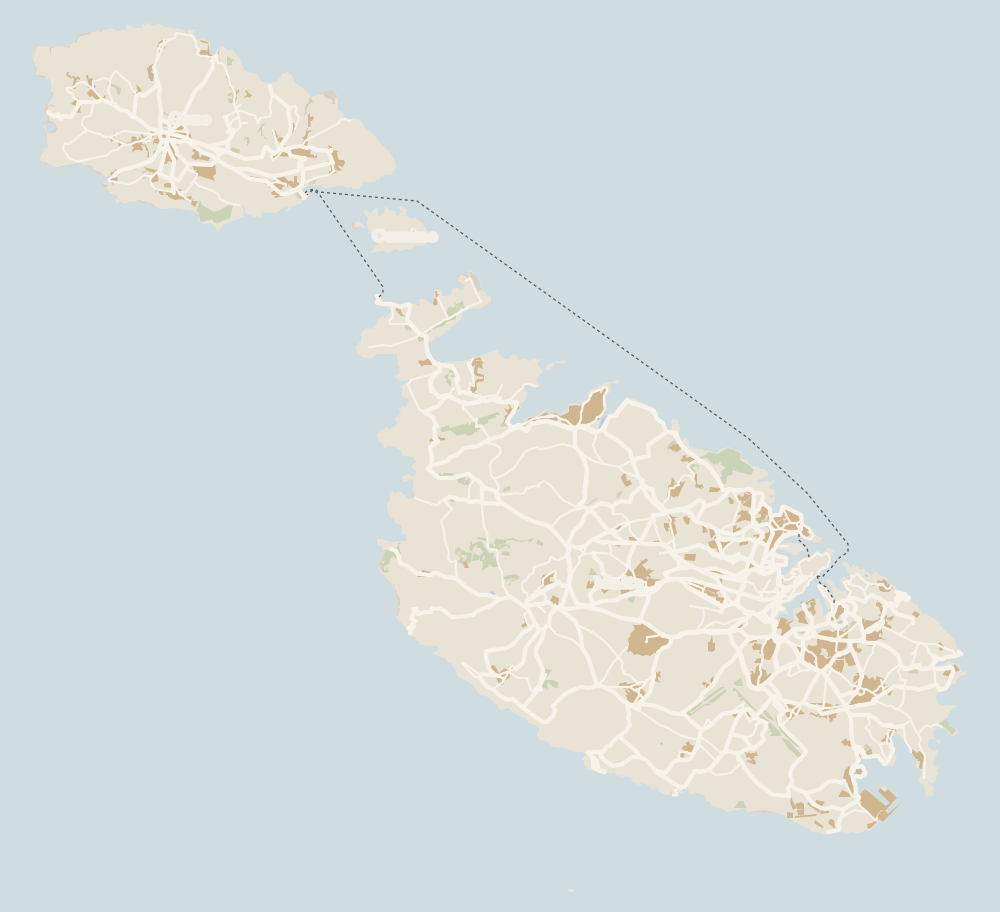
Gozo lies to the north-west, across the channel the ferry crosses from Ċirkewwa, with Comino between the two islands. Every number opens its guide.
0 of 279 Malta guides
Your next stamp
- Megalithic temples
- Tarxien
- Ħaġar Qim and Mnajdra
- UNESCO World Heritage Sites
- Ta' Ħaġrat and Skorba Temples
- Ħal Saflieni Hypogeum
- National Museum of Archaeology
- Malta in four days
- Things to do in Malta
- Gozo
- Most beautiful places
- Comino
- Prettiest villages
- Where is Malta
- The Maltese islands
- Towns and villages
- Island of Malta
- Blue Lagoon
- Fort Rinella
- Fort St Angelo
- Gardjola Gardens
- Is Malta a country?
- Popeye Village
- Things to do in Gozo
- Valletta
- Esplora
- Golden Bay
- Gozo day trip
- Inquisitor's Palace
- Population
- St John's Co-Cathedral
- St Mary's Tower
- Grandmaster's Palace
- How big is Malta
- Maritime Museum
- Mellieħa Bay
- Fort St Elmo
- Language
- Malta at War Museum
- Paradise Bay
- Barrakka Gardens
- Red Tower
- Religion
- Malta government
- Saluting Battery
- MUŻA
- Underground Valletta
- Lascaris War Rooms
- Casa Rocca Piccola
- Malta in one day
- Three Cities
- Victoria
- Birgu
- Manoel Theatre
- Weekend in Malta
- Xagħra
- City Gate and Parliament
- Malta in three days
- Nadur
- Senglea
- Cospicua
- Qala
- Valletta Waterfront
- Għajnsielem
- Kalkara
- Malta in five days
- Malta in a week
- Paola
- Xewkija
- Sannat
- Munxar
- Żabbar
- Fgura
- Fontana
- Kerċem
- Luqa
- Floriana
- Marsa
- Mellieħa
- The Citadel, Gozo
- Żebbuġ (Gozo)
- Ġgantija Temples
- Marsalforn
- Santa Luċija
- Ramla Bay
- San Lawrenz
- Xgħajra
- Xwejni salt pans
- Calypso's Cave
- Għarb
- Żejtun
- Għasri
- Gudja
- San Blas Bay
- Għaxaq
- Ħondoq Bay
- Marsaxlokk
- Kirkop
- Marsaxlokk Fish Market
- Mqabba
- St Peter's Pool
- Marsaskala
- Qrendi
- Żurrieq
- Beaches
- Comino ferry
- EU, Schengen and the euro
- Mdina
- Mġarr (Gozo)
- Blue Grotto
- Diving
- Entry requirements
- Mdina Cathedral
- Xewkija Rotunda
- Birżebbuġa
- Money and payments
- Palazzo Falson
- Safi
- Shipwrecks
- Ta' Ċenċ Cliffs
- Għar Dalam
- Mdina Dungeons
- Mġarr ix-Xini
- Prices and budget
- Snorkelling
- Boat trips
- Malta on a budget
- Playmobil FunPark
- Rabat (Malta)
- Xlendi
- Dwejra
- Gozo beaches
- History
- Siġġiewi
- St Paul's Catacombs
- Tipping
- Azure Window
- Domvs Romana
- Għar Lapsi
- Great Siege of 1565
- Plugs
- Limestone Heritage Park
- Second World War
- St Paul's Grotto
- Ta' Pinu Basilica
- Time zone
- Buskett Gardens
- Knights of Malta
- Mobile and roaming
- Wied il-Għasri
- Dingli
- Maltese cross
- Dingli Cliffs
- Flag
- Żebbuġ
- Coat of arms
- Mtarfa
- Balzan
- National anthem
- Lija
- Malta facts
- Game of Thrones
- Iklin
- Attard
- Film locations
- Forts and fortifications
- San Anton Gardens
- Ta' Qali Crafts Village
- Victoria Lines
- Catacombs
- Museums
- Where to eat
- Where to stay
- Churches
- Hotels in Valletta
- Restaurants in Valletta
- Hotels in Sliema
- Maltese food
- Restaurants in Marsaxlokk
- Viewpoints
- Hotels in St Julian's
- Pastizzi
- Walking and hiking
- Hotels in Buġibba and Qawra
- Maltese rabbit stew
- Safety
- Hotels in Mellieħa
- Kinnie and Cisk
- Scams
- Gozo hotels
- Nightlife
- Tap water
- Boat parties
- Holiday packages
- Tourist tax
- All inclusive
- Gay Malta
- Sightseeing passes
- Apartments
- Malta with kids
- Public holidays
- How to get there
- Luxury
- Malta for couples
- Taxis and ride-hailing
- Weather
- Best time to visit
- Cycling
- English schools
- Flights
- Flights from Madrid
- Sea temperature
- Shopping and souvenirs
- Airport
- Free walking tours
- In winter
- Airport transfers
- Day trips and tours
- In summer
- Ferry from Sicily
- In January
- Cruise stop
- In February
- In March
- In April
- In May
- Getting around
- In June
- Buses
- July
- August
- Hop on hop off
- Gozo ferry
- September
- Gozo fast ferry
- October
- November
- Valletta ferries
- Car hire
- December
- Driving
- Events
- St Paul's Bay
- Village feasts
- Buġibba
- Christmas
- Easter
- Qawra
- Carnival
- Xemxija
- Fireworks festival
- Malta National Aquarium
- Isle of MTV
- St Paul's Islands
- Mosta
- Mosta Rotunda
- Naxxar
- Palazzo Parisio
- Għargħur
- Mġarr (Malta)
- Sliema
- Għajn Tuffieħa Bay
- Tigné Point
- Ġnejna Bay
- St Julian's
- Paceville
- St George's Bay
- Gżira
- Msida
- Ta' Xbiex
- Pietà
- Pembroke
- Swieqi
- San Ġwann
- Birkirkara
- Ħamrun
- Santa Venera
- Qormi
Frequently asked questions
How much are Tarxien Temples tickets?
€6 for adults, €4.50 for youths, over-60s and students, and €3 for children aged 6 to 11. Show a Hypogeum ticket when buying at the Tarxien desk and you pay half.
What are the Tarxien Temples opening hours?
Until 31 October 2026, daily from 10:00 to 18:00. From 1 November to 28 February 2027, 09:00 to 17:00.
Where are the Tarxien Temples?
On Triq It-Tempji Neolitici in Tarxien, a few minutes from the Ħal Saflieni Hypogeum in neighbouring Paola.
Who discovered the Tarxien Temples?
The farmer Lorenzo Despott, in 1913. Excavations from 1915 to 1919 were led by Sir Themistocles Zammit, then Director of Museums.
What is the 'fat lady' at Tarxien?
I assume people mean the complex's colossal statue, a figure in a pleated skirt of which the lower half survives. The National Museum of Archaeology in Valletta displays the colossal statue from Tarxien.
Are the Tarxien Temples wheelchair accessible?
Yes. Heritage Malta says the complex has a dedicated, fully wheelchair-accessible walkway, plus accessible toilets.
By
Tourism graduate with a master’s in Tourism Management and Planning from the University of Málaga, who has travelled across Europe. He writes every guide from official sources and his own judgement.
Published on . Facts checked on .
Sources
Photos: Diego Delso (CC BY-SA 4.0), via Wikimedia Commons.