Rabat, at Mdina's gates
The Domvs Romana, a wealthy Melite household and its mosaics
The Domvs Romana is a Roman noble's town house in Rabat, found by chance in 1881 and a museum since 1882, known for its mosaics and a set of statues of Emperor Claudius and his family. Heritage Malta runs it; adult tickets cost €6 and it opens Tuesday to Sunday, 09:00 to 17:00.
In 30 seconds
Full read: 4 min
- The Domvs Romana is a Roman aristocrat's house from ancient Melite, in Rabat.
- It was found in 1881 and has been a museum since 1882.
- It holds mosaics and statues of Emperor Claudius and his family.
- Tickets €6; open Tuesday to Sunday, 09:00 to 17:00.
Don't expect a whole villa, because very little of the house survives. What makes the visit are the peristyle mosaics and the statues of Claudius's family, and I'd head straight for those before reading the cases.

Before you go
What I would keep in mind
-
01 Most beautiful
Sosos' doves
In the middle of the peristyle, over the impluvium, is a mosaic panel with the drinking-doves motif attributed to Sosos. It's the piece Heritage Malta puts first.
-
02 To save money
Part of the Rabat Combo
The €14 combo bundles the Domvs, St Paul's Catacombs and Mdina's Natural History Museum. Bought separately, the three come to €17.
St Paul's Catacombs -
03 My tip
Closed on Mondays
It opens Tuesday to Sunday. From 4 January to 28 February 2027 it also shuts on Wednesdays, so check the day before if you're visiting in winter.
-
04 Getting there
Between Rabat and Mdina
It's on Wesgħet il-Mużew, two minutes' walk from the bus stop according to Heritage Malta, and one of the car parks for Mdina is close by.
Mdina
What I would book
The Domvs Romana is the visit that balances out the catacombs. There you see how Melite, the Roman town that covered Mdina and Rabat, buried its dead; here you see how its wealthy lived. It’s one of my favourite small museums in Malta, provided you don’t walk in expecting a villa still standing.
A chance find in 1881
Heritage Malta tells how the house was discovered by accident in 1881. Very little of the building itself, a domus or noble town house, was recovered, but the mosaics and other finds survived, and they’re enough to picture how rich it once was. A building went up over the find to protect it, the first on the islands purpose-built to house an archaeological site and its collection.
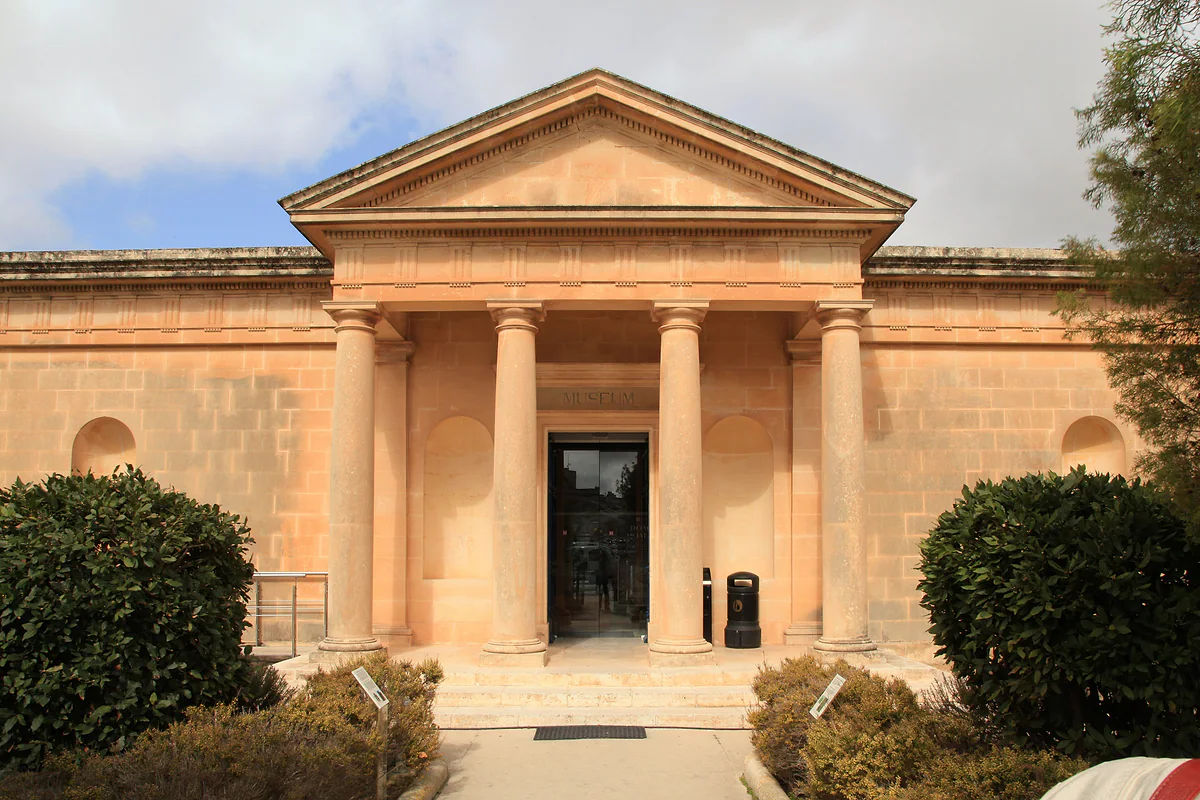
The museum opened in 1882 and became the store for Roman pieces turning up all over the island, including bits of marble that had been lying about in the streets of Mdina. Over the years it gained a façade with a triangular pediment, the 1920s portico you see as you arrive, and a large display hall. During the Second World War it closed and served as a small restoration centre, reopening in 1945.
Villa or town house?
Town house. Heritage Malta’s FAQs draw a distinction I find useful. A villa stood in the countryside and was usually linked to farming or had baths, while a domus was simply a home in a town. This was the town house of a rich family, and the museum answers the question of whether its owners were rich or poor in a single word.
How old are the mosaics?
Older than most people expect. VisitMalta’s listing dates them to the first quarter of the first century BC and calls them an excellent illustration of Hellenistic pictorial culture, laid with an extremely fine technique. It ranks them among the oldest mosaic compositions in the western Mediterranean, alongside those of Pompeii and Sicily, and suggests that parts of them came from highly skilled artists working in specialised workshops.
The main pavement, framed by a Doric peristyle, is on the lower floor, and other fine pieces fill the rooms next to it. The same listing notes that the imagery is usually read as an allegory of autumn, and that another panel of the same quality seems to have marked the main entrance to the house. I’d look at the floors first and the display cases afterwards, because the mosaics are what makes this house unique on the island.
What you shouldn’t miss
First, the mosaics. In the peristyle, the colonnaded courtyard, over the impluvium that caught the rainwater, is a central panel with a doves motif attributed to Sosos, which is the piece Heritage Malta leads with. The peristyle is original, except for the columns.
Second, the statues. Heritage Malta points out that this is the only set of marble statues of Emperor Claudius and his family that can be seen in a private house, when such works usually stood in public spaces. Among them is a bust of Claudia Antonia, the emperor’s daughter.
The rest of the museum is laid out to show you the life of an aristocratic Roman family, from who did what in the household to fashion, schooling, entertainment, food and drink. Everything on display is original, including a skeleton from the Muslim-era cemetery found on the site.
What the Rabat Combo adds
If you buy the €14 combo, the third site included is the National Museum of Natural History in Mdina’s Palazzo Vilhena, and it’s worth knowing what that is. The palace dates from 1724, when Grand Master Vilhena had it built to plans by Charles François de Mondion, a French architect. Before becoming a museum it served as a hospital in the 1837 cholera outbreak, a sanatorium for British service personnel from 1860 and a tuberculosis clinic until 1956, opening as a museum on 22 June 1973.
Heritage Malta says it holds more than 10,000 mineral and geological items and 12,000 bird and mammal specimens. One hall is devoted to the islets, Filfla, Fungus Rock, St Paul’s Islands and Comino. With children in tow, it’s the add-on I’d choose after the Domvs.
Tickets, hours and access
Adults pay €6, the reduced rate is €4.50 and a child’s ticket, for ages 6 to 11, is €3. It opens Tuesday to Sunday, 09:00 until 17:00, up to 3 January 2027; after that and through to the end of February it’s also shut on Wednesdays. Be there at least thirty minutes before closing.
Heritage Malta rates it fully accessible, with accessible toilets. There are lockers and baby-changing facilities, and you can request a guided tour through its website. If you’d like to read up first, Heritage Malta sells an official guidebook to the Domvs Romana in its online shop, and ticket holders get 15% off guidebooks at the site shop. One more practical detail. The Domvs is one of the places where Heritage Malta sells last-minute Hypogeum tickets after 12:00, at €50, for the following day only and on a first-come basis, so it’s worth knowing if Paola is still on your list.
How to combine it
It’s on Wesgħet il-Mużew in Rabat, next to Mdina, two minutes’ walk from the bus stop. Buses to Rabat include the 51, 52, 53 and 56 from Valletta, the 202 from Sliema, the 186 from Buġibba and the 214 or TD1 from the airport, according to Palazzo Falson’s visitor page. If you’re also doing St Paul’s Catacombs and the Natural History Museum, the €14 Rabat Combo saves you €3. I’d go catacombs first thing, the Domvs mid-morning and then Mdina, a short stroll away.
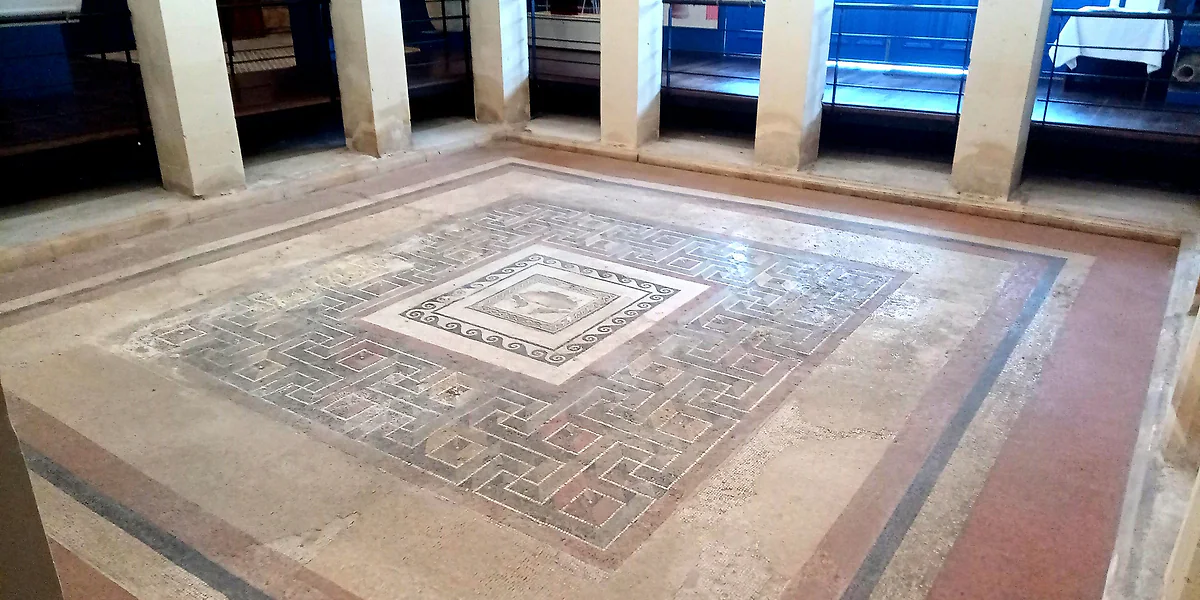
The geometric mosaic floor of the peristyle in the Roman house at Rabat, with its three-dimensional border, kept under cover.
Tickets (Heritage Malta, 2026)
| Ticket | Price |
|---|---|
| Adult (18+) | €6 |
| Youth 12-17, senior 60+ or student | €4.50 |
| Child 6-11 | €3 |
| Aged 1 to 5 | Free |
| Rabat Combo, adult | €14 |
Heritage Malta members and Heritage Malta Passport holders go free. The Rabat Combo is valid for 30 days from first use.
Opening hours
| Period | Days | Hours |
|---|---|---|
| Until 3 Jan 2027 | Tuesday to Sunday | 09:00-17:00 |
| 4 Jan to 28 Feb 2027 | Tue, Thu, Fri, Sat and Sun | 09:00-17:00 |
Last entry 30 minutes before closing. Closed on 1 January, Good Friday and 24, 25 and 31 December.
Test yourself
True or false?
0/4 Pick before you peek.
-
The Domvs Romana is a Roman country villa.
See the answer
False. It's a town house, a domus. Heritage Malta explains that villas stood in the countryside and were tied to farming, while a domus was purely a home in a town.
-
It was the first building in Malta put up to protect an archaeological site.
See the answer
True. According to Heritage Malta, the 1882 museum was the first structure on the islands purpose-built to protect a site and its collection.
-
The peristyle columns are original.
See the answer
False. Heritage Malta says the peristyle is original apart from the columns.
-
The museum closed during the Second World War.
See the answer
True. It served as a small restoration centre during the war and reopened to the public in 1945.
- Year of discovery
- 1881
- Museum opened
- 1882
- Adult ticket
- €6
- Reopened after the war
- 1945
Map
Where Domvs Romana is
Gozo lies to the north-west, across the channel the ferry crosses from Ċirkewwa, with Comino between the two islands. Every number opens its guide.
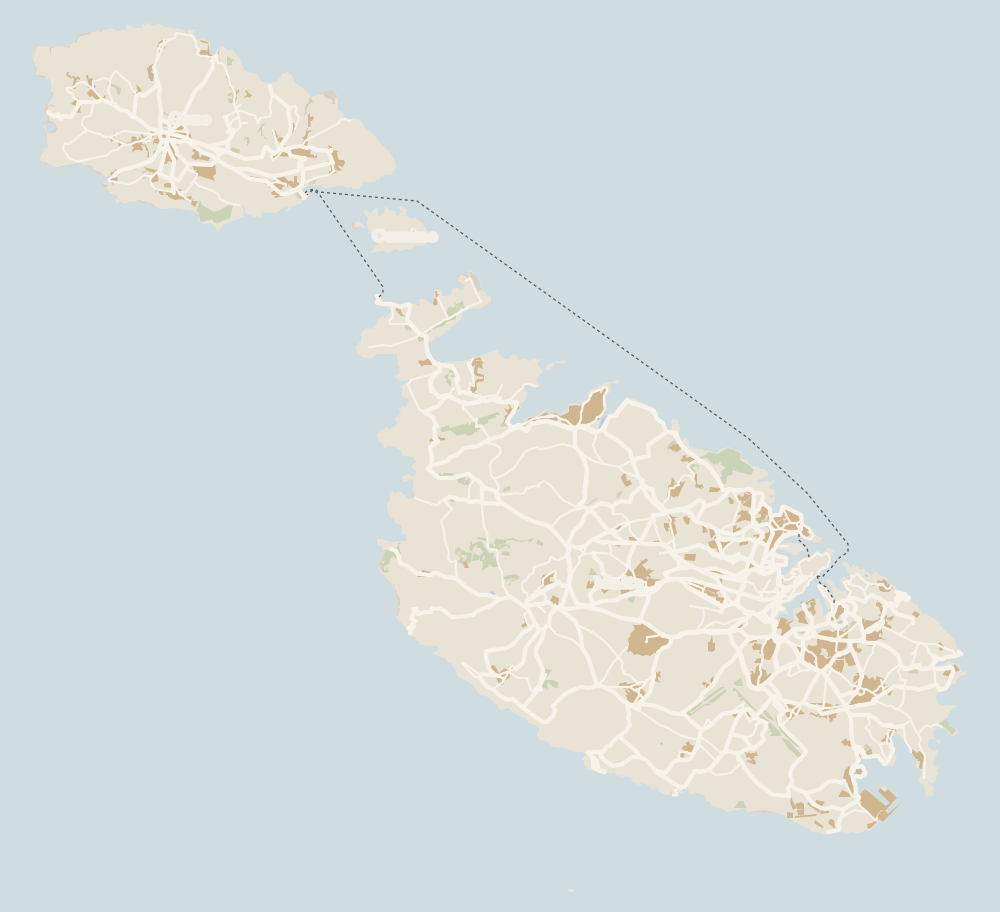 1Rabat (Malta) 2St Paul's Catacombs 3Domvs Romana 4St Paul's Grotto
 Map data © OpenStreetMap contributors (ODbL)
0 of 279 Malta guides
Your next stamp
- Rabat (Malta)
- St Paul's Catacombs
- Mosta Rotunda
- Mdina
- St Paul's Grotto
- Inquisitor's Palace
- National Museum of Archaeology
- Casa Rocca Piccola
- Things to do in Malta
- Gozo
- Most beautiful places
- Comino
- Prettiest villages
- UNESCO World Heritage Sites
- Where is Malta
- The Maltese islands
- Towns and villages
- Island of Malta
- Blue Lagoon
- Fort Rinella
- Fort St Angelo
- Gardjola Gardens
- Ħal Saflieni Hypogeum
- Is Malta a country?
- Popeye Village
- Tarxien Temples
- Things to do in Gozo
- Valletta
- Esplora
- Golden Bay
- Gozo day trip
- Population
- St John's Co-Cathedral
- St Mary's Tower
- Grandmaster's Palace
- How big is Malta
- Maritime Museum
- Mellieħa Bay
- Fort St Elmo
- Language
- Malta at War Museum
- Paradise Bay
- Barrakka Gardens
- Red Tower
- Religion
- Malta government
- Saluting Battery
- MUŻA
- Underground Valletta
- Lascaris War Rooms
- Malta in one day
- Three Cities
- Victoria
- Birgu
- Manoel Theatre
- Weekend in Malta
- Xagħra
- City Gate and Parliament
- Malta in three days
- Nadur
- Senglea
- Cospicua
- Malta in four days
- Qala
- Valletta Waterfront
- Għajnsielem
- Kalkara
- Malta in five days
- Malta in a week
- Paola
- Xewkija
- Sannat
- Tarxien
- Munxar
- Żabbar
- Fgura
- Fontana
- Kerċem
- Luqa
- Floriana
- Marsa
- Mellieħa
- The Citadel, Gozo
- Żebbuġ (Gozo)
- Ġgantija Temples
- Marsalforn
- Santa Luċija
- Ramla Bay
- San Lawrenz
- Xgħajra
- Xwejni salt pans
- Calypso's Cave
- Għarb
- Żejtun
- Għasri
- Gudja
- San Blas Bay
- Għaxaq
- Ħondoq Bay
- Marsaxlokk
- Kirkop
- Marsaxlokk Fish Market
- Mqabba
- St Peter's Pool
- Marsaskala
- Qrendi
- Żurrieq
- Beaches
- Comino ferry
- EU, Schengen and the euro
- Ħaġar Qim and Mnajdra
- Mġarr (Gozo)
- Blue Grotto
- Diving
- Entry requirements
- Mdina Cathedral
- Xewkija Rotunda
- Birżebbuġa
- Money and payments
- Palazzo Falson
- Safi
- Shipwrecks
- Ta' Ċenċ Cliffs
- Għar Dalam
- Mdina Dungeons
- Mġarr ix-Xini
- Prices and budget
- Snorkelling
- Boat trips
- Malta on a budget
- Playmobil FunPark
- Xlendi
- Dwejra
- Gozo beaches
- History
- Siġġiewi
- Tipping
- Azure Window
- Għar Lapsi
- Great Siege of 1565
- Plugs
- Limestone Heritage Park
- Second World War
- Ta' Pinu Basilica
- Time zone
- Buskett Gardens
- Knights of Malta
- Mobile and roaming
- Wied il-Għasri
- Dingli
- Maltese cross
- Dingli Cliffs
- Flag
- Żebbuġ
- Coat of arms
- Mtarfa
- Balzan
- National anthem
- Lija
- Malta facts
- Game of Thrones
- Iklin
- Attard
- Film locations
- Forts and fortifications
- San Anton Gardens
- Ta' Qali Crafts Village
- Victoria Lines
- Megalithic temples
- Catacombs
- Museums
- Where to eat
- Where to stay
- Churches
- Hotels in Valletta
- Restaurants in Valletta
- Hotels in Sliema
- Maltese food
- Restaurants in Marsaxlokk
- Viewpoints
- Hotels in St Julian's
- Pastizzi
- Walking and hiking
- Hotels in Buġibba and Qawra
- Maltese rabbit stew
- Safety
- Hotels in Mellieħa
- Kinnie and Cisk
- Scams
- Gozo hotels
- Nightlife
- Tap water
- Boat parties
- Holiday packages
- Tourist tax
- All inclusive
- Gay Malta
- Sightseeing passes
- Apartments
- Malta with kids
- Public holidays
- How to get there
- Luxury
- Malta for couples
- Taxis and ride-hailing
- Weather
- Best time to visit
- Cycling
- English schools
- Flights
- Flights from Madrid
- Sea temperature
- Shopping and souvenirs
- Airport
- Free walking tours
- In winter
- Airport transfers
- Day trips and tours
- In summer
- Ferry from Sicily
- In January
- Cruise stop
- In February
- In March
- In April
- In May
- Getting around
- In June
- Buses
- July
- August
- Hop on hop off
- Gozo ferry
- September
- Gozo fast ferry
- October
- November
- Valletta ferries
- Car hire
- December
- Driving
- Events
- St Paul's Bay
- Village feasts
- Buġibba
- Christmas
- Easter
- Qawra
- Carnival
- Xemxija
- Fireworks festival
- Malta National Aquarium
- Isle of MTV
- St Paul's Islands
- Mosta
- Naxxar
- Palazzo Parisio
- Għargħur
- Mġarr (Malta)
- Sliema
- Ta' Ħaġrat and Skorba Temples
- Għajn Tuffieħa Bay
- Tigné Point
- Ġnejna Bay
- St Julian's
- Paceville
- St George's Bay
- Gżira
- Msida
- Ta' Xbiex
- Pietà
- Pembroke
- Swieqi
- San Ġwann
- Birkirkara
- Ħamrun
- Santa Venera
- Qormi
Frequently asked questions
How much does the Domvs Romana cost?
€6 for adults, €4.50 for 12 to 17-year-olds, over-60s and students, and €3 for children aged 6 to 11. The €14 Rabat Combo adds St Paul's Catacombs and Mdina's Natural History Museum.
What are the Domvs Romana's opening hours?
Tuesday to Sunday, 09:00 to 17:00, until 3 January 2027. From 4 January to 28 February 2027 it closes on Mondays and Wednesdays.
What is there to see at the Domvs Romana?
The house's mosaics, including the doves in the peristyle, a set of marble statues of Emperor Claudius and his family, and everyday objects from a wealthy Roman household.
Where is the Domvs Romana?
On Wesgħet il-Mużew in Rabat, next to Mdina. The nearest bus stop is two minutes' walk away.
Is it wheelchair accessible?
Yes. Heritage Malta rates it fully accessible, with accessible toilets and blue-badge parking bays where the site allows.
By
Tourism graduate with a master’s in Tourism Management and Planning from the University of Málaga, who has travelled across Europe. He writes every guide from official sources and his own judgement.
Published on . Facts checked on .
Sources
Photos: Frank Vincentz (CC BY-SA 3.0); A.-K. D. (CC BY-SA 4.0), via Wikimedia Commons.