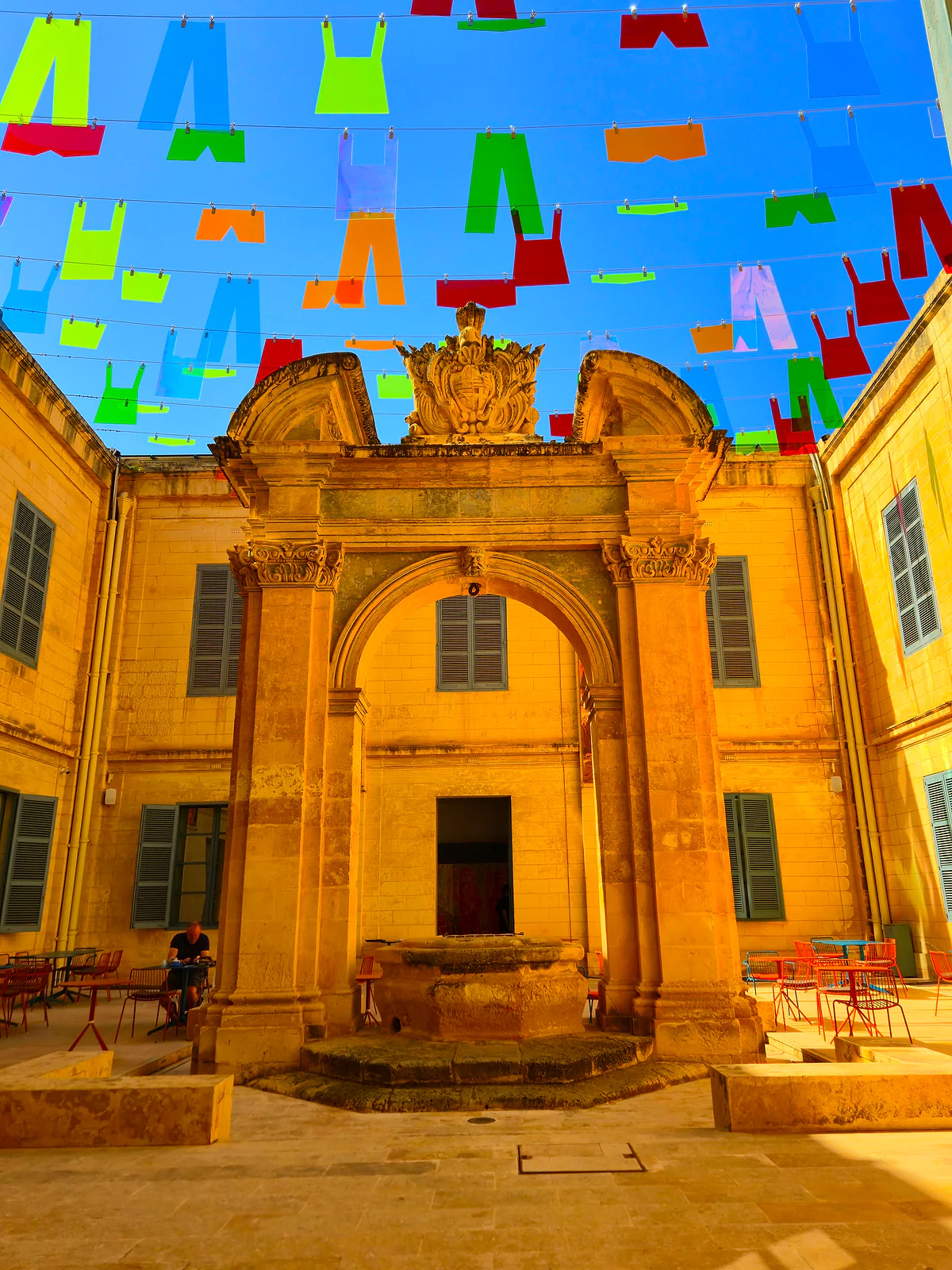
Three days a week, booking essential
Underground Valletta, the city dug out beneath the city
Underground Valletta is Heritage Malta's tour of the tunnels, cisterns and air-raid shelters beneath Valletta. Tours run on Mondays, Wednesdays and Sundays at 10:00, 11:00, 12:00 and 13:00, must be booked in advance, and meet at MUŻA half an hour before. Adults pay €15, and under-6s aren't admitted.
In 30 seconds
Full read: 3 min
- Underground Valletta is Heritage Malta's tour of the tunnels, cisterns and shelters under the city.
- Tours run only on Mondays, Wednesdays and Sundays at 10:00, 11:00, 12:00 and 13:00, pre-booked.
- Adults pay €15 and everyone else €10; the Multisite Pass doesn't cover it.
- Meet at MUŻA 30 minutes early in closed shoes; under-6s aren't admitted.
I'd book as soon as my dates were fixed, as there are only four tours on three days a week. And I'd pair it with MUŻA, the meeting point, going round the museum first so the half-hour wait isn't wasted.

Before you go
What I would keep in mind
-
01 My tip
No sandals, no flip-flops
Heritage Malta asks for closed, comfortable shoes and turns away anyone in high heels, sandals or flip-flops. Easy to forget in summer, so check before you leave the hotel.
-
02 Money
Not covered by the Multisite Pass
Heritage Malta's €60 pass specifically excludes Underground Valletta and the Hypogeum. Even with the pass, this one is €15 extra for adults.
Heritage Malta Multisite Pass -
03 Getting there
Meet at MUŻA
The meeting point is MUŻA, in the Auberge d'Italie, half an hour before your slot. Heritage Malta puts the nearest bus stop two minutes away.
MUŻA, Malta's national art museum -
04 Worth the splurge
Dearer than Fort St Elmo, but nothing else shows this
€15 is more than Fort St Elmo or MUŻA. I'd still pay it, because it's the only Heritage Malta visit into the network that kept the city alive under the bombs.
Malta in the Second World War
What I would book
My ranking, scored
Valletta's underground visits compared
My own scores out of 10, comparing what each shows of the city below ground and what it costs. They're different visits and work well together.
0 of 4 seen
-
Lascaris War Rooms
The air-defence and Sicily-landings headquarters, 150 feet below Upper Barrakka. The most complete, and the dearest.
8.6 out of 10
-
Underground Valletta
Tunnels, cisterns and civilian shelters. The visit that best explains how the city itself survived.
8.2 out of 10
-
Casa Rocca Piccola's shelters
Two of the house's wells turned into shelters, part of the palace's guided tour. The domestic version of the same story.
7.8 out of 10
-
War H.Q. Tunnels
Tours leave from the Saluting Battery; a combined headquarters from 1940 and used by NATO until 1977.
7.6 out of 10
There’s another Valletta underneath Valletta. I don’t mean that figuratively; it’s a web of tunnels, cisterns and passages the Knights dug so their capital could survive a siege, and which the Maltese extended when the bombs started falling in 1940. Underground Valletta is the tour that takes you into it, and for me it changes how you walk the streets above afterwards.
A city built to hold out
Heritage Malta tells it well. Valletta was built as a fortress first and a city second, and what lay beneath was its lifeline. There were tunnels for moving troops and storing grain, but above all the digging served two things any besieged city depends on, and any peacetime one too, water and drainage.
Centuries later came a second frenzy of digging. During the Second World War 17,000 tonnes of bombs were dropped on Malta, and Valletta’s population moved underground into a dense network of shelters that reused and enlarged the tunnels and cisterns already there. The city is a World Heritage Site, and Heritage Malta argues it can’t be fully understood without what lies below. I’d agree, and if that chapter grips you, my guide to Malta in the Second World War tells the full story.
Booking, and which days it runs
This is the part to get right, because you can’t just turn up. Tours run only on Mondays, Wednesdays and Sundays, at 10:00, 11:00, 12:00 and 13:00, and booking through Heritage Malta’s online shop is compulsory. That timetable stays the same across all three periods Heritage Malta has published, up to 28 February 2027.
The meeting point isn’t at the tunnels but at MUŻA in Valletta, half an hour before the tour. I wouldn’t cut that fine. Get there early and see the museum first; it opens at 10:00 in season and needs a little over an hour.
Sunday is its best day
There’s a quirk of the calendar worth using. St John’s Co-Cathedral is closed to visitors on Sundays, and Sunday happens to be one of the three tour days. If your Valletta stay includes a Sunday, I’d give it over to the underground, with the tunnels in the morning and MUŻA either side, and keep St John’s for a weekday. That way the Sunday closure costs you nothing.
The catch is Lascaris. The War Rooms open Monday to Saturday only, so if you want to see both underground sites on the same day, it has to be a Monday or a Wednesday. On those days I’d take an early tunnel slot, walk down to Lascaris from Upper Barrakka around midday, and catch the Saluting Battery firing at 12:00 on the way. It’s a full and very wartime day, but a genuinely satisfying one.
What they ask of you before you go down
Heritage Malta is firm about footwear. You need closed, comfortable shoes, and anyone wearing high heels, sandals or flip-flops won’t be let in. It sounds minor, but in midsummer it’s exactly what people forget.
Nor is it for every age. Under-6s can’t go in, and children aged 6 to 11 must be with an adult. Access is by steps, and some areas may have loud noises or lighting effects that bother sensitive visitors. If someone in your group has limited mobility, I’d look at another option.
Price, and whether it’s worth it
Adults pay €15, and over-60s, students, 12 to 17-year-olds and children aged 6 to 11 pay €10. It’s not in the Multisite Pass, which excludes it along with the Hypogeum. It costs more than Fort St Elmo or MUŻA, and I do feel the price. I’d still go, because nothing else shows you the civilian infrastructure that kept the city going through the bombing.
If you want more of Valletta’s underground life, there are two other ways in. The Lascaris War Rooms are the military side, the headquarters that ran the air defence. And at Casa Rocca Piccola the guided tour goes down into the two wells the family turned into shelters, where over a hundred people would squeeze in. Three different angles on the same siege, and together they explain why Malta was awarded the George Cross.
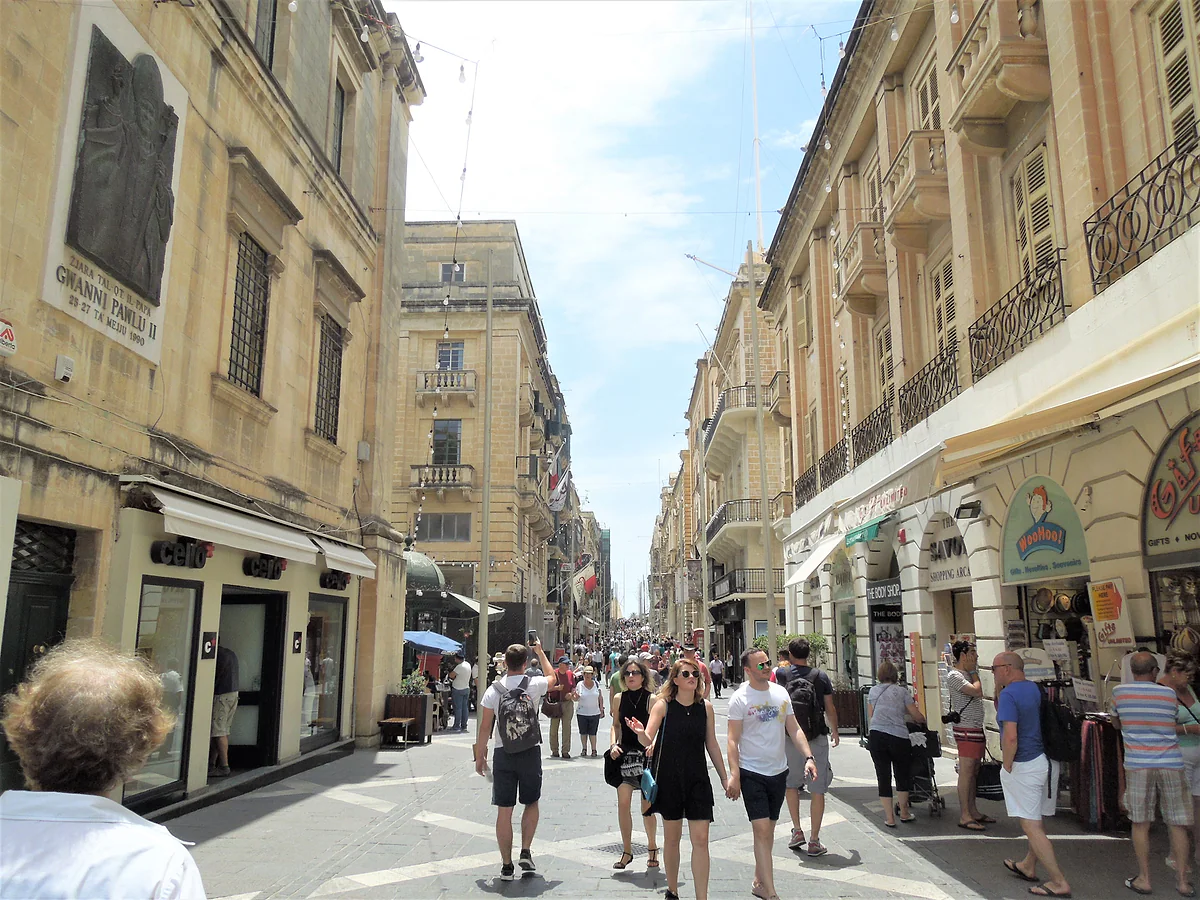
Republic Street, the main street of Valletta, busy with people walking between stone façades with balconies and shops on both sides.
Underground Valletta at a glance
| Item | Detail |
|---|---|
| Tour days | Monday, Wednesday and Sunday |
| Tour times | 10:00, 11:00, 12:00 and 13:00 |
| Adults (18+) | €15 |
| Over-60s, students, youths and children 6 to 11 | €10 |
| Under 6 | Not admitted |
| Meeting point | MUŻA, 30 minutes before |
Booking essential through Heritage Malta's online shop. Children aged 6 to 11 must be with an adult. Access is by steps, and there may be loud sounds or lighting effects. The same schedule applies in all three of Heritage Malta's periods up to 28 February 2027.
Test yourself
True or false?
0/3 Pick before you peek.
-
The tunnels under Valletta were all dug during the Second World War.
See the answer
False. Many date back to the Knights' city, for troops, grain, water and drainage. In the war they were extended into shelters.
-
Underground Valletta is included in the Multisite Pass.
See the answer
False. The pass specifically excludes Underground Valletta and the Hypogeum.
-
17,000 tonnes of bombs fell on Malta during the Second World War.
See the answer
True. That's the figure Heritage Malta gives on its Underground Valletta page.
- Tonnes of bombs dropped on Malta in the war
- 17,000 t
- Tours a day, three days a week
- 4
- Adult ticket
- €15
Map
Where Underground Valletta is
Gozo lies to the north-west, across the channel the ferry crosses from Ċirkewwa, with Comino between the two islands. Every number opens its guide.
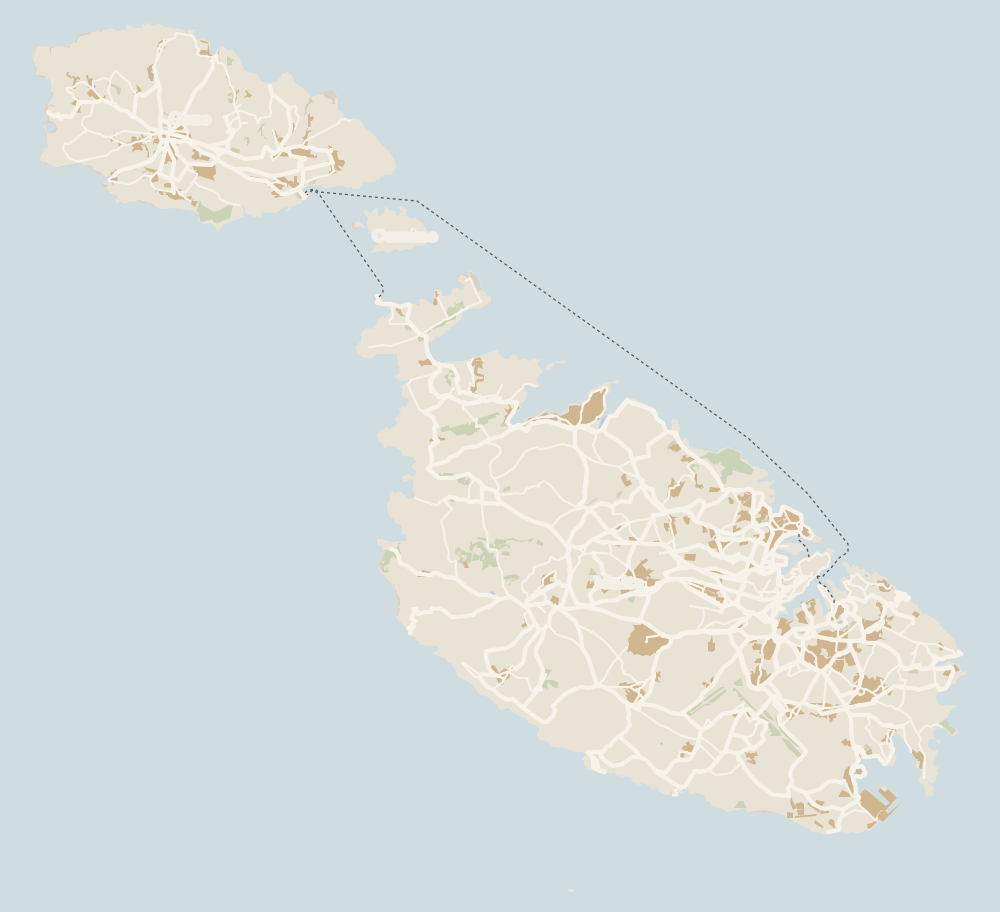 1Valletta 2St John's Co-Cathedral 3Grandmaster's Palace 4Fort St Elmo 5Barrakka Gardens 6Saluting Battery 7MUŻA 8National Museum of Archaeology 9Underground Valletta 10Lascaris War Rooms 11Casa Rocca Piccola 12Manoel Theatre 13City Gate and Parliament 14Valletta Waterfront
 Map data © OpenStreetMap contributors (ODbL)
- 1VallettaFounded 1566, on the UNESCO list since 1980
- 2St John's Co-CathedralFinished in 1577, closed on Sundays
- 3Grandmaster's PalaceHeritage Malta's most visited site
- 4Fort St ElmoFell on 23 June 1565
- 5Barrakka GardensGun salute at 12:00 and 16:00
- 6Saluting BatteryTwo firings a day, Monday to Saturday
- 7MUŻAOpened in late 2018
- 8National Museum of ArchaeologyNeolithic to Phoenician for €5
- 9Underground VallettaThree days a week, booking essential
- 10Lascaris War RoomsEisenhower's advance HQ in 1943
- 11Casa Rocca PiccolaGuided tours on the hour, 10:00 to 16:00
- 12Manoel TheatreOpened on 19 January 1732
- 13City Gate and ParliamentThe city's fifth gate, by Renzo Piano
- 14Valletta Waterfront19 Baroque warehouses from 1752
0 of 279 Malta guides
Your next stamp
- Saluting Battery
- Valletta
- Barrakka Gardens
- Mosta Rotunda
- Malta in one day
- Free walking tours
- Malta in three days
- Hotels in Valletta
- Things to do in Malta
- Gozo
- Most beautiful places
- Comino
- Prettiest villages
- UNESCO World Heritage Sites
- Where is Malta
- The Maltese islands
- Towns and villages
- Island of Malta
- Blue Lagoon
- Fort Rinella
- Fort St Angelo
- Gardjola Gardens
- Ħal Saflieni Hypogeum
- Is Malta a country?
- Popeye Village
- Tarxien Temples
- Things to do in Gozo
- Esplora
- Golden Bay
- Gozo day trip
- Inquisitor's Palace
- Population
- St John's Co-Cathedral
- St Mary's Tower
- Grandmaster's Palace
- How big is Malta
- Maritime Museum
- Mellieħa Bay
- Fort St Elmo
- Language
- Malta at War Museum
- Paradise Bay
- Red Tower
- Religion
- Malta government
- MUŻA
- National Museum of Archaeology
- Lascaris War Rooms
- Casa Rocca Piccola
- Three Cities
- Victoria
- Birgu
- Manoel Theatre
- Weekend in Malta
- Xagħra
- City Gate and Parliament
- Nadur
- Senglea
- Cospicua
- Malta in four days
- Qala
- Valletta Waterfront
- Għajnsielem
- Kalkara
- Malta in five days
- Malta in a week
- Paola
- Xewkija
- Sannat
- Tarxien
- Munxar
- Żabbar
- Fgura
- Fontana
- Kerċem
- Luqa
- Floriana
- Marsa
- Mellieħa
- The Citadel, Gozo
- Żebbuġ (Gozo)
- Ġgantija Temples
- Marsalforn
- Santa Luċija
- Ramla Bay
- San Lawrenz
- Xgħajra
- Xwejni salt pans
- Calypso's Cave
- Għarb
- Żejtun
- Għasri
- Gudja
- San Blas Bay
- Għaxaq
- Ħondoq Bay
- Marsaxlokk
- Kirkop
- Marsaxlokk Fish Market
- Mqabba
- St Peter's Pool
- Marsaskala
- Qrendi
- Żurrieq
- Beaches
- Comino ferry
- EU, Schengen and the euro
- Ħaġar Qim and Mnajdra
- Mdina
- Mġarr (Gozo)
- Blue Grotto
- Diving
- Entry requirements
- Mdina Cathedral
- Xewkija Rotunda
- Birżebbuġa
- Money and payments
- Palazzo Falson
- Safi
- Shipwrecks
- Ta' Ċenċ Cliffs
- Għar Dalam
- Mdina Dungeons
- Mġarr ix-Xini
- Prices and budget
- Snorkelling
- Boat trips
- Malta on a budget
- Playmobil FunPark
- Rabat (Malta)
- Xlendi
- Dwejra
- Gozo beaches
- History
- Siġġiewi
- St Paul's Catacombs
- Tipping
- Azure Window
- Domvs Romana
- Għar Lapsi
- Great Siege of 1565
- Plugs
- Limestone Heritage Park
- Second World War
- St Paul's Grotto
- Ta' Pinu Basilica
- Time zone
- Buskett Gardens
- Knights of Malta
- Mobile and roaming
- Wied il-Għasri
- Dingli
- Maltese cross
- Dingli Cliffs
- Flag
- Żebbuġ
- Coat of arms
- Mtarfa
- Balzan
- National anthem
- Lija
- Malta facts
- Game of Thrones
- Iklin
- Attard
- Film locations
- Forts and fortifications
- San Anton Gardens
- Ta' Qali Crafts Village
- Victoria Lines
- Megalithic temples
- Catacombs
- Museums
- Where to eat
- Where to stay
- Churches
- Restaurants in Valletta
- Hotels in Sliema
- Maltese food
- Restaurants in Marsaxlokk
- Viewpoints
- Hotels in St Julian's
- Pastizzi
- Walking and hiking
- Hotels in Buġibba and Qawra
- Maltese rabbit stew
- Safety
- Hotels in Mellieħa
- Kinnie and Cisk
- Scams
- Gozo hotels
- Nightlife
- Tap water
- Boat parties
- Holiday packages
- Tourist tax
- All inclusive
- Gay Malta
- Sightseeing passes
- Apartments
- Malta with kids
- Public holidays
- How to get there
- Luxury
- Malta for couples
- Taxis and ride-hailing
- Weather
- Best time to visit
- Cycling
- English schools
- Flights
- Flights from Madrid
- Sea temperature
- Shopping and souvenirs
- Airport
- In winter
- Airport transfers
- Day trips and tours
- In summer
- Ferry from Sicily
- In January
- Cruise stop
- In February
- In March
- In April
- In May
- Getting around
- In June
- Buses
- July
- August
- Hop on hop off
- Gozo ferry
- September
- Gozo fast ferry
- October
- November
- Valletta ferries
- Car hire
- December
- Driving
- Events
- St Paul's Bay
- Village feasts
- Buġibba
- Christmas
- Easter
- Qawra
- Carnival
- Xemxija
- Fireworks festival
- Malta National Aquarium
- Isle of MTV
- St Paul's Islands
- Mosta
- Naxxar
- Palazzo Parisio
- Għargħur
- Mġarr (Malta)
- Sliema
- Ta' Ħaġrat and Skorba Temples
- Għajn Tuffieħa Bay
- Tigné Point
- Ġnejna Bay
- St Julian's
- Paceville
- St George's Bay
- Gżira
- Msida
- Ta' Xbiex
- Pietà
- Pembroke
- Swieqi
- San Ġwann
- Birkirkara
- Ħamrun
- Santa Venera
- Qormi
Frequently asked questions
What is Underground Valletta?
It's Heritage Malta's guided visit to the network under Valletta, with tunnels for troops and grain, cisterns, drains and the shelters people crowded into during the Second World War.
How much are Underground Valletta tickets?
€15 for adults and €10 for over-60s, students, 12 to 17-year-olds and children aged 6 to 11. It isn't included in the Multisite Pass.
When can you do the Underground Valletta tour?
On Mondays, Wednesdays and Sundays, at 10:00, 11:00, 12:00 and 13:00. You need to book in advance through Heritage Malta's shop.
Where does the Underground Valletta tour start?
At MUŻA, the national art museum in the Auberge d'Italie. You need to be there 30 minutes before your booked time.
Can children go on Underground Valletta?
From age 6, and children aged 6 to 11 must be with an adult. Under-6s can't go in.
What shoes do I need for Underground Valletta?
Closed, comfortable ones. Heritage Malta won't admit anyone in high heels, sandals or flip-flops, and access is down steps.
By
Tourism graduate with a master’s in Tourism Management and Planning from the University of Málaga, who has travelled across Europe. He writes every guide from official sources and his own judgement.
Published on . Facts checked on .
Sources
Photos: Ben Williams (CC BY-SA 4.0); Cosal (CC BY-SA 4.0), via Wikimedia Commons.