Crafts, markets and local produce
What to buy in Malta, from filigree to Gozo lace
The most traditional Malta souvenirs are silver and gold filigree, which visitmalta calls the islands' most precious craft, Gozo bobbin lace, blown glass and pottery. To buy them properly, I'd head to the crafts villages at Ta' Qali on Malta and Ta' Dbiegi on Gozo, and leave the fridge magnets for the airport.
In 30 seconds
Full read: 3 min
- Malta's most precious souvenir is filigree; the most Gozitan is bobbin lace.
- For crafts, head to the workshop villages of Ta' Qali (Malta) and Ta' Dbiegi (Gozo).
- With lace, price signals quality and the eight-pointed cross marks its origin.
- Most shops close on Sundays and public holidays, except malls and chains.
I'd spend on one piece of filigree or Gozo lace rather than five cheap trinkets. And I'd buy it at a workshop where you can ask who made it, because the Ministry for Gozo warns that with lace, the price tells you a lot about the quality.

Before you go
What I would keep in mind
-
01 Worth the splurge
Filigree, the souvenir worth paying for
Visitmalta says gold and silver work flourished under the Knights and that filigree and jewellery are Malta's most precious craft today.
-
02 Watch out
Cheap lace, doubtful lace
The Ministry for Gozo warns that with Gozo lace, price is a strong sign of quality, and asks you to insist on the authentic product. The eight-pointed cross marks its origin.
the Maltese cross and its meaning -
03 Most beautiful
A village of workshops on Gozo
Ta' Dbiegi, in Għarb, brings together pottery, filigree, lace, blown glass, leather, limestone and local produce such as carob syrup and prickly pear liqueur.
Għarb -
04 My tip
Mind the Sunday closures
Spain's foreign ministry says most shops close on Sundays and public holidays, although shopping centres and chains stay open at lunchtime and at weekends.
What I would book
- Tours and ticketsGetYourGuide Tours that stop at Ta' Qali Some inland tours stop at the crafts village. If you're going under your own steam, you don't need one.
- Places to stayBooking.com Stay in Valletta The capital's shopping streets on your doorstep, handy for a relaxed browse in the late afternoon.
My ranking, scored
The Malta souvenirs I'd actually buy
My own scores out of 10. They weigh how much the object says about Malta, how easy it is to check it's genuine and how well it survives the trip home.
0 of 5 seen
-
Silver or gold filigree
Malta's most precious craft, according to visitmalta. At Ta' Dbiegi it's worked in 925 silver and 18-carat gold.
9.2 out of 10
-
Gozo bobbin lace
Il-bizzilla, popular on Gozo since the mid-1840s. Ask for the genuine article and look for the eight-pointed cross.
9.0 out of 10
-
Blown glass
Ta' Dbiegi has a glassblowing studio with pieces in blues, reds and golds. Ask them to wrap it well.
8.4 out of 10
-
DOK Gozo or native-grape wine
The DOK Gozo label guarantees island grapes. Check your airline's rules on liquids in hand luggage.
8.2 out of 10
-
Dried Gozo cheeselets
They keep well, according to the Ministry for Gozo, and are sold in supermarkets and by the cheesemakers. Check UK import rules before packing dairy.
7.8 out of 10
It’s very easy to come home from Malta with a suitcase full of Maltese cross magnets and nothing that says anything real about the place. Which is a shame, because the islands have crafts with centuries of history. Visitmalta explains that local crafts have enjoyed a revival, not just as souvenirs but for their cultural value. Here’s what I’d buy and where.
Filigree, the most precious craft
Visitmalta is clear about it. Gold and silver work flourished under the Knights of the Order, and filigree and jewellery are Malta’s most precious production today, with Maltese goldsmiths exporting to major cities abroad. If I wanted one good piece to take home, this is what I’d choose.
On Gozo, the Ministry for Gozo describes a family workshop at Ta’ Dbiegi working Maltese filigree in 925 sterling silver and 18-carat gold, with pendants, earrings, rings and bracelets. Buying where it’s made lets you ask questions and see the work.
How can you tell genuine Gozo lace?
Bobbin lace, il-bizzilla, took off on Gozo in the mid-1840s, according to the Ministry for Gozo. It’s worked on a tall pillow of straw and paper called a trajbu, in linen for the home and silk for clothing. In 1862 Gozo lace came first in its category at the International Exhibition in London, and the Ministry notes that Queen Victoria ordered pieces in the 1830s.
Two clues for buying well. First, a design with the eight-pointed cross of St John, which these days indicates the lace is Gozitan or Maltese. Second, the price. The Ministry for Gozo puts it plainly, price is highly indicative of quality, and you should ask for the authentic product. Handmade lace takes hours, and if it costs the same as a magnet, it isn’t handmade. The story behind that symbol is in my guide to the Maltese cross meaning.
Two crafts villages
On the island of Malta, the crafts village is Ta’ Qali, in the middle of the island. Visitmalta lists workshops there, such as a pottery studio in the Crafts Village, and suggests it as a stop on day trips for cruise passengers.
On Gozo, it’s Ta’ Dbiegi in Għarb, below the island’s highest hill. The Ministry for Gozo gives fourteen reasons to go, including pottery, filigree, lace and knitwear, a glassblowing studio with pieces in blues, reds and golds, leather, limestone carvings and a Gozitan produce shop selling carob syrup, honey and prickly pear liqueur.
Food and drink to take home
The easiest souvenirs to carry are the ones that keep. The Ministry for Gozo says dried Gozo cheeselets keep for a long time and are sold in supermarkets, Gozitan produce shops and by the cheesemakers. Before packing any dairy, though, check GOV.UK, because Great Britain has rules on bringing meat and dairy in from abroad. DOK Gozo wine, made only from island grapes, and honey are simpler. And a bottle of Kinnie is the most Maltese and cheapest souvenir I can think of. More in my guide to Kinnie and Cisk.
When and where to shop
Spain’s foreign ministry gives the usual shop hours as 9:00 to 13:00 and then 16:00 to 19:30 from Monday to Friday, and Saturday 9:00 to 12:30. Most shops close on Sundays and public holidays, but shopping centres and chains stay open at lunchtime and at weekends. Visitmalta adds that in tourist areas shops open from 9:00 to 19:00 or later.
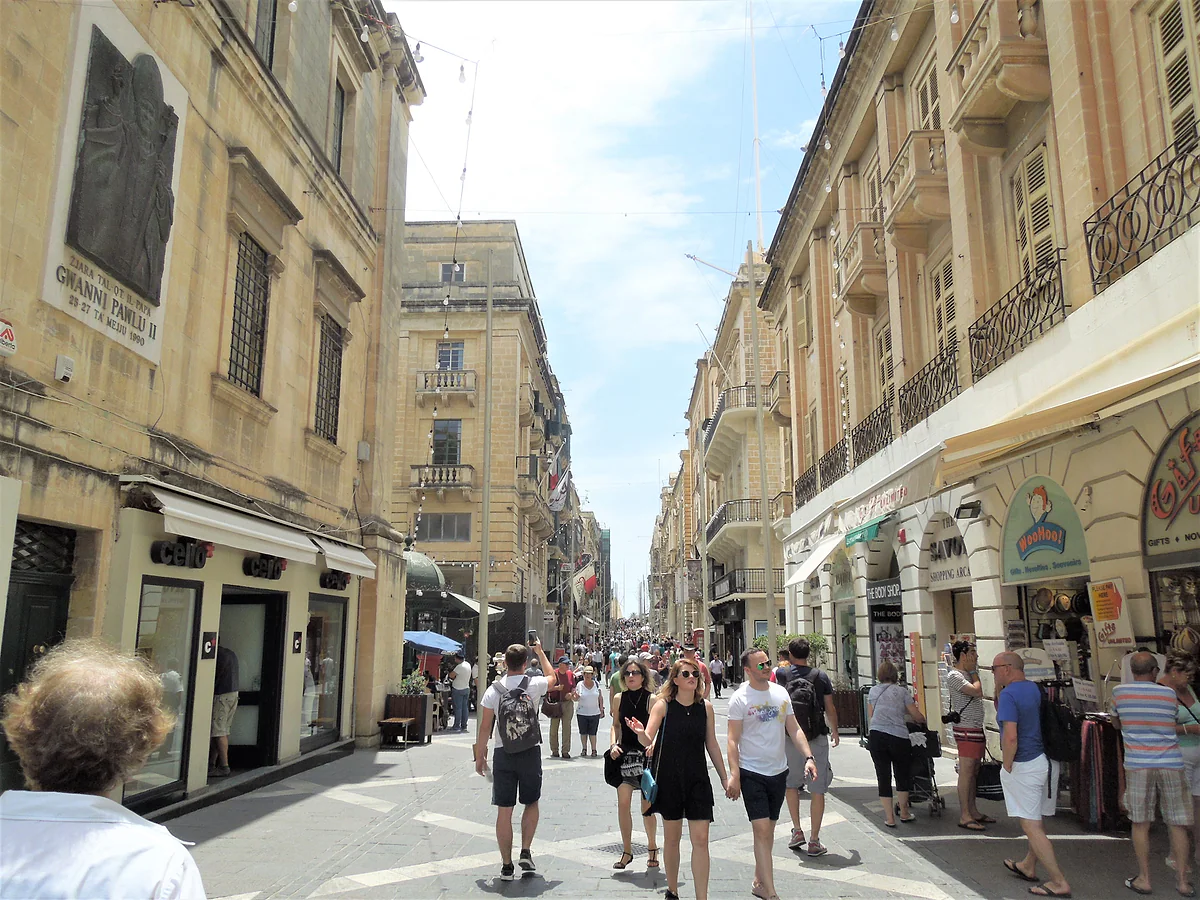
The shopping streets visitmalta names are Republic Street and Merchants Street in Valletta, Tower Road and the Strand in Sliema, and central Victoria on Gozo. For big shops under one roof, I’d head to Tigné Point, on the tip of Sliema facing Valletta. For markets, as well as Sunday at the Marsaxlokk fish market, there are weekday morning markets in Birkirkara, Birżebbuġa and Cottonera.
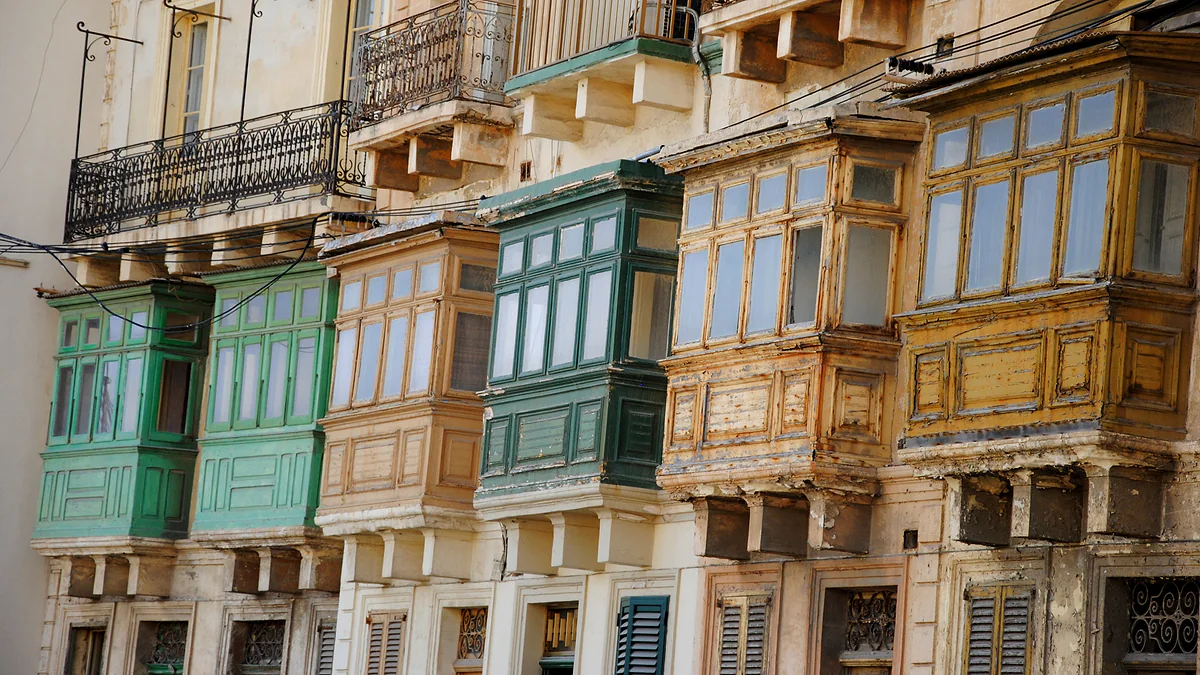
A row of enclosed wooden balconies in Valletta, painted green, ochre and cream, the classic feature of Maltese town houses.
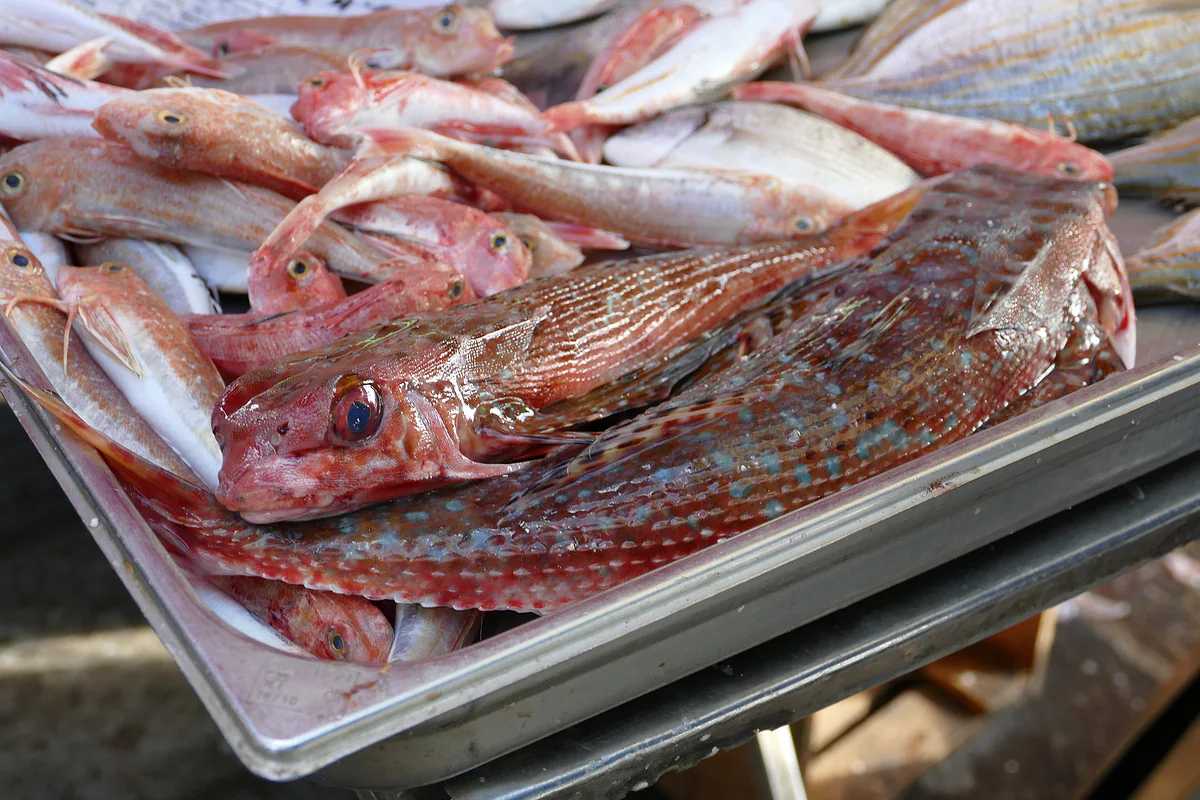
Freshly caught red mullet and gurnard on a tray at the Sunday market in Marsaxlokk, along the harbour front.
Where to shop in Malta (visitmalta)
| Area | Streets or places |
|---|---|
| Valletta | Republic Street and Merchants Street |
| Sliema | Tower Road, Bisazza Street and the Strand |
| St Julian's | Paceville and the Bay Street complex |
| Inland | Paola town centre, Ħamrun High Street, Mosta centre |
| Gozo | Victoria and the Arkadia centre |
| Crafts | Ta' Qali (Malta) and Ta' Dbiegi (Gozo) |
Visitmalta's Shopping page (archive.org copy from 2025) and Visit Gozo.
Open-air markets (visitmalta)
| Market | Day | Hours |
|---|---|---|
| Birkirkara, Tumas Fenech Street | Wednesday and Friday | 06:30-13:00 |
| Birżebbuġa, Żarenu Dalli Street | Thursday | 06:00-13:00 |
| Cottonera (Birgu and Bormla) | Tuesday | 06:30-13:00 |
| Marsaxlokk (fish) | Sunday morning | No official hours |
Hours from visitmalta; they can change, so it's worth confirming with each local council.
Test yourself
True or false?
0/3 Pick before you peek.
-
Gozo lace often features the eight-pointed cross.
See the answer
True. The Ministry for Gozo explains that the cross of St John in the design now indicates the lace is of Gozitan or Maltese origin.
-
Every shop in Malta opens on Sundays.
See the answer
False. Most close on Sundays and public holidays, apart from shopping centres and chains.
-
Gozo lace won a prize at the 1862 International Exhibition in London.
See the answer
True. The Ministry for Gozo says it came first in its category.
- When lace-making took off on Gozo
- 1840s
- Gozo lace wins in London
- 1862
- Silver standard for filigree at Ta' Dbiegi
- 925
0 of 279 Malta guides
Your next stamp
- Malta on a budget
- Things to do in Malta
- All inclusive
- Boat trips
- Kinnie and Cisk
- Gozo
- Day trips and tours
- Most beautiful places
- Comino
- Prettiest villages
- UNESCO World Heritage Sites
- Where is Malta
- The Maltese islands
- Towns and villages
- Island of Malta
- Blue Lagoon
- Fort Rinella
- Fort St Angelo
- Gardjola Gardens
- Ħal Saflieni Hypogeum
- Is Malta a country?
- Popeye Village
- Tarxien Temples
- Things to do in Gozo
- Valletta
- Esplora
- Golden Bay
- Gozo day trip
- Inquisitor's Palace
- Population
- St John's Co-Cathedral
- St Mary's Tower
- Grandmaster's Palace
- How big is Malta
- Maritime Museum
- Mellieħa Bay
- Fort St Elmo
- Language
- Malta at War Museum
- Paradise Bay
- Barrakka Gardens
- Red Tower
- Religion
- Malta government
- Saluting Battery
- MUŻA
- National Museum of Archaeology
- Underground Valletta
- Lascaris War Rooms
- Casa Rocca Piccola
- Malta in one day
- Three Cities
- Victoria
- Birgu
- Manoel Theatre
- Weekend in Malta
- Xagħra
- City Gate and Parliament
- Malta in three days
- Nadur
- Senglea
- Cospicua
- Malta in four days
- Qala
- Valletta Waterfront
- Għajnsielem
- Kalkara
- Malta in five days
- Malta in a week
- Paola
- Xewkija
- Sannat
- Tarxien
- Munxar
- Żabbar
- Fgura
- Fontana
- Kerċem
- Luqa
- Floriana
- Marsa
- Mellieħa
- The Citadel, Gozo
- Żebbuġ (Gozo)
- Ġgantija Temples
- Marsalforn
- Santa Luċija
- Ramla Bay
- San Lawrenz
- Xgħajra
- Xwejni salt pans
- Calypso's Cave
- Għarb
- Żejtun
- Għasri
- Gudja
- San Blas Bay
- Għaxaq
- Ħondoq Bay
- Marsaxlokk
- Kirkop
- Marsaxlokk Fish Market
- Mqabba
- St Peter's Pool
- Marsaskala
- Qrendi
- Żurrieq
- Beaches
- Comino ferry
- EU, Schengen and the euro
- Ħaġar Qim and Mnajdra
- Mdina
- Mġarr (Gozo)
- Blue Grotto
- Diving
- Entry requirements
- Mdina Cathedral
- Xewkija Rotunda
- Birżebbuġa
- Money and payments
- Palazzo Falson
- Safi
- Shipwrecks
- Ta' Ċenċ Cliffs
- Għar Dalam
- Mdina Dungeons
- Mġarr ix-Xini
- Prices and budget
- Snorkelling
- Playmobil FunPark
- Rabat (Malta)
- Xlendi
- Dwejra
- Gozo beaches
- History
- Siġġiewi
- St Paul's Catacombs
- Tipping
- Azure Window
- Domvs Romana
- Għar Lapsi
- Great Siege of 1565
- Plugs
- Limestone Heritage Park
- Second World War
- St Paul's Grotto
- Ta' Pinu Basilica
- Time zone
- Buskett Gardens
- Knights of Malta
- Mobile and roaming
- Wied il-Għasri
- Dingli
- Maltese cross
- Dingli Cliffs
- Flag
- Żebbuġ
- Coat of arms
- Mtarfa
- Balzan
- National anthem
- Lija
- Malta facts
- Game of Thrones
- Iklin
- Attard
- Film locations
- Forts and fortifications
- San Anton Gardens
- Ta' Qali Crafts Village
- Victoria Lines
- Megalithic temples
- Catacombs
- Museums
- Where to eat
- Where to stay
- Churches
- Hotels in Valletta
- Restaurants in Valletta
- Hotels in Sliema
- Maltese food
- Restaurants in Marsaxlokk
- Viewpoints
- Hotels in St Julian's
- Pastizzi
- Walking and hiking
- Hotels in Buġibba and Qawra
- Maltese rabbit stew
- Safety
- Hotels in Mellieħa
- Scams
- Gozo hotels
- Nightlife
- Tap water
- Boat parties
- Holiday packages
- Tourist tax
- Gay Malta
- Sightseeing passes
- Apartments
- Malta with kids
- Public holidays
- How to get there
- Luxury
- Malta for couples
- Taxis and ride-hailing
- Weather
- Best time to visit
- Cycling
- English schools
- Flights
- Flights from Madrid
- Sea temperature
- Airport
- Free walking tours
- In winter
- Airport transfers
- In summer
- Ferry from Sicily
- In January
- Cruise stop
- In February
- In March
- In April
- In May
- Getting around
- In June
- Buses
- July
- August
- Hop on hop off
- Gozo ferry
- September
- Gozo fast ferry
- October
- November
- Valletta ferries
- Car hire
- December
- Driving
- Events
- St Paul's Bay
- Village feasts
- Buġibba
- Christmas
- Easter
- Qawra
- Carnival
- Xemxija
- Fireworks festival
- Malta National Aquarium
- Isle of MTV
- St Paul's Islands
- Mosta
- Mosta Rotunda
- Naxxar
- Palazzo Parisio
- Għargħur
- Mġarr (Malta)
- Sliema
- Ta' Ħaġrat and Skorba Temples
- Għajn Tuffieħa Bay
- Tigné Point
- Ġnejna Bay
- St Julian's
- Paceville
- St George's Bay
- Gżira
- Msida
- Ta' Xbiex
- Pietà
- Pembroke
- Swieqi
- San Ġwann
- Birkirkara
- Ħamrun
- Santa Venera
- Qormi
Frequently asked questions
What souvenirs should I buy in Malta?
Silver or gold filigree, Gozo bobbin lace, blown glass, pottery and, to eat, Gozo cheeselets, honey or DOK wine. All of them feature in the visitmalta and Ministry for Gozo guides.
What is Malta famous for making?
Filigree jewellery, which visitmalta calls the islands' most precious production, and Gozo lace, with the eight-pointed cross as its mark of origin.
Where can I buy local crafts in Malta?
At the crafts villages of Ta' Qali on the island of Malta and Ta' Dbiegi in Għarb, on Gozo, with workshops for pottery, filigree, lace, glass and leather.
What are shop opening hours in Malta?
Spain's foreign ministry gives Monday to Friday 9:00 to 13:00 and 16:00 to 19:30, and Saturday 9:00 to 12:30. Most shops close on Sundays and public holidays, apart from malls and chains.
Can I bring Maltese cheese or wine back to the UK?
Wine within the allowances, yes. For cheese and other dairy, check GOV.UK before you pack, because Great Britain has rules on bringing meat and dairy in from abroad.
How can I tell if Gozo lace is genuine?
The Ministry for Gozo says price is a strong indicator of quality and asks you to insist on the authentic product. A design with the eight-pointed cross marks Gozitan or Maltese origin.
By
Tourism graduate with a master’s in Tourism Management and Planning from the University of Málaga, who has travelled across Europe. He writes every guide from official sources and his own judgement.
Published on . Facts checked on .
Sources
Photos: Cosal (CC BY-SA 4.0); Leandro Neumann Ciuffo (CC BY 2.0); Kritzolina (CC BY-SA 4.0), via Wikimedia Commons.