Drinking water
Tap water in Malta: what the water company says, and what I'd do
Malta's state water company, the Water Services Corporation, says it is a legal requirement to disinfect the supply and make sure the water is safe to drink. It uses chlorine, usually up to 1 mg per litre, which is why it can taste of bleach. I haven't found any other official source advising visitors either way.
In 30 seconds
Full read: 3 min
- The state water company disinfects the supply by law to make sure it's safe to drink.
- It contains chlorine, up to 1 mg per litre, and you may taste it.
- About 20 of the 34 million m³ supplied each year come from three desalination plants.
- No other official source advises on it; I'd drink it unless you have doubts.
Going by what the water company publishes, I wouldn't be afraid to drink tap water in Malta, though I understand anyone who can't stand the chlorine taste. For that, the company itself has a trick that works, a jug in the fridge for a few hours.

Before you go
What I would keep in mind
-
01 My tip
A jug in the fridge to lose the chlorine
The WSC suggests putting a jug of water in the fridge for a few hours before drinking it, but not for more than 24 hours, because once the chlorine has gone the water is no longer protected against bacteria.
-
02 To save money
Fill your bottle at the airport
The terminal has three water fountains, in baggage reclaim and in the Schengen and non-Schengen departure areas. Arriving with a full bottle is your first saving of the trip.
Malta airport -
03 My tip
On Comino, bring your own
Comino has no shops or services beyond seasonal kiosks, and the Ministry for Gozo reminds visitors to bring water, snacks and sun protection. In summer I'd carry more than you think you'll need.
Comino island
It’s one of the most practical questions on any trip, and in Malta the answer is less tidy than I’d like. I went looking for an official line saying, plainly, whether visitors can drink the tap water, and what exists is something slightly different. Here’s what the state water company publishes, what nobody says, and what I’d do.
What the water company says
The Water Services Corporation is Malta’s state water company. On its water quality page it explains that it adds very small amounts of chlorine at its treatment works, usually up to 1 milligram per litre, because it is a legal requirement to disinfect the water supply and make sure it’s safe to drink.
That’s as close as I’ve got to an official answer. It isn’t a seal of approval from the tourism authority, and I haven’t found tap water covered in the FCDO’s Malta travel advice. So I’d rather quote it as it stands and let you decide with it in front of you.
Where does the water come from in such a dry country?
Malta gets little rain, around 567 mm a year according to the Meteorological Office, and the WSC has turned to the sea for much of its supply. It runs three reverse osmosis plants, at Pembroke, Ċirkewwa and Għar Lapsi, which produce about 20 of the 34 million cubic metres it distributes each year. The page I read doesn’t break down the rest. It also has a tunnel carrying water from Pembroke to Ta’ Qali.
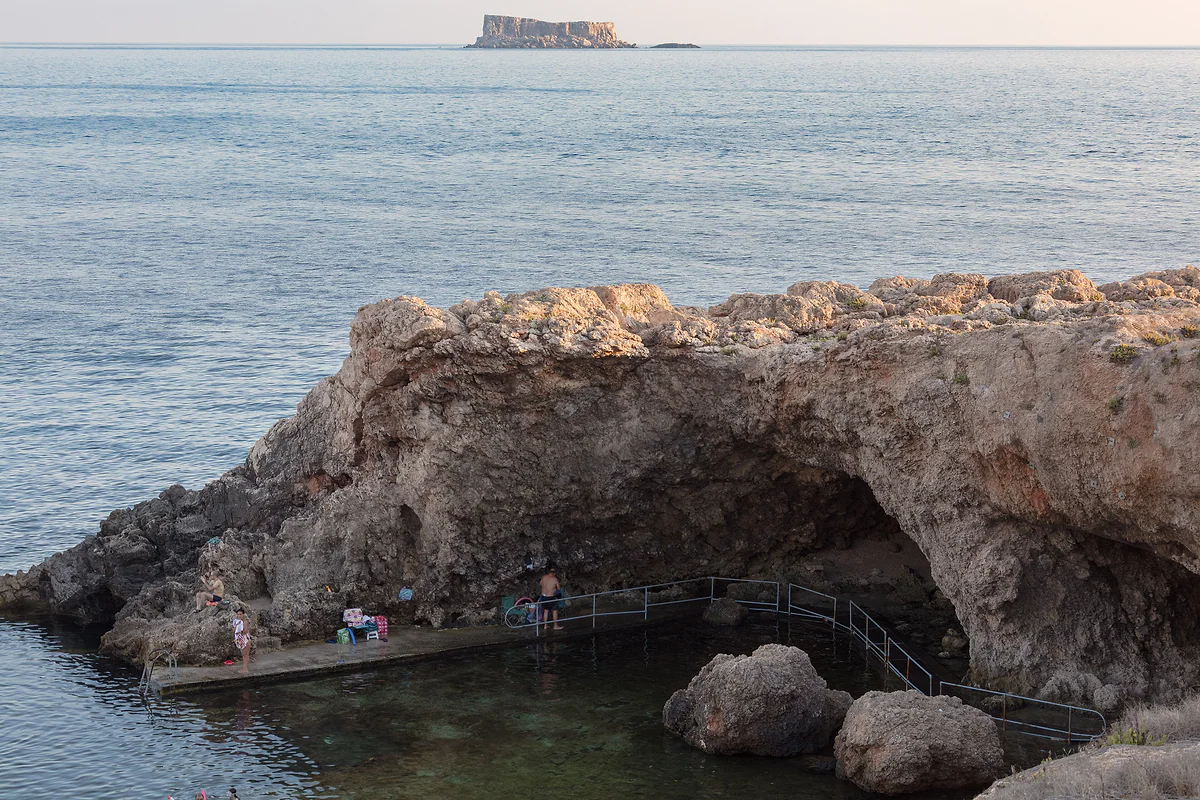
If you go swimming at Għar Lapsi, you’ll be very close to one of the plants that fill the country’s taps. The shortage goes back a long way, and in the early 17th century the Knights were already bringing water to Valletta along the Wignacourt Aqueduct, whose inspection tower still stands in Santa Venera.
Why does it taste of chlorine, and how do you get rid of it?
The WSC itself admits the water can taste of chlorine or bleach, more so in cold drinks and in the morning and evening. It puts this down to your distance from the treatment works, the water temperature, peak demand and burst mains. Its advice is simple, put a jug of water in the fridge for a few hours before drinking it. It adds a limit I think matters, though, not more than 24 hours, because once the chlorine has gone the water is no longer protected against bacteria.
The WSC also explains what to do after roadworks or maintenance. Milky water is usually air trapped in the pipes and clears from the bottom up if you leave it in a glass. Brown water comes from disturbed sediment and clears if you run the tap for up to three minutes. If it’s still the same after 24 hours, there’s a freephone number, 8007 6400.
What I’d do
With that information, I’d drink tap water in Malta rather than buying bottles every day, though I understand anyone who can’t stand the taste and prefers bottled. If you have a sensitive stomach or are travelling with a baby, no official source covers your situation, and in that case I’d choose bottled without a second thought. For cooking and brushing your teeth, the tap is fine by me.
In summer, water is about health rather than taste. The Meteorological Office gives average August highs of 32 °C, and on excursions without shade you drink far more than you expect. On Comino, for instance, the Ministry for Gozo reminds visitors to bring water, because there are no shops or services apart from seasonal kiosks.
Where to refill your bottle
The only set of public fountains I’ve found with an official source is at Malta Airport, which has three, in baggage reclaim and in the Schengen and non-Schengen departure areas. Beyond that, the sensible option is to refill where you’re staying. If you’ve booked one of the apartments in Malta, the jug in the fridge is the cheapest trick of the holiday.
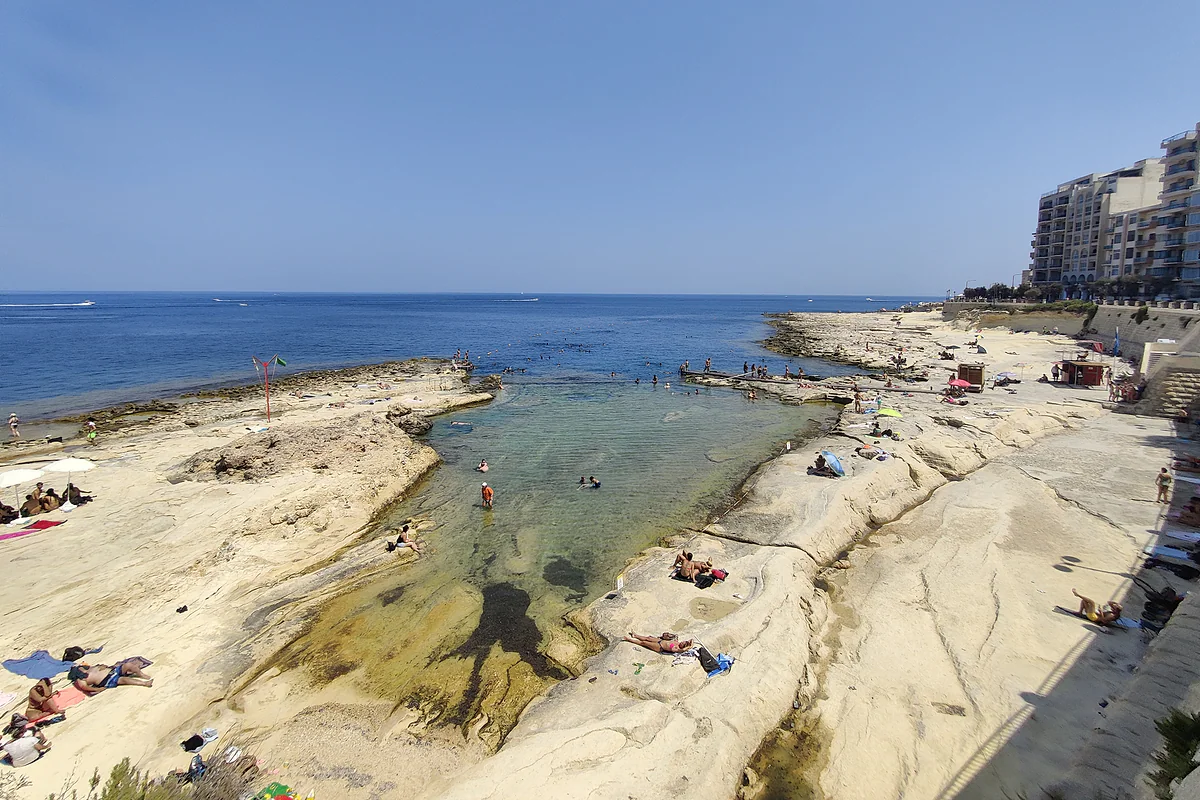
The flat rocks of Fond Għadir in Sliema, where people swim in clear rock pools right below the apartment blocks of the seafront.
Tap water in Malta: what's documented and what isn't
| Question | What the source says | Source |
|---|---|---|
| Is it disinfected? | Yes, by law, to make sure it's safe to drink | WSC |
| With what? | Chlorine, usually up to 1 mg/l at the works | WSC |
| Where does it come from? | About 20 of the 34 million m³ a year from three desalination plants | WSC |
| Why the chlorine taste? | Distance from the works, temperature, time of day and burst mains | WSC |
| Why is it cloudy? | Usually trapped air after works; it clears from the bottom up in a glass | WSC |
| Does the FCDO advise on it? | Not in the sections of its Malta advice I've read | GOV.UK |
Water Services Corporation pages on water quality and company history, read on 28 September 2026. WSC freephone for supply problems, 8007 6400.
Test yourself
True or false?
0/3 Pick before you peek.
-
A large share of Malta's mains water comes from desalination plants.
See the answer
True. The WSC runs three reverse osmosis plants, at Pembroke, Ċirkewwa and Għar Lapsi, producing about 20 of the 34 million m³ it supplies each year.
-
A chlorine taste means Malta's tap water is contaminated.
See the answer
False. The WSC explains that it adds small amounts of chlorine because disinfection is a legal requirement, and the taste varies with distance from the works, temperature and time of day.
-
Water left in the fridge to lose its chlorine keeps for a week.
See the answer
False. The WSC says not to keep it for more than 24 hours, because without chlorine the water loses its protection against bacterial growth.
- Chlorine added at the works
- 1 mg/l
- Reverse osmosis desalination plants
- 3
- Water supplied by the WSC each year
- 34m m³
- Maximum in the fridge once dechlorinated
- 24 hrs
0 of 279 Malta guides
Your next stamp
- Boat parties
- Diving
- Is Malta a country?
- Tipping
- Free walking tours
- Safety
- Things to do in Malta
- Gozo
- Most beautiful places
- Comino
- Prettiest villages
- UNESCO World Heritage Sites
- Where is Malta
- The Maltese islands
- Towns and villages
- Island of Malta
- Blue Lagoon
- Fort Rinella
- Fort St Angelo
- Gardjola Gardens
- Ħal Saflieni Hypogeum
- Popeye Village
- Tarxien Temples
- Things to do in Gozo
- Valletta
- Esplora
- Golden Bay
- Gozo day trip
- Inquisitor's Palace
- Population
- St John's Co-Cathedral
- St Mary's Tower
- Grandmaster's Palace
- How big is Malta
- Maritime Museum
- Mellieħa Bay
- Fort St Elmo
- Language
- Malta at War Museum
- Paradise Bay
- Barrakka Gardens
- Red Tower
- Religion
- Malta government
- Saluting Battery
- MUŻA
- National Museum of Archaeology
- Underground Valletta
- Lascaris War Rooms
- Casa Rocca Piccola
- Malta in one day
- Three Cities
- Victoria
- Birgu
- Manoel Theatre
- Weekend in Malta
- Xagħra
- City Gate and Parliament
- Malta in three days
- Nadur
- Senglea
- Cospicua
- Malta in four days
- Qala
- Valletta Waterfront
- Għajnsielem
- Kalkara
- Malta in five days
- Malta in a week
- Paola
- Xewkija
- Sannat
- Tarxien
- Munxar
- Żabbar
- Fgura
- Fontana
- Kerċem
- Luqa
- Floriana
- Marsa
- Mellieħa
- The Citadel, Gozo
- Żebbuġ (Gozo)
- Ġgantija Temples
- Marsalforn
- Santa Luċija
- Ramla Bay
- San Lawrenz
- Xgħajra
- Xwejni salt pans
- Calypso's Cave
- Għarb
- Żejtun
- Għasri
- Gudja
- San Blas Bay
- Għaxaq
- Ħondoq Bay
- Marsaxlokk
- Kirkop
- Marsaxlokk Fish Market
- Mqabba
- St Peter's Pool
- Marsaskala
- Qrendi
- Żurrieq
- Beaches
- Comino ferry
- EU, Schengen and the euro
- Ħaġar Qim and Mnajdra
- Mdina
- Mġarr (Gozo)
- Blue Grotto
- Entry requirements
- Mdina Cathedral
- Xewkija Rotunda
- Birżebbuġa
- Money and payments
- Palazzo Falson
- Safi
- Shipwrecks
- Ta' Ċenċ Cliffs
- Għar Dalam
- Mdina Dungeons
- Mġarr ix-Xini
- Prices and budget
- Snorkelling
- Boat trips
- Malta on a budget
- Playmobil FunPark
- Rabat (Malta)
- Xlendi
- Dwejra
- Gozo beaches
- History
- Siġġiewi
- St Paul's Catacombs
- Azure Window
- Domvs Romana
- Għar Lapsi
- Great Siege of 1565
- Plugs
- Limestone Heritage Park
- Second World War
- St Paul's Grotto
- Ta' Pinu Basilica
- Time zone
- Buskett Gardens
- Knights of Malta
- Mobile and roaming
- Wied il-Għasri
- Dingli
- Maltese cross
- Dingli Cliffs
- Flag
- Żebbuġ
- Coat of arms
- Mtarfa
- Balzan
- National anthem
- Lija
- Malta facts
- Game of Thrones
- Iklin
- Attard
- Film locations
- Forts and fortifications
- San Anton Gardens
- Ta' Qali Crafts Village
- Victoria Lines
- Megalithic temples
- Catacombs
- Museums
- Where to eat
- Where to stay
- Churches
- Hotels in Valletta
- Restaurants in Valletta
- Hotels in Sliema
- Maltese food
- Restaurants in Marsaxlokk
- Viewpoints
- Hotels in St Julian's
- Pastizzi
- Walking and hiking
- Hotels in Buġibba and Qawra
- Maltese rabbit stew
- Hotels in Mellieħa
- Kinnie and Cisk
- Scams
- Gozo hotels
- Nightlife
- Holiday packages
- Tourist tax
- All inclusive
- Gay Malta
- Sightseeing passes
- Apartments
- Malta with kids
- Public holidays
- How to get there
- Luxury
- Malta for couples
- Taxis and ride-hailing
- Weather
- Best time to visit
- Cycling
- English schools
- Flights
- Flights from Madrid
- Sea temperature
- Shopping and souvenirs
- Airport
- In winter
- Airport transfers
- Day trips and tours
- In summer
- Ferry from Sicily
- In January
- Cruise stop
- In February
- In March
- In April
- In May
- Getting around
- In June
- Buses
- July
- August
- Hop on hop off
- Gozo ferry
- September
- Gozo fast ferry
- October
- November
- Valletta ferries
- Car hire
- December
- Driving
- Events
- St Paul's Bay
- Village feasts
- Buġibba
- Christmas
- Easter
- Qawra
- Carnival
- Xemxija
- Fireworks festival
- Malta National Aquarium
- Isle of MTV
- St Paul's Islands
- Mosta
- Mosta Rotunda
- Naxxar
- Palazzo Parisio
- Għargħur
- Mġarr (Malta)
- Sliema
- Ta' Ħaġrat and Skorba Temples
- Għajn Tuffieħa Bay
- Tigné Point
- Ġnejna Bay
- St Julian's
- Paceville
- St George's Bay
- Gżira
- Msida
- Ta' Xbiex
- Pietà
- Pembroke
- Swieqi
- San Ġwann
- Birkirkara
- Ħamrun
- Santa Venera
- Qormi
Frequently asked questions
Can you drink the tap water in Malta?
The Water Services Corporation says it is legally required to disinfect the water and make sure it's safe to drink. No other official source I've read gives advice either way, so I'd drink it, and if you're unsure or have a sensitive stomach, buy bottled.
Why does Maltese tap water taste of chlorine?
Because the WSC adds chlorine to disinfect it, usually up to 1 mg per litre. It's more noticeable the further you are from the treatment works, in cold drinks and at peak times.
Where does Malta's tap water come from?
Much of it comes from three reverse osmosis plants at Pembroke, Ċirkewwa and Għar Lapsi, which produce about 20 of the 34 million m³ the WSC supplies each year.
What should I do if the water comes out cloudy or brown?
The WSC says milky water is usually air and clears in the glass, while brown water after maintenance clears if you run the tap for up to three minutes. If it persists beyond 24 hours, its freephone is 8007 6400.
Are there places to refill a water bottle in Malta?
The only public fountains I've found with an official source are the three at the airport. Elsewhere, there's no published list of public drinking fountains.
By
Tourism graduate with a master’s in Tourism Management and Planning from the University of Málaga, who has travelled across Europe. He writes every guide from official sources and his own judgement.
Published on . Facts checked on .
Sources
Photos: Diego Delso (CC BY-SA 4.0); Searching For Bliss (CC BY 4.0), via Wikimedia Commons.