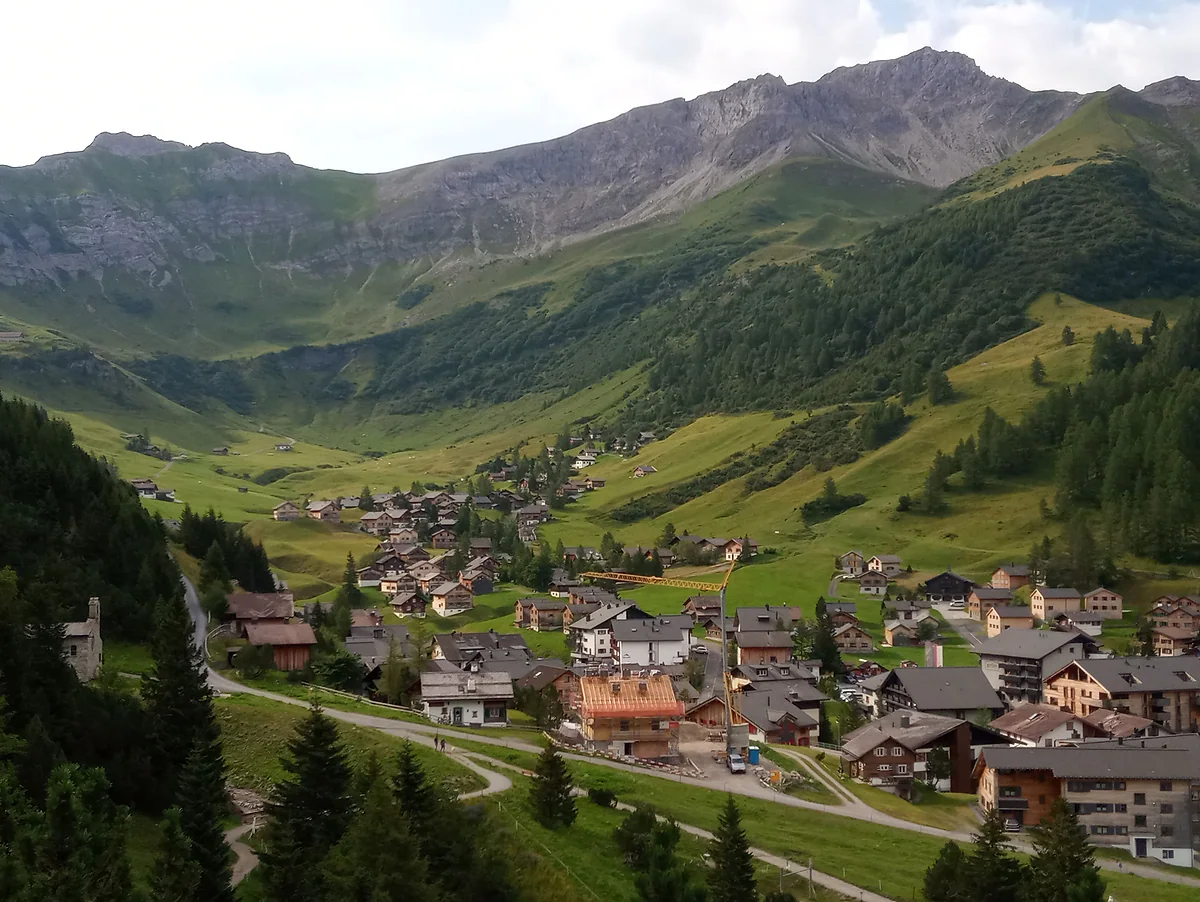
98% of Vaduz's water comes from Malbun springs
Tap water in Liechtenstein, where it comes from and which fountains to skip
Yes, you can drink the tap water in Liechtenstein. Vaduz's official 2026 water report rates it hygienically flawless and says 98% comes from springs at Malbun. In the Unterland, the water cooperative calls its quality very good and uses no chlorine. At public fountains, look for the sign saying whether the water is drinkable.
I wouldn't buy a single bottle of water in Liechtenstein. I'd bring a refillable bottle, fill it at the hotel or at a fountain marked as drinking water, and leave the bottled stuff to people who haven't read this.

Before you go
What I would keep in mind
-
01 To save money
Refill and skip the supermarket
Vaduz's tap water is 98% spring water and meets food-safety standards. Paying Swiss-franc prices for bottled water makes no sense.
-
02 My tip
Read the pictogram at fountains
Fountains on the mains carry a «Trinkwasser» sign. Those fed by their own spring carry «Kein Trinkwasser», meaning not for drinking.
-
03 Most beautiful
Vaduz's water comes down from Malbun
Most of the capital's water rises in springs at Malbun, up in the mountains. A glass from the tap in Vaduz is Alpine water from the country itself.
Malbun -
04 My tip
Free water at the Kunstmuseum
The museum has a picnic table in its side-lit gallery where you can eat something you've brought and have a glass of water.
the Kunstmuseum Liechtenstein in Vaduz
What I would book
The short answer is yes, and there’s data to back it up. Liechtenstein publishes its water quality in real detail, and what those reports say I find genuinely reassuring. Here’s where the water comes from, what the tests show, and the one precaution that does matter.
What Vaduz’s official report says
Vaduz publishes a drinking water information sheet, with figures as of 31 March 2026, prepared within the Oberland’s shared water supply. The conclusion is clear. The water reaching consumers is hygienically flawless and meets the chemical requirements of food law.
The appealing part is its origin. 98% comes from springs in the Schneeflucht area of Malbun and just 2% is groundwater from wells at Neugut and Wiesen. Vaduz’s waterworks draws about 1.5 million cubic metres a year, mostly from those mountain springs. So when you turn on a tap in the capital, you’re drinking water that has come down from the country’s own Alps. What that part of the country is like is covered in Malbun.
Is it chlorinated, and does it taste odd?
In Vaduz, spring water is disinfected with ultraviolet light, a physical treatment, and groundwater isn’t treated at all. The report itself says the water has a good taste and is always fresh. In the Unterland, the cooperative that runs the supply goes further, describing its quality as very good and saying treatment requires no chlorine or chemicals. It also uses UV on its spring water.
What you may notice, if you have sensitive skin or hair, is the hardness. In Vaduz it ranges from 15 to 31 French degrees, around 26 on average, which the report calls medium to fairly hard. In the Unterland it’s around 25 to 30. None of that stops you drinking it; it’s simply water with some lime in it. And nitrate in Vaduz sits between 1 and 6 milligrams per litre, against a reference value of 40.
How much testing lies behind it
This is the part I find most convincing. The Unterland’s cooperative takes 12 samples a year from the network, meaning customers’ taps, and another 20 at the springs before the water enters the pipes. It’s open about the fact that spring samples often show small amounts of naturally occurring bacteria, which is why it disinfects all spring water with UV, after which the water is fit to supply. That kind of transparency is exactly what I want from a water company.
A bathing lake with drinking-quality water
A detail I like. The Grossabünt bathing lake in Gamprin is fed by groundwater that the municipality itself describes as drinking-water quality, with no chemicals, and it’s drained every autumn for maintenance. It isn’t for drinking, obviously, but it says a lot about the water under the valley. It’s covered in Liechtenstein’s lakes.
The precaution that matters, fountains
This is where people get caught out. Not every public fountain gives drinking water. In the Unterland most are connected to the mains and carry a «Trinkwasser» (drinking water) pictogram. Those fed by their own spring, off the network, don’t supply drinking water and carry a «Kein Trinkwasser» pictogram. If you see that sign, don’t drink, however fresh it looks.
I’d apply the same rule across the whole country. If the fountain says «Trinkwasser», fill up. If it says nothing, or the opposite, wait for the next tap or the next café.
What I haven’t been able to check
I’ve read the Vaduz report and the Unterland’s, which according to its list of fountains supplies Eschen, Gamprin, Mauren, Ruggell and Schellenberg. I haven’t seen the reports for Schaan, Triesen, Balzers, Triesenberg or Planken, so I won’t give figures for those. I’d rather tell you that plainly than guess and present it as fact.
In the meantime, my practical advice is to carry a refillable bottle and fill it at the hotel. You’ll save buying bottled water at Swiss-franc prices, which adds up faster than you’d think. Even the Kunstmuseum in Vaduz lets visitors have a glass of water at the picnic table in its side-lit gallery, which is handy on a long museum day. What everything else costs is in Liechtenstein prices and budget, and if you’re heading into the mountains, the routes are in hiking in Liechtenstein.
Vaduz and Unterland water in figures
| Measure | Vaduz | Unterland (WLU) |
|---|---|---|
| Quality | Hygienically flawless, meets food law | Very good |
| Source | 98% springs at Malbun, 2% groundwater | Springs and groundwater |
| Treatment | UV on spring water, groundwater untreated | No chlorine or chemicals, UV on spring water |
| Hardness | 15 to 31 °fH, around 26 on average | 25 to 30 °fH |
| Nitrate | 1 to 6 mg per litre (limit 40) | Not stated |
Vaduz's official drinking water report (as of 31 March 2026) and the Wasserversorgung Liechtensteiner Unterland website. I haven't seen reports for the other Oberland municipalities.
Test yourself
True or false?
0/4 Pick before you peek.
-
Most of Vaduz's tap water is spring water.
See the answer
True. The 2026 report says 98% comes from springs in the Schneeflucht area of Malbun.
-
Every public fountain in Liechtenstein gives drinking water.
See the answer
False. Fountains fed by their own spring carry a «Kein Trinkwasser» sign and aren't drinkable.
-
The Unterland's water is chlorinated.
See the answer
False. The Unterland's cooperative says its treatment requires no chlorine or chemicals.
-
Vaduz's water is well below the nitrate limit.
See the answer
True. It contains 1 to 6 mg per litre against a reference value of 40 mg per litre.
0 of 168 Liechtenstein guides
Your next stamp
- Swimming pools
- Where to eat
- Tourist office
- With kids
- Things to do
- Where to stay
- One day
- Two days
- Municipalities
- Oberland
- Unterland
- Map
- Vaduz
- Städtle
- Mitteldorf
- Vaduz Castle
- Vaduz Cathedral
- Parliament
- Government Building
- Vaduz Town Hall
- Red House
- Prince's Winery
- Old Rhine Bridge
- Schaan
- Schalun Castle Ruin
- Balzers
- Citytrain
- Triesen
- Triesenberg
- Walser Museum
- Planken
- Gutenberg Castle
- The Rhine
- Schaan Roman fort
- Dux
- St Mamertus chapel
- Lawena valley
- Mäls
- DoMuS
- TAK Theatre
- Castles
- Churches and chapels
- Viewpoints
- Mountains
- Museums
- Kunstmuseum
- Mountain huts
- Hilti Art Foundation
- Pfälzerhütte
- Gafadura hut
- National Museum
- Treasure Chamber
- Postage Stamp Museum
- Kunstraum Engländerbau
- Eschen
- Masescha
- Gaflei
- Nendeln
- Mauren
- Silum
- Rotenboden
- Schaanwald
- Gamprin
- Wangerberg
- Bendern
- Steg
- Ruggell
- Samina valley
- Schellenberg Farmhouse Museum
- Cross-country skiing at Steg
- Küefer-Martis-Huus
- Ruggeller Riet
- Schellenberg
- Hinterschellenberg
- Fürstensteig
- Is it a country?
- Liechtenstein Trail
- Malbun
- Schellenberg castles
- Eschnerberg
- Malbun in summer
- Population
- Stage 1: Balzers - Triesenberg
- Lakes
- Sareis
- Size
- Stage 2: Triesenberg - Vaduz
- Malbun Peace Chapel
- Political system
- Stage 3: Vaduz - Nendeln
- Language
- Skiing in Malbun
- Stage 4: Nendeln - Ruggell
- Dialect
- Malbun ski pass
- Stage 5: Ruggell - Schaanwald
- Hotels in Malbun
- Stamps
- Princess Gina Trail
- Hut-to-hut Route 66
- Hiking
- Getting there
- In winter
- Weather
- Airport
- Best time to visit
- In summer
- Events
- Zurich to Liechtenstein
- National day
- Sargans to Vaduz
- Christmas
- Feldkirch to Vaduz
- By train
- Traditions
- Carnival
- Getting around
- Buses
- Funken Sunday
- Alpine cattle drive
- Driving and vignette
- Parking
- Bike hire
- Cycling
- EU and Schengen
- Entry requirements
- Borders and customs
- The prince
- The princely house
- The flag
- The coat of arms
- The national anthem
- History
- Second World War
- No army
- Facts
- Why so rich?
- Banks and tax haven
- Hilti
- Hotels in Vaduz
- False teeth
- Hostel and camping
- Rent the country?
- Restaurants in Vaduz
- Swiss invasions
- Bars and nightlife
- Food
- Käsknöpfle
- Wine
- Casinos
- Adventure Pass
- Rainy days
- Guided tours
- Day trips
- Passport stamp
- Music festivals
- Phone and roaming
- Currency and payments
- Prices and budget
- Tipping
- Plugs and sockets
- Opening hours
- Public holidays
- Safety
- Accessibility
- With a dog
- Shopping and souvenirs
Frequently asked questions
Is the tap water safe to drink in Liechtenstein?
Yes. Vaduz's official report says the water reaching consumers is hygienically flawless and meets food law requirements, and the Unterland's cooperative rates its water very good.
Can you drink from fountains in Liechtenstein?
Only those marked as drinking water. Fountains on the public mains carry a «Trinkwasser» pictogram; those fed by their own spring carry «Kein Trinkwasser» and shouldn't be drunk from.
Is Liechtenstein's water chlorinated?
The Unterland's cooperative says its treatment needs no chlorine or chemicals. In Vaduz, spring water is disinfected with ultraviolet light and groundwater isn't treated.
Where does Vaduz's tap water come from?
98% from springs in the Schneeflucht area of Malbun and the rest from groundwater wells at Neugut and Wiesen, according to the 2026 report.
Is Liechtenstein's water hard?
Fairly. In Vaduz hardness ranges from 15 to 31 French degrees, around 26 on average, which the report describes as medium to fairly hard.
By
Tourism graduate with a master’s in Tourism Management and Planning from the University of Málaga, who has travelled across Europe. He writes every guide from official sources and his own judgement.
Published on . Facts checked on .
Sources