Open to Switzerland, customs with Austria
Crossing Liechtenstein's borders, no passport check but customs
The border between Switzerland and Liechtenstein is open, with no customs since 1924, and you cross the Rhine bridges almost without noticing. The Austrian border has no fixed passport control thanks to Schengen, but it is a customs frontier, because Liechtenstein sits in the Swiss customs area. Entering from Austria, you can bring CHF 150 of goods VAT-free per person per day.
If I'd bought something pricey in Austria or Germany and was coming back through Schaanwald, I'd declare it in the QuickZoll app before crossing. It takes a minute and saves an argument at customs. Towards Switzerland, I'd cross the Rhine without a second thought.

Before you go
What I would keep in mind
-
01 Most beautiful
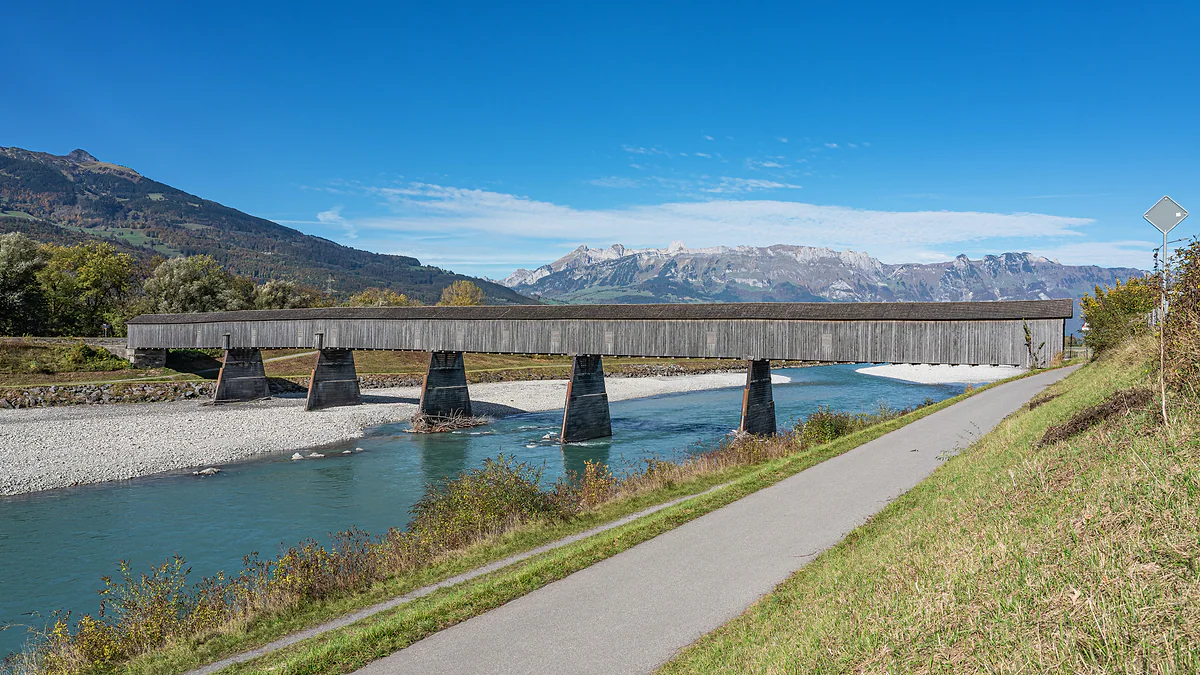
Walk into Switzerland over a wooden bridge
The covered bridge of 1901 between Vaduz and Sevelen is the last of the old wooden Rhine bridges. Crossing it on foot is the loveliest way to change countries.
the old wooden bridge between Vaduz and Sevelen -
02 Money
CHF 150 VAT-free per person per day
Entering the Swiss customs area, which includes Liechtenstein, goods for personal use or gifts come in VAT-free up to CHF 150. Above that you pay VAT on the full amount, at 8.1% or 2.6%.
-
03 Watch out
Don't count on a VAT refund
I haven't found any official source on VAT refunds for tourists in Liechtenstein. If a shop promises tax-free shopping, ask them to explain the process in writing.
shopping and souvenirs in Liechtenstein -
04 My tip
Lock your phone to a local network near the Rhine
Liechtenstein is in the EEA, Switzerland isn't, and near the river your phone may switch to a Swiss mast. With a UK tariff, I'd choose the network manually.
phone and roaming in Liechtenstein
What I would book
Liechtenstein has two borders, and they couldn’t be more different. The Swiss one you cross without noticing, over a bridge on the Rhine. The Austrian one won’t ask for your passport either, but it’s a proper customs frontier. Knowing why saves you surprises if you’re driving, buying something expensive or travelling on through Vorarlberg. The Swiss army hasn’t always respected that open frontier either, as the episodes in Swiss invasions of Liechtenstein show.
Towards Switzerland, the Rhine and little else
Customs between Switzerland and Liechtenstein disappeared in 1924, when the customs treaty turned the two countries into a single customs area. And as both are in Schengen, there’s no fixed passport control either. In practice the border is the river. According to the Office of Statistics it runs for 41.3 km along the cantons of St. Gallen and Graubünden.
You cross it by the Rhine bridges. The Historisches Lexikon records the first fixed bridges between 1867 and 1871, linking Schaan with Buchs, Bendern with Haag, Balzers with Trübbach and Vaduz with Sevelen, followed in 1929 by Ruggell to Sennwald. Of them all, only the Vaduz bridge is still wooden, a covered crossing from 1901 that you can walk. For me there’s no nicer way to go from one country to the other, and I cover it in the old Rhine bridge. Which countries border Liechtenstein, and how it looks on the map, is in the map of Liechtenstein.
Towards Austria, Schengen yes, customs too
The 36.6 km border with Vorarlberg is another matter. There’s no fixed passport control, as Liechtenstein has been in Schengen since 19 December 2011. But Austria is in the EU and Liechtenstein is part of the Swiss customs area, so crossing takes you from one customs zone to another. gov.uk spells it out in its travel advice, Switzerland handles Liechtenstein’s customs.
The main crossing is at Schaanwald on the Feldkirch road. The bus stop there is literally called Zollamt, customs office, and routes 11 and 14 call at it. Driving on the A14, you leave at exit 41, Feldkirch-Frastanz. The whole journey is laid out in Feldkirch to Vaduz.
Could anyone ask for my passport?
Usually not, but it can happen. The EU notes that Schengen countries can reintroduce temporary border controls in exceptional circumstances, and police can carry out identity checks in border areas, stations and airports. As a British visitor your passport is your only valid travel document, so keep it on you whenever you cross.
What you can bring in
Entering the Swiss customs area from Austria, Liechtenstein included, Swiss customs lets in goods and gifts for personal use VAT-free up to CHF 150 per person per day, children included. Go over and you pay VAT on the whole amount, 8.1% or 2.6% depending on the item. There are quantity limits too, 5 litres of drinks up to 18% alcohol, 1 litre of anything stronger, 250 cigarettes and 1 kg of meat.
This is where I’d use the official QuickZoll app. It lets you declare purchases and pay anything due before you cross, choosing a two-hour window, after which you can use any crossing point. For a couple of bottles of wine it’s unnecessary, but after a big shop in Feldkirch I’d rather have the peace of mind.
Heading on into the EU
If you’re driving on through Austria or Germany, you enter the EU from a non-EU country, so EU allowances apply. Your Europe lists 4 litres of still wine, 16 litres of beer, 1 litre of spirits over 22% and at least 200 cigarettes, depending on the country, plus €300 per person of other goods when travelling by land. The allowances for bringing goods home to the UK are set by the UK, so check gov.uk before you fly back.
I haven’t found a readable official source on VAT refunds for tourists, so I won’t promise you one. If a shop offers it, get them to explain how it works. What’s worth buying is in shopping and souvenirs in Liechtenstein.
The border your phone notices
There’s one more frontier, the one your phone sees. Liechtenstein is in the European Economic Area and Switzerland isn’t, and in the Rhine valley, with Switzerland just across the water, your phone can switch networks without warning. Since Brexit that matters mainly according to your UK tariff, and I have no official figures on what each network charges, so I’ll stick to the advice, lock your phone to a Liechtenstein network by hand. It’s explained in phone and roaming in Liechtenstein.
Entering the Swiss customs area (Liechtenstein included)
| Item | Duty-free |
|---|---|
| Total goods and gifts | Up to CHF 150 VAT-free per person per day |
| Drinks up to 18% vol. | 5 litres |
| Drinks over 18% vol. | 1 litre |
| Cigarettes or heated tobacco products | 250 |
| Meat | 1 kg |
Swiss customs (FOCBS). Above the allowance VAT is due at 8.1% or 2.6%. You can declare in advance with the QuickZoll app.
Driving on into the EU from Liechtenstein
| Item | Tax-free amount |
|---|---|
| Still wine | 4 litres |
| Beer | 16 litres |
| Spirits over 22% | 1 litre (or 2 litres of fortified or sparkling wine) |
| Cigarettes | At least 200, depending on the country |
| Other goods | €300 per person by land |
Your Europe (European Union). Some countries set lower limits for under-15s.
Test yourself
True or false?
0/4 Pick before you peek.
-
There's a customs border between Liechtenstein and Switzerland.
See the answer
False. Since the 1924 customs treaty the two countries have shared a customs area, with no customs between them.
-
The Austrian border is a customs border even without passport checks.
See the answer
True. Liechtenstein is in the Swiss customs area and Austria in the EU, so Schaanwald is a customs crossing, even though Schengen removes fixed passport control.
-
You can bring unlimited VAT-free shopping into Liechtenstein.
See the answer
False. Swiss customs sets the allowance at CHF 150 per person per day. Above it, VAT is charged on the total.
-
Liechtenstein's border with Switzerland is longer than its border with Austria.
See the answer
True. According to the Office of Statistics, it's 41.3 km with Switzerland and 36.6 km with Austria.
0 of 168 Liechtenstein guides
Your next stamp
- The Rhine
- Map
- Getting there
- Schaanwald
- Is it a country?
- Entry requirements
- Currency and payments
- Things to do
- One day
- Two days
- Municipalities
- Oberland
- Unterland
- Vaduz
- Städtle
- Mitteldorf
- Vaduz Castle
- Vaduz Cathedral
- Parliament
- Government Building
- Vaduz Town Hall
- Red House
- Prince's Winery
- Old Rhine Bridge
- Schaan
- Schalun Castle Ruin
- Balzers
- Citytrain
- Triesen
- Triesenberg
- Walser Museum
- Planken
- Gutenberg Castle
- Schaan Roman fort
- Dux
- St Mamertus chapel
- Lawena valley
- Mäls
- DoMuS
- TAK Theatre
- Castles
- Churches and chapels
- Viewpoints
- Mountains
- Museums
- Kunstmuseum
- Mountain huts
- Hilti Art Foundation
- Pfälzerhütte
- Gafadura hut
- National Museum
- Treasure Chamber
- Postage Stamp Museum
- Kunstraum Engländerbau
- Eschen
- Masescha
- Gaflei
- Nendeln
- Mauren
- Silum
- Rotenboden
- Gamprin
- Wangerberg
- Bendern
- Steg
- Ruggell
- Samina valley
- Schellenberg Farmhouse Museum
- Cross-country skiing at Steg
- Küefer-Martis-Huus
- Ruggeller Riet
- Schellenberg
- Hinterschellenberg
- Fürstensteig
- Liechtenstein Trail
- Malbun
- Schellenberg castles
- Eschnerberg
- Malbun in summer
- Population
- Stage 1: Balzers - Triesenberg
- Lakes
- Sareis
- Size
- Stage 2: Triesenberg - Vaduz
- Malbun Peace Chapel
- Political system
- Stage 3: Vaduz - Nendeln
- Swimming pools
- Language
- Skiing in Malbun
- Stage 4: Nendeln - Ruggell
- Dialect
- Malbun ski pass
- Stage 5: Ruggell - Schaanwald
- Hotels in Malbun
- Stamps
- Princess Gina Trail
- Hut-to-hut Route 66
- Hiking
- In winter
- Weather
- Airport
- Best time to visit
- In summer
- Events
- With kids
- Zurich to Liechtenstein
- National day
- Sargans to Vaduz
- Christmas
- Feldkirch to Vaduz
- By train
- Traditions
- Carnival
- Getting around
- Buses
- Funken Sunday
- Alpine cattle drive
- Driving and vignette
- Parking
- Bike hire
- Cycling
- EU and Schengen
- The prince
- The princely house
- The flag
- The coat of arms
- The national anthem
- History
- Second World War
- No army
- Facts
- Why so rich?
- Banks and tax haven
- Where to stay
- Hilti
- Hotels in Vaduz
- False teeth
- Hostel and camping
- Rent the country?
- Where to eat
- Restaurants in Vaduz
- Swiss invasions
- Bars and nightlife
- Food
- Käsknöpfle
- Wine
- Casinos
- Adventure Pass
- Rainy days
- Guided tours
- Tourist office
- Day trips
- Passport stamp
- Music festivals
- Phone and roaming
- Prices and budget
- Tipping
- Plugs and sockets
- Tap water
- Opening hours
- Public holidays
- Safety
- Accessibility
- With a dog
- Shopping and souvenirs
Frequently asked questions
Is there a border control between Switzerland and Liechtenstein?
No. Since the 1924 treaty there has been no customs border, and as both are in Schengen there's no fixed passport control either. You simply cross a Rhine bridge.
Is there a border check between Austria and Liechtenstein?
There's no fixed passport control, as both are in Schengen. It is, however, a customs border, because Liechtenstein belongs to the Swiss customs area and Austria to the EU.
Where is the Liechtenstein-Austria border crossing?
The main crossing is at Schaanwald on the Feldkirch road, where there's even a bus stop called Zollamt, meaning customs office. From the Austrian A14 you leave at exit 41, Feldkirch-Frastanz.
What can I bring through Liechtenstein customs?
On entry, up to CHF 150 of goods VAT-free per person per day, 5 litres of drinks up to 18%, 1 litre of stronger drinks and 250 cigarettes, according to Swiss customs.
Which countries border Liechtenstein?
Switzerland to the west and south, with 41.3 km of border, and Austria to the north and east, with 36.6 km, according to the Office of Statistics.
Can you walk from Liechtenstein to Switzerland?
Yes. The covered wooden bridge between Vaduz and Sevelen crosses the Rhine and the border, and it's the most charming way to do it.
By
Tourism graduate with a master’s in Tourism Management and Planning from the University of Málaga, who has travelled across Europe. He writes every guide from official sources and his own judgement.
Published on . Facts checked on .
Sources