5 to 10%, never compulsory
How much to tip in Liechtenstein, and when you needn't bother
Tipping in Liechtenstein isn't compulsory. The official tourist board says so plainly, adding that tips generally run at 5 to 10% of the bill. Tip in Swiss francs, the local currency, and at the mountain huts, which only take cash, leave it in notes or coins when you settle up.
I'd leave 5% for decent service and go to 10% when someone has looked after me properly. What I wouldn't do is feel obliged, because the official line is that tipping is optional.
Before you go
What I would keep in mind
-
01 Money
Tip if you like, but it's optional
The tourist board sums it up in two sentences. Tips aren't compulsory, and they're generally 5 to 10%. It's the only published guidance I've found, and it's what I'd follow.
-
02 My tip
Take coins up to the huts
The Pfälzerhütte and Gafadurahütte accept cash only, in francs or euros. If you want to leave something, plan for it before you set off, as there's no card machine up there.
mountain huts in Liechtenstein -
03 Money
Tip in francs, not pounds or euros
The currency is the Swiss franc. Pay in euros and your change comes back in francs, so leaving the tip in the same currency keeps it simple for everyone.
Liechtenstein's currency -
04 To save money
What doesn't need a tip
Buses, museum tickets and the passport stamp are fixed prices at a counter. Tips are for people who serve you, not for a ticket desk.
What I would book
Tipping is one of those customs every country handles differently and nobody explains. In Liechtenstein, happily, the official tourist board puts it in writing, and the answer is reassuring. It’s optional, and the usual amount is modest. Here’s my approach, and where it doesn’t arise at all.
What the official guidance says
In its country facts page, Liechtenstein’s tourist board covers it in two sentences. Tips aren’t compulsory, and they generally sit between 5 and 10%. There’s no further small print or published service charge, so I won’t invent rules I haven’t read anywhere.
I think that’s a sensible guideline and an easy one to apply, because it leaves you room without turning the bill into an exam. Decent service, 5%. Genuinely good service, 10%. And if it wasn’t good, nothing, since it isn’t compulsory and nobody should make you feel otherwise.
Which currency, and how to leave it
The currency is the Swiss franc, so the tidiest option is to tip in francs. Euros are accepted in plenty of places, but change tends to come back in francs, and mixing currencies at the same table only muddles things. Getting the exchange right is the subject of currency and payments in Liechtenstein.
As for adding a tip when paying by card, no official source I’ve read explains how it works. So I’d always carry a few coins or a small note in francs. It gives you the freedom to decide without depending on the card machine.
The mountains are a special case
At the Alpine Club’s huts it’s a practical question rather than a cultural one. The Pfälzerhütte accepts nothing but cash, and the Gafadurahütte warns there’s no card payment, only notes and coins in francs or euros. Anyone going up to eat or spend the night who wants to leave a tip needs to bring it from the valley. Half board at the Pfälzerhütte costs CHF 75 for non-members, so 5% would be under CHF 4. Everything else about the huts is in Liechtenstein’s mountain huts.
Where you’ll eat, and where it applies
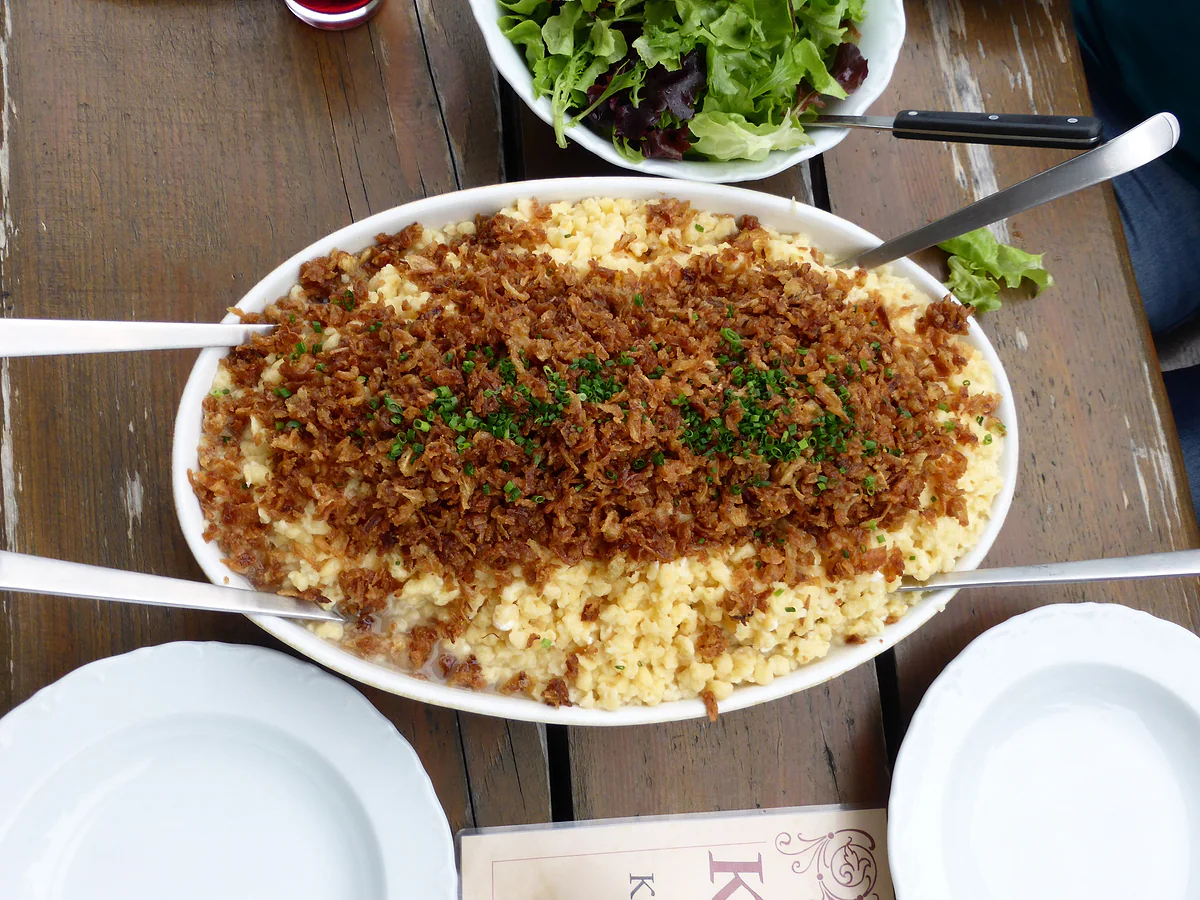
Tipping is for restaurants with table service. The tourist board recommends several places to try Käsknöpfle, the country’s best-known dish, including the Berggasthaus Masescha with 13 Gault-Millau points, the Restaurant Adler in Vaduz, open since 1908, the Wirtschaft zum Löwen in Schellenberg and the restaurant at Sareis, 2,000 metres up. I’d apply the same guidance in any of them. What to order is in Käsknöpfle and where to sit down in where to eat in Liechtenstein.
What doesn’t need a tip is anything paid at a counter at a fixed price. Buses, museum tickets, the Citytrain and the passport stamp don’t expect one. On a booked guided tour, by contrast, I would leave something for a guide who’s done a good job, with no fixed percentage, because the service is personal.
Taxis, hotels and a winery tasting
Three more situations are worth a word. Taxis, which the tourist board says are available around the clock, are a personal service, and I’d round up to the next franc or leave that 5% if the driver has helped with your bags. For hotels I haven’t seen any published custom, so I’d only leave something when a member of staff has gone out of their way for you.
The third is the Hofkellerei tasting, which costs CHF 19 and includes a guided visit of about 90 minutes. That’s a fixed price and nothing more is expected. If the guide has brought the place to life, a few coins are a kind gesture rather than a duty. The visit itself is covered in the prince’s winery.
If you’re used to British habits, none of this should feel strange. The difference is mainly the currency, and the fact that some places in the mountains won’t take a card for the bill, let alone the tip.
My summary so you needn’t think twice
Carry a little cash in francs, leave 5 to 10% in restaurants if you liked the service, and don’t feel guilty if you didn’t. In the mountains, the tip money has to come up with you. And if you’re working out the trip’s budget, what everything costs is in Liechtenstein prices and budget.
What 5% and 10% look like
| Bill | 5% | 10% |
|---|---|---|
| CHF 20 | CHF 1 | CHF 2 |
| CHF 40 | CHF 2 | CHF 4 |
| CHF 75 (half board, Pfälzerhütte) | CHF 3.75 | CHF 7.50 |
| CHF 120 | CHF 6 | CHF 12 |
Percentages from Liechtenstein's tourist board. The bills are worked examples, except the Pfälzerhütte half-board rate for non-members, which is its published price.
What I'd do in each situation
| Situation | My approach |
|---|---|
| Restaurant with table service | 5 to 10%, depending on the service |
| Mountain hut | The same, but in cash, as cards aren't taken |
| Booked guided tour | Something for a good guide, no fixed percentage |
| Bus, museum, ticket desk | Nothing, the price is fixed |
My own view, based on the official 5 to 10% guidance.
Test yourself
True or false?
0/3 Pick before you peek.
-
Tipping is compulsory in Liechtenstein's restaurants.
See the answer
False. The tourist board states that tips are not compulsory.
-
A typical tip in Liechtenstein is 5 to 10%.
See the answer
True. That's the range the official tourist board publishes.
-
You can pay the bill and tip by card at the Alpine Club's huts.
See the answer
False. The Pfälzerhütte and Gafadurahütte accept cash only.
0 of 168 Liechtenstein guides
Your next stamp
- Currency and payments
- Driving and vignette
- Prices and budget
- Casinos
- Passport stamp
- Shopping and souvenirs
- Things to do
- One day
- Two days
- Municipalities
- Oberland
- Unterland
- Map
- Vaduz
- Städtle
- Mitteldorf
- Vaduz Castle
- Vaduz Cathedral
- Parliament
- Government Building
- Vaduz Town Hall
- Red House
- Prince's Winery
- Old Rhine Bridge
- Schaan
- Schalun Castle Ruin
- Balzers
- Citytrain
- Triesen
- Triesenberg
- Walser Museum
- Planken
- Gutenberg Castle
- The Rhine
- Schaan Roman fort
- Dux
- St Mamertus chapel
- Lawena valley
- Mäls
- DoMuS
- TAK Theatre
- Castles
- Churches and chapels
- Viewpoints
- Mountains
- Museums
- Kunstmuseum
- Mountain huts
- Hilti Art Foundation
- Pfälzerhütte
- Gafadura hut
- National Museum
- Treasure Chamber
- Postage Stamp Museum
- Kunstraum Engländerbau
- Eschen
- Masescha
- Gaflei
- Nendeln
- Mauren
- Silum
- Rotenboden
- Schaanwald
- Gamprin
- Wangerberg
- Bendern
- Steg
- Ruggell
- Samina valley
- Schellenberg Farmhouse Museum
- Cross-country skiing at Steg
- Küefer-Martis-Huus
- Ruggeller Riet
- Schellenberg
- Hinterschellenberg
- Fürstensteig
- Is it a country?
- Liechtenstein Trail
- Malbun
- Schellenberg castles
- Eschnerberg
- Malbun in summer
- Population
- Stage 1: Balzers - Triesenberg
- Lakes
- Sareis
- Size
- Stage 2: Triesenberg - Vaduz
- Malbun Peace Chapel
- Political system
- Stage 3: Vaduz - Nendeln
- Swimming pools
- Language
- Skiing in Malbun
- Stage 4: Nendeln - Ruggell
- Dialect
- Malbun ski pass
- Stage 5: Ruggell - Schaanwald
- Hotels in Malbun
- Stamps
- Princess Gina Trail
- Hut-to-hut Route 66
- Hiking
- Getting there
- In winter
- Weather
- Airport
- Best time to visit
- In summer
- Events
- With kids
- Zurich to Liechtenstein
- National day
- Sargans to Vaduz
- Christmas
- Feldkirch to Vaduz
- By train
- Traditions
- Carnival
- Getting around
- Buses
- Funken Sunday
- Alpine cattle drive
- Parking
- Bike hire
- Cycling
- EU and Schengen
- Entry requirements
- Borders and customs
- The prince
- The princely house
- The flag
- The coat of arms
- The national anthem
- History
- Second World War
- No army
- Facts
- Why so rich?
- Banks and tax haven
- Where to stay
- Hilti
- Hotels in Vaduz
- False teeth
- Hostel and camping
- Rent the country?
- Where to eat
- Restaurants in Vaduz
- Swiss invasions
- Bars and nightlife
- Food
- Käsknöpfle
- Wine
- Adventure Pass
- Rainy days
- Guided tours
- Tourist office
- Day trips
- Music festivals
- Phone and roaming
- Plugs and sockets
- Tap water
- Opening hours
- Public holidays
- Safety
- Accessibility
- With a dog
Frequently asked questions
Do you tip in Liechtenstein?
You can, but you don't have to. The tourist board says tips aren't compulsory and are generally between 5 and 10%.
How much should I tip in a restaurant in Liechtenstein?
Between 5 and 10% of the bill, following the tourist board's guidance. I'd start at 5% and go higher if the service deserves it.
Should I tip in euros or Swiss francs?
Swiss francs, the local currency. Euros are taken in many places, but change usually comes back in francs, so it's simpler to tip in francs too.
Can I add a tip when paying by card?
I haven't found an official source explaining this. I'd carry a little cash for tips, especially in the mountains, where the huts only accept cash.
Is tipping expected at mountain huts?
It isn't compulsory there either. If you do leave something, it has to be cash, because the Pfälzerhütte and Gafadurahütte don't take cards.
By
Tourism graduate with a master’s in Tourism Management and Planning from the University of Málaga, who has travelled across Europe. He writes every guide from official sources and his own judgement.
Published on . Facts checked on .
Sources
Photos: © 1971markus (CC BY-SA 4.0), via Wikimedia Commons.