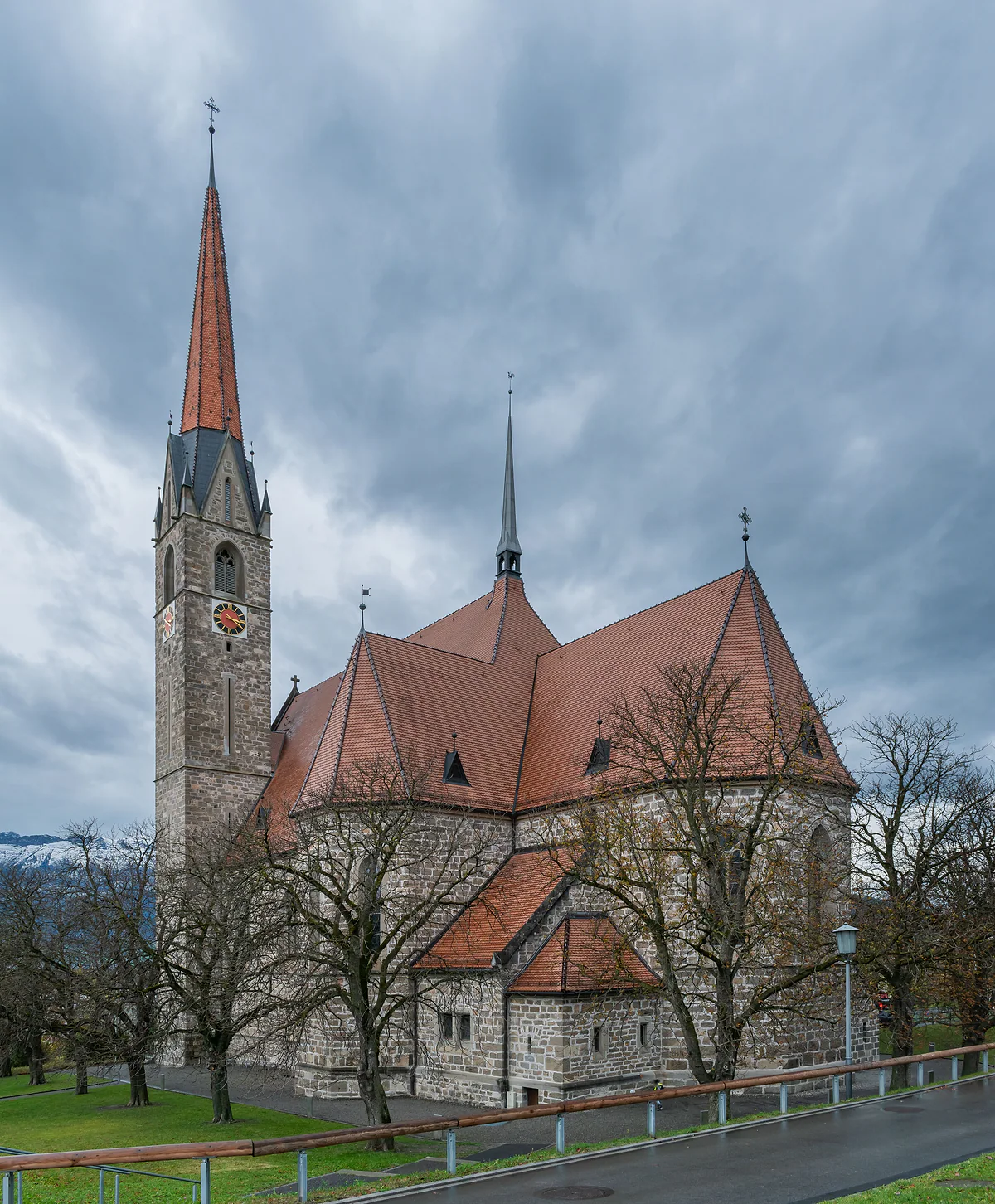
Founded in Schaan in 1941
Hilti, the Schaan firm that changed Liechtenstein
Hilti is a multinational maker of construction tools and fixings, founded in 1941 in Schaan by the brothers Eugen and Martin Hilti, and it still has its headquarters there. It employs more than 34,000 people and operates in over 120 countries. For visitors, its visible legacy is the Hilti Art Foundation in Vaduz, with more than 500 works of modern art, and a railway stop named after it.
In 30 seconds
Full read: 3 min
- Hilti was founded in Schaan in 1941 and is still headquartered there.
- It employs more than 34,000 people and operates in over 120 countries.
- In its early years it produced for the German war economy, and co-founder Martin Hilti was active in the local Nazi movement.
- What you can visit is the Hilti Art Foundation in Vaduz, free on Wednesdays.
I wouldn't bother with the headquarters, which is a working company rather than a museum. What I would do is visit the Hilti Art Foundation on a Wednesday, when entry to it and the Kunstmuseum is free, and see in an afternoon where part of this family's wealth has ended up.

Before you go
What I would keep in mind
-
01 To save money
Hilti family art, free on Wednesdays
The Hilti Art Foundation shares its ticket with the Kunstmuseum in Vaduz, CHF 15 full price and free for under-16s. On Wednesdays entry is free for everyone.
the Hilti Art Foundation in Vaduz -
02 My tip
A railway stop called Forst Hilti
The railway through the country has three stops in Liechtenstein, and one is called Forst Hilti, after the company. Check the Austrian railways website for services before relying on it.
Liechtenstein by train -
03 Most beautiful
From black cube to white cube
The foundation's 2015 museum is a white cube of polished concrete joined to the black cube of the Kunstmuseum. They share a foyer and make one of the most photogenic corners of the Städtle.
the Kunstmuseum Liechtenstein in Vaduz
What I would book
If you’ve ever worked on a building site, or know someone who has, Hilti’s red case will ring a bell. What few people realise is that the brand is from Liechtenstein, that it was born in Schaan in the middle of the war and that it still has its headquarters there. To me it’s a shortcut to grasping that this is, above all, an industrial country, and it leads you to one of the best museums on the Städtle.
From a Schaan workshop to 120 countries
It all began in a small machine shop that Eugen Hilti ran in Schaan in the 1930s, next to his car garage, where he made saws and spark plug bodies among other things. At the end of 1941 he founded Hilti Maschinenbau OHG with his brother Martin, an engineer. In 1948 the firm won its first order for steel bolts for powder-actuated fastening, and from then on it specialised in fixing things into concrete and steel.
The milestones Hilti itself highlights are the DX 100 of 1957, which it presents as the world’s first powder-actuated tool, and the TE 17 of 1967, the first electropneumatic hammer drill. In 1970 it opened its first factory abroad, at Thüringen in Austria’s Vorarlberg. It has been Liechtenstein’s biggest company since the 1960s, according to the Historisches Lexikon. Schaan’s other famous firm, Ivoclar, arrived in 1933 as a porcelain teeth factory, which explains Liechtenstein and false teeth. Today it has 34,195 employees, operations in more than 120 countries and, from January to August 2026, sales of CHF 4,244 million. How much firms like this weigh in the economy is broken down in why Liechtenstein is so rich.
A family that gave up its inheritance
There’s a governance detail I find very Liechtenstein. In 1980 the Martin Hilti Family Trust was created, and all of Martin Hilti’s direct descendants renounced their inheritance so the company would never be split. His son Michael ran it from 1990 and in 1994 stepped aside for Pius Baschera, the first chief executive from outside the family. The headquarters was completely refurbished in 2016, a year after a new innovation centre opened, as a sign that the firm is staying in Schaan. Martin Hilti also set up welfare schemes regarded locally as a model, including a company pension fund in 1959, and in 1996 a foundation that supports social, educational and cultural projects in Liechtenstein and abroad.
The awkward chapter
It would be dishonest to tell this story without its darker side. The Historisches Lexikon explains that, in its first years, the company produced mainly for the German war economy, with 70 employees in 1943 making engine parts and spark plugs. Between 1940 and 1942 Martin Hilti was one of the leaders of the local Nazi movement and editor of its newspaper, and in 1945 a Swiss military court convicted him in absentia of espionage. He held no political office after the war. The background to those years is in Liechtenstein in the Second World War.
What you can actually see
The Schaan headquarters is a working company and I haven’t found any public tours, so I wouldn’t send you there. The visitable part is in Vaduz. The family has collected art since the 1970s, started building a serious collection in 1997 and set up the foundation in 1998. In 2015 it opened its own museum on the Städtle, a white cube by Morger + Dettli Architekten attached to the black cube of the Kunstmuseum, sharing its foyer and entrance. It holds more than 500 works, with names such as Picasso, Klee, Kirchner, Giacometti and Sophie Taeuber-Arp. I cover it in depth on the Hilti Art Foundation page.
The shared ticket costs CHF 15, CHF 10 for concessions, is free for under-16s and free for everyone on Wednesdays. It’s open Tuesday to Sunday from 10:00 to 17:00, and until 20:00 on Thursdays.
A curious mark on the map
Hilti’s last calling card is a railway stop. The line that crosses Liechtenstein between Feldkirch and Buchs has three stops in the country, and one of them is called Forst Hilti. To me that sums up how much this company weighs in a territory of 160 km². If you’re thinking of using the train, read my page on getting around by train in Liechtenstein first and check the Austrian railways timetable before relying on it.
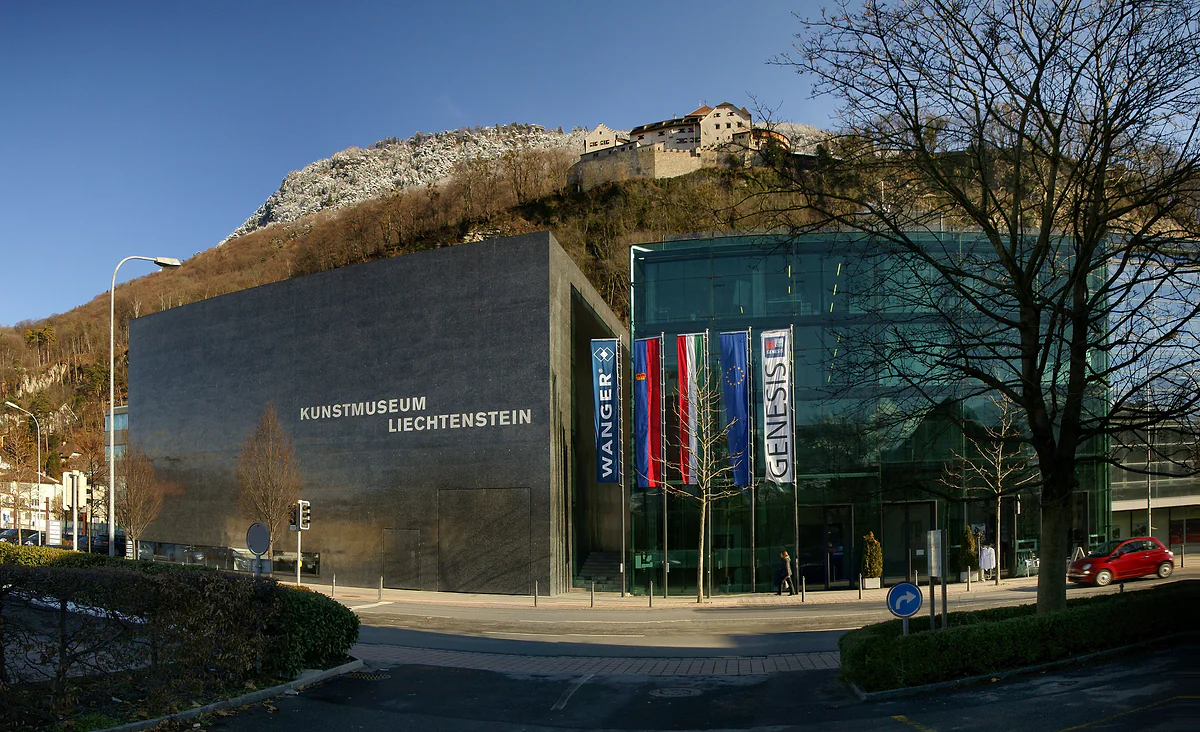
The black cube of the Kunstmuseum Liechtenstein by the street, with flags at the entrance and the castle high on the rock.
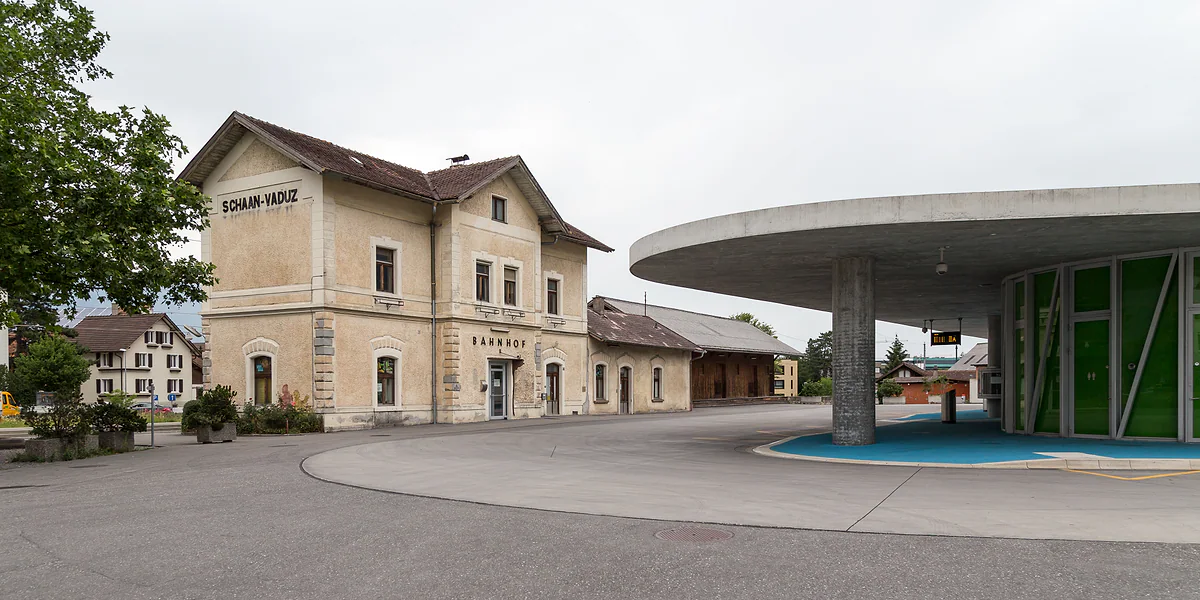
The Schaan-Vaduz railway station, in pale stone, with the round canopy of the bus station beside it.
Hilti through the years
| Year | What happened |
|---|---|
| 1941 | Eugen and Martin Hilti found Hilti Maschinenbau OHG in Schaan |
| 1948 | First order for steel bolts for powder-actuated fastening |
| 1957 | The DX 100, which Hilti calls the world's first powder-actuated tool |
| 1967 | The TE 17, the first electropneumatic hammer drill |
| 1970 | First factory abroad, at Thüringen in Vorarlberg |
| 1980 | The Martin Hilti Family Trust is set up |
| 1994 | Pius Baschera becomes the first chief executive from outside the family |
| 2015-2016 | Innovation centre and refurbished headquarters in Schaan |
Sources: Hilti, 'Our History', and the Historisches Lexikon, 'Hilti Aktiengesellschaft'.
Visiting the Hilti Art Foundation
| Item | Detail |
|---|---|
| Address | Städtle 32, Vaduz (shared entrance with the Kunstmuseum) |
| Opening hours | Tuesday to Sunday 10:00 to 17:00; Thursday until 20:00; closed Monday |
| Tickets | CHF 15, concessions CHF 10, free for under-16s |
| Free day | Every Wednesday |
Sources: kunstmuseum.li and hiltiartfoundation.li (2026 opening hours).
Test yourself
True or false?
0/4 Pick before you peek.
-
Hilti is a Swiss company.
See the answer
False. It's from Liechtenstein. It was founded in Schaan in 1941 and its trademark belongs to Hilti Corporation, 9494 Schaan.
-
Martin Hilti's direct descendants gave up their right to inherit the company.
See the answer
True. The Martin Hilti Family Trust was set up in 1980, and all his direct descendants renounced their inheritance to secure the group's future.
-
The red toolbox has been Hilti's trademark since the 1960s.
See the answer
True. According to the Historisches Lexikon, the red case has been the company's calling card since 1968.
-
The Hilti Art Foundation has a separate entrance from the Kunstmuseum.
See the answer
False. They share a foyer and ticket desk, so one ticket covers both.
- Founded in Schaan
- 1941
- Employees at 31 August 2026
- 34,195
- Countries where the group operates (over)
- 120
- Works in the foundation's collection (over)
- 500
0 of 168 Liechtenstein guides
Your next stamp
- Facts
- Second World War
- False teeth
- Political system
- Vaduz
- History
- Schaanwald
- Schaan
- Things to do
- One day
- Two days
- Municipalities
- Oberland
- Unterland
- Map
- Städtle
- Mitteldorf
- Vaduz Castle
- Vaduz Cathedral
- Parliament
- Government Building
- Vaduz Town Hall
- Red House
- Prince's Winery
- Old Rhine Bridge
- Schalun Castle Ruin
- Balzers
- Citytrain
- Triesen
- Triesenberg
- Walser Museum
- Planken
- Gutenberg Castle
- The Rhine
- Schaan Roman fort
- Dux
- St Mamertus chapel
- Lawena valley
- Mäls
- DoMuS
- TAK Theatre
- Castles
- Churches and chapels
- Viewpoints
- Mountains
- Museums
- Kunstmuseum
- Mountain huts
- Hilti Art Foundation
- Pfälzerhütte
- Gafadura hut
- National Museum
- Treasure Chamber
- Postage Stamp Museum
- Kunstraum Engländerbau
- Eschen
- Masescha
- Gaflei
- Nendeln
- Mauren
- Silum
- Rotenboden
- Gamprin
- Wangerberg
- Bendern
- Steg
- Ruggell
- Samina valley
- Schellenberg Farmhouse Museum
- Cross-country skiing at Steg
- Küefer-Martis-Huus
- Ruggeller Riet
- Schellenberg
- Hinterschellenberg
- Fürstensteig
- Is it a country?
- Liechtenstein Trail
- Malbun
- Schellenberg castles
- Eschnerberg
- Malbun in summer
- Population
- Stage 1: Balzers - Triesenberg
- Lakes
- Sareis
- Size
- Stage 2: Triesenberg - Vaduz
- Malbun Peace Chapel
- Stage 3: Vaduz - Nendeln
- Swimming pools
- Language
- Skiing in Malbun
- Stage 4: Nendeln - Ruggell
- Dialect
- Malbun ski pass
- Stage 5: Ruggell - Schaanwald
- Hotels in Malbun
- Stamps
- Princess Gina Trail
- Hut-to-hut Route 66
- Hiking
- Getting there
- In winter
- Weather
- Airport
- Best time to visit
- In summer
- Events
- With kids
- Zurich to Liechtenstein
- National day
- Sargans to Vaduz
- Christmas
- Feldkirch to Vaduz
- By train
- Traditions
- Carnival
- Getting around
- Buses
- Funken Sunday
- Alpine cattle drive
- Driving and vignette
- Parking
- Bike hire
- Cycling
- EU and Schengen
- Entry requirements
- Borders and customs
- The prince
- The princely house
- The flag
- The coat of arms
- The national anthem
- No army
- Why so rich?
- Banks and tax haven
- Where to stay
- Hotels in Vaduz
- Hostel and camping
- Rent the country?
- Where to eat
- Restaurants in Vaduz
- Swiss invasions
- Bars and nightlife
- Food
- Käsknöpfle
- Wine
- Casinos
- Adventure Pass
- Rainy days
- Guided tours
- Tourist office
- Day trips
- Passport stamp
- Music festivals
- Phone and roaming
- Currency and payments
- Prices and budget
- Tipping
- Plugs and sockets
- Tap water
- Opening hours
- Public holidays
- Safety
- Accessibility
- With a dog
- Shopping and souvenirs
Frequently asked questions
Is Hilti a Liechtenstein company?
Yes. It was founded in 1941 in Schaan and the group is still headquartered there; the trademark is registered to Hilti Corporation, 9494 Schaan. It has been the country's largest company since the 1960s, according to the Historisches Lexikon.
Who founded Hilti?
The brothers Eugen and Martin Hilti, in 1941. Eugen died in 1964 and Martin in 1997. Martin's son Michael ran the group from 1990 and in 1994 handed over to the first chief executive from outside the family.
How many people does Hilti employ?
34,195 as of 31 August 2026, according to the company, spread across more than 120 countries. From January to August 2026 its sales came to CHF 4,244 million.
Can you visit Hilti in Schaan?
The headquarters is a working company and I haven't found any public tours. What you can visit is the Hilti Art Foundation on the Städtle in Vaduz, with more than 500 works from the family collection.
What was Hilti's link to the Second World War?
The Historisches Lexikon records that the newly founded firm produced mainly for the German war economy, and that Martin Hilti was a leader of the local Nazi movement, the VDBL, between 1940 and 1942.
By
Tourism graduate with a master’s in Tourism Management and Planning from the University of Málaga, who has travelled across Europe. He writes every guide from official sources and his own judgement.
Published on . Facts checked on .
Sources
Photos: Tournasol7 (CC BY 4.0); böhringer friedrich (CC BY-SA 2.5); JoachimKohlerBremen (CC BY-SA 4.0), via Wikimedia Commons.