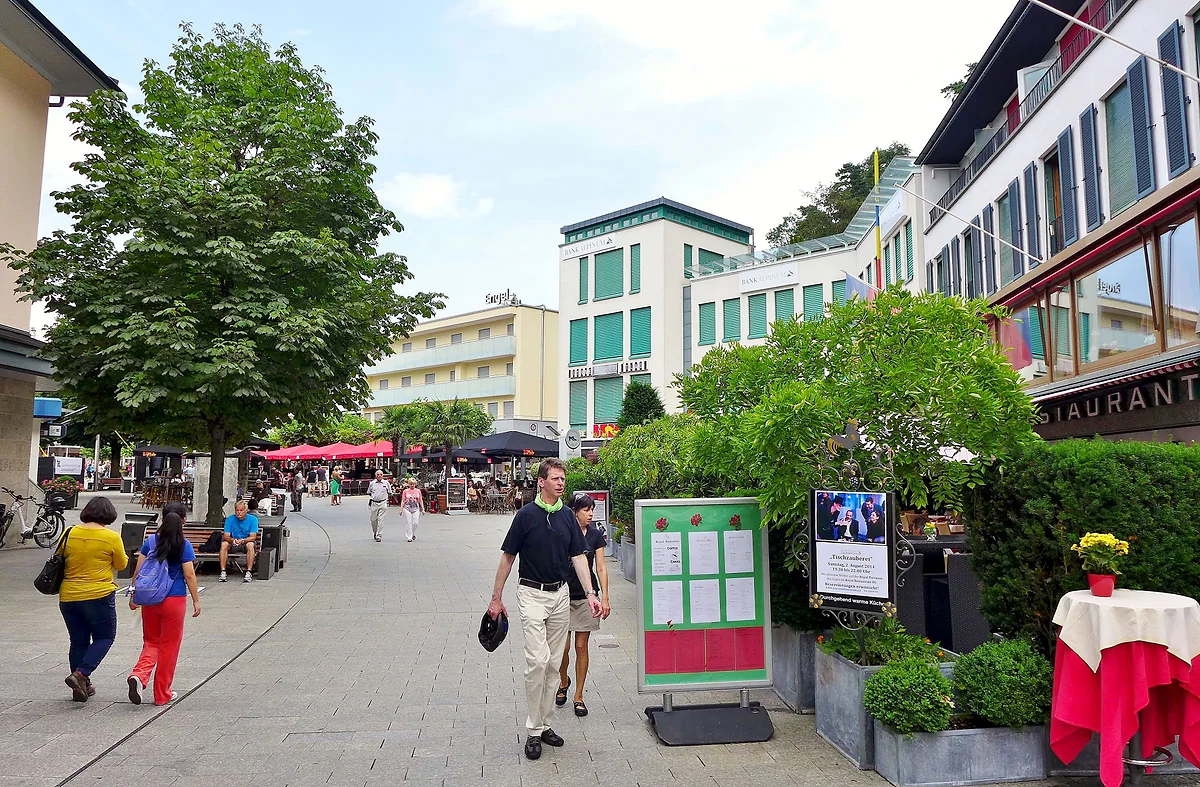
Opened on 19 November 1933
Vaduz Rathaus, a bold bet placed in the depths of 1931
Vaduz Town Hall, the Rathaus, stands at the northern end of the Städtle. Franz Roeckle designed it, it was built in 1932-1933 and it opened on 19 November 1933, on a budget of up to CHF 350,000, nearly three times the municipality's income. Its balcony carries a fresco of St Urban, patron saint of winegrowers, and the Citytrain leaves from its square.
In 30 seconds
Full read: 3 min
- Vaduz Town Hall is the work of Franz Roeckle and opened on 19 November 1933.
- It cost up to CHF 350,000, nearly three times the town's annual income, in the middle of a slump.
- Its balcony has a fresco of St Urban, patron saint of winegrowers, by Johannes Troyer.
- The coach terminal and the Citytrain departure point are right beside it.
I wouldn't go in, because it's a working council office, but I'd stop under the balcony to find the winegrowers' saint and the pair of grape pickers. They say more about what Vaduz used to be than any sign, and the Citytrain leaves a few steps away.

Before you go
What I would keep in mind
-
01 Most beautiful
A patron saint of wine on the façade
Johannes Troyer's balcony fresco shows St Urban, patron of winegrowers, while the balustrade carries a male and a female winegrower with ears of wheat and maize. It's farming Vaduz painted onto the town's most official building.
Liechtenstein wine -
02 Getting there
Coaches stop here and the little train sets off
Beside the town hall is the coach terminal, in place since 1998, and right there the Citytrain has its stop and ticket desk, with departures at 13:00 and 16:30 from April to October.
the Vaduz Citytrain -
03 My tip
The covered square has a busy calendar
The covered town hall square hosts festivals such as the Genussfestival, held from 5 to 13 September in 2026. Check the Vaduz calendar before you go, as it changes the mood completely.
the calendar of events in Liechtenstein
Vaduz Town Hall doesn’t feature on many sightseeing lists, and I can see why. There’s no museum and you can’t tour the inside. But I love its story, because it tells how a village with no money decided to give itself a proper seat in the very hardest years, and its façade holds the best reminder of winegrowing Vaduz anywhere in the centre.
A building that cost three times what was in the kitty
The tourist board’s page tells it in detail. In 1931 Vaduz was in poor economic shape, yet on 17 November that year the town meeting approved a new town hall, with premises for a bank, opposite the Gasthof «Engel». The budget ran to CHF 350,000, nearly three times the municipality’s income. The driving force was Mayor Ludwig Ospelt, the first to have his office in the building.
Plenty of architects wanted the job, but on 29 January 1932 Franz Roeckle showed his plans to the council and was hired the same day. Work moved fast and the Rathaus opened on 19 November 1933. Roeckle worked mainly in Stuttgart and Frankfurt, and the Historical Lexicon counts him among the early modernists in Frankfurt, with buildings such as the Westend synagogue.
The winegrowers’ balcony
What I’d take time over is the south front. Johannes Troyer’s balcony fresco shows St Urban, the pope who is patron saint of winegrowers. On the front of the balustrade are a male and a female winegrower, with ears of wheat and maize on the sides. It’s a curious thing to find the farming village painted onto the most official building in town, and I think it’s the best summary of Vaduz on the Städtle. Troyer, incidentally, designed 74 of the country’s stamps, a link to the hobby I cover in the guide to Liechtenstein stamps. For the wine side of things, see my guide to Liechtenstein wine.
At the entrance is the municipal crest, carved in stone by Engelbert Ospelt. It’s the 1978 design, quartered with a red princely hat on silver and a silver church banner on red, the banner recalling the counts of Werdenberg-Sargans, who in 1342 laid the foundations of the country. Vaduz was also the first municipality in Liechtenstein to get a coat of arms, in 1932. With it came the right to its own flag, split horizontally with a red and white upper half and a red lower half, and in 1978 it was kept unchanged. If you spot a flag like that in Vaduz, it belongs to the town, not the country.
From bank and post office to town office
For half a century the building was a bit of everything. Besides the mayor’s office, council and administration, it housed the Bank in Liechtenstein, the Landesbank, the post office and several local societies. It was altered several times, and the big renovation of 1984, under Mayor Arthur Konrad, left it for council use alone. Today it’s a working office, so I’d admire it from outside. Ludwig Ospelt, the mayor who pushed it through, served from 1930 to 1933 and again from 1936 to 1942, and was the first to sit in the building he’d fought for. I like that the man who took the gamble got to use it.
The square where half of Vaduz begins
The town hall square is the way in for a lot of visitors. A coach terminal has stood beside it since 1998, and as the Lexicon points out, most people who visit Vaduz come for the day only. The Vaduz Citytrain has its stop right there, with a ticket desk run jointly with the tourist board, and between 1 April and 31 October it leaves at 13:00 and 16:30.
The square is covered and keeps a calendar of its own. In 2026 it hosted the Genussfestival from 5 to 13 September. I’d check the Liechtenstein events calendar before going, because a festival day changes the atmosphere entirely.
Fitting it into your walk
Arrive by coach, or by bus to Vaduz, Städtle, and you’ll start here. I’d reverse that, entering from the south through the government quarter and ending the walk along the Städtle in Vaduz outside the town hall, in time to board the Citytrain or carry on walking to the Mitteldorf vineyards, which begin a little further north.
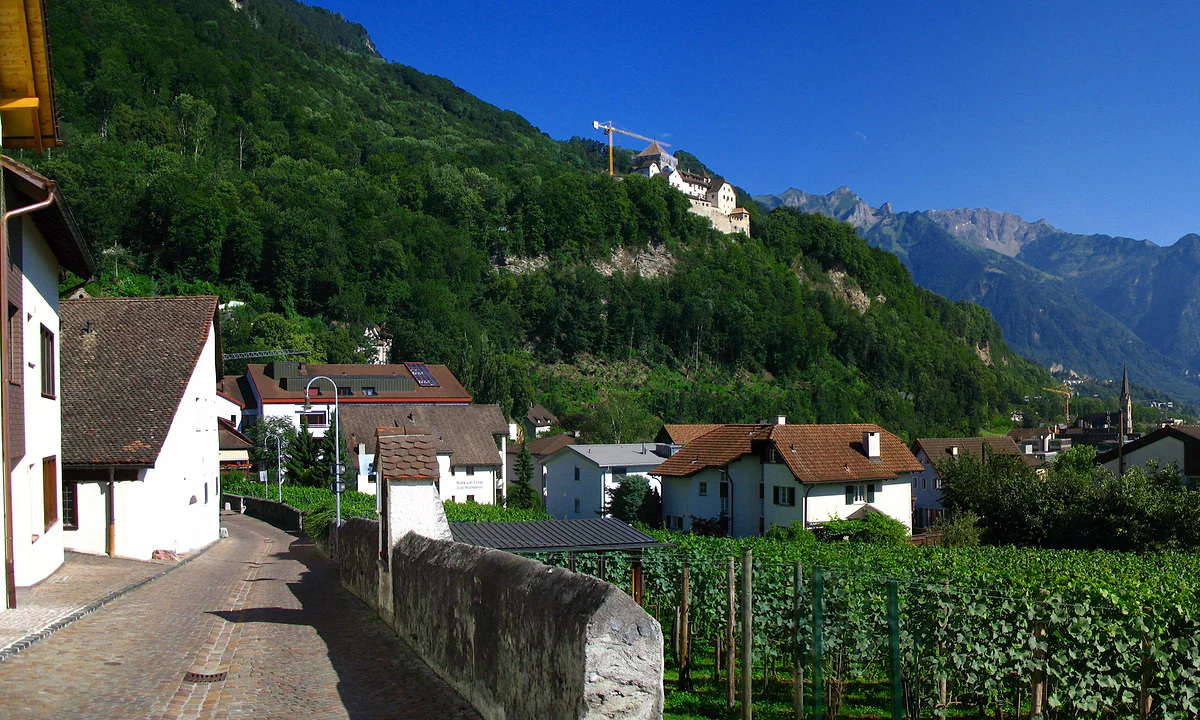
A cobbled lane in the Mitteldorf quarter of Vaduz between white houses and vineyards, with the castle high on the wooded slope and the Alps behind.
The Rathaus through the years
| Date | What happened |
|---|---|
| 17 Nov 1931 | Town meeting approves a town hall with premises for a bank |
| 29 Jan 1932 | Franz Roeckle presents his plans and wins the commission that day |
| 31 Jul 1932 | Vaduz becomes the first municipality in the country with a coat of arms |
| 19 Nov 1933 | Opening |
| 26 Jul 1978 | New municipal crest, the one carved in stone at the entrance |
| 1984 | Major renovation; since then, council use only |
| 1998 | Coach terminal opens beside the building |
From the official tourist board's page, the Historical Lexicon and the municipality's website.
Who has occupied it
| Tenant | When |
|---|---|
| Mayor's office, council and town administration | 1933 to today |
| Bank in Liechtenstein and Landesbank | Until the 1984 renovation |
| Post office | Until the 1984 renovation |
| Local clubs and societies | Until the 1984 renovation |
Test yourself
True or false?
0/3 Pick before you peek.
-
Vaduz Town Hall was built during an economic boom.
See the answer
False. It was approved in 1931, when the town's finances were in a bad way, and its budget of up to CHF 350,000 was nearly three times its income.
-
Vaduz was the first municipality in Liechtenstein with its own coat of arms.
See the answer
True. Prince Franz I granted it on 31 July 1932, ahead of every other municipality; the current design dates from 1978.
-
For decades the town hall shared its building with banks and the post office.
See the answer
True. The Bank in Liechtenstein, the Landesbank, the post office and local societies were all inside until the 1984 renovation.
- Year it opened
- 1933
- Maximum approved budget
- CHF 350,000
- Times the town's income it cost
- 3
Map
Where Vaduz Town Hall is
The dashed line is the border: Switzerland across the Rhine, Austria to the north and east. Every number opens its guide.
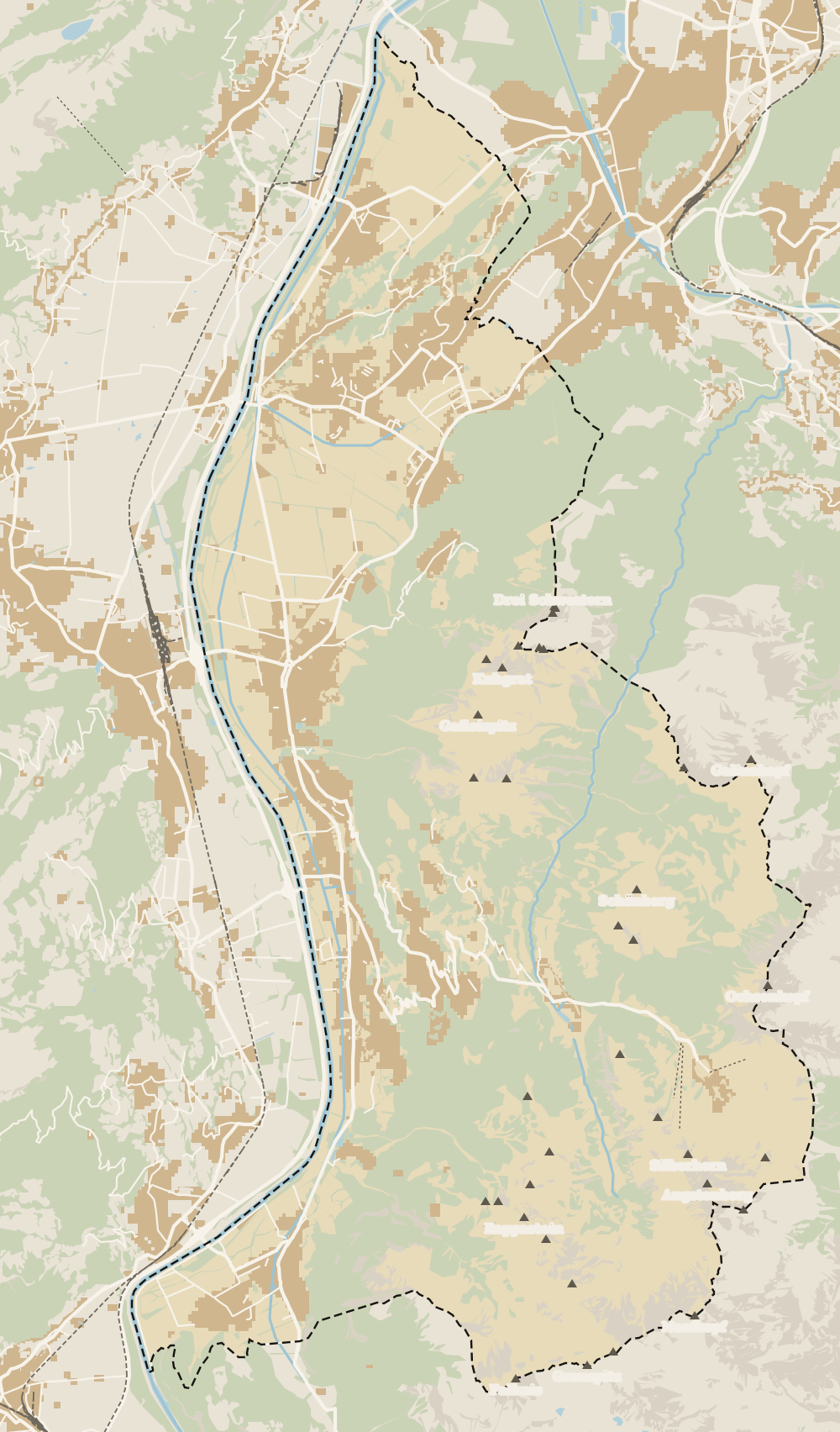 1Vaduz 2Städtle 3Mitteldorf 4Vaduz Castle 5Vaduz Cathedral 6Parliament 7Government Building 8Vaduz Town Hall 9Prince's Winery 10Old Rhine Bridge 11Schalun Castle Ruin 12Citytrain
 Map data © OpenStreetMap contributors (ODbL)
- 1VaduzA capital since 1719, home to 6,108 people
- 2StädtleCar-free since 28 June 2004
- 3MitteldorfVineyards protected until 2081
- 4Vaduz CastleThe Prince's residence, closed to visitors
- 5Vaduz CathedralA cathedral since 2 December 1997
- 6ParliamentNext sitting, 30 September to 2 October
- 7Government BuildingOpened on 28 December 1905
- 8Vaduz Town HallOpened on 19 November 1933
- 9Prince's WineryDaily tasting at 15:00, Saturdays at 14:00
- 10Old Rhine BridgeThe last wooden bridge on the Rhine
- 11Schalun Castle RuinAt 862 m, an hour's walk from Vaduz
- 12Citytrain2026 season runs until 31 October
0 of 168 Liechtenstein guides
Your next stamp
- Red House
- Citytrain
- Städtle
- Mitteldorf
- Vaduz Cathedral
- Government Building
- Guided tours
- Kunstmuseum
- Things to do
- One day
- Two days
- Municipalities
- Oberland
- Unterland
- Map
- Vaduz
- Vaduz Castle
- Parliament
- Prince's Winery
- Old Rhine Bridge
- Schaan
- Schalun Castle Ruin
- Balzers
- Triesen
- Triesenberg
- Walser Museum
- Planken
- Gutenberg Castle
- The Rhine
- Schaan Roman fort
- Dux
- St Mamertus chapel
- Lawena valley
- Mäls
- DoMuS
- TAK Theatre
- Castles
- Churches and chapels
- Viewpoints
- Mountains
- Museums
- Mountain huts
- Hilti Art Foundation
- Pfälzerhütte
- Gafadura hut
- National Museum
- Treasure Chamber
- Postage Stamp Museum
- Kunstraum Engländerbau
- Eschen
- Masescha
- Gaflei
- Nendeln
- Mauren
- Silum
- Rotenboden
- Schaanwald
- Gamprin
- Wangerberg
- Bendern
- Steg
- Ruggell
- Samina valley
- Schellenberg Farmhouse Museum
- Cross-country skiing at Steg
- Küefer-Martis-Huus
- Ruggeller Riet
- Schellenberg
- Hinterschellenberg
- Fürstensteig
- Is it a country?
- Liechtenstein Trail
- Malbun
- Schellenberg castles
- Eschnerberg
- Malbun in summer
- Population
- Stage 1: Balzers - Triesenberg
- Lakes
- Sareis
- Size
- Stage 2: Triesenberg - Vaduz
- Malbun Peace Chapel
- Political system
- Stage 3: Vaduz - Nendeln
- Swimming pools
- Language
- Skiing in Malbun
- Stage 4: Nendeln - Ruggell
- Dialect
- Malbun ski pass
- Stage 5: Ruggell - Schaanwald
- Hotels in Malbun
- Stamps
- Princess Gina Trail
- Hut-to-hut Route 66
- Hiking
- Getting there
- In winter
- Weather
- Airport
- Best time to visit
- In summer
- Events
- With kids
- Zurich to Liechtenstein
- National day
- Sargans to Vaduz
- Christmas
- Feldkirch to Vaduz
- By train
- Traditions
- Carnival
- Getting around
- Buses
- Funken Sunday
- Alpine cattle drive
- Driving and vignette
- Parking
- Bike hire
- Cycling
- EU and Schengen
- Entry requirements
- Borders and customs
- The prince
- The princely house
- The flag
- The coat of arms
- The national anthem
- History
- Second World War
- No army
- Facts
- Why so rich?
- Banks and tax haven
- Where to stay
- Hilti
- Hotels in Vaduz
- False teeth
- Hostel and camping
- Rent the country?
- Where to eat
- Restaurants in Vaduz
- Swiss invasions
- Bars and nightlife
- Food
- Käsknöpfle
- Wine
- Casinos
- Adventure Pass
- Rainy days
- Tourist office
- Day trips
- Passport stamp
- Music festivals
- Phone and roaming
- Currency and payments
- Prices and budget
- Tipping
- Plugs and sockets
- Tap water
- Opening hours
- Public holidays
- Safety
- Accessibility
- With a dog
- Shopping and souvenirs
Frequently asked questions
Where is Vaduz Town Hall?
At the northern end of the Städtle, the pedestrian street in the centre, opposite what was the Gasthof «Engel». The nearest bus stops are Vaduz, Städtle and Vaduz, Post.
Who designed Vaduz Town Hall?
The architect Franz Roeckle, known in Frankfurt for early modernist work such as the Westend synagogue. He won the commission on 29 January 1932 and the building opened on 19 November 1933.
Can you visit Vaduz Town Hall?
It houses the mayor's office, the council and the municipal administration, so you see it from outside. The interest lies on the façade, in the balcony fresco and the stone crest at the entrance.
What does the fresco on Vaduz Town Hall show?
St Urban, the pope who is patron saint of winegrowers, painted by Johannes Troyer. The front of the balcony balustrade shows a male and a female winegrower, with ears of wheat and maize on the sides.
What does the Vaduz coat of arms look like?
It's quartered, with a red princely hat on silver in the first and fourth quarters and a silver church banner on red in the other two, recalling the counts of Werdenberg-Sargans. Prince Franz Josef II granted it on 26 July 1978.
By
Tourism graduate with a master’s in Tourism Management and Planning from the University of Málaga, who has travelled across Europe. He writes every guide from official sources and his own judgement.
Published on . Facts checked on .
Sources
Photos: Bahnfrend (CC BY-SA 4.0); Andrew Bossi (CC BY-SA 2.5), via Wikimedia Commons.