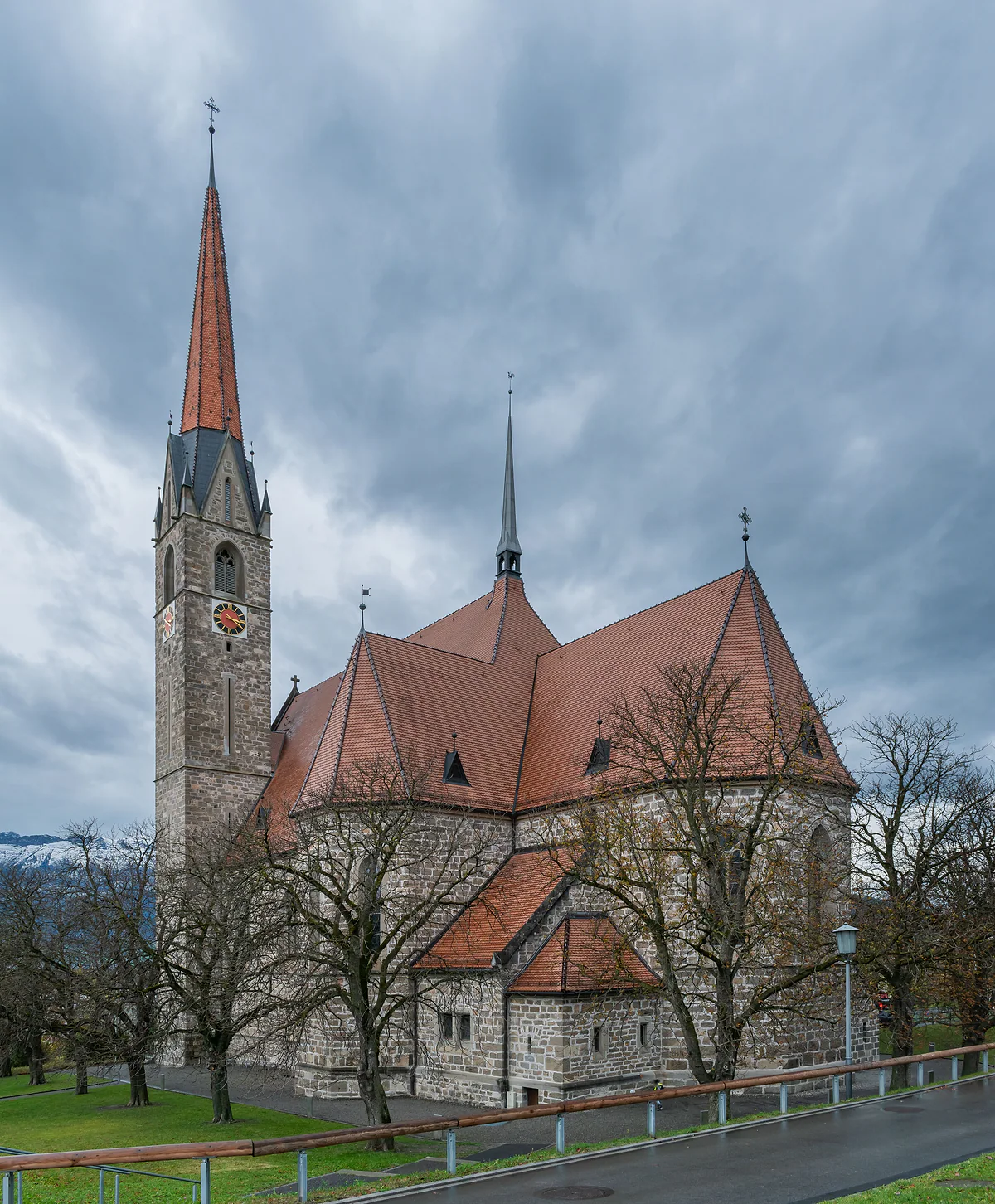
4th century, in the middle of town
Schaan's Roman fort and the chapel built on its walls
In the centre of Schaan, beside St Petersplatz, are the remains of a Roman fort of roughly 57 by 60 metres that stood in the second half of the 4th century and protected the road between Milan and Augsburg. St Peter's chapel rises on its walls, and its baptistery dates from the 5th century, among the oldest things Liechtenstein has.
In 30 seconds
Full read: 3 min
- Schaan's Roman fort measured about 57 by 60 metres and stood in the second half of the 4th century.
- It guarded the road between Milan and Augsburg and burnt down in the first half of the 5th century.
- St Peter's chapel stands partly on its walls and keeps a 5th-century baptistery.
- It's station 2 of Schaan's heritage walk and a stop on stage 3 of the Liechtenstein Trail.
I'd make it the first stop on Schaan's heritage walk, with the panel in front of you and the plan of the fort in your head. Without that context it's a few walls beside a chapel; with it, it's the place where you best understand that this valley was an imperial highway.

Before you go
What I would keep in mind
-
01 Most beautiful
A Gothic chapel perched on a Roman wall
St Peter's rests partly on the fort's walls. According to the Historisches Lexikon, its vaulted nave is the only late Gothic one of its kind left in the country.
churches and chapels in Liechtenstein -
02 To save money
No official source charges to see it
The fort is station 2 on Schaan's Kulturweg and St Peter's is station 3. The whole loop, about six kilometres, takes an hour and has no tickets.
Schaan, Liechtenstein's biggest town -
03 Getting there
Stage 3 of the Liechtenstein Trail passes by
The 13.4 km stage from Vaduz to Nendeln takes in Schaan's Roman ruins along with the Prince's winery, the Red House and the Dux tower.
stage 3 of the Liechtenstein Trail, Vaduz to Nendeln -
04 My tip
The finds are in Vaduz
Coins, pottery, lamps and bone combs came out of the digs. To see the country's archaeology behind glass, head for the National Museum on the Städtle.
the Liechtenstein National Museum (LandesMuseum)
Most people link Liechtenstein with a princely castle and some banks. What caught me out, reading up on Schaan, is that the country has the remains of a 4th-century Roman army camp in the middle of a town, with a chapel leaning on its walls. Here’s how I’d see it so it amounts to more than a few stones.
An imperial barracks on the road to Italy
The fort stands in the centre of Schaan, beside St Petersplatz, at 455 m. The Historisches Lexikon says it was known from 1847, Ferdinand Keller published the first plan in 1864 and David Beck led the systematic dig between 1956 and 1958. The plan is almost square, about 57 by 60 metres, with four towers jutting out at the corners.
For such a compact site the numbers are striking. The towers measured 4 by 4 metres inside and stood about 10 metres tall, and the walls were 3.60 m thick and 6 to 8 m high. You entered through a tower in the middle of the north side, with two gates roughly three metres wide. Inside were barracks either side of the gate, a granary against the south wall and a bath suite with underfloor heating and warm, hot and cold rooms.
Why did Rome want a fort in Schaan?
Look at a map. Schaan sits on the road that linked Milan with Augsburg, and the Lexikon explains that the fort watched over it and acted as a rear base for the fortified Rhine, Danube and Iller frontier built under Valentinian I after AD 364. In a crisis it also gave shelter to people in the valley.
The coins and finds date it to the second half of the 4th century. Schaan council adds that there was a Roman presence in the village from the 1st century and that the fort burnt down in the first half of the 5th. Its life was short, but it left something that has lasted.
St Peter’s, sitting on the wall
That something is the church. The Lexikon says that in the 5th century a small church with a baptistery was built inside the walls, between the gate tower and the north-east tower, and the council links it to a Christian community that probably existed by the 5th or 6th century. The St Peter’s chapel you see today stands partly on the fort’s walls and is recorded as a church in 1298.
The present building is a later story. It goes back to a late Gothic rebuild of the later 1400s, was damaged in the village fire of 1849 and was reworked between 1961 and 1963 with a new bell tower. The Lexikon says its vaulted nave is the only one from that period left in the country, and wall paintings from several centuries came to light in 1995. The sources disagree on whether it’s Liechtenstein’s oldest church, so I’d put it among the oldest, alongside St Mamertus chapel in Triesen. The others are side by side in my overview of churches and chapels in Liechtenstein.
The ground under Schaan is still talking
What I like most is that the story isn’t closed. In September and October 2024, a rescue excavation at Obergass 46, just 180 metres from St Peter’s, uncovered seven graves from the 7th to 9th centuries, with traces of wooden coffins, plus Roman-era rubbish pits holding a coin of Constantine from the early 4th century. The council says the analysis is ongoing.
Finds from the older digs, coins, fine tableware, lamps, bone combs and soapstone vessels, aren’t kept on the square. If you want to see them in a case, I’d go to the National Museum of Liechtenstein on the Städtle in Vaduz.
How I’d see it
The fort is station 2 of Schaan’s Kulturweg and St Peter’s is station 3, so it makes sense to start the walk here. I’ve seen neither a price nor opening hours for the site on any official website, and I haven’t found opening times for the chapel interior either. I’d go in daylight, read the panel and walk round the chapel looking for the line of the wall.
If you’re walking, stage 3 of the Liechtenstein Trail, Vaduz to Nendeln, passes Schaan’s Roman ruins before climbing to the Dux tower. If you’re on the bus, it’s five minutes on foot from the centre of Schaan.
The fort by numbers
| Feature | Detail |
|---|---|
| Plan | Almost square, about 57 × 60 m |
| Corner towers | Four, 4 × 4 m inside and about 10 m tall |
| Walls | 3.60 m thick and 6 to 8 m high |
| Gate | Tower in the middle of the north side, two gates about 3 m wide |
| Granary (horreum) | Hall 13 to 15 m wide against the south wall |
| Baths | Furnace room, warm, hot and cold rooms |
Figures from the Historisches Lexikon, based on the 1956 to 1958 excavation led by David Beck.
From Rome to today
| Date | What happened |
|---|---|
| 1st century AD | First Roman traces in Schaan |
| Second half of the 4th century | The fort is in use |
| First half of the 5th century | The fort burns down |
| 5th century | A church with a baptistery inside the walls |
| 1298 | First mention of St Peter's church |
| 1956 to 1958 | Systematic excavation |
| 2024 | Seven 7th to 9th-century graves at Obergass 46 |
Dates from the Historisches Lexikon and the Schaan council website.
Test yourself
True or false?
0/4 Pick before you peek.
-
Schaan's Roman fort dates from the reign of Augustus.
See the answer
False. It's far later. The coins and finds put it in the second half of the 4th century, when the Rhine frontier was being strengthened.
-
St Peter's chapel is built partly on the walls of the fort.
See the answer
True. The Historisches Lexikon says so, adding that a small church with a baptistery was built inside the walls in the 5th century, between the gate tower and the north-east tower.
-
The fort's walls were more than three metres thick.
See the answer
True. They were 3.60 m thick and between 6 and 8 m high, with corner towers of about 10 m.
-
The soldiers had their own heated baths.
See the answer
True. By the east wall there was a bath suite with a furnace room, warm, hot and cold rooms and underfloor heating.
- Footprint of the fort
- 57 × 60 m
- Thickness of the walls
- 3.60 m
- Baptistery of the first church
- 5th c.
- First mention of St Peter's
- 1298
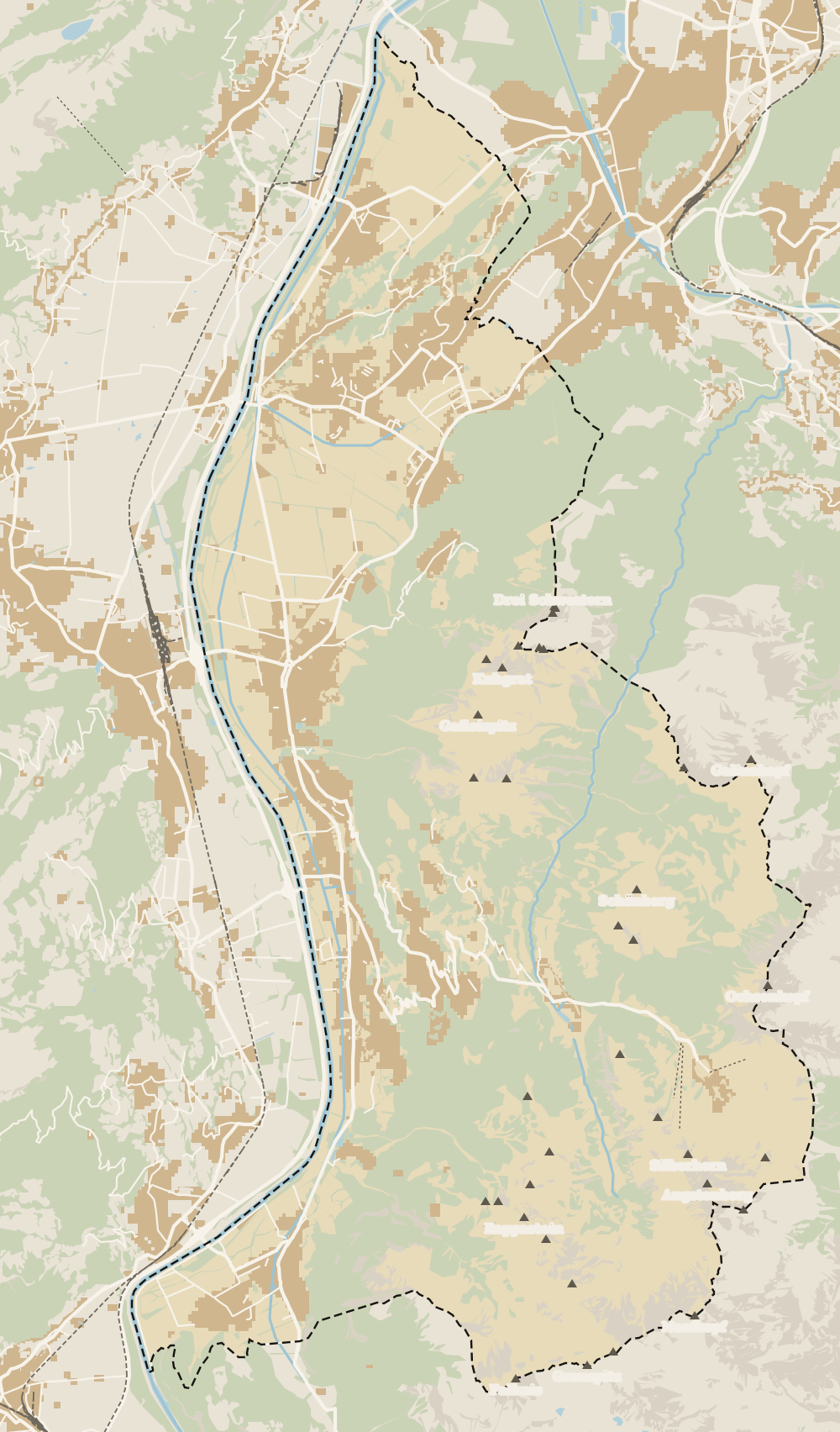
Map
Where Schaan Roman fort is
The dashed line is the border: Switzerland across the Rhine, Austria to the north and east. Every number opens its guide.
0 of 168 Liechtenstein guides
Your next stamp
- Schaan
- Churches and chapels
- Dux
- Hilti
- Schaanwald
- Things to do
- One day
- Two days
- Municipalities
- Oberland
- Unterland
- Map
- Vaduz
- Städtle
- Mitteldorf
- Vaduz Castle
- Vaduz Cathedral
- Parliament
- Government Building
- Vaduz Town Hall
- Red House
- Prince's Winery
- Old Rhine Bridge
- Schalun Castle Ruin
- Balzers
- Citytrain
- Triesen
- Triesenberg
- Walser Museum
- Planken
- Gutenberg Castle
- The Rhine
- St Mamertus chapel
- Lawena valley
- Mäls
- DoMuS
- TAK Theatre
- Castles
- Viewpoints
- Mountains
- Museums
- Kunstmuseum
- Mountain huts
- Hilti Art Foundation
- Pfälzerhütte
- Gafadura hut
- National Museum
- Treasure Chamber
- Postage Stamp Museum
- Kunstraum Engländerbau
- Eschen
- Masescha
- Gaflei
- Nendeln
- Mauren
- Silum
- Rotenboden
- Gamprin
- Wangerberg
- Bendern
- Steg
- Ruggell
- Samina valley
- Schellenberg Farmhouse Museum
- Cross-country skiing at Steg
- Küefer-Martis-Huus
- Ruggeller Riet
- Schellenberg
- Hinterschellenberg
- Fürstensteig
- Is it a country?
- Liechtenstein Trail
- Malbun
- Schellenberg castles
- Eschnerberg
- Malbun in summer
- Population
- Stage 1: Balzers - Triesenberg
- Lakes
- Sareis
- Size
- Stage 2: Triesenberg - Vaduz
- Malbun Peace Chapel
- Political system
- Stage 3: Vaduz - Nendeln
- Swimming pools
- Language
- Skiing in Malbun
- Stage 4: Nendeln - Ruggell
- Dialect
- Malbun ski pass
- Stage 5: Ruggell - Schaanwald
- Hotels in Malbun
- Stamps
- Princess Gina Trail
- Hut-to-hut Route 66
- Hiking
- Getting there
- In winter
- Weather
- Airport
- Best time to visit
- In summer
- Events
- With kids
- Zurich to Liechtenstein
- National day
- Sargans to Vaduz
- Christmas
- Feldkirch to Vaduz
- By train
- Traditions
- Carnival
- Getting around
- Buses
- Funken Sunday
- Alpine cattle drive
- Driving and vignette
- Parking
- Bike hire
- Cycling
- EU and Schengen
- Entry requirements
- Borders and customs
- The prince
- The princely house
- The flag
- The coat of arms
- The national anthem
- History
- Second World War
- No army
- Facts
- Why so rich?
- Banks and tax haven
- Where to stay
- Hotels in Vaduz
- False teeth
- Hostel and camping
- Rent the country?
- Where to eat
- Restaurants in Vaduz
- Swiss invasions
- Bars and nightlife
- Food
- Käsknöpfle
- Wine
- Casinos
- Adventure Pass
- Rainy days
- Guided tours
- Tourist office
- Day trips
- Passport stamp
- Music festivals
- Phone and roaming
- Currency and payments
- Prices and budget
- Tipping
- Plugs and sockets
- Tap water
- Opening hours
- Public holidays
- Safety
- Accessibility
- With a dog
- Shopping and souvenirs
Frequently asked questions
Where is the Roman fort in Schaan?
In the centre of Schaan, by St Petersplatz and the Obergass, at 455 m. St Peter's chapel stands on part of its walls, and the site is station 2 of the council's Kulturweg heritage walk.
How old is Schaan's Roman fort?
According to the Historisches Lexikon, the coins and finds place it in the second half of the 4th century. Schaan council adds that it burnt down in the first half of the 5th century.
What was the fort for?
It guarded the road between Milan and Augsburg and served as a rear base for the Rhine, Danube and Iller frontier built under Valentinian I after AD 364. In troubled times it also sheltered local people.
Is St Peter's in Schaan the oldest church in Liechtenstein?
It's among the oldest. The Historisches Lexikon calls it the oldest church building in the country and dates its baptistery to the 5th century, but the tourist board gives that title to St Mamertus in Triesen, so I'd say it's one of the oldest.
Do you have to pay to see the fort?
None of the official sources I've read charges admission or gives opening hours for the site, which sits in the street next to the chapel. The Kulturweg that runs past it is a free, self-guided walk.
How do I get there from Vaduz?
Take a LIEmobil bus to the centre of Schaan, a few minutes from Vaduz, and walk to St Petersplatz. On foot, stage 3 of the Liechtenstein Trail passes the Roman ruins on its way to Nendeln.
By
Tourism graduate with a master’s in Tourism Management and Planning from the University of Málaga, who has travelled across Europe. He writes every guide from official sources and his own judgement.
Published on . Facts checked on .
Sources
Photos: Tournasol7 (CC BY 4.0), via Wikimedia Commons.