15.7 km and the longest climb on the route
Liechtenstein Trail stage 1, from Gutenberg Castle to the Walser village
The first stage of the Liechtenstein Trail leaves Balzers below Gutenberg Castle, crosses Triesen along the old Roman road and past a former textile mill, then climbs to Triesenberg. It's 15.7 km and about 4 hours 35 minutes, with 535 m of ascent and just 137 m of descent, between 466 and 905 m above sea level.
In 30 seconds
Full read: 3 min
- Stage 1 runs from Balzers to Triesenberg over 15.7 km.
- The tourist board reckons on 4 hours 35 minutes of walking.
- It's the stage with the most climbing, 535 m, up to 905 m.
- It passes Gutenberg, the Roman road, Triesen and St Mamertus's chapel.
I'd leave Vaduz early so the final pull up to Triesenberg is done before the midday heat, and I'd save some energy for the Walser Museum, which shuts at 18:00 on weekdays and 11:00 on Saturdays. If your first day falls on a Sunday, swap the stages round.

Before you go
What I would keep in mind
-
01 Most beautiful
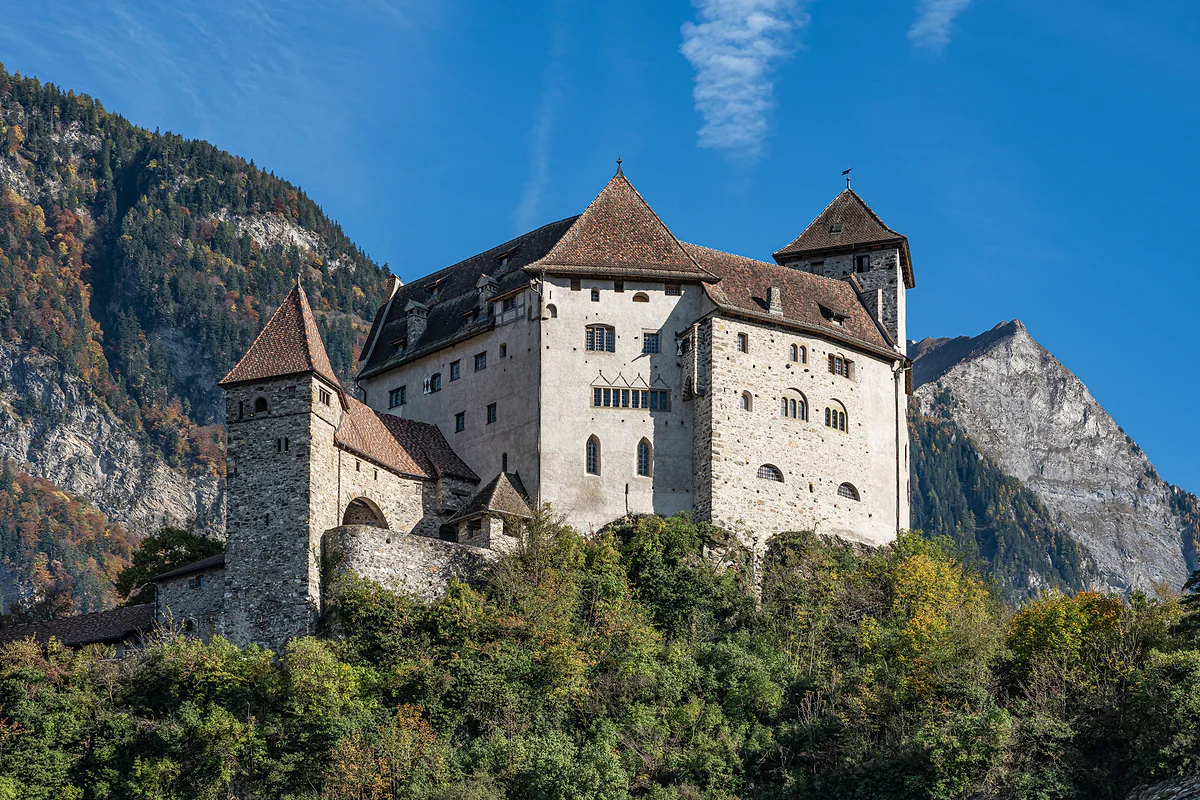
Setting off beneath Gutenberg
The stage begins below Gutenberg Castle, the best-known silhouette in the south of the country. From May to October the chapel and rose garden open free on Sundays, 10:00 to 17:00.
Gutenberg Castle in Balzers -
02 Watch out
You can't just wander into the castle
Gutenberg Castle only opens by prior booking, from 1 May to 31 October. On an ordinary day you'll see it from outside and in the outer bailey, which is free all year.
Gutenberg Castle in Balzers -
03 Getting there
Bus 11 or 13 to Balzers, Höfle
From Vaduz, take the bus to the Balzers, Höfle stop, then walk about 20 minutes to the stone where the trail begins. At the end, route 21 runs from Triesenberg back to Vaduz.
Liechtenstein's buses -
04 My tip
Sunday? Do a different stage
The Walser Museum in Triesenberg, the best finish you could ask for, opens Monday to Saturday; on Sundays it only takes booked groups.
the Walser Museum in Triesenberg
What I would book
The first stage of the Liechtenstein Trail is a bit of a mission statement. It starts on the Swiss border beneath a medieval castle and finishes halfway up a mountainside in a village founded by settlers from the Valais. In between sits an old industrial village. If you want to know what the whole route is about, day one sums it up nicely.
Getting to the start
The trail doesn’t begin in the middle of Balzers but at an old boundary stone on the way to Luzisteig. For anyone staying in Vaduz, the tourist board puts it simply, bus 11 or 13 from Vaduz, Post to Balzers, Höfle, then about 20 minutes on foot. From Haus Gutenberg in Balzers it’s about 25 minutes’ walk.
I’d catch one of the early buses. The stage isn’t long in kilometres, but it saves the climb for the end, and it’s worth reaching Triesenberg with time to look around properly.
Gutenberg and the Roman road
Within minutes you’re standing below Gutenberg Castle on its hill in Balzers. Manage your expectations here, as it isn’t a turn-up-and-go castle. Visits inside need booking and only run in the May-to-October season, although on Sundays in those months the chapel and rose garden are open to anyone, free of charge. The outer bailey is open to wander all year round, also free. If you happen to pass on a summer Sunday, I’d stop.
From there the trail heads north along the old Roman road. It’s the gentlest part of the day, flat and with the Swiss mountains facing you across the Rhine.
What’s worth a look in Triesen?
Triesen is the stage’s pleasant surprise. The tourist board calls it historic Triesen, and the path crosses the site of the old Jenny, Spörry & Cie. cotton mill. That’s where you’ll find the Gasometer, now an arts centre with exhibitions and events. Industrial heritage like this interests me as much as any castle, because it shows how people in the valley made a living long before the banks arrived.
A little higher up, in the upper village, comes St Mamertus’s chapel, one of the oldest in the country and, to my mind, the loveliest spot of the day. It’s a good place for a breather before what’s coming.
The climb to Triesenberg
This is where the stage gets serious. Most of the day’s 535 m of climbing is packed in between Triesen and Triesenberg. The high point is 905 m and the low point, near the start, 466 m. There are no technical sections or exposed bits, just gradient, so it comes down to pace and plenty of water.
The reward is arriving in the Walser village, which the tourist board sells on its sweeping views of the valley. The Walser were settlers from the Swiss Valais who made the hillside their home in the 13th century, and the village has kept its own identity, dialect included.
What to do once you arrive
My first stop would be the Walser Museum, which tells the story of those settlers and their way of life. It opens weekday mornings and afternoons plus Saturday mornings (full times in the table), and adult entry is 5 francs. On Sundays it only takes booked groups, so if your first stage lands on a Sunday I’d reshuffle the days.
The other stop the tourist board flags is the farm shop at the local llama and alpaca farm, selling regional produce. It’s hardly a sight, but it’s a better place for a souvenir than anything in the Städtle.
To get back, route 21 links Triesenberg with Vaduz. Pay by card or with the app, as LIEmobil buses don’t take cash. And if you’re carrying on tomorrow, stage 2 down to Vaduz starts right here and is the most beautiful of the lot.
Is it worth doing on its own?
Yes, especially if you’re curious about the less obvious side of the country. It has a castle, industrial heritage, a very old chapel and a mountain village with a culture of its own. What it lacks is the view of Vaduz Castle and the Städtle, which come the next day. If I could only walk one day I’d choose the second, but this is the right way to begin the full Liechtenstein Trail.
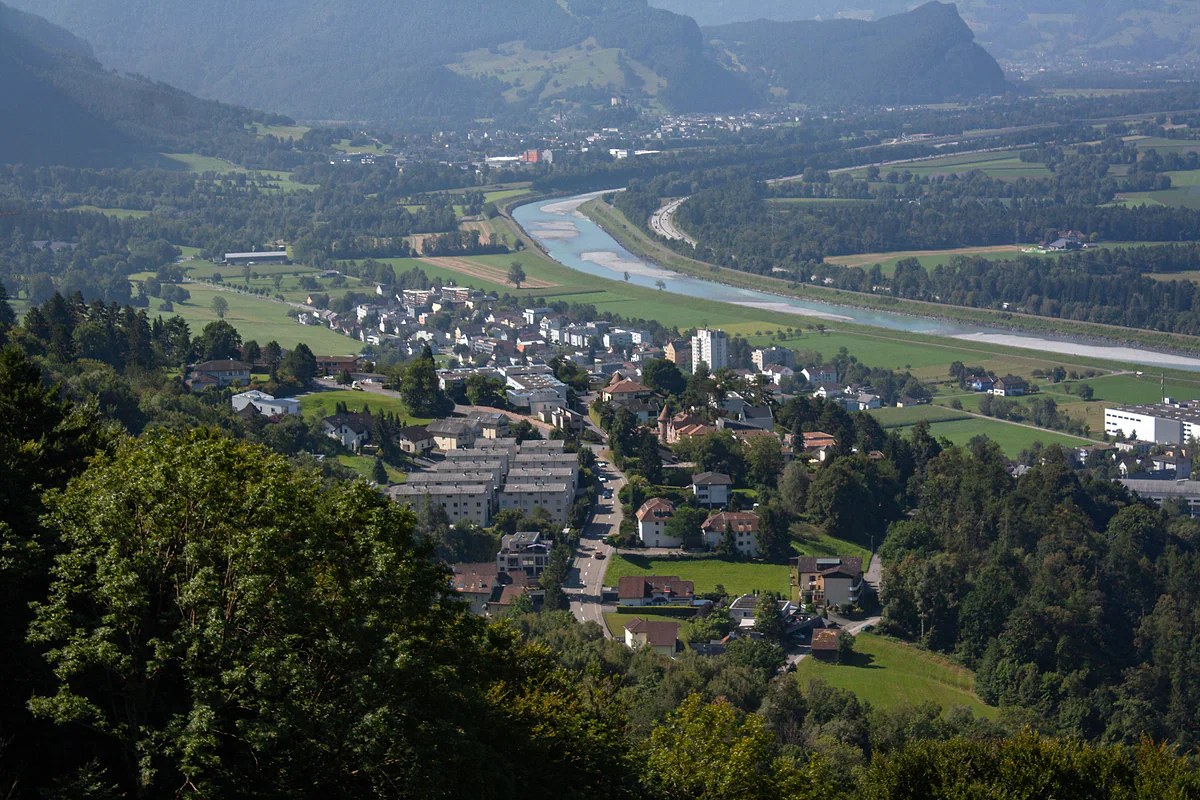
Triesen seen from the hillside, with houses below the forest, the Rhine winding through the valley and the Swiss mountains behind.
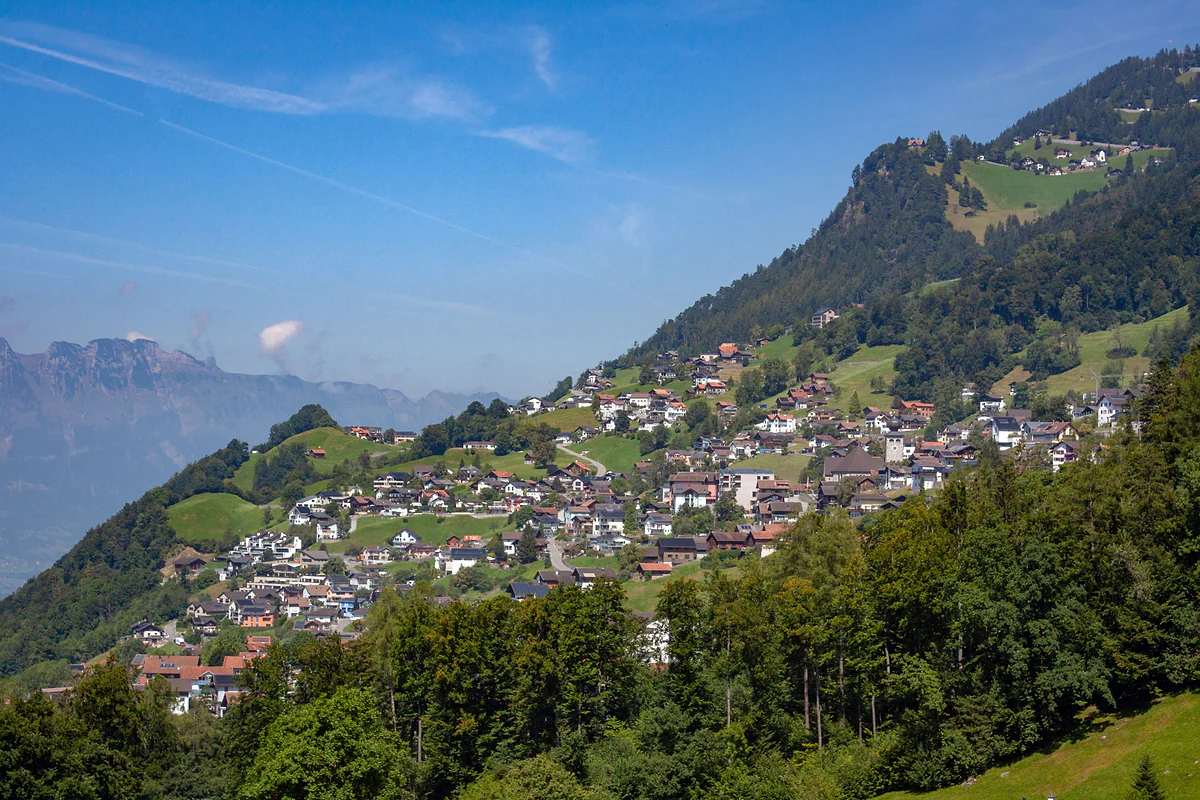
The houses of Triesenberg scattered across the green hillside above the Rhine valley, under a blue sky.
Official card for stage 1
| Fact | Figure |
|---|---|
| Start | Old boundary stone towards Luzisteig (Balzers) |
| Finish | Triesenberg |
| Distance | 15.7 km |
| Walking time | 4 h 35 min |
| Ascent and descent | +535 m and -137 m |
| Highest and lowest point | 905 m and 466 m |
Tourist board figures (archive.org copy, 10-05-2026).
Useful opening times on the way
| Place | When it opens | Price |
|---|---|---|
| Gutenberg Castle, chapel and rose garden | Sundays, May to October, 10:00-17:00 | Free |
| Gutenberg Castle, guided tour | 1 May to 31 October, booking only | On request |
| Walser Museum, Triesenberg | Mon-Fri 08:00-12:00 and 15:00-18:00, Sat 08:00-11:00 | CHF 5 adults, children free |
Test yourself
True or false?
0/3 Pick before you peek.
-
Stage 1 has far more ascent than descent.
See the answer
True. It climbs 535 m and descends 137 m, because it starts on the valley floor in Balzers and ends up on the hillside in Triesenberg.
-
You can tour Gutenberg Castle on any day of the year.
See the answer
False. It only opens by booking from 1 May to 31 October. The outer bailey is free to enter all year.
-
The route passes through the grounds of an old textile mill.
See the answer
True. In Triesen it crosses the site of the former Jenny, Spörry & Cie. cotton mill, now home to the Gasometer arts centre.
- Length of the stage
- 15.7 km
- Total ascent
- 535 m
- Highest point
- 905 m
Map
Where Stage 1: Balzers - Triesenberg is
The dashed line is the border: Switzerland across the Rhine, Austria to the north and east. Every number opens its guide.
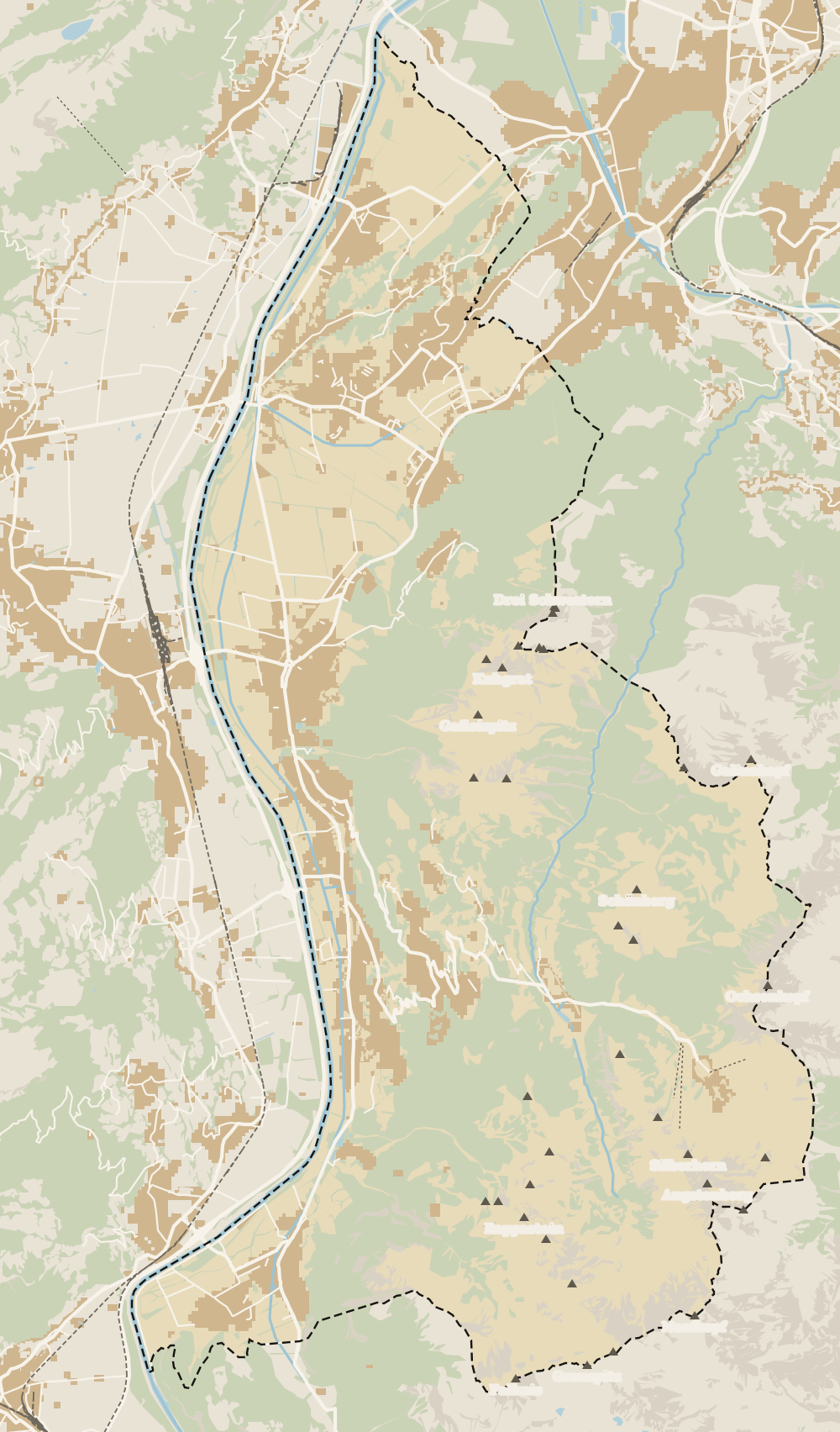 1Liechtenstein Trail 2Stage 1: Balzers - Triesenberg 3Stage 2: Triesenberg - Vaduz 4Stage 3: Vaduz - Nendeln 5Stage 4: Nendeln - Ruggell 6Stage 5: Ruggell - Schaanwald
 Map data © OpenStreetMap contributors (ODbL)
- 1Liechtenstein TrailSwiss border to Austrian border in five days
- 2Stage 1: Balzers - Triesenberg15.7 km and the longest climb on the route
- 3Stage 2: Triesenberg - VaduzThe short stage with the route's highest point
- 4Stage 3: Vaduz - NendelnVineyards, Romans and the steepest descent
- 5Stage 4: Nendeln - RuggellThe flattest stage, with a swimming lake halfway
- 6Stage 5: Ruggell - SchaanwaldThe longest stage ends at a customs post
0 of 168 Liechtenstein guides
Your next stamp
- Stage 2: Triesenberg - Vaduz
- Liechtenstein Trail
- Triesen
- Hut-to-hut Route 66
- Stage 3: Vaduz - Nendeln
- Balzers
- Masescha
- Triesenberg
- Things to do
- One day
- Two days
- Municipalities
- Oberland
- Unterland
- Map
- Vaduz
- Städtle
- Mitteldorf
- Vaduz Castle
- Vaduz Cathedral
- Parliament
- Government Building
- Vaduz Town Hall
- Red House
- Prince's Winery
- Old Rhine Bridge
- Schaan
- Schalun Castle Ruin
- Citytrain
- Walser Museum
- Planken
- Gutenberg Castle
- The Rhine
- Schaan Roman fort
- Dux
- St Mamertus chapel
- Lawena valley
- Mäls
- DoMuS
- TAK Theatre
- Castles
- Churches and chapels
- Viewpoints
- Mountains
- Museums
- Kunstmuseum
- Mountain huts
- Hilti Art Foundation
- Pfälzerhütte
- Gafadura hut
- National Museum
- Treasure Chamber
- Postage Stamp Museum
- Kunstraum Engländerbau
- Eschen
- Gaflei
- Nendeln
- Mauren
- Silum
- Rotenboden
- Schaanwald
- Gamprin
- Wangerberg
- Bendern
- Steg
- Ruggell
- Samina valley
- Schellenberg Farmhouse Museum
- Cross-country skiing at Steg
- Küefer-Martis-Huus
- Ruggeller Riet
- Schellenberg
- Hinterschellenberg
- Fürstensteig
- Is it a country?
- Malbun
- Schellenberg castles
- Eschnerberg
- Malbun in summer
- Population
- Lakes
- Sareis
- Size
- Malbun Peace Chapel
- Political system
- Swimming pools
- Language
- Skiing in Malbun
- Stage 4: Nendeln - Ruggell
- Dialect
- Malbun ski pass
- Stage 5: Ruggell - Schaanwald
- Hotels in Malbun
- Stamps
- Princess Gina Trail
- Hiking
- Getting there
- In winter
- Weather
- Airport
- Best time to visit
- In summer
- Events
- With kids
- Zurich to Liechtenstein
- National day
- Sargans to Vaduz
- Christmas
- Feldkirch to Vaduz
- By train
- Traditions
- Carnival
- Getting around
- Buses
- Funken Sunday
- Alpine cattle drive
- Driving and vignette
- Parking
- Bike hire
- Cycling
- EU and Schengen
- Entry requirements
- Borders and customs
- The prince
- The princely house
- The flag
- The coat of arms
- The national anthem
- History
- Second World War
- No army
- Facts
- Why so rich?
- Banks and tax haven
- Where to stay
- Hilti
- Hotels in Vaduz
- False teeth
- Hostel and camping
- Rent the country?
- Where to eat
- Restaurants in Vaduz
- Swiss invasions
- Bars and nightlife
- Food
- Käsknöpfle
- Wine
- Casinos
- Adventure Pass
- Rainy days
- Guided tours
- Tourist office
- Day trips
- Passport stamp
- Music festivals
- Phone and roaming
- Currency and payments
- Prices and budget
- Tipping
- Plugs and sockets
- Tap water
- Opening hours
- Public holidays
- Safety
- Accessibility
- With a dog
- Shopping and souvenirs
Frequently asked questions
Where does stage 1 of the Liechtenstein Trail start?
In Balzers, by an old boundary stone on the way to Luzisteig. It's about 20 minutes' walk from the Balzers, Höfle bus stop, or about 25 from Haus Gutenberg.
How long does stage 1 take?
The tourist board gives 4 hours 35 minutes of walking for 15.7 km. With stops at Gutenberg, in Triesen and at St Mamertus's chapel, I'd allow the whole day.
Is the first stage hard?
It has the most climbing of all five, 535 m, most of it at the end between Triesen and Triesenberg. There's nothing technical, but carry water and tackle the hill while it's cool.
What do you see on stage 1?
Gutenberg Castle, the old Roman road, the former textile mill site in Triesen with the Gasometer arts centre, St Mamertus's chapel and the Walser village of Triesenberg with its museum.
How do I get back from Triesenberg?
LIEmobil route 21 links Triesenberg with Vaduz. The buses are cashless, so pay by card or with the app.
By
Tourism graduate with a master’s in Tourism Management and Planning from the University of Málaga, who has travelled across Europe. He writes every guide from official sources and his own judgement.
Published on . Facts checked on .
Sources
Photos: A.Savin (FAL); Lucas Kendall (CC BY-SA 4.0); Lucas Kendall (CC BY-SA 4.0), via Wikimedia Commons.