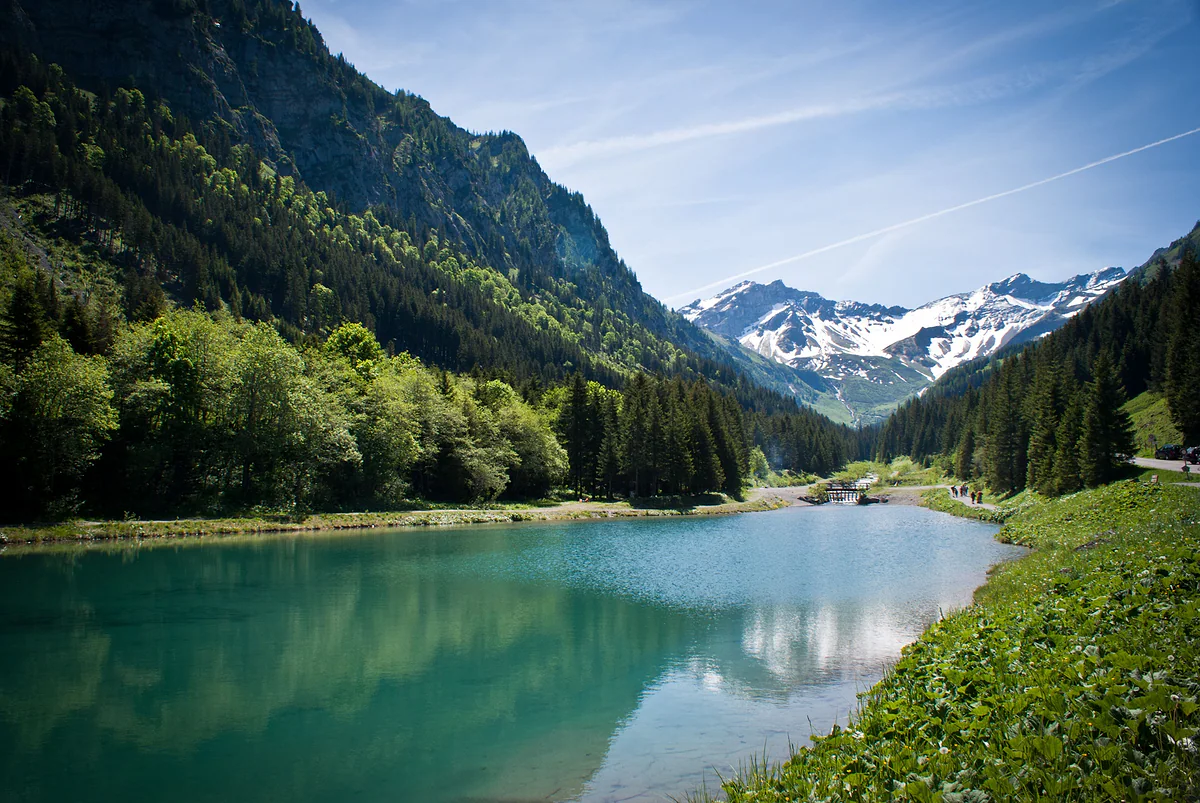
A country of rivers, not lakes
Liechtenstein's lakes, few and nearly all man-made
Liechtenstein has hardly any lakes. Its waters are mostly rivers and canals, and the largest natural lake is the Gampriner Seelein in Gamprin, with 1.37 hectares of water, formed in the Rhine flood of 1927. The rest are artificial ponds, such as those at Hälos in Triesen, the Steg reservoir and the Grossabünt bathing lake.
In 30 seconds
Full read: 3 min
- Liechtenstein has hardly any lakes; its waters are mainly rivers and canals.
- The largest natural lake is the Gampriner Seelein, 1.37 ha, formed in 1927.
- The biggest ponds are man-made, Hälos in Triesen (3.56 ha) and the Steg reservoir (3.2 ha).
- For a swim there's the Grossabünt bathing lake in Gamprin.
If you're after a picture-postcard Alpine lake, Liechtenstein isn't the place. What I'd do is visit the Gampriner Seelein in winter to see the egrets, swim at the Grossabünt in summer, which is less than a kilometre away, and head up to the Steg valley for the country's most photogenic reservoir.

Before you go
What I would keep in mind
-
01 Most beautiful
A lake from 1927
The Gampriner Seelein formed when the Rhine flood of autumn 1927 scoured out the plain between the Eschnerberg and the river. It's been a reserve since 1961 and is the country's largest natural lake.
Gamprin and Bendern -
02 My tip
For a swim, head to the Grossabünt
The Seelein is a reserve and I've found nothing official inviting you to swim. Less than a kilometre away, the Grossabünt has a natural bathing lake of over 3,500 m², open daily with no lifeguard.
swimming pools in Liechtenstein -
03 Most beautiful
The Steg reservoir, up in the mountains
In the high Steg valley there's a 3.2-hectare reservoir built to generate power. To me it's the loveliest stretch of still water in the country's mountains.
Steg and its ring of huts -
04 To save money
Ponds in the middle of town
In Vaduz, west of the Giessen, the Haberfeld nature park has ponds and pools a few minutes from the centre, according to the municipality. It's a free stroll.
Vaduz, the capital of Liechtenstein
What I would book
My ranking, scored
The still waters I'd visit
My score out of 10 based on how attractive the spot is, what it offers a visitor and whether you can enjoy it, swimming or strolling. These are my opinions.
0 of 5 seen
-
Gampriner Seelein
The only natural lake worth the name, formed in 1927, with reintroduced crayfish and egrets in winter. For walking and watching.
8.4 out of 10
-
Grossabünt bathing lake
Artificial but natural in the way it cleans itself, with over 3,500 m² for swimming. In summer, the best open-air dip in the Unterland.
8.2 out of 10
-
Steg reservoir
A 3.2 ha reservoir in the Samina valley, ringed by forest and peaks. Better for photos than for swimming.
8.0 out of 10
-
Haberfeld nature park, Vaduz
Ponds, marshy patches and pools a few minutes from the centre of the capital. A short walk with some unusual plants and wildlife.
6.6 out of 10
-
Hälos ponds, Triesen
The country's largest pond, 3.56 ha, man-made and protected. Interesting as a habitat rather than a tourist outing.
6.2 out of 10
Plenty of people search for Liechtenstein’s lakes expecting something like Switzerland or Austria, and the short answer is that there are hardly any. This is a country of rivers, canals and mountains, and you can count its still waters on your fingers. The few there are come with odd stories, though, and one of them, the Gampriner Seelein, was literally born from a disaster.
A country of rivers, not lakes
The Historisches Lexikon puts it plainly, Liechtenstein’s waters are mostly flowing. The country drains through three systems, the inland canal, with a 117 km² catchment, the Samina, which gathers 50 km² of mountains and reaches the Rhine via Austria, and the Spiersbach, with 11 km² in the north. Above them all is the Rhine, the border with Switzerland, which I cover on the Rhine in Liechtenstein.
There used to be plenty of pools and ponds in the Rhine meadows, but they vanished from the mid-19th century as the river was tamed and the land farmed and built on. The last pond on the valley floor, near Gamprin, dried up in 1973. According to the Lexikon, almost every pond today is man-made, apart from the Gampriner Seelein and a few mountain tarns such as the Sass-See.
What is the largest lake in Liechtenstein?
It depends what you call a lake. If you mean water that formed on its own, the record goes to the Gampriner Seelein in Gamprin, at 1.37 hectares. It’s the child of the great flood of 1927, when the Rhine burst out and the current gouged a hollow in the plain just where the hill comes closest to the river. It was protected in 1961, and by the late 1970s it was at risk of drying up because the riverbed and the groundwater had dropped, so in 1979-80 it was cleaned out and given a supply from the inland canal. In 1980 noble crayfish, a species the country had lost in the early 20th century, were released there again, and they’ve since spread along the streams as far as the Ruggeller Riet. From October to April great egrets are easy to spot.
Count man-made waters and the largest are the ponds at Hälos in Triesen, 3.56 hectares and protected as a reserve, and the Steg reservoir, 3.2 hectares, built to generate power. The Schwabbrünnen-Äscher habitat, 0.4 hectares, is man-made too, as are the ponds beside the old textile mills in Vaduz and Triesen.
Steg, the most photogenic
If I had to choose one lake for looks, it would be the Steg reservoir. It sits in the high Samina valley, ringed by forest with peaks behind, and it’s the picture I’d take home from the country’s mountains. I describe it and its setting on the Samina valley and on the page for Steg. I haven’t found anything official about swimming in it, so treat it as a place to look rather than dive in.
Where to swim in a lake
For a swim, I’d head to the Grossabünt in Gamprin, a short walk from the Seelein. It’s a lake made on purpose for bathing, but without chlorine, because the water comes up from underground at drinking quality and cleans itself by flowing through a planted pond. The bathing area tops 3,500 m², with a deep part for jumping off a rock and a shallow one for little ones. The council provides no supervision and only lets you swim in daylight. To weigh it against the paying pools, all four are on swimming pools in Liechtenstein.
One practical warning from the municipality that applies to any natural lake. Waterbirds sometimes bring in tiny larvae that can cause itchy rashes on sensitive skin, so they ask you not to feed the ducks, to shower before going in and to towel off properly afterwards. In autumn the lake is also drained for cleaning, so don’t count on it outside summer.
Ponds with a past
A couple of oddities I enjoy. Vaduz Castle had two ponds fed by a pipe from the Erbli stream. The small one supplied the lord’s buildings and fountains, and the large one, the Lexikon says, served from around 1840 as a swimming pool for the country’s military contingent. And Mauren had a pond, gone by the 17th century, that was probably used for processing flax.
Today, in Vaduz, the Haberfeld nature park west of the Giessen has ponds, marshy patches and pools with some unusual plants and wildlife, a few minutes from the centre. It’s the easiest still-water outing if you don’t leave the capital.
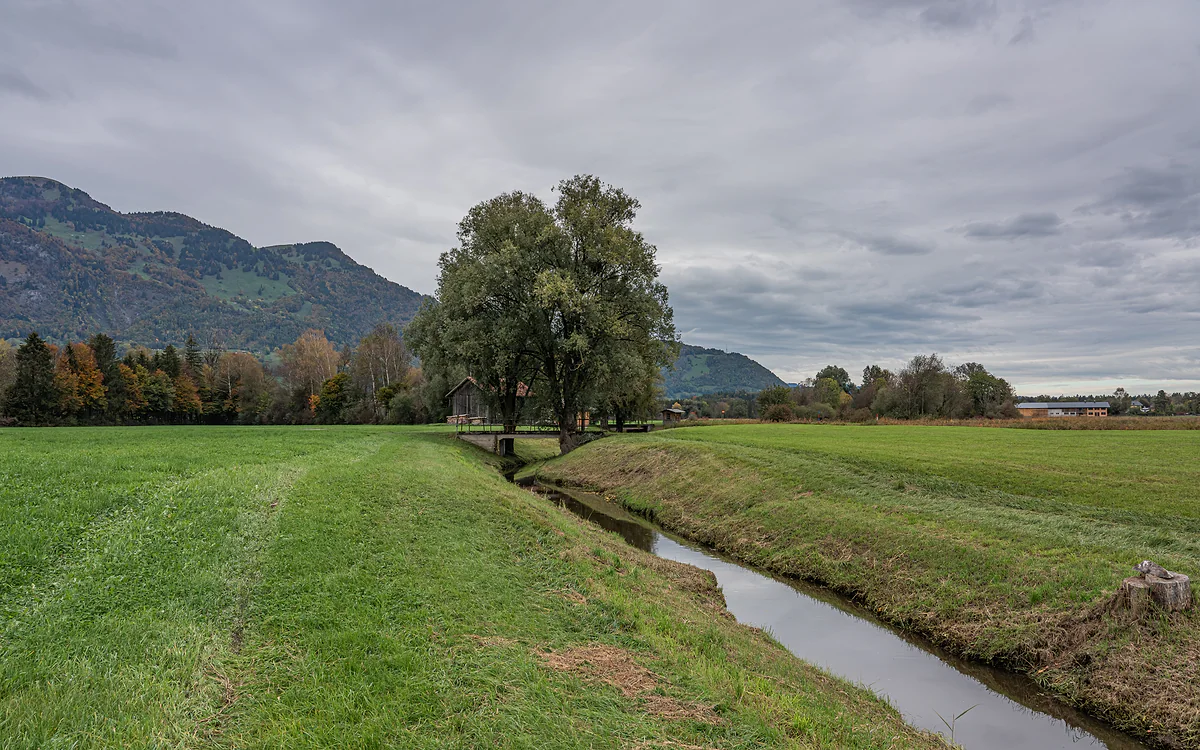
The Ruggeller Riet, with a ditch between meadows, a large tree and the mountains under a grey sky.
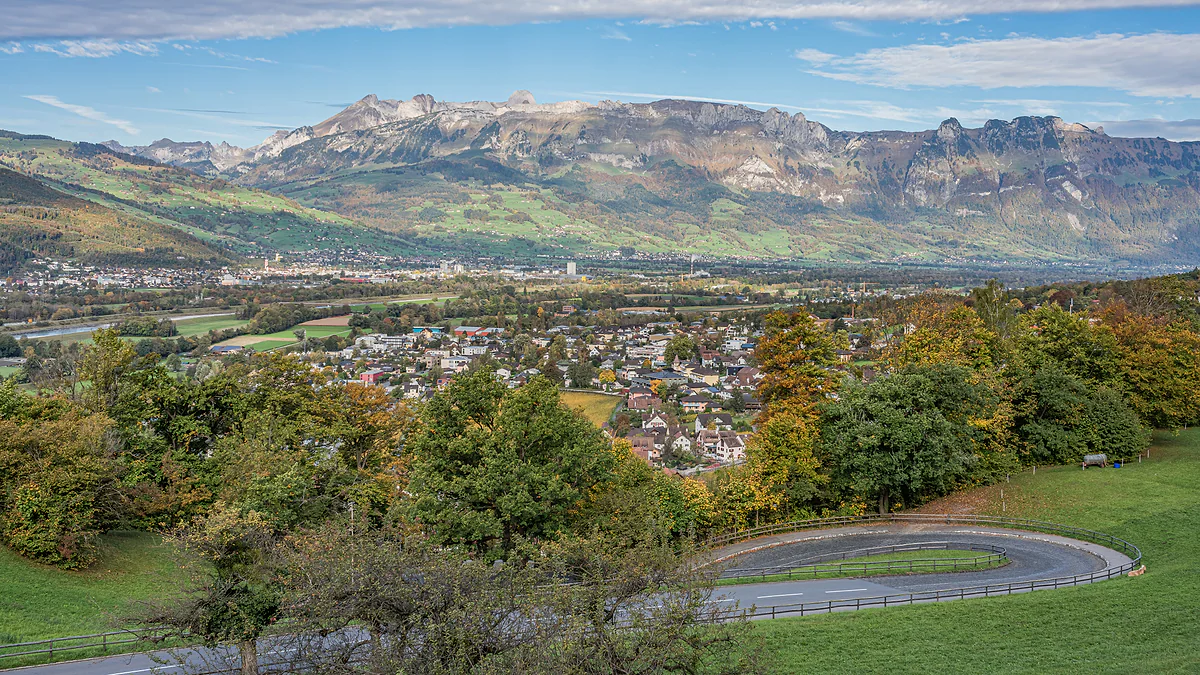
The Rhine valley seen from Vaduz Castle, with the town among autumn trees and the Swiss mountains on the horizon.
Liechtenstein's still waters
| Name | Where | Size | Origin |
|---|---|---|---|
| Gampriner Seelein | Gamprin | 1.37 ha of water | Natural, 1927 flood |
| Hälos | Triesen | 3.56 ha | Man-made, nature reserve |
| Steg reservoir | Triesenberg | 3.2 ha | Man-made, for power |
| Grossabünt lake | Gamprin | Over 3,500 m² for swimming | Man-made bathing lake |
| Sass-See | Mountains | Small | Natural mountain tarn |
Historisches Lexikon, entries «Gewässer», «Weiher» and «Gampriner Seelein»; Gamprin municipality.
Test yourself
True or false?
0/4 Pick before you peek.
-
Liechtenstein's largest natural lake is less than a hundred years old.
See the answer
True. The Gampriner Seelein formed in the Rhine flood of autumn 1927.
-
The Grossabünt bathing lake is filled with Rhine water.
See the answer
False. It's filled with groundwater of drinking quality that flows in along a stream, and on very hot days it's cooled with mains water.
-
A pond at Vaduz Castle once served as a swimming pool.
See the answer
True. The Lexikon says the larger of the castle's two ponds was used from around 1840 as a swimming pool for the country's military contingent.
-
The Steg reservoir is a natural lake.
See the answer
False. It was built to generate power, like the ponds beside the old textile mills in Vaduz and Triesen.
- Water area of the Gampriner Seelein
- 1.37 ha
- Flood that created it
- 1927
- Steg reservoir
- 3.2 ha
- Inland canal catchment
- 117 km²
0 of 168 Liechtenstein guides
Your next stamp
- Gamprin
- Swimming pools
- Viewpoints
- In summer
- Is it a country?
- Mountains
- With kids
- Size
- Things to do
- One day
- Two days
- Municipalities
- Oberland
- Unterland
- Map
- Vaduz
- Städtle
- Mitteldorf
- Vaduz Castle
- Vaduz Cathedral
- Parliament
- Government Building
- Vaduz Town Hall
- Red House
- Prince's Winery
- Old Rhine Bridge
- Schaan
- Schalun Castle Ruin
- Balzers
- Citytrain
- Triesen
- Triesenberg
- Walser Museum
- Planken
- Gutenberg Castle
- The Rhine
- Schaan Roman fort
- Dux
- St Mamertus chapel
- Lawena valley
- Mäls
- DoMuS
- TAK Theatre
- Castles
- Churches and chapels
- Museums
- Kunstmuseum
- Mountain huts
- Hilti Art Foundation
- Pfälzerhütte
- Gafadura hut
- National Museum
- Treasure Chamber
- Postage Stamp Museum
- Kunstraum Engländerbau
- Eschen
- Masescha
- Gaflei
- Nendeln
- Mauren
- Silum
- Rotenboden
- Schaanwald
- Wangerberg
- Bendern
- Steg
- Ruggell
- Samina valley
- Schellenberg Farmhouse Museum
- Cross-country skiing at Steg
- Küefer-Martis-Huus
- Ruggeller Riet
- Schellenberg
- Hinterschellenberg
- Fürstensteig
- Liechtenstein Trail
- Malbun
- Schellenberg castles
- Eschnerberg
- Malbun in summer
- Population
- Stage 1: Balzers - Triesenberg
- Sareis
- Stage 2: Triesenberg - Vaduz
- Malbun Peace Chapel
- Political system
- Stage 3: Vaduz - Nendeln
- Language
- Skiing in Malbun
- Stage 4: Nendeln - Ruggell
- Dialect
- Malbun ski pass
- Stage 5: Ruggell - Schaanwald
- Hotels in Malbun
- Stamps
- Princess Gina Trail
- Hut-to-hut Route 66
- Hiking
- Getting there
- In winter
- Weather
- Airport
- Best time to visit
- Events
- Zurich to Liechtenstein
- National day
- Sargans to Vaduz
- Christmas
- Feldkirch to Vaduz
- By train
- Traditions
- Carnival
- Getting around
- Buses
- Funken Sunday
- Alpine cattle drive
- Driving and vignette
- Parking
- Bike hire
- Cycling
- EU and Schengen
- Entry requirements
- Borders and customs
- The prince
- The princely house
- The flag
- The coat of arms
- The national anthem
- History
- Second World War
- No army
- Facts
- Why so rich?
- Banks and tax haven
- Where to stay
- Hilti
- Hotels in Vaduz
- False teeth
- Hostel and camping
- Rent the country?
- Where to eat
- Restaurants in Vaduz
- Swiss invasions
- Bars and nightlife
- Food
- Käsknöpfle
- Wine
- Casinos
- Adventure Pass
- Rainy days
- Guided tours
- Tourist office
- Day trips
- Passport stamp
- Music festivals
- Phone and roaming
- Currency and payments
- Prices and budget
- Tipping
- Plugs and sockets
- Tap water
- Opening hours
- Public holidays
- Safety
- Accessibility
- With a dog
- Shopping and souvenirs
Frequently asked questions
What lakes are there in Liechtenstein?
Very few. The largest natural lake is the Gampriner Seelein in Gamprin, and the rest are man-made ponds, such as those at Hälos in Triesen, the Steg reservoir and the Grossabünt bathing lake.
What is the largest lake in Liechtenstein?
Of natural origin, the Gampriner Seelein, with 1.37 hectares of water. Among the man-made ones, the Hälos ponds in Triesen, at 3.56 hectares, and the Steg reservoir at 3.2.
Can you swim in a lake in Liechtenstein?
Yes, at the Grossabünt bathing lake in Gamprin, filled with groundwater of drinking quality. There's no lifeguard and swimming is allowed from sunrise to sunset.
Why doesn't Liechtenstein have lakes?
Its waters are mostly flowing, the Rhine, the Samina and the inland canal, and the ponds on the plain vanished with the taming of the Rhine and farming. The last one on the valley floor, near Gamprin, dried up in 1973.
What rivers does Liechtenstein have?
The Rhine, which forms the border with Switzerland, and three systems draining the country, the inland canal, with a 117 km² catchment, the Samina, 50 km² of mountains, and the Spiersbach, 11 km² in the north.
By
Tourism graduate with a master’s in Tourism Management and Planning from the University of Málaga, who has travelled across Europe. He writes every guide from official sources and his own judgement.
Published on . Facts checked on .
Sources
Photos: Clemens v. Vogelsang from Liechtenstein (CC BY 2.0); A.Savin (FAL); A.Savin (FAL), via Wikimedia Commons.